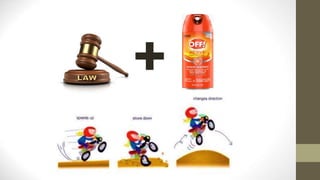
I. Law of Inertia
II. F=ma
III. Action-Reaction
Investigate the relationship between
the amount of force applied and the
mass of the object to the amount of
change in the object’s motion
(S8FE-Ia-15)
Learning Competency
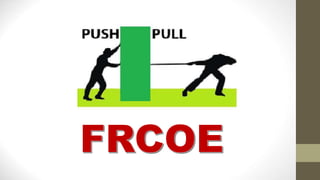
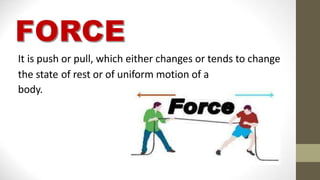
It is push or pull, which either changes or tends to change
the state of rest or of uniform motion of a
body.
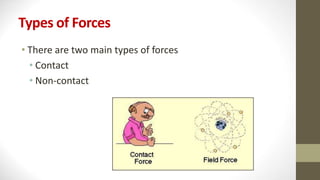
Types of Forces
• There are two main types of forces
• Contact
• Non-contact
Contact Forces
• Contact Force
• Exists when an object from the external world
touches a system and exerts a force on it
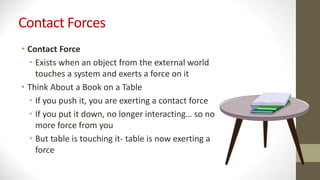
• Think About a Book on a Table
• If you push it, you are exerting a contact force
• If you put it down, no longer interacting… so no
more force from you
• But table is touching it- table is now exerting a
force
Non-contact Forces
• An object can move without something directly touching it
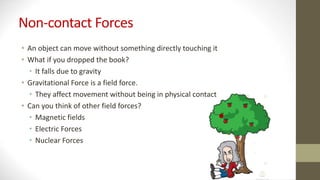
• What if you dropped the book?
• It falls due to gravity
• Gravitational Force is a field force.
• They affect movement without being in physical contact
• Can you think of other field forces?
• Magnetic fields
• Electric Forces
• Nuclear Forces
Inertia
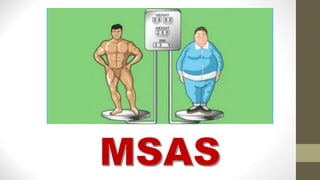
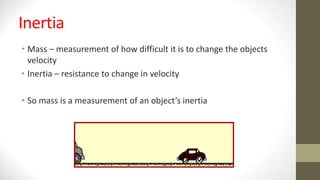
• Mass – measurement of how difficult it is to change the objects
velocity
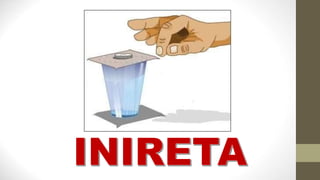
• Inertia – resistance to change in velocity
• So mass is a measurement of an object’s inertia
Newton’s Laws
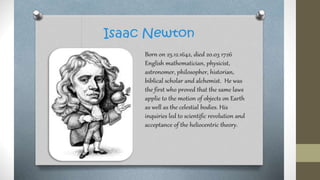
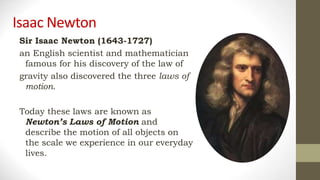
Isaac Newton
Sir Isaac Newton (1643-1727)
an English scientist and mathematician
famous for his discovery of the law of
gravity also discovered the three laws of
motion.
Today these laws are known as
Newton’s Laws of Motion and
describe the motion of all objects on
the scale we experience in our everyday
lives.
Newton’s Laws of Motion
1. An object in motion tends to stay in motion and an
object at rest tends to stay at rest unless acted upon
by an unbalanced force.
2. Force equals mass times acceleration
(F = ma).
3. For every action there is an equal and opposite
reaction.
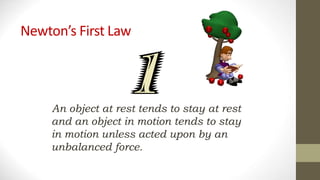
Newton’s First Law
An object at rest tends to stay at rest
and an object in motion tends to stay
in motion unless acted upon by an
unbalanced force.
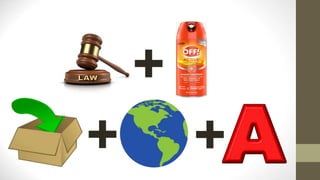
+
+ +
What does this mean?
Basically, an object will “keep doing what it was doing”
unless acted on by an unbalanced force.
If the object was sitting still, it will remain stationary. If
it was moving at a constant velocity, it will keep
moving.
It takes force to change the motion of an object.
What is meant by unbalanced force?
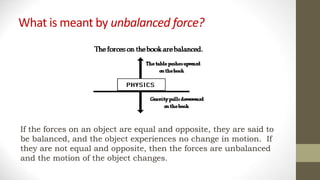
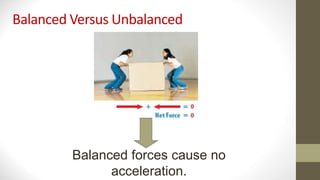
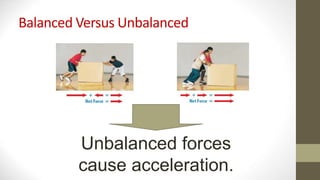
If the forces on an object are equal and opposite, they are said to
be balanced, and the object experiences no change in motion. If
they are not equal and opposite, then the forces are unbalanced
and the motion of the object changes.
Some Examples from Real Life
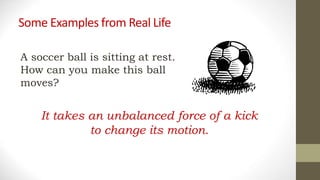
It takes an unbalanced force of a kick
to change its motion.
A soccer ball is sitting at rest.
How can you make this ball
moves?
Some Examples from Real Life
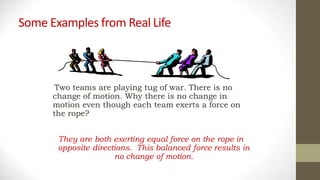
They are both exerting equal force on the rope in
opposite directions. This balanced force results in
no change of motion.
Two teams are playing tug of war. There is no
change of motion. Why there is no change in
motion even though each team exerts a force on
the rope?
Newton’s First Law is also called the Law
of Inertia
Inertia: the tendency of an object to resist changes in
its state of motion
The First Law states that all objects have inertia.
The more mass an object has, the more inertia it has
(and the harder it is to change its motion).
More Examples from Real Life
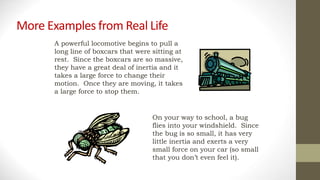
A powerful locomotive begins to pull a
long line of boxcars that were sitting at
rest. Since the boxcars are so massive,
they have a great deal of inertia and it
takes a large force to change their
motion. Once they are moving, it takes
a large force to stop them.
On your way to school, a bug
flies into your windshield. Since
the bug is so small, it has very
little inertia and exerts a very
small force on your car (so small
that you don’t even feel it).
If objects in motion tend to stay in motion, why don’t moving
objects keep moving forever?
Things don’t keep moving forever because
there’s almost always an unbalanced force
acting upon it.
A book sliding across a table slows
down and stops because of the force
of friction.
If you throw a ball upwards it will
eventually slow down and fall
because of the force of gravity.
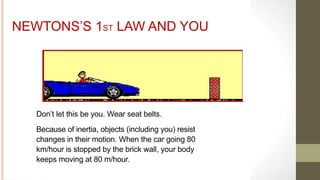
In outer space, away from gravity and
any sources of friction, a rocket ship
launched with a certain speed and
direction would keep going in that
same direction and at that same speed
forever.
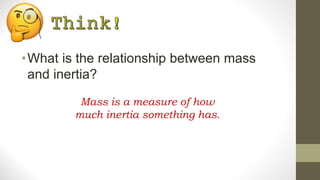
NEWTONS’S 1ST LAW AND YOU
Don’t let this be you. Wear seat belts.
Because of inertia, objects (including you) resist
changes in their motion. When the car going 80
km/hour is stopped by the brick wall, your body
keeps moving at 80 m/hour.
•What is the relationship between mass
and inertia?
Mass is a measure of how
much inertia something has.
•Is inertia a force?
No, inertia is a property of matter.
Something has inertia. Inertia does
not act on something.
• A force of gravity between the sun and its planets
holds the planets in orbit around the sun. If that force
of gravity suddenly disappeared, in what kind of path
would the planets move?
Each planet would move in a straight line
at constant speed.
•The Earth moves about 30 km/s relative to the
sun. But when you jump upward in front of a
wall, the wall doesn’t slam into you at 30 km/s.
Why?
both you and the wall are moving at the
same speed, before, during, and after
your jump.
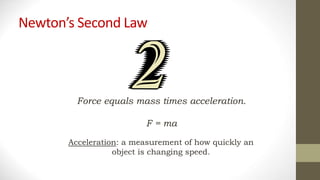
Newton’s Second Law
Force equals mass times acceleration.
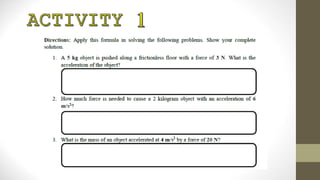
F = ma
Acceleration: a measurement of how quickly an
object is changing speed.
+
+
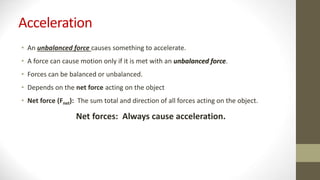
Acceleration
• An unbalanced force causes something to accelerate.
• A force can cause motion only if it is met with an unbalanced force.
• Forces can be balanced or unbalanced.
• Depends on the net force acting on the object
• Net force (Fnet): The sum total and direction of all forces acting on the object.
Net forces: Always cause acceleration.
Balanced Versus Unbalanced
Balanced forces cause no
acceleration.
Unbalanced forces
cause acceleration.
Balanced Versus Unbalanced
What does F = ma mean?
Force is directly proportional to mass and acceleration.
Imagine a ball of a certain mass moving at a certain
acceleration. This ball has a certain force.
Now imagine we make the ball twice as big (double the
mass) but keep the acceleration constant. F = ma says
that this new ball has twice the force of the old ball.
Now imagine the original ball moving at twice the
original acceleration. F = ma says that the ball will
again have twice the force of the ball at the original
acceleration.
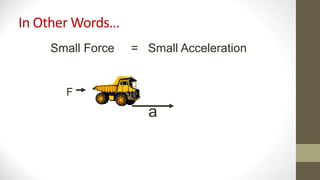
In Other Words…
F
a
Small Force = Small Acceleration
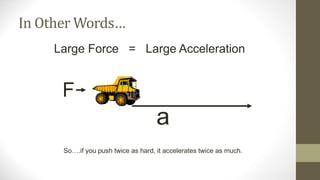
In Other Words…
Large Force = Large Acceleration
F
a
So….if you push twice as hard, it accelerates twice as much.
But there is a twist….
• Acceleration is INVERSELY related to the mass of the object.
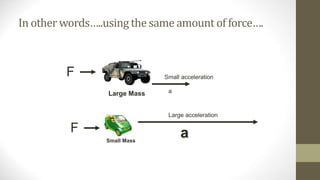
In other words…..using the same amount of force….
F
Large Mass a
Small acceleration
F
Small Mass
Large acceleration
a
More about F = ma
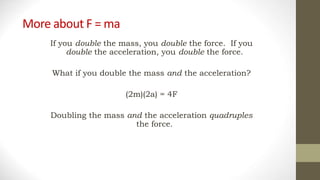
If you double the mass, you double the force. If you
double the acceleration, you double the force.
What if you double the mass and the acceleration?
(2m)(2a) = 4F
Doubling the mass and the acceleration quadruples
the force.
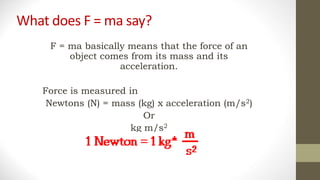
What does F = ma say?
F = ma basically means that the force of an
object comes from its mass and its
acceleration.
Force is measured in
Newtons (N) = mass (kg) x acceleration (m/s2)
Or
kg m/s2
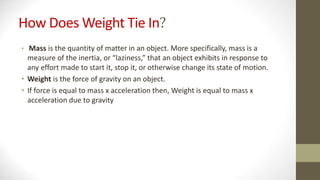
How Does Weight Tie In?
• Mass is the quantity of matter in an object. More specifically, mass is a
measure of the inertia, or “laziness,” that an object exhibits in response to
any effort made to start it, stop it, or otherwise change its state of motion.
• Weight is the force of gravity on an object.
• If force is equal to mass x acceleration then, Weight is equal to mass x
acceleration due to gravity
•Suppose that the acceleration of an object is
zero. Does this mean that there are no forces
acting on it?
No, it means the forces acting on it are
balanced and the net force is zero.
Think about gravity and normal force acting
on stationary objects.
• When a basketball player dribbles a ball, it falls to the
floor and bounces up. Is a force required to make it
bounce? Why? If a force is needed, what is the
agent.
Yes, when it bounced it changed direction. A
change in direction = acceleration.
Acceleration requires a force. The agent was
the floor.
Newton’s Third Law
For every action there is an equal and opposite reaction.
Infer that when a body exerts a
force on another, an equal amount
of force is exerted back on it
(S8FE-Ia-15)
Learning Competency
+
+ +
What does this mean?
For every force acting on an object, there is an equal force
acting in the opposite direction. Right now, gravity is pulling
you down in your seat, but Newton’s Third Law says your
seat is pushing up against you with equal force. This is why
you are not moving. There is a balanced force acting on you–
gravity pulling down, your seat pushing up.
Think about it . . .
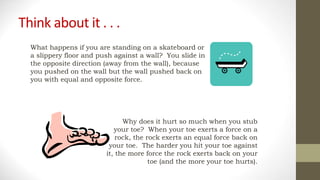
What happens if you are standing on a skateboard or
a slippery floor and push against a wall? You slide in
the opposite direction (away from the wall), because
you pushed on the wall but the wall pushed back on
you with equal and opposite force.
Why does it hurt so much when you stub
your toe? When your toe exerts a force on a
rock, the rock exerts an equal force back on
your toe. The harder you hit your toe against
it, the more force the rock exerts back on your
toe (and the more your toe hurts).
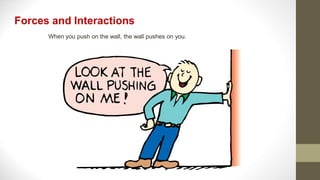
When you push on the wall, the wall pushes on you.
Forces and Interactions
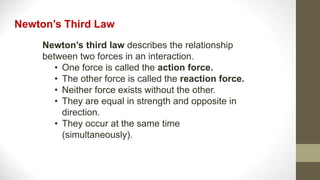
Newton’s third law describes the relationship
between two forces in an interaction.
• One force is called the action force.
• The other force is called the reaction force.
• Neither force exists without the other.
• They are equal in strength and opposite in
direction.
• They occur at the same time
(simultaneously).
Newton’s Third Law
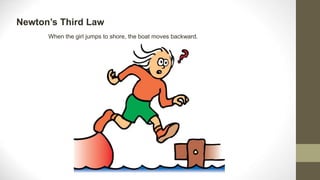
When the girl jumps to shore, the boat moves backward.
Newton’s Third Law
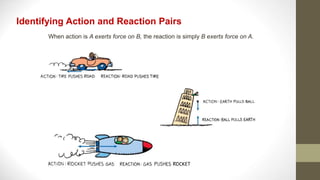
When action is A exerts force on B, the reaction is simply B exerts force on A.
Identifying Action and Reaction Pairs
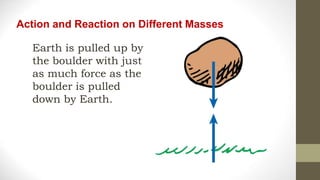
Earth is pulled up by
the boulder with just
as much force as the
boulder is pulled
down by Earth.
Action and Reaction on Different Masses
Question
1. A force interaction requires at least a(n)
a. single force.
b. pair of forces.
c. action force.
d. reaction force.
• We know that Earth pulls on the moon. Does the moon also
pull on Earth? If so, which pull is stronger?
Asking which pull is stronger is like asking which distance is
greater—between New York and San Francisco, or between San
Francisco and New York. The distances either way are the same.
It is the same with force pairs. Both Earth and moon pull on each
other with equal and opposite forces.

• Suppose a friend who hears about Newton’s third law says that you
can’t move a football by kicking it because the reaction force by the
kicked ball would be equal and opposite to your kicking force. The net
force would be zero, so no matter how hard you kick, the ball won’t
move! What do you say to your friend?
If you kick a football, it will accelerate. No
other force has been applied to the ball.
Tell your friend that you can’t cancel a
force on the ball with a force on your foot.
Directions: Summarize the Newton’s laws of motion
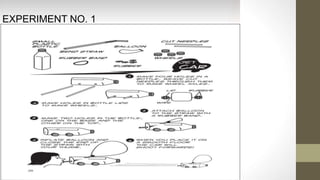
EXPERIMENT NO. 1
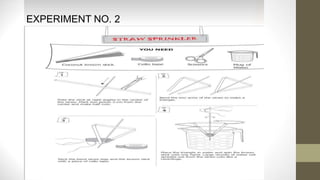
EXPERIMENT NO. 2