2.8 – To explain the electrolytic
property of a solute using ion
dissociation
3.3 – To associate the concept of
the mole with the measurement of
quantity of matter
3.5 – To associate the concept of
the mole with a measure of the
molar mass of a substance
436MOLES
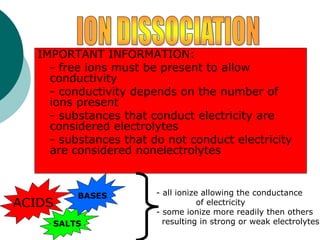
IMPORTANT INFORMATION:
- free ions must be present to allow
conductivity
- conductivity depends on the number of
ions present
- substances that conduct electricity are
considered electrolytes
- substances that do not conduct electricity
are considered nonelectrolytes
ACIDS
SALTS
- all ionize allowing the conductance
of electricity
- some ionize more readily then others
resulting in strong or weak electrolytes
BASES
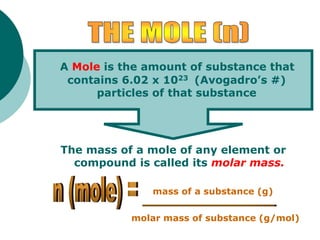
The mass of a mole of any element or
compound is called its molar mass.
A Mole is the amount of substance that
contains 6.02 x 10²³ (Avogadro’s #)
particles of that substance
mass of a substance (g)
molar mass of substance (g/mol)
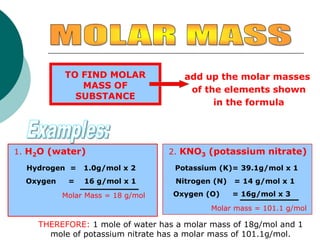
TO FIND MOLAR
MASS OF
SUBSTANCE
add up the molar masses
of the elements shown
in the formula
1. H2O (water)
Hydrogen = 1.0g/mol x 2
Oxygen = 16 g/mol x 1
Molar Mass = 18 g/mol
2. KNO3 (potassium nitrate)
Potassium (K)= 39.1g/mol x 1
Nitrogen (N) = 14 g/mol x 1
Oxygen (O) = 16g/mol x 3
Molar mass = 101.1 g/mol
THEREFORE: 1 mole of water has a molar mass of 18g/mol and 1
mole of potassium nitrate has a molar mass of 101.1g/mol.
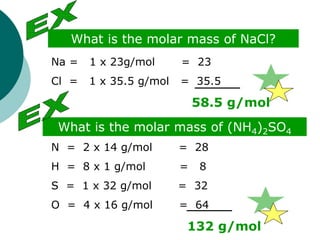
What is the molar mass of (NH4)2SO4
What is the molar mass of NaCl?
Na = 1 x 23g/mol = 23
Cl = 1 x 35.5 g/mol = 35.5
58.5 g/mol
N = 2 x 14 g/mol = 28
H = 8 x 1 g/mol = 8
S = 1 x 32 g/mol = 32
O = 4 x 16 g/mol = 64
132 g/mol
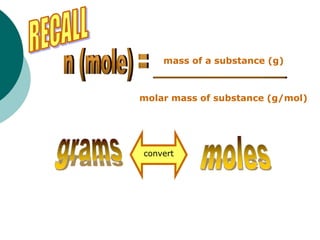
mass of a substance (g)
molar mass of substance (g/mol)
convert
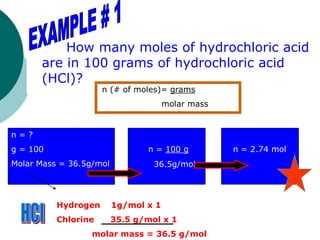
How many moles of hydrochloric acid
are in 100 grams of hydrochloric acid
(HCl)?
n = ?
g = 100
Molar Mass = 36.5g/mol
n = 100 g
36.5g/mol
n = 2.74 mol
n (# of moles)= grams
molar mass
Hydrogen 1g/mol x 1
Chlorine 35.5 g/mol x 1
molar mass = 36.5 g/mol
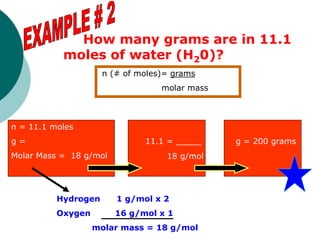
How many grams are in 11.1
moles of water (H20)?
n = 11.1 moles
g =
Molar Mass = 18 g/mol
11.1 = _____
18 g/mol
g = 200 grams
n (# of moles)= grams
molar mass
Hydrogen 1 g/mol x 2
Oxygen 16 g/mol x 1
molar mass = 18 g/mol
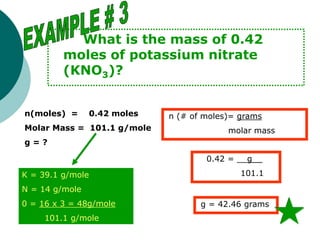
What is the mass of 0.42
moles of potassium nitrate
(KNO3)?
n(moles) = 0.42 moles
Molar Mass = 101.1 g/mole
g = ?
n (# of moles)= grams
molar mass
K = 39.1 g/mole
N = 14 g/mole
0 = 16 x 3 = 48g/mole
101.1 g/mole
0.42 = __g__
101.1
g = 42.46 grams
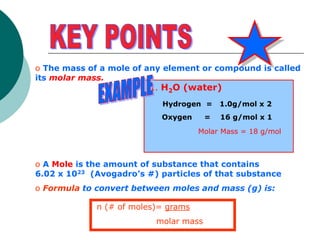
o The mass of a mole of any element or compound is called
its molar mass.
o A Mole is the amount of substance that contains
6.02 x 10²³ (Avogadro’s #) particles of that substance
o Formula to convert between moles and mass (g) is:
1. H2O (water)
Hydrogen = 1.0g/mol x 2
Oxygen = 16 g/mol x 1
Molar Mass = 18 g/mol
n (# of moles)= grams
molar mass
 Study guide, Module 3, page 11 and
18
 436 WORKSHEET # 2

Moles

  • 1.
    2.8 – Toexplain the electrolytic property of a solute using ion dissociation 3.3 – To associate the concept of the mole with the measurement of quantity of matter 3.5 – To associate the concept of the mole with a measure of the molar mass of a substance 436MOLES
  • 2.
    IMPORTANT INFORMATION: - freeions must be present to allow conductivity - conductivity depends on the number of ions present - substances that conduct electricity are considered electrolytes - substances that do not conduct electricity are considered nonelectrolytes ACIDS SALTS - all ionize allowing the conductance of electricity - some ionize more readily then others resulting in strong or weak electrolytes BASES
  • 3.
    The mass ofa mole of any element or compound is called its molar mass. A Mole is the amount of substance that contains 6.02 x 10²³ (Avogadro’s #) particles of that substance mass of a substance (g) molar mass of substance (g/mol)
  • 4.
    TO FIND MOLAR MASSOF SUBSTANCE add up the molar masses of the elements shown in the formula 1. H2O (water) Hydrogen = 1.0g/mol x 2 Oxygen = 16 g/mol x 1 Molar Mass = 18 g/mol 2. KNO3 (potassium nitrate) Potassium (K)= 39.1g/mol x 1 Nitrogen (N) = 14 g/mol x 1 Oxygen (O) = 16g/mol x 3 Molar mass = 101.1 g/mol THEREFORE: 1 mole of water has a molar mass of 18g/mol and 1 mole of potassium nitrate has a molar mass of 101.1g/mol.
  • 5.
    What is themolar mass of (NH4)2SO4 What is the molar mass of NaCl? Na = 1 x 23g/mol = 23 Cl = 1 x 35.5 g/mol = 35.5 58.5 g/mol N = 2 x 14 g/mol = 28 H = 8 x 1 g/mol = 8 S = 1 x 32 g/mol = 32 O = 4 x 16 g/mol = 64 132 g/mol
  • 6.
    mass of asubstance (g) molar mass of substance (g/mol) convert
  • 7.
    How many molesof hydrochloric acid are in 100 grams of hydrochloric acid (HCl)? n = ? g = 100 Molar Mass = 36.5g/mol n = 100 g 36.5g/mol n = 2.74 mol n (# of moles)= grams molar mass Hydrogen 1g/mol x 1 Chlorine 35.5 g/mol x 1 molar mass = 36.5 g/mol
  • 8.
    How many gramsare in 11.1 moles of water (H20)? n = 11.1 moles g = Molar Mass = 18 g/mol 11.1 = _____ 18 g/mol g = 200 grams n (# of moles)= grams molar mass Hydrogen 1 g/mol x 2 Oxygen 16 g/mol x 1 molar mass = 18 g/mol
  • 9.
    What is themass of 0.42 moles of potassium nitrate (KNO3)? n(moles) = 0.42 moles Molar Mass = 101.1 g/mole g = ? n (# of moles)= grams molar mass K = 39.1 g/mole N = 14 g/mole 0 = 16 x 3 = 48g/mole 101.1 g/mole 0.42 = __g__ 101.1 g = 42.46 grams
  • 10.
    o The massof a mole of any element or compound is called its molar mass. o A Mole is the amount of substance that contains 6.02 x 10²³ (Avogadro’s #) particles of that substance o Formula to convert between moles and mass (g) is: 1. H2O (water) Hydrogen = 1.0g/mol x 2 Oxygen = 16 g/mol x 1 Molar Mass = 18 g/mol n (# of moles)= grams molar mass
  • 11.
     Study guide,Module 3, page 11 and 18  436 WORKSHEET # 2