Periodic Table
Objectives
 5.4 Locate metals, nonmetals and metalloids in the
periodic table.
 5.5 Locate the family of alkali metals, alkaline earth
metals, halogens and inert gases in the periodic
table.
 5.6 Describe the progression of certain properties
of elements in a given period on the basis of
their atomic number.
 5.8 Justify the classification of alkali metals,
alkaline earth metals, halogens and inert gases
in the periodic table on the basis of the
simplified atomic model currently in use.
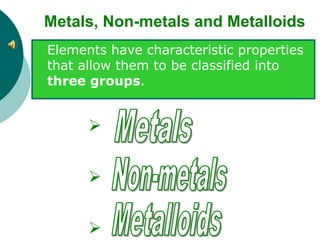
Metals, Non-metals and Metalloids
Elements have characteristic properties
that allow them to be classified into
three groups.
1
2
3
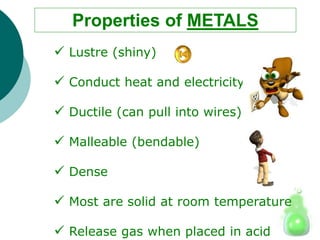
 Lustre (shiny)
 Conduct heat and electricity
 Ductile (can pull into wires)
 Malleable (bendable)
 Dense
 Most are solid at room temperature
 Release gas when placed in acid
Properties of METALS
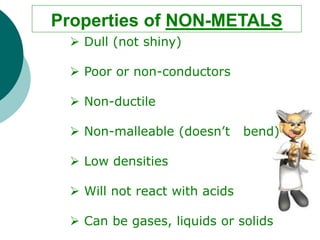
 Dull (not shiny)
 Poor or non-conductors
 Non-ductile
 Non-malleable (doesn’t bend)
 Low densities
 Will not react with acids
 Can be gases, liquids or solids
Properties of NON-METALS
Metalloids are known as the
“in between” group.
They have some properties of both
metals and non-metals.
There are only 7 of these.
Properties of METALLOIDS
Si (Silicon) is shiny but is not
malleable or ductile
Metals, Non-metals and Metalloids
 Metals are found to the left of the
step line on the periodic table.
 Non-metals are to the right of this
line.
o Metalloids
cluster right
around this
line.
Hydrogen is
not a metal
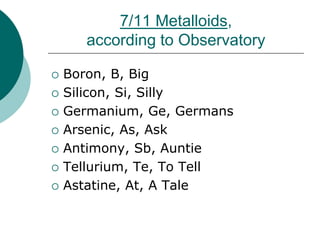
7/11 Metalloids,
according to Observatory
 Boron, B, Big
 Silicon, Si, Silly
 Germanium, Ge, Germans
 Arsenic, As, Ask
 Antimony, Sb, Auntie
 Tellurium, Te, To Tell
 Astatine, At, A Tale
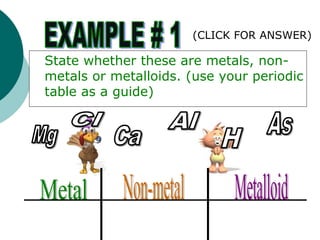
State whether these are metals, non-
metals or metalloids. (use your periodic
table as a guide)
(CLICK FOR ANSWER)
State whether each of these is a metals
non-metal or metalloid
1.Shiny and ductile ______________________
2. Malleable and non conductor _____________
3. Reacts with an acid and non ductile _________
4. Non malleable and dull _________________
(CLICK FOR ANSWER)
5. Releases a gas when placed in an acid
______________________
6. Will not react with an acid _________________
7. Ductile and non conductor _________________
8. Low density _________________
9. Non malleable and ductile _________________
PERIODIC TABLE
Elements on the periodic table are
organized according to their similar
properties.
 Columns (going down on the periodic table) are
called groups or families
 Rows (going across of the periodic table are called
periods.
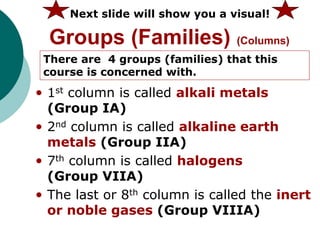
Groups (Families) (Columns)
• 1st column is called alkali metals
(Group IA)
• 2nd column is called alkaline earth
metals (Group IIA)
• 7th column is called halogens
(Group VIIA)
• The last or 8th column is called the inert
or noble gases (Group VIIIA)
There are 4 groups (families) that this
course is concerned with.
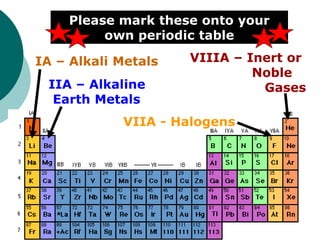
Next slide will show you a visual!
Please mark these onto your
own periodic table
IA – Alkali Metals
IIA – Alkaline
Earth Metals
VIIA - Halogens
VIIIA – Inert or
Noble
Gases
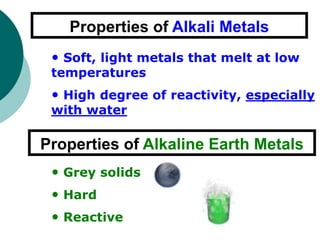
Properties of Alkali Metals
Properties of Alkaline Earth Metals
• Soft, light metals that melt at low
temperatures
• High degree of reactivity, especially
with water
• Grey solids
• Hard
• Reactive
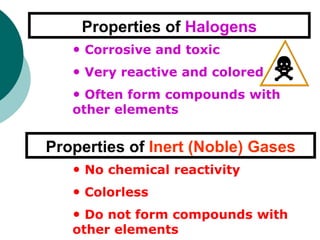
Properties of Halogens
Properties of Inert (Noble) Gases
• Corrosive and toxic
• Very reactive and colored
• Often form compounds with
other elements
• No chemical reactivity
• Colorless
• Do not form compounds with
other elements
State which FAMILY the following
substances belong to by reading its
description:
1.Very Hard ______________________
2. Very reactive and corrosive _____________
3. Soft light metal ___________________
4. Non reactive with other elements
_________________
(CLICK FOR ANSWER)
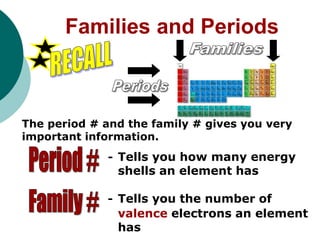
Families and Periods
The period # and the family # gives you very
important information.
- Tells you how many energy
shells an element has
- Tells you the number of
valence electrons an element
has
3 P+
4 N0
2 e-
1 e-
Li
7
3
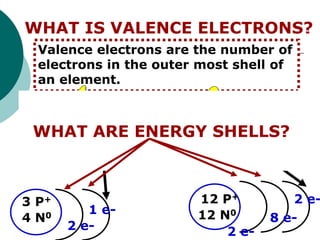
WHAT IS VALENCE ELECTRONS?
Valence electrons are the number of
electrons in the outer most shell of
an element.
1 valence
electron
Lithium Magnesium
Mg
24
12
8 e-
2 e-
2 e-
2 valence
electrons
12 P+
12 N0
WHAT ARE ENERGY SHELLS?
Recall:
Families - # of valence
Periods - # of shells
1st family so…. 1 valence electron
3rd period so…. 3 energy shells
How many valence electrons and
shells does the following element have?
7th family so…. 7 valence electron
4th period so…. 4 energy shells
4th family so…. 4 valence electron
5th period so…. 5 energy shells
How many energy shells and
valence electrons do the following
elements have? (Click For Answer)
Element Valence
Electron
Energy
Shells
Ca 2 4
N 5 2
Rb 1 5
Te 6 5
F 7 2
WHICH ELEMENT…..
Is reactive and has 2
energy shells?
Has 4 energy shells and
is very reactive with
water?
Has 3 valence electrons
and 4 energy shells?
Is a colorless gas and has 4 energy
levels?
 Note the difference of the properties of
metals, non-metals and metalloids.
 Be able to find metals, nonmetals and
metalloids on your periodic table
 Know the Families and names of the
first two and last two rows
 Group IA – Alkali Metals
 Group IIA – Alkaline Earth Metals
 Group VIIA – Halogens
 Group VIIIA – Inert or Noble Gases
 Valence Electrons are found in the
outermost shell. The maximum number is 8.
 You must be able to tell how many valence
electrons each Family on the Periodic Table
has.
 Remember:
Families – tells you # of
valence electrons
Periods – tells you # of
energy shells
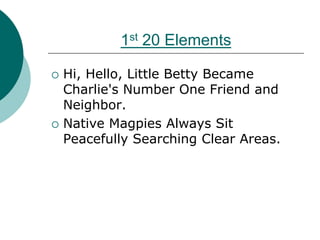
1st 20 Elements
 Hi, Hello, Little Betty Became
Charlie's Number One Friend and
Neighbor.
 Native Magpies Always Sit
Peacefully Searching Clear Areas.

Periodic Table

  • 1.
    Periodic Table Objectives  5.4Locate metals, nonmetals and metalloids in the periodic table.  5.5 Locate the family of alkali metals, alkaline earth metals, halogens and inert gases in the periodic table.  5.6 Describe the progression of certain properties of elements in a given period on the basis of their atomic number.  5.8 Justify the classification of alkali metals, alkaline earth metals, halogens and inert gases in the periodic table on the basis of the simplified atomic model currently in use.
  • 2.
    Metals, Non-metals andMetalloids Elements have characteristic properties that allow them to be classified into three groups. 1 2 3
  • 3.
     Lustre (shiny) Conduct heat and electricity  Ductile (can pull into wires)  Malleable (bendable)  Dense  Most are solid at room temperature  Release gas when placed in acid Properties of METALS
  • 4.
     Dull (notshiny)  Poor or non-conductors  Non-ductile  Non-malleable (doesn’t bend)  Low densities  Will not react with acids  Can be gases, liquids or solids Properties of NON-METALS
  • 5.
    Metalloids are knownas the “in between” group. They have some properties of both metals and non-metals. There are only 7 of these. Properties of METALLOIDS Si (Silicon) is shiny but is not malleable or ductile
  • 6.
    Metals, Non-metals andMetalloids  Metals are found to the left of the step line on the periodic table.  Non-metals are to the right of this line. o Metalloids cluster right around this line. Hydrogen is not a metal
  • 7.
    7/11 Metalloids, according toObservatory  Boron, B, Big  Silicon, Si, Silly  Germanium, Ge, Germans  Arsenic, As, Ask  Antimony, Sb, Auntie  Tellurium, Te, To Tell  Astatine, At, A Tale
  • 8.
    State whether theseare metals, non- metals or metalloids. (use your periodic table as a guide) (CLICK FOR ANSWER)
  • 9.
    State whether eachof these is a metals non-metal or metalloid 1.Shiny and ductile ______________________ 2. Malleable and non conductor _____________ 3. Reacts with an acid and non ductile _________ 4. Non malleable and dull _________________ (CLICK FOR ANSWER)
  • 10.
    5. Releases agas when placed in an acid ______________________ 6. Will not react with an acid _________________ 7. Ductile and non conductor _________________ 8. Low density _________________ 9. Non malleable and ductile _________________
  • 11.
    PERIODIC TABLE Elements onthe periodic table are organized according to their similar properties.  Columns (going down on the periodic table) are called groups or families  Rows (going across of the periodic table are called periods.
  • 12.
    Groups (Families) (Columns) •1st column is called alkali metals (Group IA) • 2nd column is called alkaline earth metals (Group IIA) • 7th column is called halogens (Group VIIA) • The last or 8th column is called the inert or noble gases (Group VIIIA) There are 4 groups (families) that this course is concerned with. Next slide will show you a visual!
  • 13.
    Please mark theseonto your own periodic table IA – Alkali Metals IIA – Alkaline Earth Metals VIIA - Halogens VIIIA – Inert or Noble Gases
  • 14.
    Properties of AlkaliMetals Properties of Alkaline Earth Metals • Soft, light metals that melt at low temperatures • High degree of reactivity, especially with water • Grey solids • Hard • Reactive
  • 15.
    Properties of Halogens Propertiesof Inert (Noble) Gases • Corrosive and toxic • Very reactive and colored • Often form compounds with other elements • No chemical reactivity • Colorless • Do not form compounds with other elements
  • 16.
    State which FAMILYthe following substances belong to by reading its description: 1.Very Hard ______________________ 2. Very reactive and corrosive _____________ 3. Soft light metal ___________________ 4. Non reactive with other elements _________________ (CLICK FOR ANSWER)
  • 17.
    Families and Periods Theperiod # and the family # gives you very important information. - Tells you how many energy shells an element has - Tells you the number of valence electrons an element has
  • 18.
    3 P+ 4 N0 2e- 1 e- Li 7 3 WHAT IS VALENCE ELECTRONS? Valence electrons are the number of electrons in the outer most shell of an element. 1 valence electron Lithium Magnesium Mg 24 12 8 e- 2 e- 2 e- 2 valence electrons 12 P+ 12 N0 WHAT ARE ENERGY SHELLS?
  • 19.
    Recall: Families - #of valence Periods - # of shells 1st family so…. 1 valence electron 3rd period so…. 3 energy shells How many valence electrons and shells does the following element have? 7th family so…. 7 valence electron 4th period so…. 4 energy shells 4th family so…. 4 valence electron 5th period so…. 5 energy shells
  • 20.
    How many energyshells and valence electrons do the following elements have? (Click For Answer) Element Valence Electron Energy Shells Ca 2 4 N 5 2 Rb 1 5 Te 6 5 F 7 2
  • 21.
    WHICH ELEMENT….. Is reactiveand has 2 energy shells? Has 4 energy shells and is very reactive with water? Has 3 valence electrons and 4 energy shells? Is a colorless gas and has 4 energy levels?
  • 22.
     Note thedifference of the properties of metals, non-metals and metalloids.  Be able to find metals, nonmetals and metalloids on your periodic table  Know the Families and names of the first two and last two rows  Group IA – Alkali Metals  Group IIA – Alkaline Earth Metals  Group VIIA – Halogens  Group VIIIA – Inert or Noble Gases
  • 23.
     Valence Electronsare found in the outermost shell. The maximum number is 8.  You must be able to tell how many valence electrons each Family on the Periodic Table has.  Remember: Families – tells you # of valence electrons Periods – tells you # of energy shells
  • 24.
    1st 20 Elements Hi, Hello, Little Betty Became Charlie's Number One Friend and Neighbor.  Native Magpies Always Sit Peacefully Searching Clear Areas.