Introduction to Welding
Dr. H. K. Khaira
Professor in MSME
MANIT, Bhopal
Welding
• Welding is the process of joining together
pieces of metal or metallic parts by bringing
them into intimate proximity and heating the
place of content to a state of fusion or
plasticity
Welding
• A concentrated heat source melts the material
in the weld area; the molten area then
solidifies to join the pieces together
• Sometimes a filler material is added to the
molten pool to strengthen the weld
following are the key features of welding:
• The welding structures are normally lighter than
riveted or bolted structures.
• The welding joints provide maximum
efficiency, which is not possible in other type of
joints.
• The addition and alterations can be easily made
in the existing structure.
• A welded joint has a great strength.
• The welding provides very rigid joints.
• The process of welding takes less time than other
type of joints.
largely used in the following fields of
engineering:
• Manufacturing of machine tools, auto
parts, cycle parts, etc.
• Fabrication of farm machinery & equipment.
• Fabrication of buildings, bridges & ships.
• Construction of
boilers, furnaces, railways, cars, aeroplanes, rock
ets and missiles.
• Manufacturing of television
sets, refrigerators, kitchen cabinets, etc.
Types of Welding
• Fusion Welding
• Pressure Welding
Fusion Welding
Fusion Welding
It is defined as melting together and joining
metals by means of heat.
It uses heat to melt the base metals and may add
a filler metal.
The thermal energy required for these operations
is usually supplied by chemical or electrical
means.
Filler metals may or may not be used.
Welding Metallurgy
The base metal(s) and filler metal mix together
during melting, forming an alloy when they
solidify

The solidification of the metals can be
considered as casting a small amount of metal
in a metal mold
Fusion Welding
• All fusion welding process have three requirements.
– Heat
– Shielding
– Filler metal
• The method used to meet these three requirements
is the primary difference between welding processes.
Types of Fusion Welding
(i). Arc welding
•
Carbon arc
•
Metal arc
•
Metal inert gas
•
Tungsten inert gas
•
Plasma arc
•
Submerged arc
•
Electro-slag
(ii). Gas Welding
•
•
•

Oxy-acetylene
Air-acetylene
Oxy-hydrogen

(iv). Thermit Welding
(vi)Newer Welding
– Electron-beam
–

Laser
Types of Fusion Welding
(i). Gas Welding
1. Oxy-acetylene
2. Air-acetylene
3. Oxy-hydrogen
(ii). Arc welding
1. Carbon arc
2. Metal arc
3. Metal inert gas
4. Tungsten inert gas
5. Plasma arc
6. Submerged arc
7. Electro-slag

(iv). Thermit Welding
(v)Newer Welding
1. Electron-beam
2. Laser
Pressure Welding
When pressure is used to join two metal parts
with or without heat, it is known as pressure
welding.
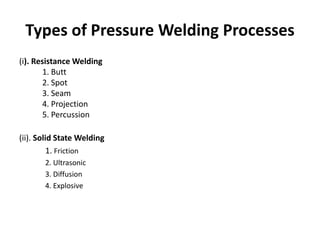
Types of Pressure Welding Processes
(i). Resistance Welding
1. Butt
2. Spot
3. Seam
4. Projection
5. Percussion

(ii). Solid State Welding
1. Friction
2. Ultrasonic
3. Diffusion
4. Explosive
Factors Affecting Welding
•
•
•
•

Heat source
Weld Metal Protection
Heat affected zone
Weldability
Heat Sources
Heat Sources in Welding
•
•
•
•
•
•

1. Combustion of fuel gas
2. Electric arc
3. Electrical resistance
4. Friction
5. Chemical reaction
6. Other sources
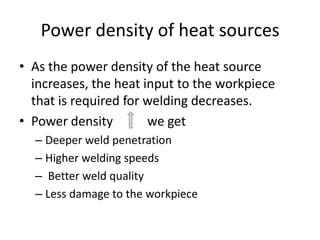
Power density of heat sources
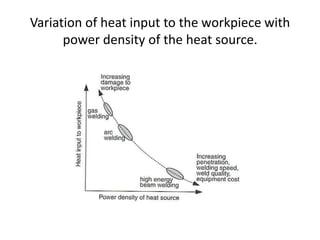
• As the power density of the heat source
increases, the heat input to the workpiece
that is required for welding decreases.
• Power density
we get
– Deeper weld penetration
– Higher welding speeds
– Better weld quality
– Less damage to the workpiece
Variation of heat input to the workpiece with
power density of the heat source.
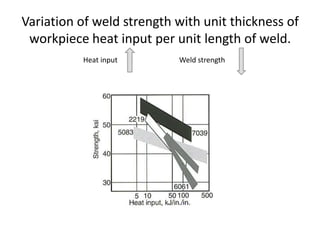
Variation of weld strength with unit thickness of
workpiece heat input per unit length of weld.
Heat input

Weld strength
Power density of heat sources
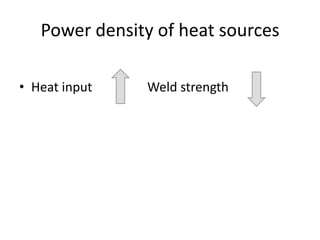
• Heat input

Weld strength
Weld Metal Protection
• During fusion welding, the molten metal in the weld
“puddle” is susceptible to oxidation
• Must protect weld puddle from the atmosphere
Weld Metal Protection
• Methods
– Weld Fluxes
– Inert Gases
– Vacuum
Weld Fluxes
• Typical fluxes
– SiO2, TiO2, FeO, MgO, Al2O3
– Produces a gaseous shield to prevent
contamination
– Act as scavengers to reduce oxides
– Add alloying elements to the weld
– Influence shape of weld bead during solidification
Inert Gases
• Argon, helium, nitrogen, and carbon dioxide
form a protective envelope around the weld
area
• Used in
– MIG
– TIG
– Shielded Metal Arc
Vacuum
• Produce high-quality welds
• Used in electron beam welding
• Nuclear/special metal applications
– Zr, Hf, Ti

• Reduces impurities by a factor of 20 versus
other methods
• Expensive and time-consuming
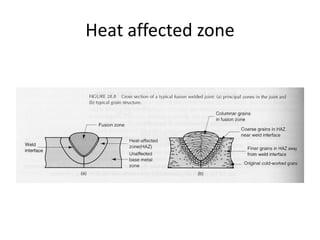
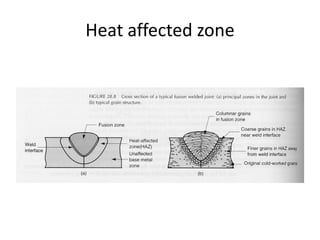
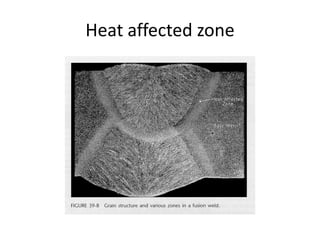
Heat affected zone
Heat affected zone
The surrounding area of base metal that did
not melt, but was heated enough to affect its
grain structure is known as heat affected zone
Heat affected zone
Heat affected zone
Heat affected zone
Weldability
Weldability
• Weldability is the ease of a material or a
combination of materials to be welded under
fabrication conditions into a specific, suitably
designed structure, and to perform
satisfactorily in the intended service
Weldability
• Metallurgical Capacity
– Parent metal will join with the weld metal without
formation of deleterious constituents or alloys

• Mechanical Soundness
– Joint will be free from discontinuities, gas
porosity, shrinkage, slag, or cracks

• Serviceability
– Weld is able to perform under varying conditions of service
(e.g., extreme temperatures, corrosive
environments, fatigue, high pressures, etc.)
Summary
Fusion welding melts the material then allows it to
solidify and join it together
Solid-state welding uses pressure, and sometimes
heat, to allow the metal to bond together
without melting
Welding allows the production of parts that would
be difficult or impossible to form as one piece
 welding

welding

  • 1.
    Introduction to Welding Dr.H. K. Khaira Professor in MSME MANIT, Bhopal
  • 2.
    Welding • Welding isthe process of joining together pieces of metal or metallic parts by bringing them into intimate proximity and heating the place of content to a state of fusion or plasticity
  • 3.
    Welding • A concentratedheat source melts the material in the weld area; the molten area then solidifies to join the pieces together • Sometimes a filler material is added to the molten pool to strengthen the weld
  • 4.
    following are thekey features of welding: • The welding structures are normally lighter than riveted or bolted structures. • The welding joints provide maximum efficiency, which is not possible in other type of joints. • The addition and alterations can be easily made in the existing structure. • A welded joint has a great strength. • The welding provides very rigid joints. • The process of welding takes less time than other type of joints.

  • 5.
    largely used inthe following fields of engineering: • Manufacturing of machine tools, auto parts, cycle parts, etc. • Fabrication of farm machinery & equipment. • Fabrication of buildings, bridges & ships. • Construction of boilers, furnaces, railways, cars, aeroplanes, rock ets and missiles. • Manufacturing of television sets, refrigerators, kitchen cabinets, etc.
  • 6.
    Types of Welding •Fusion Welding • Pressure Welding
  • 7.
  • 8.
    Fusion Welding It isdefined as melting together and joining metals by means of heat. It uses heat to melt the base metals and may add a filler metal. The thermal energy required for these operations is usually supplied by chemical or electrical means. Filler metals may or may not be used.
  • 9.
    Welding Metallurgy The basemetal(s) and filler metal mix together during melting, forming an alloy when they solidify The solidification of the metals can be considered as casting a small amount of metal in a metal mold
  • 10.
    Fusion Welding • Allfusion welding process have three requirements. – Heat – Shielding – Filler metal • The method used to meet these three requirements is the primary difference between welding processes.
  • 11.
    Types of FusionWelding (i). Arc welding • Carbon arc • Metal arc • Metal inert gas • Tungsten inert gas • Plasma arc • Submerged arc • Electro-slag (ii). Gas Welding • • • Oxy-acetylene Air-acetylene Oxy-hydrogen (iv). Thermit Welding (vi)Newer Welding – Electron-beam – Laser
  • 12.
    Types of FusionWelding (i). Gas Welding 1. Oxy-acetylene 2. Air-acetylene 3. Oxy-hydrogen (ii). Arc welding 1. Carbon arc 2. Metal arc 3. Metal inert gas 4. Tungsten inert gas 5. Plasma arc 6. Submerged arc 7. Electro-slag (iv). Thermit Welding (v)Newer Welding 1. Electron-beam 2. Laser
  • 13.
    Pressure Welding When pressureis used to join two metal parts with or without heat, it is known as pressure welding.
  • 14.
    Types of PressureWelding Processes (i). Resistance Welding 1. Butt 2. Spot 3. Seam 4. Projection 5. Percussion (ii). Solid State Welding 1. Friction 2. Ultrasonic 3. Diffusion 4. Explosive
  • 15.
    Factors Affecting Welding • • • • Heatsource Weld Metal Protection Heat affected zone Weldability
  • 16.
  • 17.
    Heat Sources inWelding • • • • • • 1. Combustion of fuel gas 2. Electric arc 3. Electrical resistance 4. Friction 5. Chemical reaction 6. Other sources
  • 18.
    Power density ofheat sources • As the power density of the heat source increases, the heat input to the workpiece that is required for welding decreases. • Power density we get – Deeper weld penetration – Higher welding speeds – Better weld quality – Less damage to the workpiece
  • 19.
    Variation of heatinput to the workpiece with power density of the heat source.
  • 20.
    Variation of weldstrength with unit thickness of workpiece heat input per unit length of weld. Heat input Weld strength
  • 21.
    Power density ofheat sources • Heat input Weld strength
  • 22.
  • 23.
    Weld Metal Protection •During fusion welding, the molten metal in the weld “puddle” is susceptible to oxidation • Must protect weld puddle from the atmosphere
  • 24.
    Weld Metal Protection •Methods – Weld Fluxes – Inert Gases – Vacuum
  • 25.
    Weld Fluxes • Typicalfluxes – SiO2, TiO2, FeO, MgO, Al2O3 – Produces a gaseous shield to prevent contamination – Act as scavengers to reduce oxides – Add alloying elements to the weld – Influence shape of weld bead during solidification
  • 26.
    Inert Gases • Argon,helium, nitrogen, and carbon dioxide form a protective envelope around the weld area • Used in – MIG – TIG – Shielded Metal Arc
  • 27.
    Vacuum • Produce high-qualitywelds • Used in electron beam welding • Nuclear/special metal applications – Zr, Hf, Ti • Reduces impurities by a factor of 20 versus other methods • Expensive and time-consuming
  • 28.
  • 29.
    Heat affected zone Thesurrounding area of base metal that did not melt, but was heated enough to affect its grain structure is known as heat affected zone
  • 30.
  • 31.
  • 32.
  • 33.
  • 34.
    Weldability • Weldability isthe ease of a material or a combination of materials to be welded under fabrication conditions into a specific, suitably designed structure, and to perform satisfactorily in the intended service
  • 35.
    Weldability • Metallurgical Capacity –Parent metal will join with the weld metal without formation of deleterious constituents or alloys • Mechanical Soundness – Joint will be free from discontinuities, gas porosity, shrinkage, slag, or cracks • Serviceability – Weld is able to perform under varying conditions of service (e.g., extreme temperatures, corrosive environments, fatigue, high pressures, etc.)
  • 36.
    Summary Fusion welding meltsthe material then allows it to solidify and join it together Solid-state welding uses pressure, and sometimes heat, to allow the metal to bond together without melting Welding allows the production of parts that would be difficult or impossible to form as one piece