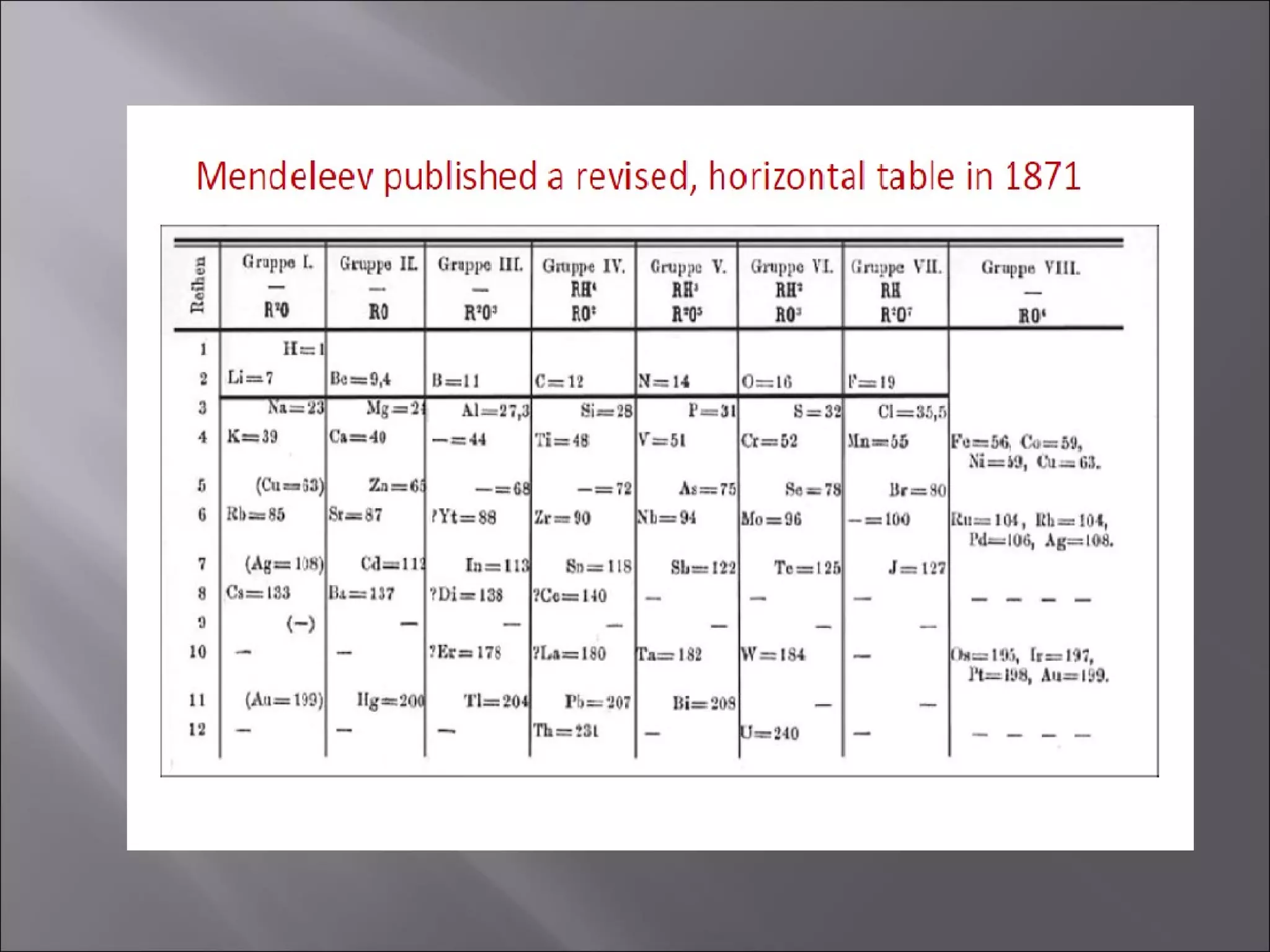
Geochemistry studies the chemical composition and properties of rocks. It examines the distribution and behavior of chemical elements within the Earth's crust. The periodic table evolved over time as scientists like Döbereiner grouped elements into triads based on their atomic weights, and Mendeleev arranged the known elements into the first periodic table based on recurring trends in their properties. This allowed prediction of properties of yet-to-be discovered elements and established atomic weight as the basis for organization until Moseley showed atomic number provided an even more systematic relationship.
• Geochemistry isthe branch of geology in
which we study rocks according to their
chemical prospective.
• It trace and find the fate and behavior of
chemical elements in the earth crust.
Listed 33 SubstancesSimples (elements) in his Traité
Élémentaire de Chimie (1789). He divided them in two
parts,
1. light (lumière)
2. caloric (calorique)
Called them material substances
4.
He presentatomic theory in 1808.
All bodies are made up of a vast number of
extremely small particles, or atoms of matter
bound together by a force of attraction.
Same and homogeneous bodies are perfectly
alike in weight, figure, etc.
5.
1. Atoms havedefinite relative weights “expressed in
atoms of hydrogen, each of which is denoted by unity”
2. Atoms combine in simple numerical ratios to form
compounds.
3. Under given experimental conditions a particular atom
will always behave in the same manner.
4. Atoms are indestructible
6.
He gavethe chemical sign, the initial letter of the Latin name of
each elementary substance: but as several have the same initial
letter, so
He distinguished them in the following manner:
1. metalloids, he employed the initial letter only, even when this
letter is common to the metalloid and some metal.
2. metals, he distinguished those that have the same initials
with another metal, or a metalloid, by writing the first two
letters of the word.
examples, S = sulphur, Si = silicium, St = stibium (antimony),
Sn = stannum (tin), C = carbonicum, Co = cobaltum (cobalt),
Cu = cuprum (copper), O = oxygen, Os = osmium, &c.
7.
Döbereiner’ Triads:
Döbereiner groupedelements to show that atomic weights
of a middle element were an average of two
Examples
1. Cl = 35.45
Br = 79.90
I = 126.90
2. Li = 6.94
Na = 22.99
K = 39.10
8.
“If theelements are arranged in the order of their
equivalents, with a few slight transpositions, it will be
observed that elements belonging to the same group
usually appear on the same horizontal line.”
9.
“He beganto look about and write down the
elements with their atomic weights and typical
properties, analogous elements and like atomic
weights on separate cards convinced him that
the properties of elements are in periodic
dependence upon their atomic weights.”
10.
1. The valueof the atomic weight determines the character
of the element.
2. There are unknown elements to discover e.g., elements
similar to Al and Si with atomic weights in range 65 75.‐
3. The atomic weights of some elements may be changed
from knowing the properties of neighbouring elements.
Thus the atomic weight of Te must be in range 123 126. It‐
cannot be 128.
4. Some typical properties of an element can be predicted
from its atomic weight.
12.
In 1913,using x ray diffraction spectra, Moseley‐
showed a systematic relation between wavelength and
atomic number.
Resulted in arrangement of the periodic table by atomic
number rather than atomic weight.