27/03/2025 3
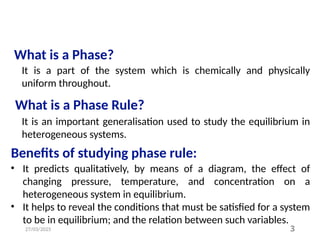
What isa Phase?
What is a Phase Rule?
Benefits of studying phase rule:
It is an important generalisation used to study the equilibrium in
heterogeneous systems.
• It predicts qualitatively, by means of a diagram, the effect of
changing pressure, temperature, and concentration on a
heterogeneous system in equilibrium.
• It helps to reveal the conditions that must be satisfied for a system
to be in equilibrium; and the relation between such variables.
It is a part of the system which is chemically and physically
uniform throughout.
4.
27/03/2025 4
Phase Rule:
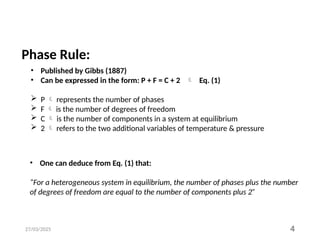
•Published by Gibbs (1887)
• Can be expressed in the form: P + F = C + 2 Eq. (1)
P represents the number of phases
F is the number of degrees of freedom
C is the number of components in a system at equilibrium
2 refers to the two additional variables of temperature & pressure
• One can deduce from Eq. (1) that:
“For a heterogeneous system in equilibrium, the number of phases plus the number
of degrees of freedom are equal to the number of components plus 2”
5.
5
Phase , component,and degree of freedom
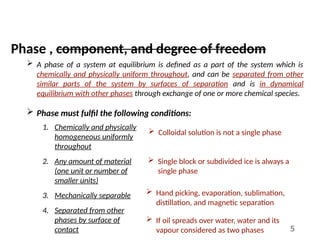
A phase of a system at equilibrium is defined as a part of the system which is
chemically and physically uniform throughout, and can be separated from other
similar parts of the system by surfaces of separation and is in dynamical
equilibrium with other phases through exchange of one or more chemical species.
Phase must fulfil the following conditions:
1. Chemically and physically
homogeneous uniformly
throughout
2. Any amount of material
(one unit or number of
smaller units)
3. Mechanically separable
4. Separated from other
phases by surface of
contact
Colloidal solution is not a single phase
Single block or subdivided ice is always a
single phase
Hand picking, evaporation, sublimation,
distillation, and magnetic separation
If oil spreads over water, water and its
vapour considered as two phases
6.
27/03/2025 6
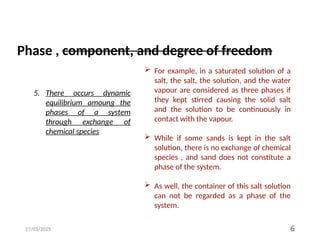
5. Thereoccurs dynamic
equilibrium amoung the
phases of a system
through exchange of
chemical species
For example, in a saturated solution of a
salt, the salt, the solution, and the water
vapour are considered as three phases if
they kept stirred causing the solid salt
and the solution to be continuously in
contact with the vapour.
While if some sands is kept in the salt
solution, there is no exchange of chemical
species , and sand does not constitute a
phase of the system.
As well, the container of this salt solution
can not be regarded as a phase of the
system.
Phase , component, and degree of freedom
7.
27/03/2025 7
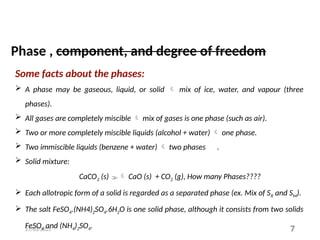
Some factsabout the phases:
A phase may be gaseous, liquid, or solid mix of ice, water, and vapour (three
phases).
All gases are completely miscible mix of gases is one phase (such as air).
Two or more completely miscible liquids (alcohol + water) one phase.
Two immiscible liquids (benzene + water) two phases .
Solid mixture:
CaCO3 (s) CaO (s) + CO2 (g), How many Phases????
Each allotropic form of a solid is regarded as a separated phase (ex. Mix of SR and SM).
The salt FeSO4.(NH4)2SO4.6H2O is one solid phase, although it consists from two solids
FeSO4 and (NH4)2SO4.
Phase , component, and degree of freedom