Guru Jambheshwar University of
Science & Technology
Topic in concern The Geochemical Distribution of Elements
Submitted to:-
Dr. Naresh Sir
By:-
Ajay Pal
16094047
B.Sc. Hons Biotechnology
(2017-19)
Date:-15/11/2018
Why to Study the factors behind The Geochemical
Distribution of Elements
The relative abundance of the elements in the earth's crust is a subject of fundamental importance to mining
geologists but is one which is seldom studied comprehensively. A great number of the elements present in the
earth in very low concentration are being used in every day artifacts, and it has become essential to discover the
factors causing these metals to become concentrated in certain rocks. The search for many of the rarer metals
has been stimulated by their increasing use in the realms of catalysis and electron emission ,where the quantity
used is quite small. At this time, when the search for strategic materials is the basis of production, it would seem
advisable to review briefly our knowledge concerning the causes for the present distribution of minerals.
Although such knowledge will not lead us immediately to a source of rich ore, it will save us the time which
might be spent in prospecting for material in an impossible location.
This study received a great and much-needed impetus between the years 1910 and 1920, due mainly to the work
of F. W. Clarke in the U. S. and V. M. Goldschmidt in Germany. The latter, by his use of visual and r-ray
spectrography, successfully covered a great deal of ground and eliminated the error introduced in chemical
analysis by the impurities in the large quantities of reagents necessary for the treatment of large samples. His
determinations of ionic radii, carried out as a part of this work, will stand as a lasting memorial to his
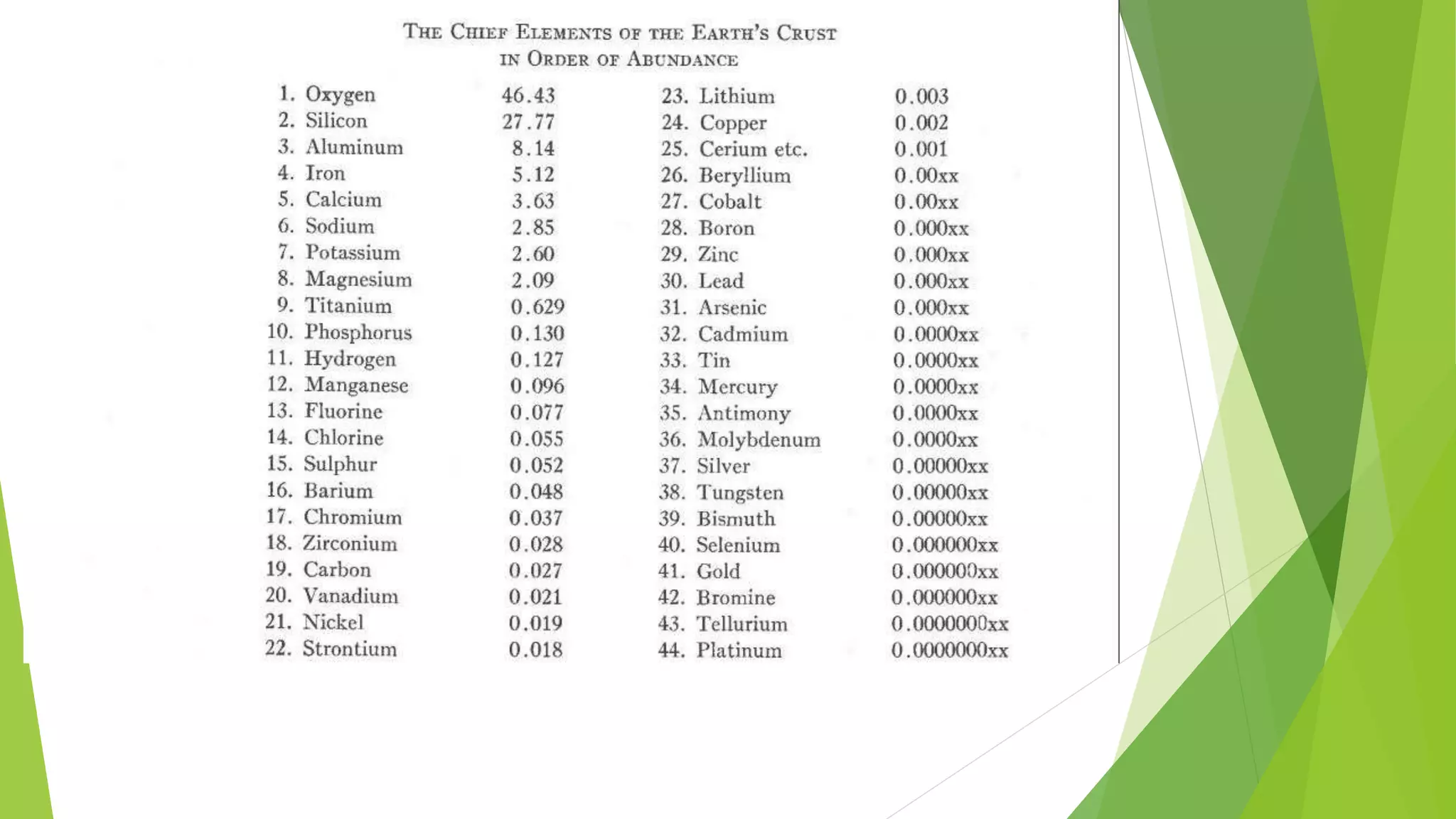
perseverance. The average percentage composition of the earth's crust is now known to a high degree of
precision, and the following table is taken principally from the results obtained by Clarke and Washington. It is
worth remembering that although these figures relate to the lithosphere only, the inclusion of the atmosphere
and hydrosphere does not alter them, as they stand. Many of the elements, for instance radium, beryllium,
molybdenum, vanadium and tungsten, which are exceedingly scarce, have become quite familiar to us as a result
of their highly important chemical and physical properties. Their use, however, would be prohibited if they had
not been concentrated by natural processes in certain parts of the earth's crust to such an extent that their
extraction is relatively simple. In 1922 V. M. Goldschmidt suggested that the scarcity of the precious metals was
not an inherent characteristic of planetary bodies, but was caused by a process of selective elimination, because
of the large partition ratios of these elements between silicate slags and ferro-compounds
Old Milestones
So We will Study
 What is Geochemical Distribution.
 Geochemical classification on basis of distribution.
 The Geochemical factors affecting the distribution of Metals
In Order to Study
Geochemical effect on distribution of metals
 What is Geochemical Distribution. (Terminology)
 Geochemical classification on basis of distribution.
(Helpful for deep Understanding)
We should Know
Geochemical Distribution of Metals
It is the study of concentration of metals at different regions in relation to geochemistry
of that particular region.
The concentration of any particular metal in particular region is dependent on various
factors and the information of these factors along with their level of influence can be
used in a reverse engineered way to predict the different types of ores and minerals
which can be found in a region upon mining
Geochemistry is the science that uses the tools and principles of chemistry to explain the
mechanisms behind major geological systems such as the Earth’s crust and its oceans.
Geochemistry has made important contributions to the understanding of a number of processes
including mantle convection, the formation of planets and the origins of granite and basalt.
Geochemical classification on basis of Distribution
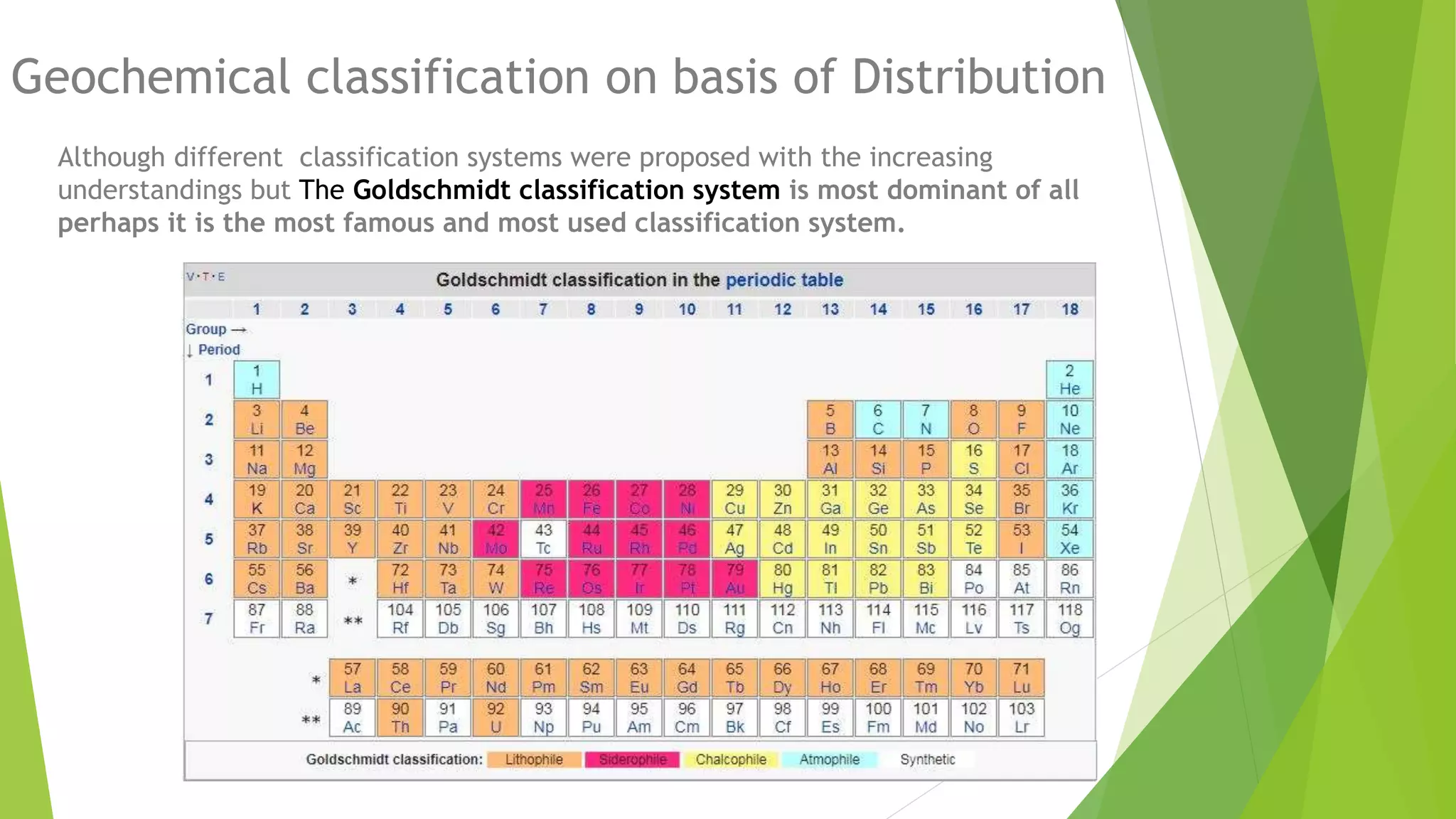
Although different classification systems were proposed with the increasing
understandings but The Goldschmidt classification system is most dominant of all
perhaps it is the most famous and most used classification system.
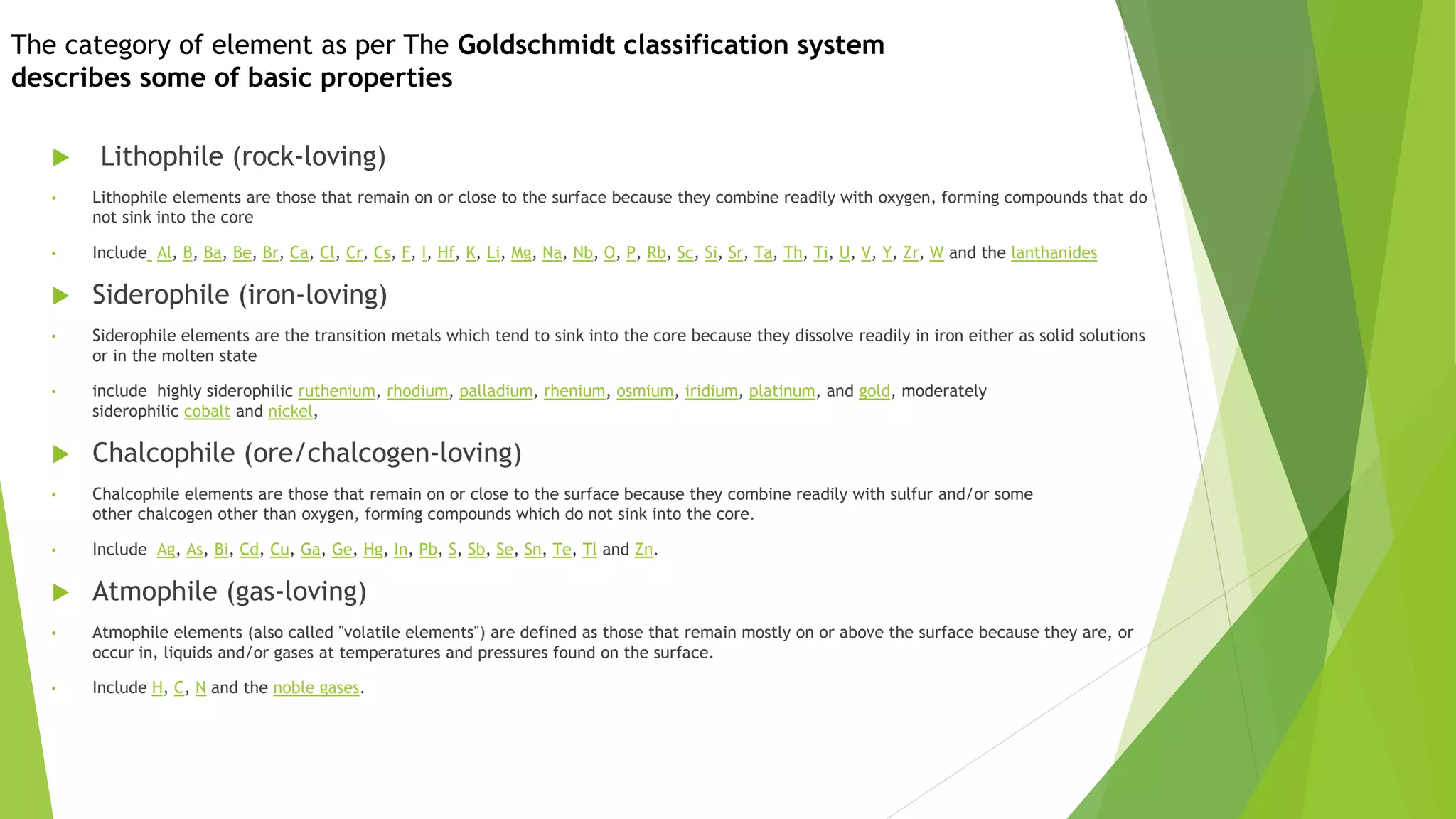
The category of element as per The Goldschmidt classification system
describes some of basic properties
 Lithophile (rock-loving)
• Lithophile elements are those that remain on or close to the surface because they combine readily with oxygen, forming compounds that do
not sink into the core
• Include Al, B, Ba, Be, Br, Ca, Cl, Cr, Cs, F, I, Hf, K, Li, Mg, Na, Nb, O, P, Rb, Sc, Si, Sr, Ta, Th, Ti, U, V, Y, Zr, W and the lanthanides
 Siderophile (iron-loving)
• Siderophile elements are the transition metals which tend to sink into the core because they dissolve readily in iron either as solid solutions
or in the molten state
• include highly siderophilic ruthenium, rhodium, palladium, rhenium, osmium, iridium, platinum, and gold, moderately
siderophilic cobalt and nickel,
 Chalcophile (ore/chalcogen-loving)
• Chalcophile elements are those that remain on or close to the surface because they combine readily with sulfur and/or some
other chalcogen other than oxygen, forming compounds which do not sink into the core.
• Include Ag, As, Bi, Cd, Cu, Ga, Ge, Hg, In, Pb, S, Sb, Se, Sn, Te, Tl and Zn.
 Atmophile (gas-loving)
• Atmophile elements (also called "volatile elements") are defined as those that remain mostly on or above the surface because they are, or
occur in, liquids and/or gases at temperatures and pressures found on the surface.
• Include H, C, N and the noble gases.
FACTORS INFLUENCING THE DISTRIBUTION OF THE
ELEMENTs
In short:-
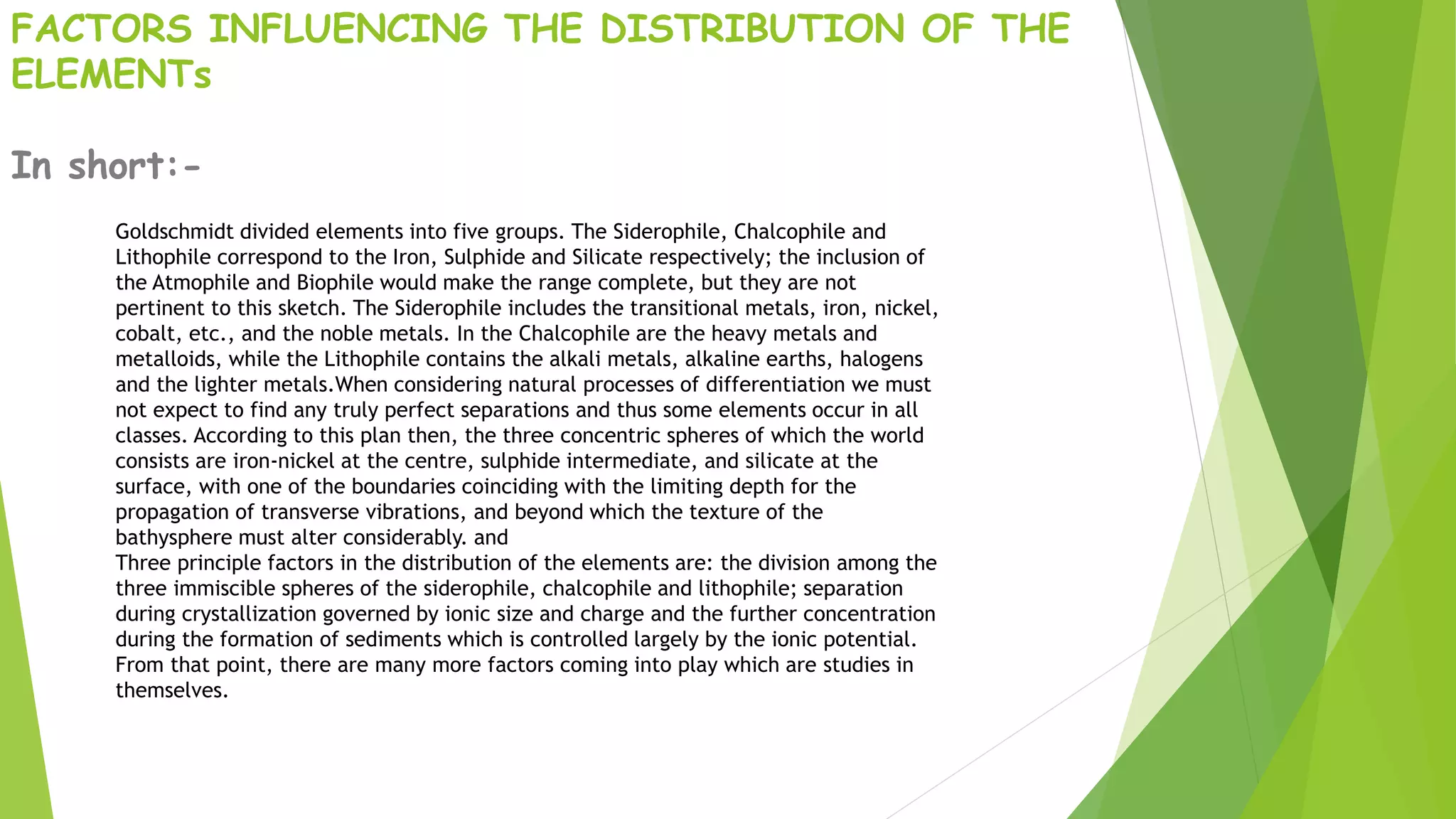
Goldschmidt divided elements into five groups. The Siderophile, Chalcophile and
Lithophile correspond to the Iron, Sulphide and Silicate respectively; the inclusion of
the Atmophile and Biophile would make the range complete, but they are not
pertinent to this sketch. The Siderophile includes the transitional metals, iron, nickel,
cobalt, etc., and the noble metals. In the Chalcophile are the heavy metals and
metalloids, while the Lithophile contains the alkali metals, alkaline earths, halogens
and the lighter metals.When considering natural processes of differentiation we must
not expect to find any truly perfect separations and thus some elements occur in all
classes. According to this plan then, the three concentric spheres of which the world
consists are iron-nickel at the centre, sulphide intermediate, and silicate at the
surface, with one of the boundaries coinciding with the limiting depth for the
propagation of transverse vibrations, and beyond which the texture of the
bathysphere must alter considerably. and
Three principle factors in the distribution of the elements are: the division among the
three immiscible spheres of the siderophile, chalcophile and lithophile; separation
during crystallization governed by ionic size and charge and the further concentration
during the formation of sediments which is controlled largely by the ionic potential.
From that point, there are many more factors coming into play which are studies in
themselves.
FACTORS INFLUENCING THE DISTRIBUTION OF
THE ELEMENTs
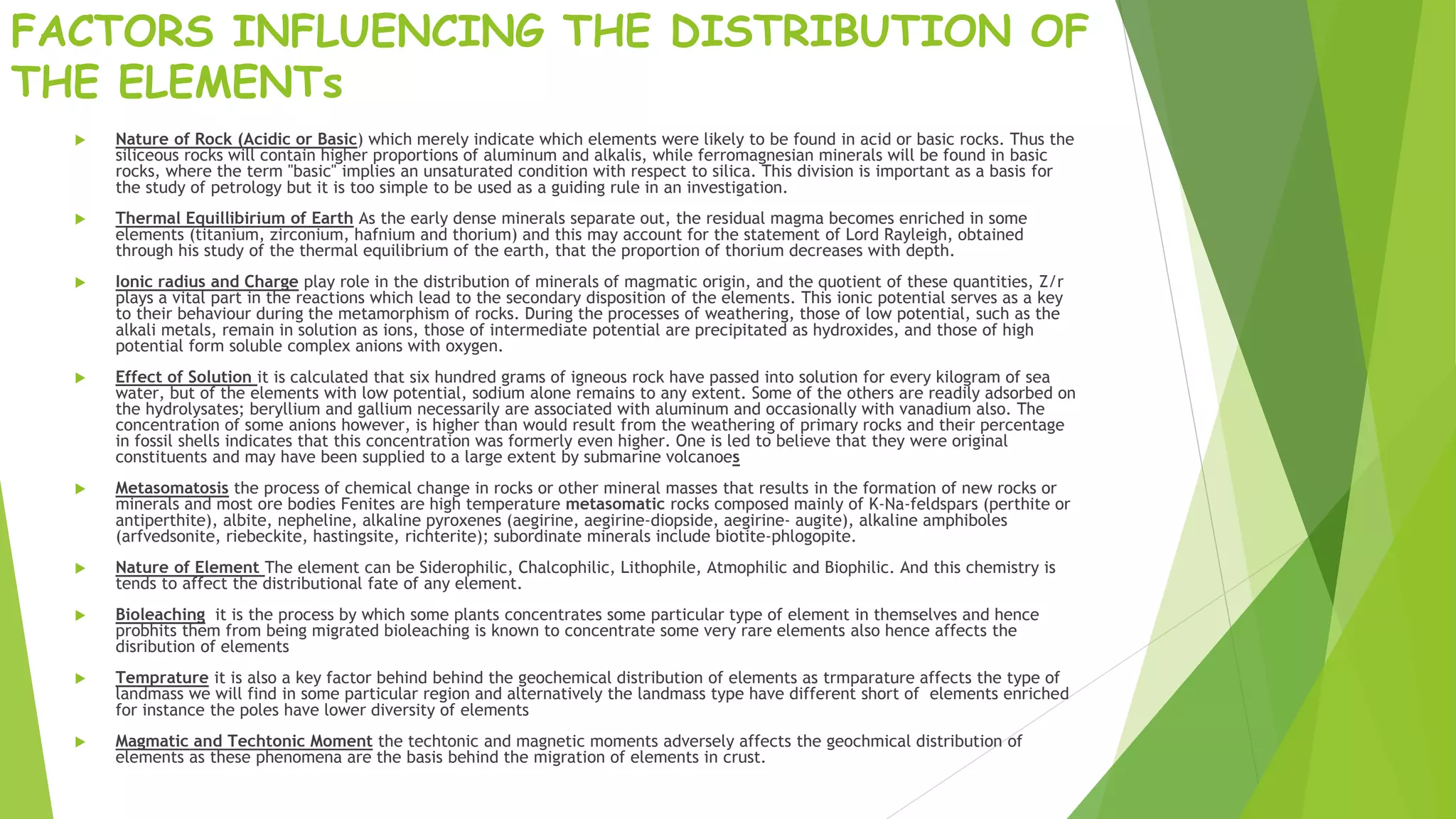
 Nature of Rock (Acidic or Basic) which merely indicate which elements were likely to be found in acid or basic rocks. Thus the
siliceous rocks will contain higher proportions of aluminum and alkalis, while ferromagnesian minerals will be found in basic
rocks, where the term "basic" implies an unsaturated condition with respect to silica. This division is important as a basis for
the study of petrology but it is too simple to be used as a guiding rule in an investigation.
 Thermal Equillibirium of Earth As the early dense minerals separate out, the residual magma becomes enriched in some
elements (titanium, zirconium, hafnium and thorium) and this may account for the statement of Lord Rayleigh, obtained
through his study of the thermal equilibrium of the earth, that the proportion of thorium decreases with depth.
 Ionic radius and Charge play role in the distribution of minerals of magmatic origin, and the quotient of these quantities, Z/r
plays a vital part in the reactions which lead to the secondary disposition of the elements. This ionic potential serves as a key
to their behaviour during the metamorphism of rocks. During the processes of weathering, those of low potential, such as the
alkali metals, remain in solution as ions, those of intermediate potential are precipitated as hydroxides, and those of high
potential form soluble complex anions with oxygen.
 Effect of Solution it is calculated that six hundred grams of igneous rock have passed into solution for every kilogram of sea
water, but of the elements with low potential, sodium alone remains to any extent. Some of the others are readily adsorbed on
the hydrolysates; beryllium and gallium necessarily are associated with aluminum and occasionally with vanadium also. The
concentration of some anions however, is higher than would result from the weathering of primary rocks and their percentage
in fossil shells indicates that this concentration was formerly even higher. One is led to believe that they were original
constituents and may have been supplied to a large extent by submarine volcanoes
 Metasomatosis the process of chemical change in rocks or other mineral masses that results in the formation of new rocks or
minerals and most ore bodies Fenites are high temperature metasomatic rocks composed mainly of K-Na-feldspars (perthite or
antiperthite), albite, nepheline, alkaline pyroxenes (aegirine, aegirine-diopside, aegirine- augite), alkaline amphiboles
(arfvedsonite, riebeckite, hastingsite, richterite); subordinate minerals include biotite-phlogopite.
 Nature of Element The element can be Siderophilic, Chalcophilic, Lithophile, Atmophilic and Biophilic. And this chemistry is
tends to affect the distributional fate of any element.
 Bioleaching it is the process by which some plants concentrates some particular type of element in themselves and hence
probhits them from being migrated bioleaching is known to concentrate some very rare elements also hence affects the
disribution of elements
 Temprature it is also a key factor behind behind the geochemical distribution of elements as trmparature affects the type of
landmass we will find in some particular region and alternatively the landmass type have different short of elements enriched
for instance the poles have lower diversity of elements
 Magmatic and Techtonic Moment the techtonic and magnetic moments adversely affects the geochmical distribution of
elements as these phenomena are the basis behind the migration of elements in crust.
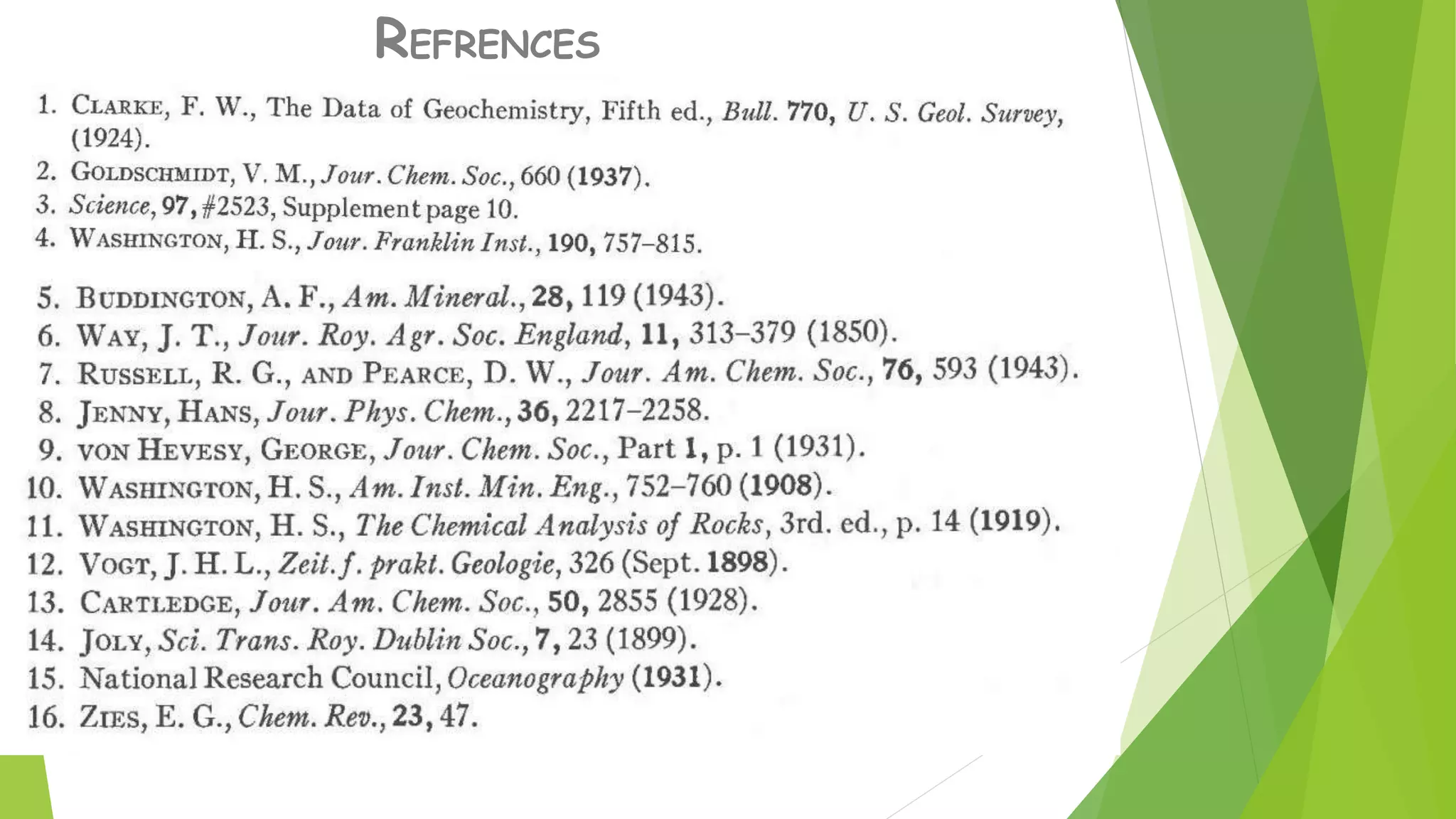
REFRENCES
Thanx to me……..
Still Have questions in mind try
Google/Yahoo/Bing/DuckDuckgo

Geochemical distribution of elements

  • 1.
    Guru Jambheshwar Universityof Science & Technology Topic in concern The Geochemical Distribution of Elements Submitted to:- Dr. Naresh Sir By:- Ajay Pal 16094047 B.Sc. Hons Biotechnology (2017-19) Date:-15/11/2018
  • 2.
    Why to Studythe factors behind The Geochemical Distribution of Elements The relative abundance of the elements in the earth's crust is a subject of fundamental importance to mining geologists but is one which is seldom studied comprehensively. A great number of the elements present in the earth in very low concentration are being used in every day artifacts, and it has become essential to discover the factors causing these metals to become concentrated in certain rocks. The search for many of the rarer metals has been stimulated by their increasing use in the realms of catalysis and electron emission ,where the quantity used is quite small. At this time, when the search for strategic materials is the basis of production, it would seem advisable to review briefly our knowledge concerning the causes for the present distribution of minerals. Although such knowledge will not lead us immediately to a source of rich ore, it will save us the time which might be spent in prospecting for material in an impossible location. This study received a great and much-needed impetus between the years 1910 and 1920, due mainly to the work of F. W. Clarke in the U. S. and V. M. Goldschmidt in Germany. The latter, by his use of visual and r-ray spectrography, successfully covered a great deal of ground and eliminated the error introduced in chemical analysis by the impurities in the large quantities of reagents necessary for the treatment of large samples. His determinations of ionic radii, carried out as a part of this work, will stand as a lasting memorial to his perseverance. The average percentage composition of the earth's crust is now known to a high degree of precision, and the following table is taken principally from the results obtained by Clarke and Washington. It is worth remembering that although these figures relate to the lithosphere only, the inclusion of the atmosphere and hydrosphere does not alter them, as they stand. Many of the elements, for instance radium, beryllium, molybdenum, vanadium and tungsten, which are exceedingly scarce, have become quite familiar to us as a result of their highly important chemical and physical properties. Their use, however, would be prohibited if they had not been concentrated by natural processes in certain parts of the earth's crust to such an extent that their extraction is relatively simple. In 1922 V. M. Goldschmidt suggested that the scarcity of the precious metals was not an inherent characteristic of planetary bodies, but was caused by a process of selective elimination, because of the large partition ratios of these elements between silicate slags and ferro-compounds Old Milestones
  • 3.
    So We willStudy  What is Geochemical Distribution.  Geochemical classification on basis of distribution.  The Geochemical factors affecting the distribution of Metals In Order to Study Geochemical effect on distribution of metals  What is Geochemical Distribution. (Terminology)  Geochemical classification on basis of distribution. (Helpful for deep Understanding) We should Know
  • 4.
    Geochemical Distribution ofMetals It is the study of concentration of metals at different regions in relation to geochemistry of that particular region. The concentration of any particular metal in particular region is dependent on various factors and the information of these factors along with their level of influence can be used in a reverse engineered way to predict the different types of ores and minerals which can be found in a region upon mining Geochemistry is the science that uses the tools and principles of chemistry to explain the mechanisms behind major geological systems such as the Earth’s crust and its oceans. Geochemistry has made important contributions to the understanding of a number of processes including mantle convection, the formation of planets and the origins of granite and basalt.
  • 5.
    Geochemical classification onbasis of Distribution Although different classification systems were proposed with the increasing understandings but The Goldschmidt classification system is most dominant of all perhaps it is the most famous and most used classification system.
  • 6.
    The category ofelement as per The Goldschmidt classification system describes some of basic properties  Lithophile (rock-loving) • Lithophile elements are those that remain on or close to the surface because they combine readily with oxygen, forming compounds that do not sink into the core • Include Al, B, Ba, Be, Br, Ca, Cl, Cr, Cs, F, I, Hf, K, Li, Mg, Na, Nb, O, P, Rb, Sc, Si, Sr, Ta, Th, Ti, U, V, Y, Zr, W and the lanthanides  Siderophile (iron-loving) • Siderophile elements are the transition metals which tend to sink into the core because they dissolve readily in iron either as solid solutions or in the molten state • include highly siderophilic ruthenium, rhodium, palladium, rhenium, osmium, iridium, platinum, and gold, moderately siderophilic cobalt and nickel,  Chalcophile (ore/chalcogen-loving) • Chalcophile elements are those that remain on or close to the surface because they combine readily with sulfur and/or some other chalcogen other than oxygen, forming compounds which do not sink into the core. • Include Ag, As, Bi, Cd, Cu, Ga, Ge, Hg, In, Pb, S, Sb, Se, Sn, Te, Tl and Zn.  Atmophile (gas-loving) • Atmophile elements (also called "volatile elements") are defined as those that remain mostly on or above the surface because they are, or occur in, liquids and/or gases at temperatures and pressures found on the surface. • Include H, C, N and the noble gases.
  • 8.
    FACTORS INFLUENCING THEDISTRIBUTION OF THE ELEMENTs In short:- Goldschmidt divided elements into five groups. The Siderophile, Chalcophile and Lithophile correspond to the Iron, Sulphide and Silicate respectively; the inclusion of the Atmophile and Biophile would make the range complete, but they are not pertinent to this sketch. The Siderophile includes the transitional metals, iron, nickel, cobalt, etc., and the noble metals. In the Chalcophile are the heavy metals and metalloids, while the Lithophile contains the alkali metals, alkaline earths, halogens and the lighter metals.When considering natural processes of differentiation we must not expect to find any truly perfect separations and thus some elements occur in all classes. According to this plan then, the three concentric spheres of which the world consists are iron-nickel at the centre, sulphide intermediate, and silicate at the surface, with one of the boundaries coinciding with the limiting depth for the propagation of transverse vibrations, and beyond which the texture of the bathysphere must alter considerably. and Three principle factors in the distribution of the elements are: the division among the three immiscible spheres of the siderophile, chalcophile and lithophile; separation during crystallization governed by ionic size and charge and the further concentration during the formation of sediments which is controlled largely by the ionic potential. From that point, there are many more factors coming into play which are studies in themselves.
  • 9.
    FACTORS INFLUENCING THEDISTRIBUTION OF THE ELEMENTs  Nature of Rock (Acidic or Basic) which merely indicate which elements were likely to be found in acid or basic rocks. Thus the siliceous rocks will contain higher proportions of aluminum and alkalis, while ferromagnesian minerals will be found in basic rocks, where the term "basic" implies an unsaturated condition with respect to silica. This division is important as a basis for the study of petrology but it is too simple to be used as a guiding rule in an investigation.  Thermal Equillibirium of Earth As the early dense minerals separate out, the residual magma becomes enriched in some elements (titanium, zirconium, hafnium and thorium) and this may account for the statement of Lord Rayleigh, obtained through his study of the thermal equilibrium of the earth, that the proportion of thorium decreases with depth.  Ionic radius and Charge play role in the distribution of minerals of magmatic origin, and the quotient of these quantities, Z/r plays a vital part in the reactions which lead to the secondary disposition of the elements. This ionic potential serves as a key to their behaviour during the metamorphism of rocks. During the processes of weathering, those of low potential, such as the alkali metals, remain in solution as ions, those of intermediate potential are precipitated as hydroxides, and those of high potential form soluble complex anions with oxygen.  Effect of Solution it is calculated that six hundred grams of igneous rock have passed into solution for every kilogram of sea water, but of the elements with low potential, sodium alone remains to any extent. Some of the others are readily adsorbed on the hydrolysates; beryllium and gallium necessarily are associated with aluminum and occasionally with vanadium also. The concentration of some anions however, is higher than would result from the weathering of primary rocks and their percentage in fossil shells indicates that this concentration was formerly even higher. One is led to believe that they were original constituents and may have been supplied to a large extent by submarine volcanoes  Metasomatosis the process of chemical change in rocks or other mineral masses that results in the formation of new rocks or minerals and most ore bodies Fenites are high temperature metasomatic rocks composed mainly of K-Na-feldspars (perthite or antiperthite), albite, nepheline, alkaline pyroxenes (aegirine, aegirine-diopside, aegirine- augite), alkaline amphiboles (arfvedsonite, riebeckite, hastingsite, richterite); subordinate minerals include biotite-phlogopite.  Nature of Element The element can be Siderophilic, Chalcophilic, Lithophile, Atmophilic and Biophilic. And this chemistry is tends to affect the distributional fate of any element.  Bioleaching it is the process by which some plants concentrates some particular type of element in themselves and hence probhits them from being migrated bioleaching is known to concentrate some very rare elements also hence affects the disribution of elements  Temprature it is also a key factor behind behind the geochemical distribution of elements as trmparature affects the type of landmass we will find in some particular region and alternatively the landmass type have different short of elements enriched for instance the poles have lower diversity of elements  Magmatic and Techtonic Moment the techtonic and magnetic moments adversely affects the geochmical distribution of elements as these phenomena are the basis behind the migration of elements in crust.
  • 10.
  • 11.
    Thanx to me…….. StillHave questions in mind try Google/Yahoo/Bing/DuckDuckgo