
Technique
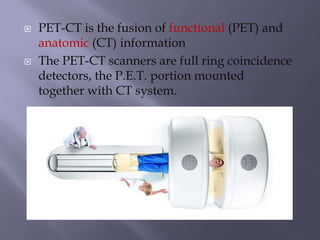
 PET-CT is the fusion of functional (PET) and
anatomic (CT) information
 The PET-CT scanners are full ring coincidence
detectors, the P.E.T. portion mounted
together with CT system.
 Fasting for 4-6 h before injection of 18F- FDG.
 The scan was performed 40-60 min after IV
injection of 18F- FDG
(0.1 millicurie/kilogram (mCi/kg); maximum
dose = 20 mCi/kg).
 The patients in supine position.
 A whole body examination from skull base to
mid thighs.
 The total examination time range between 13
and 17 minutes.
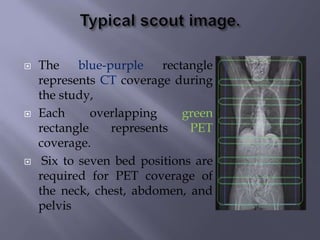
 The blue-purple rectangle
represents CT coverage during
the study,
 Each overlapping green
rectangle represents PET
coverage.
 Six to seven bed positions are
required for PET coverage of
the neck, chest, abdomen, and
pelvis
Standarized uptake value:-
 It is used for relative tissue uptake of FDG
tracer.
 SUV threshold value used for malignancy is
(> 2.5) .
 Formula:-
SUV= Tumor activity concentration [mCi/ml]
X body weight (g)/injected dose FDG [mCi ].
 Many benign infectious/inflammatory
processes (e.g: TB granuloma) will have a high
SUV value…..false positive results.
Dual time scanning :-
Delayed imaging is performed one hour following the
initial scan,
If SUV increased by 10%= malignancy.
If stationary or decreased= benign lesion.
Many slowly growing malignant processes
(e.g: BAC and carcinoid) may have minimal
uptake, and low SUV values….false negative
results.
Reference tissue :-
 - A number of tissues have been advocated as
reference tissue including, blood pool, liver,
lung and cerebellum.
 - Scientists found that mediastinal blood pool
showed the least inter-patient coefficient of
variance
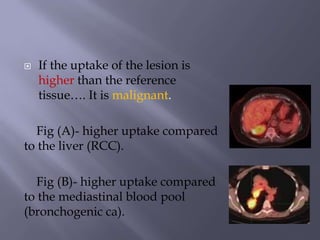
 If the uptake of the lesion is
higher than the reference
tissue…. It is malignant.
Fig (A)- higher uptake compared
to the liver (RCC).
Fig (B)- higher uptake compared
to the mediastinal blood pool
(bronchogenic ca).
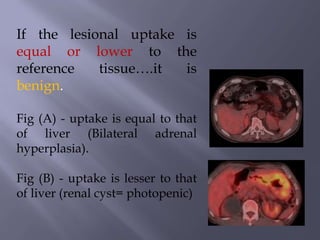
If the lesional uptake is
equal or lower to the
reference tissue….it is
benign.
Fig (A) - uptake is equal to that
of liver (Bilateral adrenal
hyperplasia).
Fig (B) - uptake is lesser to that
of liver (renal cyst= photopenic)
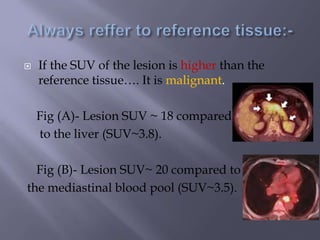
 If the SUV of the lesion is higher than the
reference tissue…. It is malignant.
Fig (A)- Lesion SUV ~ 18 compared
to the liver (SUV~3.8).
Fig (B)- Lesion SUV~ 20 compared to
the mediastinal blood pool (SUV~3.5).
Thank you

Pet ct technique

  • 1.
  • 2.
     PET-CT isthe fusion of functional (PET) and anatomic (CT) information  The PET-CT scanners are full ring coincidence detectors, the P.E.T. portion mounted together with CT system.
  • 3.
     Fasting for4-6 h before injection of 18F- FDG.  The scan was performed 40-60 min after IV injection of 18F- FDG (0.1 millicurie/kilogram (mCi/kg); maximum dose = 20 mCi/kg).  The patients in supine position.  A whole body examination from skull base to mid thighs.  The total examination time range between 13 and 17 minutes.
  • 4.
     The blue-purplerectangle represents CT coverage during the study,  Each overlapping green rectangle represents PET coverage.  Six to seven bed positions are required for PET coverage of the neck, chest, abdomen, and pelvis
  • 5.
    Standarized uptake value:- It is used for relative tissue uptake of FDG tracer.  SUV threshold value used for malignancy is (> 2.5) .  Formula:- SUV= Tumor activity concentration [mCi/ml] X body weight (g)/injected dose FDG [mCi ].
  • 6.
     Many benigninfectious/inflammatory processes (e.g: TB granuloma) will have a high SUV value…..false positive results. Dual time scanning :- Delayed imaging is performed one hour following the initial scan, If SUV increased by 10%= malignancy. If stationary or decreased= benign lesion. Many slowly growing malignant processes (e.g: BAC and carcinoid) may have minimal uptake, and low SUV values….false negative results.
  • 7.
    Reference tissue :- - A number of tissues have been advocated as reference tissue including, blood pool, liver, lung and cerebellum.  - Scientists found that mediastinal blood pool showed the least inter-patient coefficient of variance
  • 8.
     If theuptake of the lesion is higher than the reference tissue…. It is malignant. Fig (A)- higher uptake compared to the liver (RCC). Fig (B)- higher uptake compared to the mediastinal blood pool (bronchogenic ca).
  • 9.
    If the lesionaluptake is equal or lower to the reference tissue….it is benign. Fig (A) - uptake is equal to that of liver (Bilateral adrenal hyperplasia). Fig (B) - uptake is lesser to that of liver (renal cyst= photopenic)
  • 10.
     If theSUV of the lesion is higher than the reference tissue…. It is malignant. Fig (A)- Lesion SUV ~ 18 compared to the liver (SUV~3.8). Fig (B)- Lesion SUV~ 20 compared to the mediastinal blood pool (SUV~3.5).
  • 11.