Basic Principles of
CT Scanning
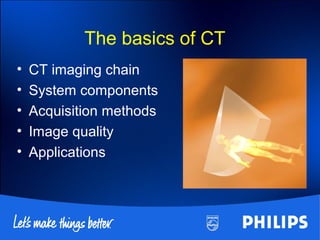
The basics of CT
• CT imaging chain
• System components
• Acquisition methods
• Image quality
• Applications
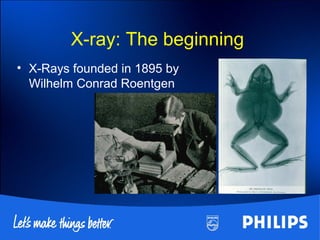
X-ray: The beginning
• X-Rays founded in 1895 by
Wilhelm Conrad Roentgen
CT: The beginning
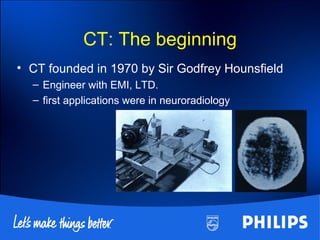
• CT founded in 1970 by Sir Godfrey Hounsfield
– Engineer with EMI, LTD.
– first applications were in neuroradiology
CT Scanner
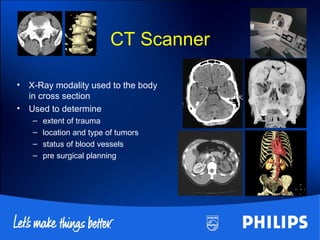
• X-Ray modality used to the body
in cross section
• Used to determine
– extent of trauma
– location and type of tumors
– status of blood vessels
– pre surgical planning
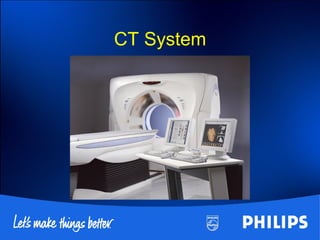
CT System
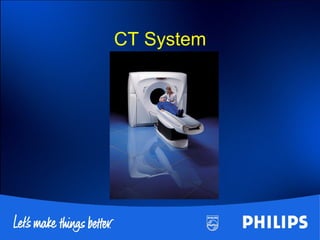
CT System
Basic CT scanner components
• Gantry
• X-Ray Tube
• Detector
• Control Console
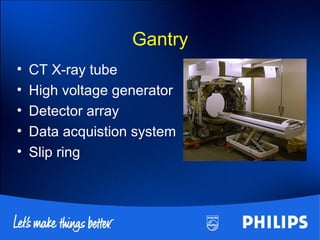
Gantry
• CT X-ray tube
• High voltage generator
• Detector array
• Data acquistion system
• Slip ring
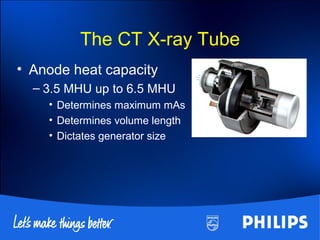
The CT X-ray Tube
• Anode heat capacity
– 3.5 MHU up to 6.5 MHU
• Determines maximum mAs
• Determines volume length
• Dictates generator size
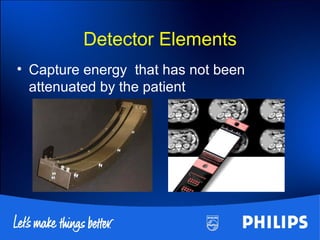
Detector Elements
• Capture energy that has not been
attenuated by the patient
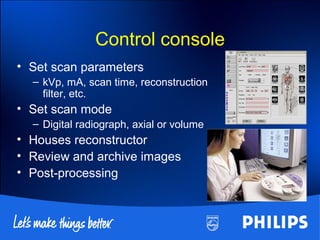
Control console
• Set scan parameters
– kVp, mA, scan time, reconstruction
filter, etc.
• Set scan mode
– Digital radiograph, axial or volume
• Houses reconstructor
• Review and archive images
• Post-processing
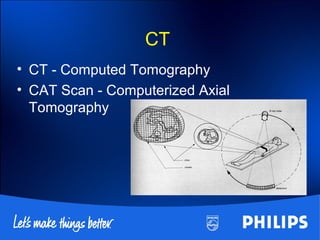
CT
• CT - Computed Tomography
• CAT Scan - Computerized Axial
Tomography
Scanning methods
• Digital projection
– AP, PA, Lat or Oblique projection
– Surview, Scanogram
• Conventional CT
– Axial
• Start/stop
• Volumetric CT
– Helical or spiral CT
• Continuous acquisition
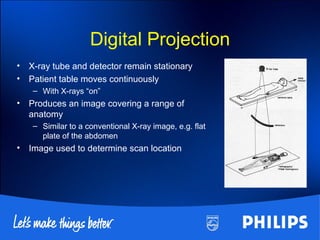
Digital Projection
• X-ray tube and detector remain stationary
• Patient table moves continuously
– With X-rays “on”
• Produces an image covering a range of
anatomy
– Similar to a conventional X-ray image, e.g. flat
plate of the abdomen
• Image used to determine scan location
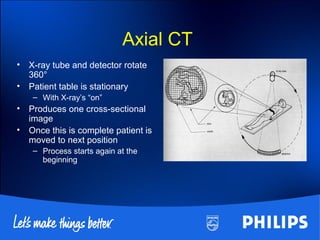
Axial CT
• X-ray tube and detector rotate
360°
• Patient table is stationary
– With X-ray’s “on”
• Produces one cross-sectional
image
• Once this is complete patient is
moved to next position
– Process starts again at the
beginning
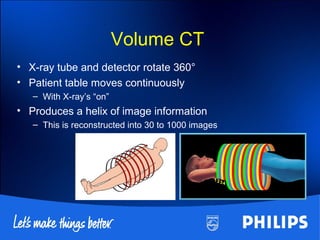
Volume CT
• X-ray tube and detector rotate 360°
• Patient table moves continuously
– With X-ray’s “on”
• Produces a helix of image information
– This is reconstructed into 30 to 1000 images
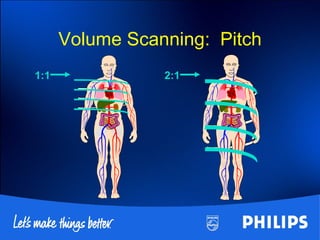
Volume Scanning: Pitch
1:1 2:1
Advantages of Volume CT
• More coverage in a breath-hold
– Chest, Vascular studies, trauma
• Reduced misregistration of slices
– Improved MPR, 3D and MIP images
• Potentially less IV contrast required
• Gapless coverage
• Arbitrary slice positioning
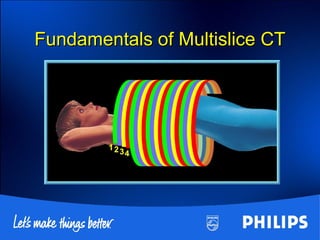
Fundamentals of Multislice CTFundamentals of Multislice CT
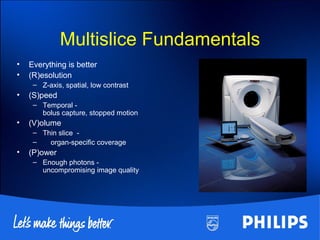
Multislice Fundamentals
• Everything is better
• (R)esolution
– Z-axis, spatial, low contrast
• (S)peed
– Temporal -
bolus capture, stopped motion
• (V)olume
– Thin slice -
– organ-specific coverage
• (P)ower
– Enough photons -
uncompromising image quality
Single Slice = One 10mm slice per rotation
Dual Slice = Two 5mm slices per rotation
Quad Slice = Four 2.5mm slices per rotation
Multislice Effectiveness
• Everything is better
– Resolution 2x 4x-8x
– Speed same same
– Volume same same
– Power same same
Dual Quad
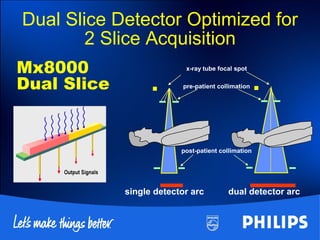
. .
single detector arc dual detector arc
pre-patient collimation
post-patient collimation
x-ray tube focal spot
___
Mx8000
Dual Slice
Dual Slice Detector Optimized for
2 Slice Acquisition
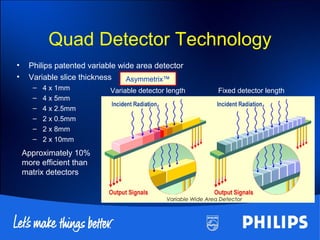
Approximately 10%
more efficient than
matrix detectors
Variable Wide Area Detector
Asymmetrix™
Variable detector length Fixed detector length
Quad Detector Technology
• Philips patented variable wide area detector
• Variable slice thickness
– 4 x 1mm
– 4 x 5mm
– 4 x 2.5mm
– 2 x 0.5mm
– 2 x 8mm
– 2 x 10mm
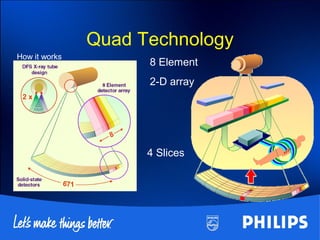
8 Element
2-D array
4 Slices
Quad Technology
How it works
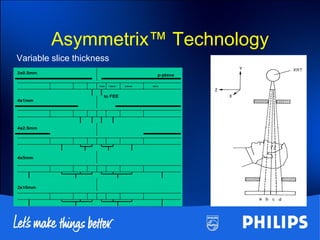
2x0.5mm
4x1mm
4x2.5mm
4x5mm
2x10mm
p-plane
fused fused
to FEE
1mm 1.5mm 2.5mm 5mm
Asymmetrix™ Technology
Variable slice thickness
CT
• CT attenuation information
• CT image quality
Attenuation
• X-ray beam passes through patient
• Each structure attenuates X-ray beam
differently
– According to individual densities
• Radiation received by detector varies
according to these densities
Density information
• Transferred from detector to CT computer
(A to D converter)
• Reconstructed by computer into a cross-sectional image
– Displayed on screen
– Each pixel displayed on monitor has varying brightness
• The greater the attenuation, the brighter the pixel
• The less attenuation, the darker the pixel
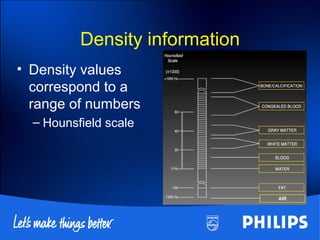
Density information
• Density values
correspond to a
range of numbers
– Hounsfield scale
Window settings
• Window width
– Determines range of CT numbers displayed on an image
• Values above this range = white
• Values below this range = black
– Window level
• Sets the center CT number displayed on the monitor
• Determines the location on the Hounsfield scale about which the
window width will be centered
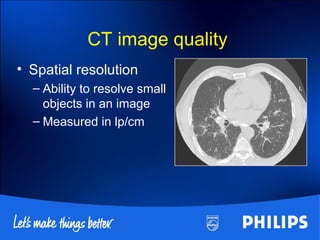
CT image quality
• Spatial resolution
– Ability to resolve small
objects in an image
– Measured in lp/cm
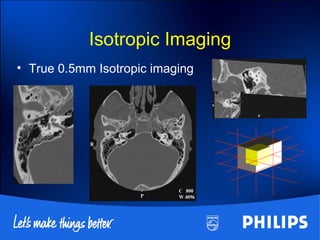
Isotropic Imaging
• True 0.5mm Isotropic imaging
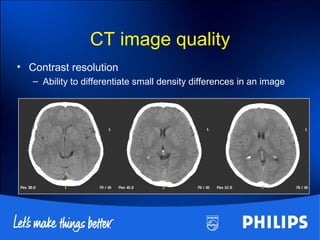
CT image quality
• Contrast resolution
– Ability to differentiate small density differences in an image
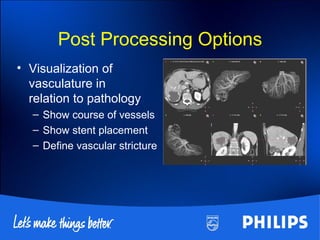
Post Processing Options
• Visualization of
vasculature in
relation to pathology
– Show course of vessels
– Show stent placement
– Define vascular stricture
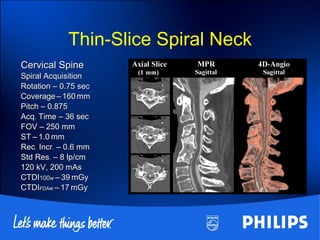
Cervical SpineCervical Spine
Spiral AcquisitionSpiral Acquisition
Rotation – 0.75 secRotation – 0.75 sec
CoverageCoverage –– 160160 mmmm
Pitch – 0.875Pitch – 0.875
AcqAcq.. Time – 36 secTime – 36 sec
FOV – 250 mmFOV – 250 mm
STST –– 1.01.0 mmmm
RecRec.. IncrIncr.. – 0.6 mm– 0.6 mm
Std ResStd Res.. – 8 lp/cm– 8 lp/cm
120 kV, 200 mAs120 kV, 200 mAs
CTDICTDI100100ww –– 3939 mGymGy
CTDICTDIFDAFDAww –– 1717 mGymGy
Thin-Slice Spiral Neck
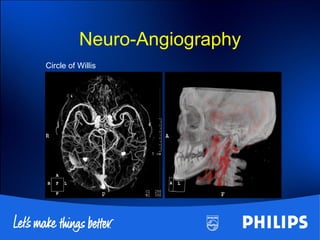
Neuro-Angiography
Circle of Willis
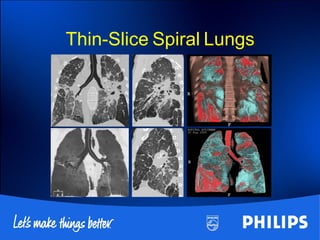
Thin-Slice Spiral Lungs
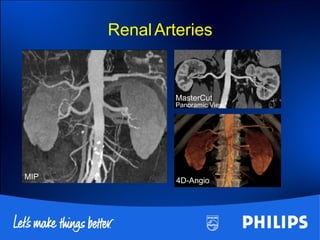
MIP 4D-Angio
MasterCut
Panoramic View
RenalArteries
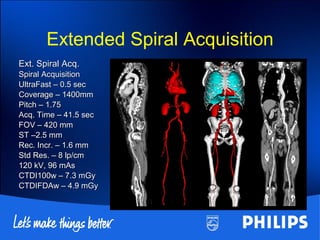
Ext. Spiral Acq.Ext. Spiral Acq.
Spiral AcquisitionSpiral Acquisition
UltraFast – 0.5 secUltraFast – 0.5 sec
Coverage – 1400mmCoverage – 1400mm
Pitch – 1.75Pitch – 1.75
Acq. Time – 41.5 secAcq. Time – 41.5 sec
FOV – 420 mmFOV – 420 mm
ST –2.5 mmST –2.5 mm
Rec. Incr. – 1.6 mmRec. Incr. – 1.6 mm
Std Res. – 8 lp/cmStd Res. – 8 lp/cm
120 kV, 96 mAs120 kV, 96 mAs
CTDI100w – 7.3 mGyCTDI100w – 7.3 mGy
CTDIFDAw – 4.9 mGyCTDIFDAw – 4.9 mGy
Extended Spiral Acquisition
CT Scanners
• Provide a window into the body
• Customer considerations
– How many patients
– Referring physicians
– Budget
– Upgrade expectations
• Philips has ALL the answers

Basic principles of ct scanning

  • 1.
  • 2.
    The basics ofCT • CT imaging chain • System components • Acquisition methods • Image quality • Applications
  • 3.
    X-ray: The beginning •X-Rays founded in 1895 by Wilhelm Conrad Roentgen
  • 4.
    CT: The beginning •CT founded in 1970 by Sir Godfrey Hounsfield – Engineer with EMI, LTD. – first applications were in neuroradiology
  • 5.
    CT Scanner • X-Raymodality used to the body in cross section • Used to determine – extent of trauma – location and type of tumors – status of blood vessels – pre surgical planning
  • 6.
  • 7.
  • 8.
    Basic CT scannercomponents • Gantry • X-Ray Tube • Detector • Control Console
  • 9.
    Gantry • CT X-raytube • High voltage generator • Detector array • Data acquistion system • Slip ring
  • 10.
    The CT X-rayTube • Anode heat capacity – 3.5 MHU up to 6.5 MHU • Determines maximum mAs • Determines volume length • Dictates generator size
  • 11.
    Detector Elements • Captureenergy that has not been attenuated by the patient
  • 12.
    Control console • Setscan parameters – kVp, mA, scan time, reconstruction filter, etc. • Set scan mode – Digital radiograph, axial or volume • Houses reconstructor • Review and archive images • Post-processing
  • 13.
    CT • CT -Computed Tomography • CAT Scan - Computerized Axial Tomography
  • 14.
    Scanning methods • Digitalprojection – AP, PA, Lat or Oblique projection – Surview, Scanogram • Conventional CT – Axial • Start/stop • Volumetric CT – Helical or spiral CT • Continuous acquisition
  • 15.
    Digital Projection • X-raytube and detector remain stationary • Patient table moves continuously – With X-rays “on” • Produces an image covering a range of anatomy – Similar to a conventional X-ray image, e.g. flat plate of the abdomen • Image used to determine scan location
  • 16.
    Axial CT • X-raytube and detector rotate 360° • Patient table is stationary – With X-ray’s “on” • Produces one cross-sectional image • Once this is complete patient is moved to next position – Process starts again at the beginning
  • 17.
    Volume CT • X-raytube and detector rotate 360° • Patient table moves continuously – With X-ray’s “on” • Produces a helix of image information – This is reconstructed into 30 to 1000 images
  • 18.
  • 19.
    Advantages of VolumeCT • More coverage in a breath-hold – Chest, Vascular studies, trauma • Reduced misregistration of slices – Improved MPR, 3D and MIP images • Potentially less IV contrast required • Gapless coverage • Arbitrary slice positioning
  • 20.
    Fundamentals of MultisliceCTFundamentals of Multislice CT
  • 21.
    Multislice Fundamentals • Everythingis better • (R)esolution – Z-axis, spatial, low contrast • (S)peed – Temporal - bolus capture, stopped motion • (V)olume – Thin slice - – organ-specific coverage • (P)ower – Enough photons - uncompromising image quality
  • 22.
    Single Slice =One 10mm slice per rotation Dual Slice = Two 5mm slices per rotation Quad Slice = Four 2.5mm slices per rotation Multislice Effectiveness • Everything is better – Resolution 2x 4x-8x – Speed same same – Volume same same – Power same same Dual Quad
  • 23.
    . . single detectorarc dual detector arc pre-patient collimation post-patient collimation x-ray tube focal spot ___ Mx8000 Dual Slice Dual Slice Detector Optimized for 2 Slice Acquisition
  • 24.
    Approximately 10% more efficientthan matrix detectors Variable Wide Area Detector Asymmetrix™ Variable detector length Fixed detector length Quad Detector Technology • Philips patented variable wide area detector • Variable slice thickness – 4 x 1mm – 4 x 5mm – 4 x 2.5mm – 2 x 0.5mm – 2 x 8mm – 2 x 10mm
  • 25.
    8 Element 2-D array 4Slices Quad Technology How it works
  • 26.
    2x0.5mm 4x1mm 4x2.5mm 4x5mm 2x10mm p-plane fused fused to FEE 1mm1.5mm 2.5mm 5mm Asymmetrix™ Technology Variable slice thickness
  • 27.
    CT • CT attenuationinformation • CT image quality
  • 28.
    Attenuation • X-ray beampasses through patient • Each structure attenuates X-ray beam differently – According to individual densities • Radiation received by detector varies according to these densities
  • 29.
    Density information • Transferredfrom detector to CT computer (A to D converter) • Reconstructed by computer into a cross-sectional image – Displayed on screen – Each pixel displayed on monitor has varying brightness • The greater the attenuation, the brighter the pixel • The less attenuation, the darker the pixel
  • 30.
    Density information • Densityvalues correspond to a range of numbers – Hounsfield scale
  • 31.
    Window settings • Windowwidth – Determines range of CT numbers displayed on an image • Values above this range = white • Values below this range = black – Window level • Sets the center CT number displayed on the monitor • Determines the location on the Hounsfield scale about which the window width will be centered
  • 32.
    CT image quality •Spatial resolution – Ability to resolve small objects in an image – Measured in lp/cm
  • 33.
    Isotropic Imaging • True0.5mm Isotropic imaging
  • 34.
    CT image quality •Contrast resolution – Ability to differentiate small density differences in an image
  • 35.
    Post Processing Options •Visualization of vasculature in relation to pathology – Show course of vessels – Show stent placement – Define vascular stricture
  • 36.
    Cervical SpineCervical Spine SpiralAcquisitionSpiral Acquisition Rotation – 0.75 secRotation – 0.75 sec CoverageCoverage –– 160160 mmmm Pitch – 0.875Pitch – 0.875 AcqAcq.. Time – 36 secTime – 36 sec FOV – 250 mmFOV – 250 mm STST –– 1.01.0 mmmm RecRec.. IncrIncr.. – 0.6 mm– 0.6 mm Std ResStd Res.. – 8 lp/cm– 8 lp/cm 120 kV, 200 mAs120 kV, 200 mAs CTDICTDI100100ww –– 3939 mGymGy CTDICTDIFDAFDAww –– 1717 mGymGy Thin-Slice Spiral Neck
  • 37.
  • 38.
  • 39.
  • 40.
    Ext. Spiral Acq.Ext.Spiral Acq. Spiral AcquisitionSpiral Acquisition UltraFast – 0.5 secUltraFast – 0.5 sec Coverage – 1400mmCoverage – 1400mm Pitch – 1.75Pitch – 1.75 Acq. Time – 41.5 secAcq. Time – 41.5 sec FOV – 420 mmFOV – 420 mm ST –2.5 mmST –2.5 mm Rec. Incr. – 1.6 mmRec. Incr. – 1.6 mm Std Res. – 8 lp/cmStd Res. – 8 lp/cm 120 kV, 96 mAs120 kV, 96 mAs CTDI100w – 7.3 mGyCTDI100w – 7.3 mGy CTDIFDAw – 4.9 mGyCTDIFDAw – 4.9 mGy Extended Spiral Acquisition
  • 41.
    CT Scanners • Providea window into the body • Customer considerations – How many patients – Referring physicians – Budget – Upgrade expectations • Philips has ALL the answers

Editor's Notes

  • #19 In a 1:1 pitch the table speed and collimator thickness are identical but by doubling the table speed you are covering twice the distance while still using the same collimator thickness. Does this mean that you will maintain the same image quality?
  • #22 With multislice CT, everything is better. For a given protocol, multislice is better by the number of detector rings. For this example we will use a typical single-slice protocol, 40 second continuous spiral run, one second per rev scan time, 5mm slice thickness, 200 mA and 200cm total anatomic coverage using an Mx8000 quad-slice scanner. For multislice, using four as the number of rings, the same protocol would equal either Better resolution — Nominal Slice Thickness of 5mm divided by four with the same total coverage, scan time and mAs or More Speed — 40 second continuous spiral run divided by four with the same nominal slice thickness, scan coverage and mAs or Greater volume coverage — 20cm times four with the same nominal slice thickness, scan time and mAs or Power Effective mA — 200 mA times four with the same nominal slice thickness, scan time and coverage
  • #25 There are at least two approaches to Multislice CT – Matrix Detector. One simply stacks up detectors of equal widths back to back in the z-axis. This is called a matrix detector. To achieve different slice thicknesses, the detectors are electronically coupled at the beginning of each scan based on the selected slice width. You can never reconstruct images less than that original slice thickness, but by combing slices you can reconstruct thicker slices. The benefit of this will be a reduction in the effects of partial volume artifacts and image noise. This approach is costly, requires more detectors (and more dose), is not very efficient (due to the large gaps between each detector, and it limits z-axis resolution to the size of the detector). Asymmetrix™ Detector. A second, slightly more sophisticated approach combines fewer detectors of variable widths and a post-patient collimator to precisely define slice widths. As with matrix detectors, you can’t reconstruct slice widths smaller than the original requested slice width, but you can combine slices to reconstruct thicker slices with the benefit of reducing the effects of partial volume artifacts and reducing image noise. This approach is 10 percent more efficient than the matrix approach due to the fact that there is less unusable space. Better dose efficiency means less dose is required per patient to achieve the same (or even better) image quality. In addition this unique combination permits slice widths as small as 0.5mm (or 150 percent better z-axis resolution than matrix detectors, which are limited to 1.25mm).
  • #26 This particular multislice design combines up to eight rings of detectors in the z-axis to yield four slices per revolution of the gantry.
  • #27 This illustration demonstrates how the combination of a patient-plane collimator with variable-width detectors can create a variety of combinations of slice widths.