RADIATION DOSE REDUCTION IN
COMPURIZED TOMOGRAPHY
BY
CH.Harisree
BSc. Radiology-3rd Year
Guided by Dr.I.Gurubharath. M.D., Ph.D.,
Sri Sathya Sai Medical College and Research Institute
CONTENT
Patient safety
Images with noise
Automatic exposure control
Major CT parameters
Low Dose CT
Conclusion
 Perform scan only if indicated.
 It should be understood that performing more than
significant number of imaging examinations are
unnecessary. So, consultation between the
referring physician and radiologist is recommended.
 Encourage use of alternative Non-ionizing imaging
(MRI, ULTRASOUND).
 When appropriate especially in younger patients
 Always check if patient may be pregnant.
 Use special signs and informative materials
notifying the patients , that they must inform the
staff if there is a possibility of pregnancy.
Please notify staff if you
think you might be
pregnant!
IMAGES WITH SOME NOISE
 High quality images may look nice, but they impart higher
radiation dose to patients .So start using images with
some noise without loss of diagnostic Information
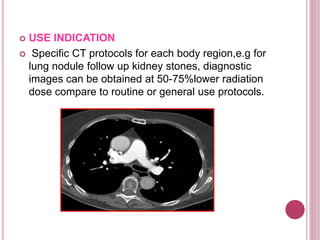
 USE INDICATION
 Specific CT protocols for each body region,e.g for
lung nodule follow up kidney stones, diagnostic
images can be obtained at 50-75%lower radiation
dose compare to routine or general use protocols.
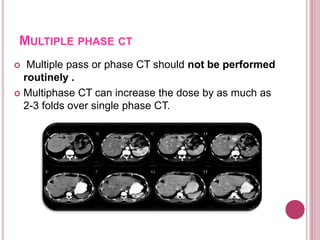
 Multiple pass or phase CT should not be performed
routinely .
 Multiphase CT can increase the dose by as much as
2-3 folds over single phase CT.
MULTIPLE PHASE CT
LARGE PATIENT SMALL PATIENT
Adjust exposure parameters according to patient
and body part .
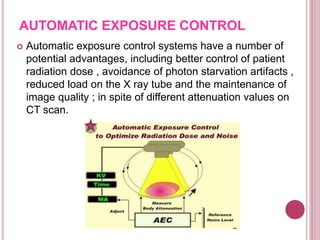
AUTOMATIC EXPOSURE CONTROL
 Automatic exposure control systems have a number of
potential advantages, including better control of patient
radiation dose , avoidance of photon starvation artifacts ,
reduced load on the X ray tube and the maintenance of
image quality ; in spite of different attenuation values on
CT scan.
MAJOR CT PARAMETERS AFFECTING DOSE
 Tube current (mA)
 Tube voltage (kV)
 Pitch
 Managing slice thickness
 Restricting the scan length
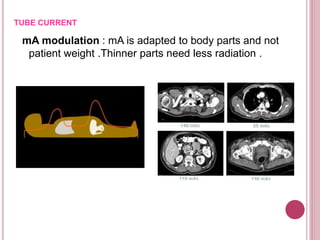
mA modulation : mA is adapted to body parts and not
patient weight .Thinner parts need less radiation .
TUBE CURRENT
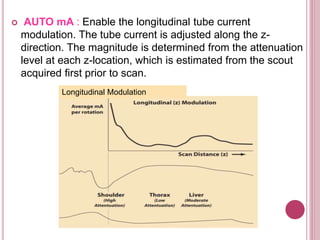
 AUTO mA : Enable the longitudinal tube current
modulation. The tube current is adjusted along the z-
direction. The magnitude is determined from the attenuation
level at each z-location, which is estimated from the scout
acquired first prior to scan.
Longitudinal Modulation
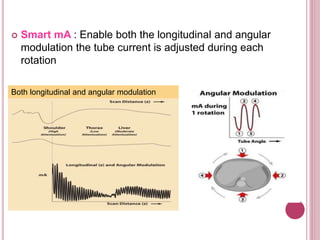
 Smart mA : Enable both the longitudinal and angular
modulation the tube current is adjusted during each
rotation
Both longitudinal and angular modulation
TUBE VOLTAGE KV
 Decreasing the tube voltage significantly reduces
the dose .
140KV- 2.3mSv
120KV-1.6mSv
100KV-1.0mSv
80KV-0.5mSv
KV = Radiation dose
PITCH
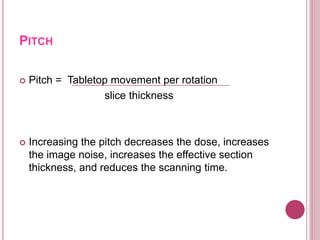
 Pitch = Tabletop movement per rotation
slice thickness
 Increasing the pitch decreases the dose, increases
the image noise, increases the effective section
thickness, and reduces the scanning time.
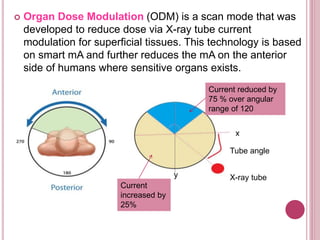
 Organ Dose Modulation (ODM) is a scan mode that was
developed to reduce dose via X-ray tube current
modulation for superficial tissues. This technology is based
on smart mA and further reduces the mA on the anterior
side of humans where sensitive organs exists.
Tube angle
X-ray tubey
x
Current reduced by
75 % over angular
range of 120
Current
increased by
25%
SHIELDING
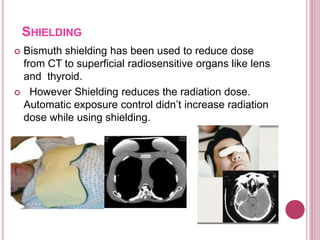
 Bismuth shielding has been used to reduce dose
from CT to superficial radiosensitive organs like lens
and thyroid.
 However Shielding reduces the radiation dose.
Automatic exposure control didn’t increase radiation
dose while using shielding.
SCAN LENGTH
 Scan length defines the exposed region of the
patient.
 Scan length is directly related to CT radiation dose.
 A shorter scan length means lower dose if all other
scan parameters and the anatomical region are
held constant: «The smaller the exposed area, the
smaller the dose».
Decreasing slice thickness (to improve detail)-small voxels more noise-
will require increased dose to reduce noise level.
Hence, thin slice should be requested only when necessary
LOW DOSE COMPUTED
TOMOGRAPHY
 Computed Tomography(CT) has become the reference
technique in medical imaging. But its main limitation is
the radiation dose.
 Improvement of technological factors relies mainly on
using
 Automatic tube current modulation
 Lowering the tube voltage
 Increasing the pitch
 Limiting the scan coverage
To minimize abdomen thickness strap band is used or
can patient can be examined in prone.
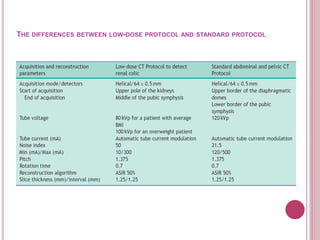
LOW-DOSE CT FOR RENAL COLIC:
 Especially as urinary stone diseases tends to relapse and
mainly affects young people.
 5 Rules of low-dose CT for suspected renal colic:
1) comply with the indications.
2) center and restrict the acquisition coverage area.
3) use automatic tube current modulation.
4) Lower tube current and tube voltage.
5) use iterative reconstructions.
THE DIFFERENCES BETWEEN LOW-DOSE PROTOCOL AND STANDARD PROTOCOL
PEDIATRIC CT DOSE REDUCTION
 Normally use shortest rotation time available.
 Only single-phase scans
 Use spiral scan with greater pitch
 Using of proper shielding
 Use newer dose reduction strategies such as iterative
reconstruction and adaptive modulation.
EFFECTS OF CT ADAPTATIONS ON DOSE
 50% decrease in mA = 50% dose reduction
 20%decreasing kvp = 30-50%dose reduction
 50% increase pitch = 50% dose reduction
 Thicker slices decreases dose.
 Thinner slices increases dose.
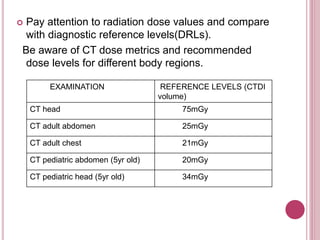
 Pay attention to radiation dose values and compare
with diagnostic reference levels(DRLs).
Be aware of CT dose metrics and recommended
dose levels for different body regions.
EXAMINATION REFERENCE LEVELS (CTDI
volume)
CT head 75mGy
CT adult abdomen 25mGy
CT adult chest 21mGy
CT pediatric abdomen (5yr old) 20mGy
CT pediatric head (5yr old) 34mGy
CONCLUSION
 CT has become the reference technique to diagnose
 Most important measure that implemented for dose
reduction in CT are :
 Use automatic tube current modulation and reduce
mA an kv.
 Images with some noise without loss of diagnosis.
 Adjusting exposure parameters.
 Organ dose modulation.
 Restricting scan length.
CT RADIATION DOSE REDUCTION

CT RADIATION DOSE REDUCTION

  • 1.
    RADIATION DOSE REDUCTIONIN COMPURIZED TOMOGRAPHY BY CH.Harisree BSc. Radiology-3rd Year Guided by Dr.I.Gurubharath. M.D., Ph.D., Sri Sathya Sai Medical College and Research Institute
  • 2.
    CONTENT Patient safety Images withnoise Automatic exposure control Major CT parameters Low Dose CT Conclusion
  • 3.
     Perform scanonly if indicated.  It should be understood that performing more than significant number of imaging examinations are unnecessary. So, consultation between the referring physician and radiologist is recommended.
  • 4.
     Encourage useof alternative Non-ionizing imaging (MRI, ULTRASOUND).  When appropriate especially in younger patients
  • 5.
     Always checkif patient may be pregnant.  Use special signs and informative materials notifying the patients , that they must inform the staff if there is a possibility of pregnancy. Please notify staff if you think you might be pregnant!
  • 6.
    IMAGES WITH SOMENOISE  High quality images may look nice, but they impart higher radiation dose to patients .So start using images with some noise without loss of diagnostic Information
  • 7.
     USE INDICATION Specific CT protocols for each body region,e.g for lung nodule follow up kidney stones, diagnostic images can be obtained at 50-75%lower radiation dose compare to routine or general use protocols.
  • 8.
     Multiple passor phase CT should not be performed routinely .  Multiphase CT can increase the dose by as much as 2-3 folds over single phase CT. MULTIPLE PHASE CT
  • 9.
    LARGE PATIENT SMALLPATIENT Adjust exposure parameters according to patient and body part .
  • 10.
    AUTOMATIC EXPOSURE CONTROL Automatic exposure control systems have a number of potential advantages, including better control of patient radiation dose , avoidance of photon starvation artifacts , reduced load on the X ray tube and the maintenance of image quality ; in spite of different attenuation values on CT scan.
  • 11.
    MAJOR CT PARAMETERSAFFECTING DOSE  Tube current (mA)  Tube voltage (kV)  Pitch  Managing slice thickness  Restricting the scan length
  • 12.
    mA modulation :mA is adapted to body parts and not patient weight .Thinner parts need less radiation . TUBE CURRENT
  • 13.
     AUTO mA: Enable the longitudinal tube current modulation. The tube current is adjusted along the z- direction. The magnitude is determined from the attenuation level at each z-location, which is estimated from the scout acquired first prior to scan. Longitudinal Modulation
  • 14.
     Smart mA: Enable both the longitudinal and angular modulation the tube current is adjusted during each rotation Both longitudinal and angular modulation
  • 15.
    TUBE VOLTAGE KV Decreasing the tube voltage significantly reduces the dose . 140KV- 2.3mSv 120KV-1.6mSv 100KV-1.0mSv 80KV-0.5mSv KV = Radiation dose
  • 16.
    PITCH  Pitch =Tabletop movement per rotation slice thickness  Increasing the pitch decreases the dose, increases the image noise, increases the effective section thickness, and reduces the scanning time.
  • 17.
     Organ DoseModulation (ODM) is a scan mode that was developed to reduce dose via X-ray tube current modulation for superficial tissues. This technology is based on smart mA and further reduces the mA on the anterior side of humans where sensitive organs exists. Tube angle X-ray tubey x Current reduced by 75 % over angular range of 120 Current increased by 25%
  • 18.
    SHIELDING  Bismuth shieldinghas been used to reduce dose from CT to superficial radiosensitive organs like lens and thyroid.  However Shielding reduces the radiation dose. Automatic exposure control didn’t increase radiation dose while using shielding.
  • 19.
    SCAN LENGTH  Scanlength defines the exposed region of the patient.  Scan length is directly related to CT radiation dose.  A shorter scan length means lower dose if all other scan parameters and the anatomical region are held constant: «The smaller the exposed area, the smaller the dose».
  • 20.
    Decreasing slice thickness(to improve detail)-small voxels more noise- will require increased dose to reduce noise level. Hence, thin slice should be requested only when necessary
  • 21.
    LOW DOSE COMPUTED TOMOGRAPHY Computed Tomography(CT) has become the reference technique in medical imaging. But its main limitation is the radiation dose.  Improvement of technological factors relies mainly on using  Automatic tube current modulation  Lowering the tube voltage  Increasing the pitch  Limiting the scan coverage To minimize abdomen thickness strap band is used or can patient can be examined in prone.
  • 22.
    LOW-DOSE CT FORRENAL COLIC:  Especially as urinary stone diseases tends to relapse and mainly affects young people.  5 Rules of low-dose CT for suspected renal colic: 1) comply with the indications. 2) center and restrict the acquisition coverage area. 3) use automatic tube current modulation. 4) Lower tube current and tube voltage. 5) use iterative reconstructions.
  • 23.
    THE DIFFERENCES BETWEENLOW-DOSE PROTOCOL AND STANDARD PROTOCOL
  • 24.
    PEDIATRIC CT DOSEREDUCTION  Normally use shortest rotation time available.  Only single-phase scans  Use spiral scan with greater pitch  Using of proper shielding  Use newer dose reduction strategies such as iterative reconstruction and adaptive modulation.
  • 25.
    EFFECTS OF CTADAPTATIONS ON DOSE  50% decrease in mA = 50% dose reduction  20%decreasing kvp = 30-50%dose reduction  50% increase pitch = 50% dose reduction  Thicker slices decreases dose.  Thinner slices increases dose.
  • 26.
     Pay attentionto radiation dose values and compare with diagnostic reference levels(DRLs). Be aware of CT dose metrics and recommended dose levels for different body regions. EXAMINATION REFERENCE LEVELS (CTDI volume) CT head 75mGy CT adult abdomen 25mGy CT adult chest 21mGy CT pediatric abdomen (5yr old) 20mGy CT pediatric head (5yr old) 34mGy
  • 27.
    CONCLUSION  CT hasbecome the reference technique to diagnose  Most important measure that implemented for dose reduction in CT are :  Use automatic tube current modulation and reduce mA an kv.  Images with some noise without loss of diagnosis.  Adjusting exposure parameters.  Organ dose modulation.  Restricting scan length.