Linear Accelerator Acceptance,
Commissioning and Annual QA

09/17/2008 – 11/14/2008
MENTORS: TIM WALDRON AND DR. JOE MODRICK
BY
VIBHA CHASWAL
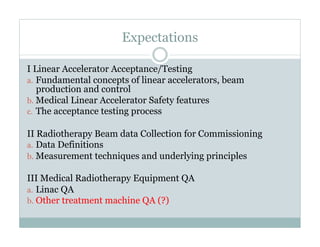
Expectations
I Linear Accelerator Acceptance/Testing
a.  Fundamental concepts of linear accelerators, beam
production and control
b.  Medical Linear Accelerator Safety features
c.  The acceptance testing process
II Radiotherapy Beam data Collection for Commissioning
a.  Data Definitions
b.  Measurement techniques and underlying principles
III Medical Radiotherapy Equipment QA
a.  Linac QA
b.  Other treatment machine QA (?)
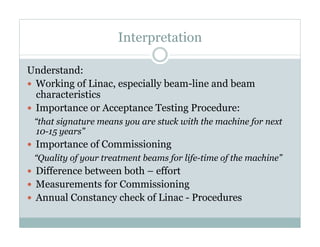
Interpretation
Understand:
  Working of Linac, especially beam-line and beam
characteristics
  Importance or Acceptance Testing Procedure:
“that signature means you are stuck with the machine for next
10-15 years”
  Importance of Commissioning

“Quality of your treatment beams for life-time of the machine”
  Difference between both – effort
  Measurements for Commissioning
  Annual Constancy check of Linac - Procedures


  Lectures
  Data measurements
  Annual QA
  Reading
  Reading
Linac Beam Line
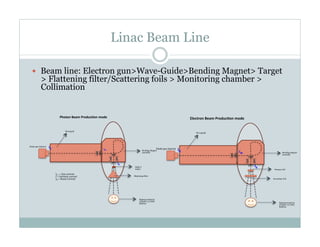
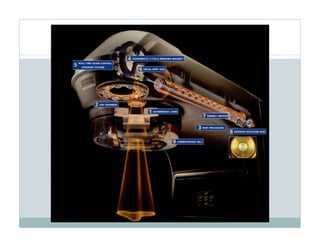
  Beam line: Electron gun>Wave-Guide>Bending Magnet> Target

> Flattening filter/Scattering foils > Monitoring chamber >
Collimation

Photon	
  Beam	
  Produc2on	
  mode	
  

Electron	
  Beam	
  Produc2on	
  mode	
  

Waveguid
e

Diode gun injector

IG	


Waveguide

IIN	


Diode gun injector

Bending Magnet
assembly

IB	
  	
  
IG = Gun current
I = Intrinsic current
IB = Beam Current

High Z
target

IG	


IIN	


Bending Magnet
assembly

IB	


Primary foil

Flattening filter
Secondary foil

Patient treated at
CEIGRT at UIHC
RadOnc

Patient treated at
CEIGRT at UIHC
RadOnc
Beam Characteristics
  Energy: RF, BMI, Gun current
  Fluence: Gun Current, RF
  Flatness: Flattening filter
  Symmetry: Flattening filter
Acceptance: Verifying Specifications
  AAPM TG – 45
  Procedure starts at Installation, or even before while

making purchase agreement
  Importance
  Order in which tests should be performed
  Relative importance of some tests
  Procedures of preliminary calibration, isocenter
verification, end effect measurement
  Seemingly un-important tasks/tests that are absolutely
essential – (Oh! The electron mold kit doesn’t have the
frame for 25x25 cone)
Commissioning
  Much more effort!
  How much effort? – what is the minimum amount of

data you would require to commission a beam for
your CLINIC REQUIREMENTS.
  Beam characteristics important for treatment types
performed most commonly.
  Data measured.
AND ………..ANNUAL QA
  Oncor D with Sarah
  AAPM TG-40
  Techniques for Acceptance Procedures and

Commissioning data measurements
- 3D water tank and Linear array for profiles and
PDDs
-  Gantry, Collimator and Table star-shots
-  Mechanicals

  End effect
  Virtual Source for 12 meV and 15 MeV electrons on

Oncor B


Thank
you !!

Linear Accelerator Acceptance, Commissioning and Annual QA

  • 1.
    Linear Accelerator Acceptance, Commissioningand Annual QA 09/17/2008 – 11/14/2008 MENTORS: TIM WALDRON AND DR. JOE MODRICK BY VIBHA CHASWAL
  • 2.
    Expectations I Linear AcceleratorAcceptance/Testing a.  Fundamental concepts of linear accelerators, beam production and control b.  Medical Linear Accelerator Safety features c.  The acceptance testing process II Radiotherapy Beam data Collection for Commissioning a.  Data Definitions b.  Measurement techniques and underlying principles III Medical Radiotherapy Equipment QA a.  Linac QA b.  Other treatment machine QA (?)
  • 3.
    Interpretation Understand:   Working ofLinac, especially beam-line and beam characteristics   Importance or Acceptance Testing Procedure: “that signature means you are stuck with the machine for next 10-15 years”   Importance of Commissioning “Quality of your treatment beams for life-time of the machine”   Difference between both – effort   Measurements for Commissioning   Annual Constancy check of Linac - Procedures
  • 4.
       Lectures   Datameasurements   Annual QA   Reading   Reading
  • 5.
    Linac Beam Line  Beam line: Electron gun>Wave-Guide>Bending Magnet> Target > Flattening filter/Scattering foils > Monitoring chamber > Collimation Photon  Beam  Produc2on  mode   Electron  Beam  Produc2on  mode   Waveguid e Diode gun injector IG     Waveguide IIN     Diode gun injector Bending Magnet assembly IB     IG = Gun current I = Intrinsic current IB = Beam Current High Z target IG     IIN     Bending Magnet assembly IB     Primary foil Flattening filter Secondary foil Patient treated at CEIGRT at UIHC RadOnc Patient treated at CEIGRT at UIHC RadOnc
  • 7.
    Beam Characteristics   Energy:RF, BMI, Gun current   Fluence: Gun Current, RF   Flatness: Flattening filter   Symmetry: Flattening filter
  • 8.
    Acceptance: Verifying Specifications  AAPM TG – 45   Procedure starts at Installation, or even before while making purchase agreement   Importance   Order in which tests should be performed   Relative importance of some tests   Procedures of preliminary calibration, isocenter verification, end effect measurement   Seemingly un-important tasks/tests that are absolutely essential – (Oh! The electron mold kit doesn’t have the frame for 25x25 cone)
  • 9.
    Commissioning   Much moreeffort!   How much effort? – what is the minimum amount of data you would require to commission a beam for your CLINIC REQUIREMENTS.   Beam characteristics important for treatment types performed most commonly.   Data measured.
  • 10.
    AND ………..ANNUAL QA  Oncor D with Sarah   AAPM TG-40   Techniques for Acceptance Procedures and Commissioning data measurements - 3D water tank and Linear array for profiles and PDDs -  Gantry, Collimator and Table star-shots -  Mechanicals
  • 11.
       End effect  Virtual Source for 12 meV and 15 MeV electrons on Oncor B
  • 12.