z
NEURO RADIOLOGY
Reference:
Neuroradiology signs
book
Contrast enhancement
Homogenous
- Meningioma
- Lymphoma
- Aneurysms
Heterogenous
Glioma
Metastases
Marginal
Abscess
Glioma
Serpiginous
AVM
No enhancement
Cysts
Calcifications
Subependymoma
Infiltrating glioma
z
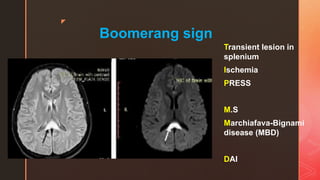
Boomerang sign
Transient lesion in
splenium
Ischemia
PRESS
M.S
Marchiafava-Bignami
disease (MBD)
DAI
z
7 sign (Lt side)
Aberrant ICA
z
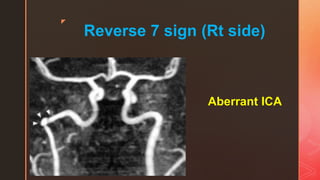
Reverse 7 sign (Rt side)
Aberrant ICA
z
Split pons sign
Horizontal gaze palsy with
progressive scoliosis (HGPPS)
z
Butterfly Medulla
Horizontal gaze palsy with progressive scoliosis
(HGPPS)
z
CADASIL
 Young adult.
 Bilateral anterior temporal and external capsule affection.
 Spares subcortical U fibers (unlike M.S)
z
SWI
 Magnitude Phase
z
Incomplete ring sign
 Demyelinating disease
 Lymphoma
z
Trident sign
 Osmotic demyelination
syndrome
z
BOXCAR VENTRICLES
 Huntington disease
 Other neurodegenerative disorders
z
Bright T2 basal ganglia
 Toxic poisoning
 Inflammation/infection
 Metabolic derangements
 Neurodegenerative disorders
 Vascular conditions
 Malignancy
z
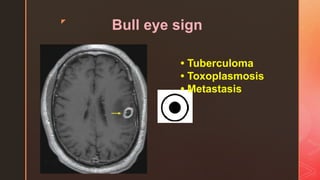
Bull eye sign
• Tuberculoma
• Toxoplasmosis
• Metastasis
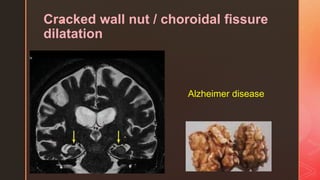
zCracked wall nut / choroidal fissure
dilatation
Alzheimer disease
z
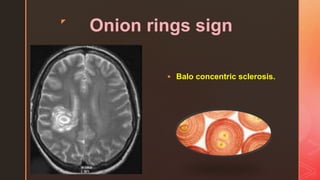
Onion rings sign
 Balo concentric sclerosis.
z
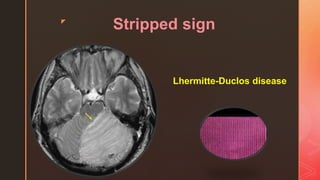
Stripped sign
Lhermitte-Duclos disease
z
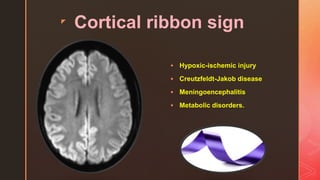
Cortical ribbon sign
 Hypoxic-ischemic injury
 Creutzfeldt-Jakob disease
 Meningoencephalitis
 Metabolic disorders.
z
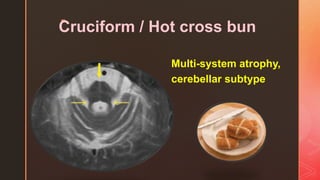
Cruciform / Hot cross bun
Multi-system atrophy,
cerebellar subtype
z
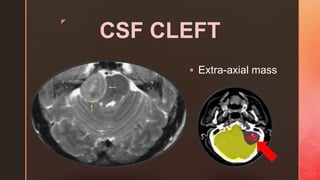
CSF CLEFT
 Extra-axial mass
zFLAIR SULCAL HYPERINTENSITY
 Subarachnoid hemorrhage
 Meningitis
 Leptomeningeal
carcinomatosis.
z
DIMPLE
Abscess
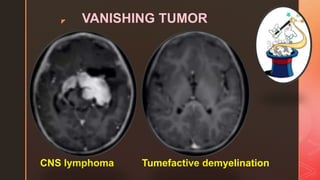
z VANISHING TUMOR
CNS lymphoma Tumefactive demyelination
z
DUCKY BREAST
Normal central sulcus
z DURAL/PACHYMENINGEAL
ENHANCEMENT
• Intracranial hypotension.
• Inflammation / infection.
• Malignancy.
• Idiopathic hypertrophic
pachymeningitis.
z
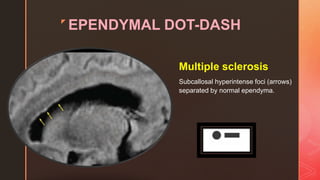
EPENDYMAL DOT-DASH
Multiple sclerosis
Subcallosal hyperintense foci (arrows)
separated by normal ependyma.
zARTERY OF PERCHERON INFARCT
Rare vascular variant, in which a single common trunk arises from one of the PCAs to
supply both thalami and the midbrain.
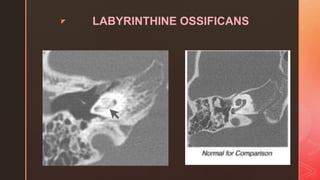
z LABYRINTHINE OSSIFICANS
z
Rabbit ear sign
Alexander disease
= Nodular enhancement of frontal PV rim.
N.B:- basal ganglia enhancement seen in image too.
z
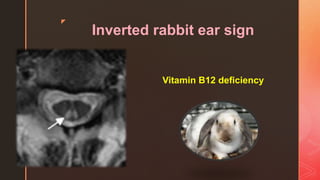
Inverted rabbit ear sign
Vitamin B12 deficiency
z
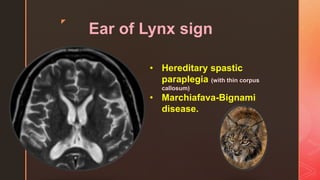
Ear of Lynx sign
• Hereditary spastic
paraplegia (with thin corpus
callosum)
• Marchiafava-Bignami
disease.
z
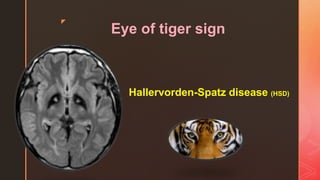
Eye of tiger sign
Hallervorden-Spatz disease (HSD)
z
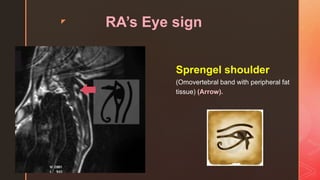
RA’s Eye sign
Sprengel shoulder
(Omovertebral band with peripheral fat
tissue) (Arrow).
z Owl’s eye sign
Cord infarction
Compressive myelopathy.
Cord contusion,
and various infectious or
inflammatory conditions
z
Snake eye sign= Owl’s eye sign
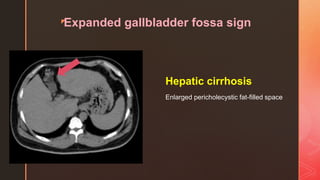
zExpanded gallbladder fossa sign
Hepatic cirrhosis
Enlarged pericholecystic fat-filled space
z
Puff of Smoke
Moya- Moya
Disease
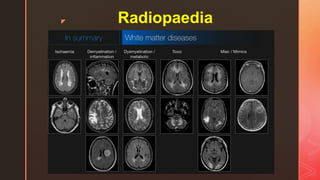
z Radiopaedia
z
• Bubbly T2 lesion
• Cortical
• Convulsions.
• Characteristic:- Bright
FLAIR rim.
DNET
Dysembryoplastic
neuroepithelial tumors
• Bubbly T2 lesion
• Subcortical.
• Headache.
MVNT
Multinodular and
vacuolating neuronal
tumor
z
• Young age.
• Temporal lobe
affected.
CADASIL
Cerebral AD arteriopathy with
subcortical infarctions and
leukoencephalopathy.
• Old age
• Temporal lobe
NOT affected.
SAE
Subcortical arteriosclerotic
encephalopathy
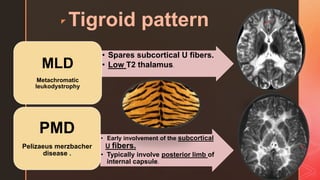
z Tigroid pattern
• Spares subcortical U fibers.
• Low T2 thalamus.MLD
Metachromatic
leukodystrophy
• Early involvement of the subcortical
U fibers.
• Typically involve posterior limb of
internal capsule.
PMD
Pelizaeus merzbacher
disease .
z
Reverse Tigroid pattern
Pachygyria
Frontal cortical thickening (double arrow)
z
Swiss cheese brain
Dilated Virchow-Robin spaces
Mucopolysaccharidosis
M.S
Lacunar infarcts-
z Tigroid pattern
 Dark stripes (spared perivascular white matter) within bright
demyelinated periventricular WM on T2 images.
z
Bat wing configuration of Sylvain fissure
Glutaric aciduria type I
(BG high T2 signal / restricted diffusion).
z
• Age:< 2 years
• Sites:-
• Periaqueductal,
brain stem and BG.Leigh’s
disease
• Older than Leigh’s.
• Sites:-
Periaqueductal,
brain stem and
mammillary body.
• Enhancement.
• Hemorrhage.
Wernicke’s
encephalopathy
z
Metabolic WM diseases
z
Wallerian
degeneration
Atrophy
along the
cortico-
spinal tract
through the
posterior
limb of the
internal
capsule into
the left
cerebral
peduncle
and pons.
z
Wallerian degeneration
 Definition:- Axonal loss ….
 Causes:-
 Infarction .
 Trauma.
 ….
 ……
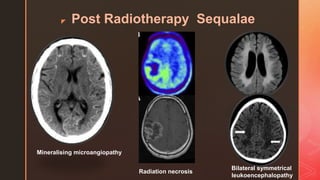
z Post Radiotherapy Sequalae
Mineralising microangiopathy
Bilateral symmetrical
leukoencephalopathy
Radiation necrosis
zCerebral vascular malformations
**With shunting
AVM Dural AVF Proliferative
angiopathy
Vein of
Galen
zCerebral vascular malformations
**Without shunting
Capillary
telangectasia
Cavernous
haemangioma
Sinus
pericanii
DVA
z1- Regional / Diffuse white matter
changes
{Bilateral symmetrical}
Dysmyelination. (Children)
HIV encephalopathy.
RTH / CTH
z
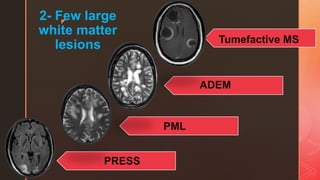
2- Few large
white matter
lesions Tumefactive MS
ADEM
PML
PRESS
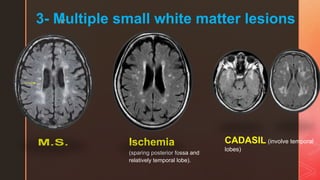
z3- Multiple small white matter lesions
Ischemia
(sparing posterior fossa and
relatively temporal lobe).
CADASIL (involve temporal
lobes)
z
Viral encephalitis.
Both GM and WM affection.
Neurosarcoidosis.
Multiple enhancing lesions
Multiple small white matter lesions
zMultiple small white matter lesions
Vasculitis (SLE and PAN )
Normal MRAThe presence of microbleeds may help the diagnosis
(tiny hypointense dot / red arrow).
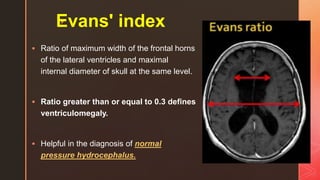
zEvans' index
 Ratio of maximum width of the frontal horns
of the lateral ventricles and maximal
internal diameter of skull at the same level.
 Ratio greater than or equal to 0.3 defines
ventriculomegaly.
 Helpful in the diagnosis of normal
pressure hydrocephalus.
z Hydrocephalus
Temporal horns > 2mm.Ballooning of frontal horns and third ventricle
(Mickey mouse ears sign)
z
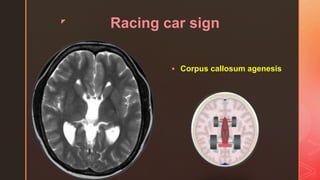
Racing car sign
 Corpus callosum agenesis
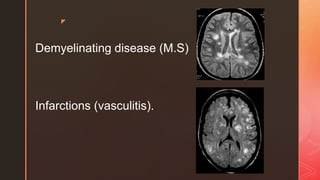
zMultifocal hyperintense T2/FLAIR
lesions
 Neoplasm (metastasis, lymphoma),
 Infection (abscess, septic emboli),
 Trauma (diffuse axonal injury)
z
Demyelinating disease (M.S)
Infarctions (vasculitis).
zPeripheral lesions at GM / WM
interface = Systemic origin lesions.
Gm/Wm junction -------- Regions of high blood flow
Septic emboli Metastasis
z
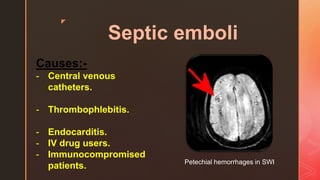
Causes:-
- Central venous
catheters.
- Thrombophlebitis.
- Endocarditis.
- IV drug users.
- Immunocompromised
patients. Petechial hemorrhages in SWI
Septic emboli
z
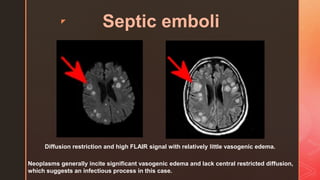
Septic emboli
Diffusion restriction and high FLAIR signal with relatively little vasogenic edema.
Neoplasms generally incite significant vasogenic edema and lack central restricted diffusion,
which suggests an infectious process in this case.
z
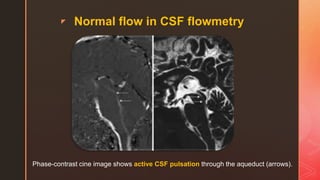
Phase-contrast cine image shows active CSF pulsation through the aqueduct (arrows).
Normal flow in CSF flowmetry
z
Aqueductal stenosis.
Phase contrast images shows no flow at the aqueduct of Sylvius
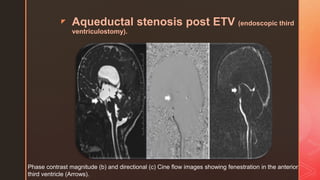
z Aqueductal stenosis post ETV (endoscopic third
ventriculostomy).
Phase contrast magnitude (b) and directional (c) Cine flow images showing fenestration in the anterior
third ventricle (Arrows).
z
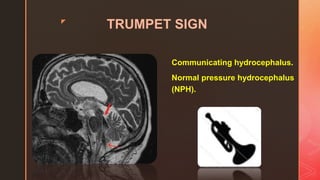
TRUMPET SIGN
Communicating hydrocephalus.
Normal pressure hydrocephalus
(NPH).
z Fronto-temporal dementia
Frontal lobe atrophy…. Behavioral changes.
Temporal lobe atrophy….. Language affection.
z
Alzheimer
 Parietotemporal??/?
 Look in sagittal for parietal lobe atrophy.
z
Hyperparathyroidism
Bilateral BG calcifications.
Salt and pepper skull.
Dural calcifications.
‘’ Pipe stem’’ calcifications of the carotid arteries (young patient).
z
Petro-occipital synchondrosis (Arrow heads)
The most common site of origin for chondrosarcoma of
the skull base.
z
z MSUD
Sites:-
o Peri-rolandic cerebral white matter
o Corticospinal tracts.
o Posterior limb of the internal
capsule, thalami, globe pallidi,
o Dorsal brainstem.
o Cerebral peduncles.
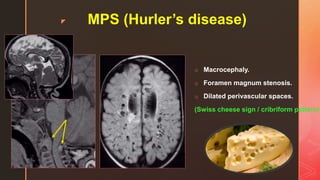
z MPS (Hurler’s disease)
o Macrocephaly.
o Foramen magnum stenosis.
o Dilated perivascular spaces.
(Swiss cheese sign / cribriform pattern)
z
Normal myelination at birth
Normally in newborn babies, there are
areas of high T1 and low T2 signal
located at :-
o The posterior half of the posterior
limb of the internal capsule
(pyramidal tract)
o The ventral posterolateral nucleus of
the thalamus.
z Hypoxic ischemic encephalopathy
Loss of the normal low T2 signal in PLIC
(Blue arrows)
Atrophy of the brain occurred after one
month.
z
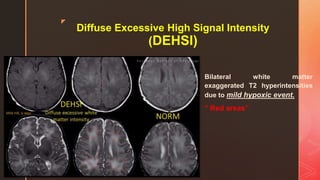
Diffuse Excessive High Signal Intensity
(DEHSI)
Bilateral white matter
exaggerated T2 hyperintensities
due to mild hypoxic event.
’’ Red areas’’
z
BESS
o Normal in 2-7 months of age due
discrepancy in size between
skull and brain.
o Rapid head growth or frank
macrocrania.
o Neurologically normal.
Bridging veins ‘’ arrows’’
z
Differential diagnosis
SDH BESS
z
z
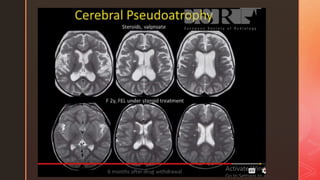
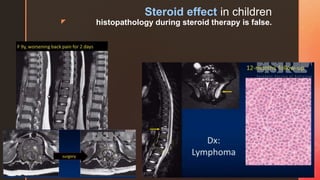
Steroid effect in children
histopathology during steroid therapy is false.
z
z
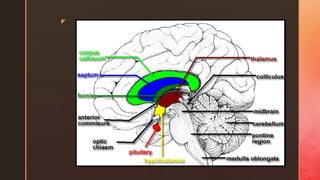
Sagittal midline
AC Anterior commissure.
MI Mass intermedia of
thalamus
OC Optic chiasm
MB Mammillary body.
z
Normal 3rd vent
= Anteater sign.
z
Dilated 3rd ventricle
= Snoopy sign
Aqueductal web
= Snoopy collar
z FU after ETV  snoopy decrease in size
z
z
Embryonal Tumors of the CNS in pediatrics
Medulloblastoma
Most common CNS
embryonal
Tumor.
AT/RT (Atypical
teratoid rhabdoid tumor)
- Less common.
- Young (< 4y)
- Aggressive tumor ( Hge,
or cystic/necrotic
changes), Internal
calcifications.
CNS PNET /
embryonal tumor with
multilayered rosettes
(ETMR).
- Less common.
- Young (< 4y)
- Aggressive tumor
z
Embryonal Tumors of the CNS in pediatrics
Medulloblastoma
Most common CNS
embryonal
Tumor.
AT/RT (Atypical
teratoid rhabdoid tumor)
- Less common.
- Young (< 4y)
- Aggressive tumor ( Hge,
or cystic/necrotic
changes), Internal
calcifications.
CNS PNET /
embryonal tumor with
multilayered rosettes
(ETMR).
- Less common.
- Young (< 4y)
- Aggressive tumor

Neuro signs