• Line between the
center of the femoral
head and the center of
the knee joint (between
both femoral condyles).
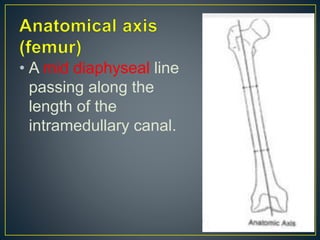
• A mid diaphyseal line
passing along the
length of the
intramedullary canal.
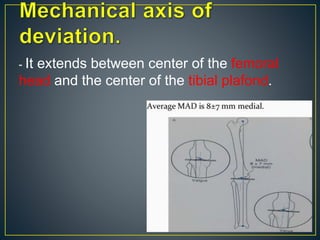
- It extends between center of the femoral
head and the center of the tibial plafond.
- Lines represent the
orientation of the joint in
certain plane.
- Knee Joint
- Along the subchondral line of
the tibial plateau.
- Line tangential to the most
distal point of the femoral
condyles.
Normally joint lines are parallel within 2
degrees.
Angles greater than 2 degrees are
considered as a source of mechanical axis
deviation (MAD).
-Angle between:
-Line along the
mechanical axis of the
femur and line along
the distal point of the
femoral condyles
- Normal range is 85-
90 degrees.
-Angle between:
-Line along the
mechanical axis of
the tibia and line
along the tibial
plateau.
- Normal range is
85- 90 degrees.
In cases of deformity:-
- Angle between the distal tibial mechanical axis and
line along the tibial plafond.
- If one side is normal then it is used as a template
for the deformed site.
- If both are deformed then consider normal angles.
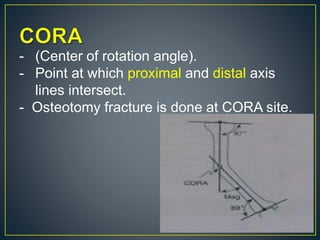
- (Center of rotation angle).
- Point at which proximal and distal axis
lines intersect.
- Osteotomy fracture is done at CORA site.
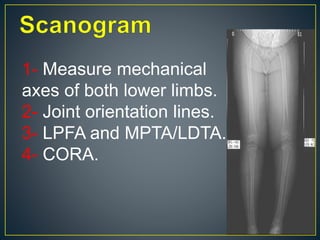
1- Measure mechanical
axes of both lower limbs.
2- Joint orientation lines.
3- LPFA and MPTA/LDTA.
4- CORA.
•THANK YOU

Deformity correction

  • 2.
    • Line betweenthe center of the femoral head and the center of the knee joint (between both femoral condyles).
  • 3.
    • A middiaphyseal line passing along the length of the intramedullary canal.
  • 4.
    - It extendsbetween center of the femoral head and the center of the tibial plafond.
  • 6.
    - Lines representthe orientation of the joint in certain plane. - Knee Joint - Along the subchondral line of the tibial plateau. - Line tangential to the most distal point of the femoral condyles.
  • 7.
    Normally joint linesare parallel within 2 degrees. Angles greater than 2 degrees are considered as a source of mechanical axis deviation (MAD).
  • 8.
    -Angle between: -Line alongthe mechanical axis of the femur and line along the distal point of the femoral condyles - Normal range is 85- 90 degrees.
  • 9.
    -Angle between: -Line alongthe mechanical axis of the tibia and line along the tibial plateau. - Normal range is 85- 90 degrees.
  • 11.
    In cases ofdeformity:- - Angle between the distal tibial mechanical axis and line along the tibial plafond. - If one side is normal then it is used as a template for the deformed site. - If both are deformed then consider normal angles.
  • 12.
    - (Center ofrotation angle). - Point at which proximal and distal axis lines intersect. - Osteotomy fracture is done at CORA site.
  • 14.
    1- Measure mechanical axesof both lower limbs. 2- Joint orientation lines. 3- LPFA and MPTA/LDTA. 4- CORA.
  • 16.