Vascular signs
Dr. Dalia El Saied, MD
Child with neurofibromatosis / hypertension
causes
NF 1 ---- RAS.
NF 2 ---- usually associated with pheochromcytoma.
Internal carotid angiography
AP LA
T
Vertebrobasilar angiogrpahy
Mesenteric angiography
SMA branches
IMA branches
String of beads sign = FMD
Paget Schroetter syndrome
(effort thrombosis of SCV/ thoracic outlet $/ arm swelling)
Median arcuate ligament syndrome
Hairpin curve sign
Mid-aortic syndrome
 Child.
 RAS (at ostium of renal a)
 Vascular hypertension.
 Mid aortic stenosis.
= Neurofibromatosis
type1.
Nutcracker syndrome
Compression of the left renal vein between the (SMA) - Congested left gonadal vein.
SMA syndrome …Compression of third part of duodenum by SMA.
May Thurner syndrome
Compression of the left common iliac vein by the right common iliac artery
Selective gonadal venography.
Venography……. caliber increased as we go distal.
Arteriography…. caliber decreased as we go distal.
Testicular varicocele embolization
Materials used
• Coils (solid) / this case.
• PVA (particles).
Embolizing materials
Temporary … Gel foam …… e.g: GIT bleeding
Permanent …
 PVA (particles).
 Onyx (liquid).
 Coils (solid).
7 sign (Lt ICA)
reverse 7 sign (if on the Rt side)
Aberrant ICA
Adventitial cystic disease
- Affects the peripheral vessels.
- Often in the femoral region.
- It causes extrinsic compression :-
- Of the artery:- claudication and
pain.
- Of the vein (rare):- leads to
swelling of the lower limb.
Adventitial cystic disease
Cyst is encasing the vessel (femoral vein).
Scimitar sign
Adventitial cystic disease
Lateral displacement and stenosis of the popliteal
artery in conventional , CT or MR angiography.
Adventitial cystic disease
Cysts are believed to be due to
repetitive microtrauma or ganglions
especially that they are sometimes
connected with the joint space.
Classic site:- popliteal artery.
D.D:- Popliteal entrapment syndrome.
Flow-related aneurysm
Flow related aneurysm
** Proximal flow Related aneurysm
- Located on the vessel or branch points of the
circle of Willis or proximal to it (i.e. ICA, ACA, PPCA,
A1 or P1, VA or BA)
** Distal flow related aneurysm
- More distal locations beyond the circle of Willis.
Proximal Flow related aneurysm
Distal Flow related aneurysm
Intranidal aneurysm
Non flow related aneurysm
Vascular malformations
AVM
(Nidus of vessels
through which
arteriovenous
shunting occurs).
AVF
(An abnormal
connection between
an adjacent artery
and vein).
VOG
(Median
prosencephalic
arteriovenous
fistula)
High Flow
Low flow
Venous
malformation
/cavernoma.
Capillary
telangectasia
(Cluster of
enlarged
capillaries with
interposed
parenchyma)
DVA Sinus
pericarnii
(Communication
between dural sinuses
and extracranial
venous structures)
Vein of Gallen malformation
Median prosencephalic vein (MPV) (a precursor of the vein of Galen)
The MPV fails to regress and becomes aneurysmally dilated. It drains via the straight sinus or
a persistent falcine sinus, and the vein of Galen does not form.
Diffuse nidus type AVM (Old name)
Cerebral proliferative angiopathy
Large areas of parenchymal
involvement, (entire lobe or even a
hemisphere)
** The characteristic features :
Normal feeder size (or moderately
enlarged).
Fuzzy nidus (not well circumscribed).
Lack of dominant feeder
Stenosis of feeder arteries is often present
Scattered “puddling” of contrast material in the widespread
nidus
No dominant arterial feeder identified.
Absence of early venous drainage.
( which helps to differentiate CPA from a classical cerebral AVM).
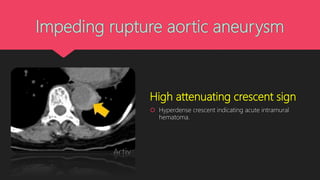
Impeding rupture aortic aneurysm
High attenuating crescent sign
 Hyperdense crescent indicating acute intramural
hematoma.
Tangential calcium sign
Calcium is pointing out away (Arrow)
Draped aorta sign
 Indistinct posterior aortic wall.
 the posterior aorta follows the spinal contour
on one or both sides.
Aortic aneurysm rupture
Aortoduodenal fistula
Intravenous contrast in the intestinal
lumen.
EVAR (endovascular aneurysm repair)
Complications:-
 Perigraft infection.
 Limb thrombosis
 Stent migration.
 Endoleak
Stent graft complications
Perigraft infection. Limb thrombosis. Graft migration. Endoleak.
Type I Endoleak
Located proximal (Black arrow) or distal to the
stent-graft.
Flow of blood into the aneurysm sac through branch vessels such as lumbar arteries or a patent inferior
mesenteric artery
Type II Endoleak (the most common)
Tear in the body of the stent-graft.
Type III Endoleak
Too many pores in the graft / diffuse
endoleak.
Type IV Endoleak

Intervention signs