Dr. Anoop.K.R
Dept of General Medicine
 Generalized term including disorders of any
cause affecting PNS
 May involve sensory nerves, motor nerves, or
both
 May affect one nerve (mononeuropathy),
several nerves together (polyneuropathy) or
several nerves not contiguous
(Mononeuropathy multiplex)
 Further classified into those that primarily
affect the cell body (e.g., neuronopathy or
ganglionopathy), myelin (myelinopathy), and
the axon (axonopathy)
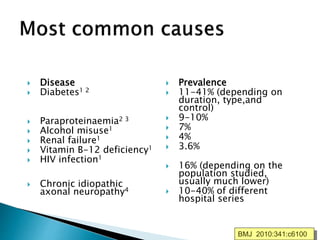
 Disease
 Diabetes1 2
 Paraproteinaemia2 3
 Alcohol misuse1
 Renal failure1
 Vitamin B-12 deficiency1
 HIV infection1
 Chronic idiopathic
axonal neuropathy4
 Prevalence
 11-41% (depending on
duration, type,and
control)
 9-10%
 7%
 4%
 3.6%
 16% (depending on the
population studied,
usually much lower)
 10-40% of different
hospital series
BMJ 2010:341:c6100
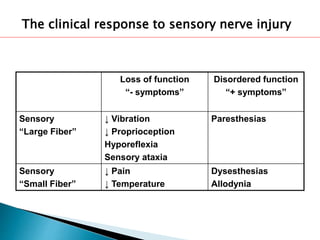
Loss of function
“- symptoms”
Disordered function
“+ symptoms”
Sensory
“Large Fiber”
↓ Vibration
↓ Proprioception
Hyporeflexia
Sensory ataxia
Paresthesias
Sensory
“Small Fiber”
↓ Pain
↓ Temperature
Dysesthesias
Allodynia
The clinical response to sensory nerve injury
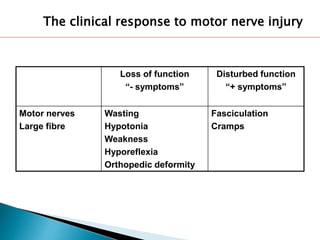
Loss of function
“- symptoms”
Disturbed function
“+ symptoms”
Motor nerves
Large fibre
Wasting
Hypotonia
Weakness
Hyporeflexia
Orthopedic deformity
Fasciculation
Cramps
The clinical response to motor nerve injury
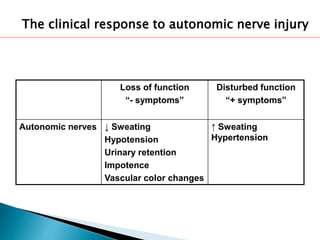
Loss of function
“- symptoms”
Disturbed function
“+ symptoms”
Autonomic nerves ↓ Sweating
Hypotension
Urinary retention
Impotence
Vascular color changes
↑ Sweating
Hypertension
The clinical response to autonomic nerve injury
 By far the majority of the toxic, metabolic and
endocrine causes
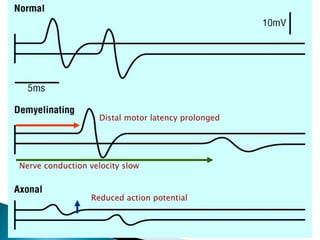
 NCVs: CMAPs ↓ 80% lower limit of normal w/o or
min velocity or distal motor latency change.
 Legs>> arms.
 EMG: Signs of denervation (acute, chronic) and
reinnervation
 Unusual by comparison with axonopathies
 Clues: hypertrophic nerves on exam
global arreflexia
weakness without wasting
motor >> sensory deficits
NCS can discriminate inherited from
acquired
 NCS: Distal motor latency prolonged (>125%
ULN)
Conduction velocities slowed (<80% LLN)
May have conduction block
EMG: Reduced recruitment w/o much
denervation
 SJOGREN’S SYNDROME
 VIT B12 NEUROPATHY
 CISPLATIN
 PYRIDOXINE NEUROTOXICITY
 FRIEDEREICH’S ATAXIA
PAIN-
burning,shock
like,stabbing,pric
kling,shooting,la
ncinating
Allodynia
Decreased
pinprick
sensation
Tight band like
pressure
Insensitive to
heat and cold
Diminished
temperature
sensation
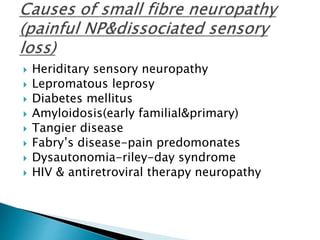
 Heriditary sensory neuropathy
 Lepromatous leprosy
 Diabetes mellitus
 Amyloidosis(early familial&primary)
 Tangier disease
 Fabry’s disease-pain predomonates
 Dysautonomia-riley-day syndrome
 HIV & antiretroviral therapy neuropathy
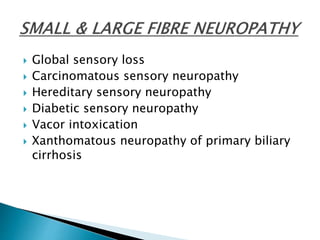
 Global sensory loss
 Carcinomatous sensory neuropathy
 Hereditary sensory neuropathy
 Diabetic sensory neuropathy
 Vacor intoxication
 Xanthomatous neuropathy of primary biliary
cirrhosis
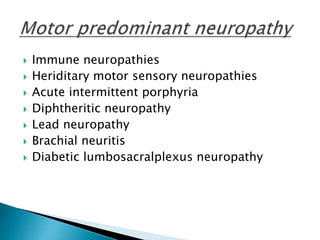
 Immune neuropathies
 Heriditary motor sensory neuropathies
 Acute intermittent porphyria
 Diphtheritic neuropathy
 Lead neuropathy
 Brachial neuritis
 Diabetic lumbosacralplexus neuropathy
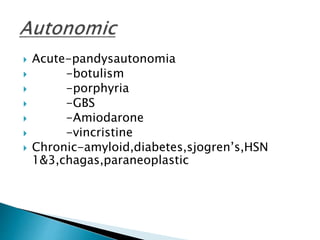
 Acute-pandysautonomia
 -botulism
 -porphyria
 -GBS
 -Amiodarone
 -vincristine
 Chronic-amyloid,diabetes,sjogren’s,HSN
1&3,chagas,paraneoplastic
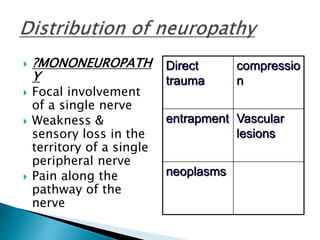
 ?MONONEUROPATH
Y
 Focal involvement
of a single nerve
 Weakness &
sensory loss in the
territory of a single
peripheral nerve
 Pain along the
pathway of the
nerve
Direct
trauma
compressio
n
entrapment Vascular
lesions
neoplasms
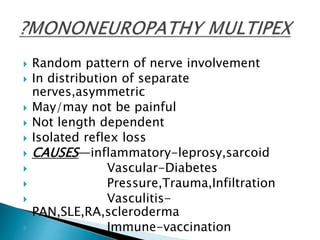
 Random pattern of nerve involvement
 In distribution of separate
nerves,asymmetric
 May/may not be painful
 Not length dependent
 Isolated reflex loss
 CAUSES—inflammatory-leprosy,sarcoid
 Vascular-Diabetes
 Pressure,Trauma,Infiltration
 Vasculitis-
PAN,SLE,RA,scleroderma
 Immune-vaccination
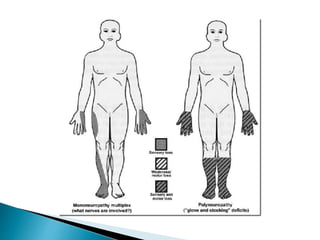
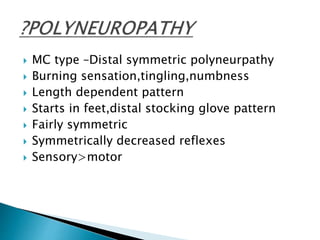
 MC type –Distal symmetric polyneurpathy
 Burning sensation,tingling,numbness
 Length dependent pattern
 Starts in feet,distal stocking glove pattern
 Fairly symmetric
 Symmetrically decreased reflexes
 Sensory>motor
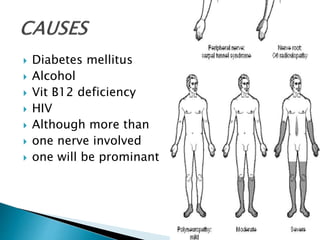
 Diabetes mellitus
 Alcohol
 Vit B12 deficiency
 HIV
 Although more than
 one nerve involved
 one will be prominant
 Lumbosacral polyradiculopathy/stenosis
 Myelopathy-structural
 -nonstructural
 Vascular insufficiency-exercise related
cramps,aching pain>numbness
 Orthopedics –stress #,plantar fascitis
 ?POLYRADICULOPATHY
 Disease of multiple peripheral nerve roots
 Asymmetric with erratic distribution-proximal in
one,distal in another
 Pain is a common feature
 ?MONORADICULOPATHY
 Root disease by disease of spinal column
 Changes in distribution of spinal nerve root
 ?SENSORY NEURONOPATHY
 Ganglion cells predominantly affected
 Both proximal & distal involvement
 Sensory ataxia is common
 No weakness
 But awkward movement d/t sensory disturbances
 ?MOTOR NEURONOPATHY
 Disorder of ant horn cells
 Weakness,fasciculation,atrophy
 Not properly a process of peripheral NP
 ?PLEXOPATHY
 Asymmetric
 Painful onset
 Multiple nerves in a single limb
 Rapid onset of weakness,atrophy
 Isolated reflex loss
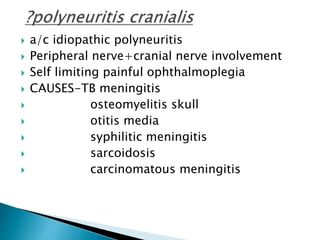
 a/c idiopathic polyneuritis
 Peripheral nerve+cranial nerve involvement
 Self limiting painful ophthalmoplegia
 CAUSES-TB meningitis
 osteomyelitis skull
 otitis media
 syphilitic meningitis
 sarcoidosis
 carcinomatous meningitis
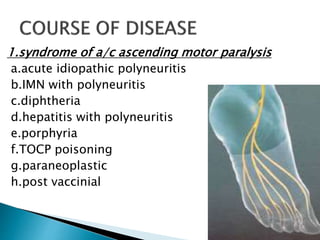
1.syndrome of a/c ascending motor paralysis
a.acute idiopathic polyneuritis
b.IMN with polyneuritis
c.diphtheria
d.hepatitis with polyneuritis
e.porphyria
f.TOCP poisoning
g.paraneoplastic
h.post vaccinial
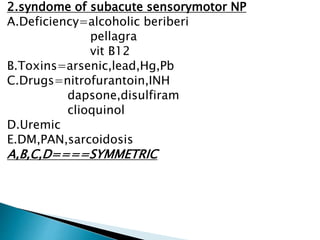
2.syndome of subacute sensorymotor NP
A.Deficiency=alcoholic beriberi
pellagra
vit B12
B.Toxins=arsenic,lead,Hg,Pb
C.Drugs=nitrofurantoin,INH
dapsone,disulfiram
clioquinol
D.Uremic
E.DM,PAN,sarcoidosis
A,B,C,D====SYMMETRIC
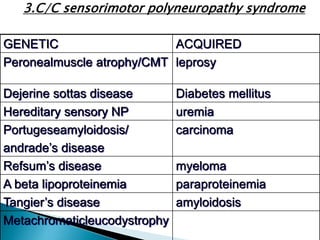
3.C/C sensorimotor polyneuropathy syndrome
GENETIC ACQUIRED
Peronealmuscle atrophy/CMT leprosy
Dejerine sottas disease Diabetes mellitus
Hereditary sensory NP uremia
Portugeseamyloidosis/
andrade’s disease
carcinoma
Refsum’s disease myeloma
A beta lipoproteinemia paraproteinemia
Tangier’s disease amyloidosis
Metachromaticleucodystrophy
 RECURRENT POLYNEUROPATHY
 Relapsing CIDP
 Porphyria
 Refsum’s disease
 HNPP
 GBS
 Beriberi
 Toxic neuropathy
 SENSORY ATAXIC NEUROPATHY
 Sensory NP(polyganglionopathy)
 Paraneoplastic sensory NP=sjogren’s
 =idiopathic
 Toxic=cisplatin
 =vit B6 excess
 Demyelinating polyradiculopathy=MGUS
 =Millerfisher
 DM
 hypothyroidism
 chronic renal failure
 liver disease
 intestinal
malabsorption
 malignancy
 connective tissue
diseases
 [HIV]
 drug use
 Vitamin B6 toxicity
 alcohol and dietary
habits
•Weight loss, malaise, and anorexia.
 Diabetes and Pre-Diabetes
 Alcohol neuropathy
 Chemotherapy
◦ Platinum-based
 Paraproteinemia
 Vasculitis and Connective Tissue Diseases
 Heavy metals and other toxins
 HIV
 Amyloidosis
 Porphyria
 Axonal
Vincristine
Paclitaxel
Nitrous oxide
Colchicine Probenecid
Isoniazid
Hydralazine
Metronidazole
Pyridoxine
Didanosine
Lithium
Alfa interferon
Dapsone
 Axonal - continued..
Phenytoin
Cimetidine
Disulfiram
Chloroquine
Ethambutol
Amitriptyline
 Demyelinating
Amiodarone
Chloroquine
Suramin
Gold
 Neuronopathy
Thalidomide
Cisplatin
Pyridoxine
 ETIOLOGICAL CLASSIFICATION
 1.metabolic-DM,amyloidosis,porphyria
 2.infections-leprosy,HIV,CMV,syphilis,
 diphtheria,lymedisease
 3.immune- GBS,CIDN,MMN
 4.hereditary-CMT
 5.Toxic-drugs,alcohol,heavymetals
 6.vasculitis-PAN,CSS,cryoglobulinemia
 7.paraneoplastic-lung
 8.nutritional- B1,B6,B12
◦ Guillain-Barré syndrome
◦ Chronic inflammatory demyelinating
polyradiculoneuropathy
◦ Diabetes mellitus
◦ Porphyria
◦ Osteosclerotic myeloma
◦ Waldenstrom's macroglobulinemia
◦ Monoclonal gammopathy of undetermined significance
◦ Acute arsenic polyneuropathy
◦ Lymphoma
◦ Diphtheria
◦ HIV/AIDS
◦ Lyme disease
◦ Hypothyroidism
◦ Vincristine (Oncovin, Vincosar PFS) toxicity
 The temporal course of a neuropathy varies,
based on the etiology.
◦ With trauma or ischemic infarction, the onset will
be acute, with the most severe symptoms at
onset.
◦ Inflammatory and some metabolic neuropathies
have a subacute course extending over days to
weeks.
◦ A chronic course over weeks to months is the
hallmark of most toxic and metabolic
neuropathies.
 A chronic, slowly progressive neuropathy over
many years occurs with most hereditary
neuropathies or with chronic inflammatory
demyelinating polyradiculoneuropathy (CIDP).
 Neuropathies with a relapsing and remitting
course include CIDP, acute porphyria,
Refsum's disease, hereditary neuropathy with
liability to pressure palsies (HNPP), familial
brachial plexus neuropathy, and repeated
episodes of toxin exposure.
 Ischemic neuropathies often have pain as a
prominent feature.
 Small-fiber neuropathies often present with
burning pain, lightning-like or lancinating
pain, aching, or uncomfortable paresthesias
(dysesthesias).
 Dying-back (distal symmetric axonal)
neuropathies initially involve the tips of the
toes and progress proximally in a stocking-
glove distribution.
 Peripheral neuropathy can present as restless
leg syndrome.
 Proximal involvement may result in difficulty
climbing stairs, getting out of a chair, lifting
and bulbar involvement can also be seen
 The clinical assessment should include:
◦ careful past medical history, looking for systemic
diseases that can be associated with neuropathy,
such as diabetes or hypothyroidism.
 All patients should be questioned regarding
◦ HIV risk factors
◦ diet (nutrition)
◦ vitamin use (especially B6)
◦ possibility of a tick bite (Lyme disease)
◦ Constitutional symtoms (malignancy)
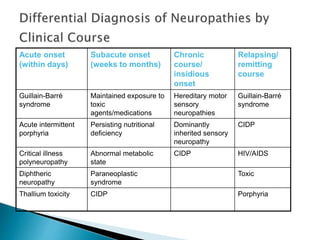
Acute onset
(within days)
Subacute onset
(weeks to months)
Chronic
course/
insidious
onset
Relapsing/
remitting
course
Guillain-Barré
syndrome
Maintained exposure to
toxic
agents/medications
Hereditary motor
sensory
neuropathies
Guillain-Barré
syndrome
Acute intermittent
porphyria
Persisting nutritional
deficiency
Dominantly
inherited sensory
neuropathy
CIDP
Critical illness
polyneuropathy
Abnormal metabolic
state
CIDP HIV/AIDS
Diphtheric
neuropathy
Paraneoplastic
syndrome
Toxic
Thallium toxicity CIDP Porphyria
 A cranial nerve examination can provide
evidence of mononeuropathies.
 Funduscopic examination may show
abnormalities such as optic pallor, which can
be present in leukodystrophies and vitamin
B12 deficiency.
 Thickened nerves
 Cardiovagal
◦ Heart rate variability
 Adrenergic
◦ Valsalva maneuver
 Induces BP changes and monitors pulse reaction
 Postganglionic sudomotor function
◦ QSART
 Screening laboratory tests may be
considered for all patients with DSP (Level
C).
 Tests with the highest yield of abnormality:
1. blood glucose (fasting)
2. serum B12 with metabolites
(methylmalonic acid, homocysteine)
3. SPEP(serum protein electrophoresis)
(Level C).
 ANA, RF, Anti-dsDNA, Anti-Ro, Anti-La,
ANCA screen, cryoglobulins
 Urine for heavy metals, porphyrins
 IFE/urine IFE/ plasma light chain analysis
 BLOOD
 TC,DC,ESR
 Urea,electrolytes,LFT
 RBS,HbA1C
 Serum protein electrophoresis
 Auto Ab=ANA,Antiganglioside,Antineuronal
 Vit B 12 level
 DNA analysis=chr 17 duplication-HMSN1&1A
 =chr 17 deletion -HLPP
 URINE
 BJ protein
 Porphyria
 Heavy metals
 CSF ANALYSIS
 NERVE CONDUCTION STUDY
 Variation in axonal,demyelinating neuropathy
 Conduction block-CIDP,GBS,MMN
 EMG-muscle denervation changes
 Sensory threshold
 Thermal & vibration threshold
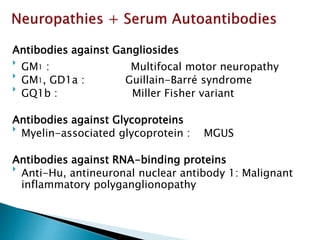
Antibodies against Gangliosides

GM1 : Multifocal motor neuropathy

GM1, GD1a : Guillain-Barré syndrome

GQ1b : Miller Fisher variant
Antibodies against Glycoproteins

Myelin-associated glycoprotein : MGUS
Antibodies against RNA-binding proteins

Anti-Hu, antineuronal nuclear antibody 1: Malignant
inflammatory polyganglionopathy
 (1) Confirming the presence of neuropathy,
 (2) Locating focal nerve lesions,
 (3) Nature of the underlying nerve pathology
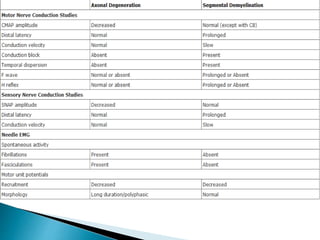
Distal motor latency prolonged
Nerve conduction velocity slow
Reduced action potential
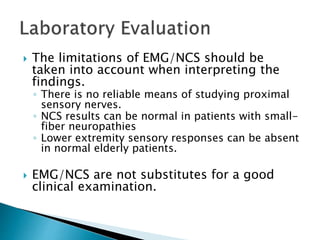
 The limitations of EMG/NCS should be
taken into account when interpreting the
findings.
◦ There is no reliable means of studying proximal
sensory nerves.
◦ NCS results can be normal in patients with small-
fiber neuropathies
◦ Lower extremity sensory responses can be absent
in normal elderly patients.
 EMG/NCS are not substitutes for a good
clinical examination.
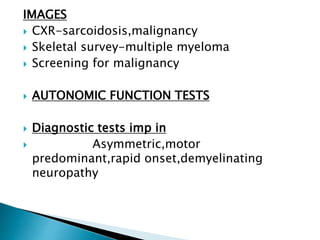
IMAGES
 CXR-sarcoidosis,malignancy
 Skeletal survey-multiple myeloma
 Screening for malignancy
 AUTONOMIC FUNCTION TESTS
 Diagnostic tests imp in
 Asymmetric,motor
predominant,rapid onset,demyelinating
neuropathy
VASCULITIS GIANT AXONAL NPthy
AMYLOIDOSIS Infantile neuroaxonal
dystrophy
SARCOIDOSIS CMT 1&3
LEPROSY CIDPolyradiculoneuropathy
KRABBE’S Paraprotein neuropathy
METACHROMATIC
LEUKODYSTROPY
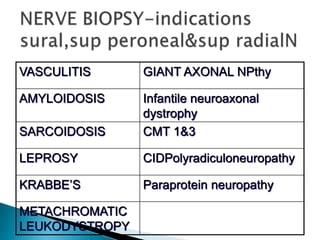
 In vasculitis, amyloid neuropathy, leprosy, CIDP,
Inherited disorders of myelin, and rare
axonopathies
 The Sural nerve is selected most commonly
 The superficial peroneal nerve – alternative;
:advantage of allowing simultaneous biopsy of
the peroneus brevis muscle through the same
incision.
 This combined nerve and muscle biopsy
procedure increases the yield of identifying
suspected vasculitis
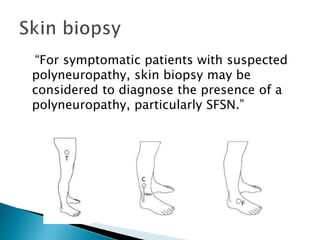
“For symptomatic patients with suspected
polyneuropathy, skin biopsy may be
considered to diagnose the presence of a
polyneuropathy, particularly SFSN.”
 Slow progression
◦ Treat causative factors if possible
◦ If rapidly progressing
 IVIG
 Immunomodulating agents
 Symptom Management
 Tricyclic antidepressants
◦ Amitryptilin, nortryptilin
 Calcium channel alpha-2-delta ligands
◦ Gabapentin, pregabalin
 SNRI’s
◦ Duloxetine, venlafaxine
 Topical Agents
◦ Lidocaine, Capsaicin
 Antiepileptic Drugs
◦ Carbamazepine, phenytoin, lacosamide
 SSRI’s
 Opioid analgesics
 Tramadol
 Miscellaneous
◦ Botulinum toxin
◦ Mexiletine
◦ Alpha lipoic acid
 Physical Therapy
◦ Gait and balance training
 Assistive devices
 Safe environment
 Footwear at all times
 Foot hygiene
Thanks

Peripheral neuropathy

  • 1.
    Dr. Anoop.K.R Dept ofGeneral Medicine
  • 2.
     Generalized termincluding disorders of any cause affecting PNS  May involve sensory nerves, motor nerves, or both  May affect one nerve (mononeuropathy), several nerves together (polyneuropathy) or several nerves not contiguous (Mononeuropathy multiplex)
  • 3.
     Further classifiedinto those that primarily affect the cell body (e.g., neuronopathy or ganglionopathy), myelin (myelinopathy), and the axon (axonopathy)
  • 4.
     Disease  Diabetes12  Paraproteinaemia2 3  Alcohol misuse1  Renal failure1  Vitamin B-12 deficiency1  HIV infection1  Chronic idiopathic axonal neuropathy4  Prevalence  11-41% (depending on duration, type,and control)  9-10%  7%  4%  3.6%  16% (depending on the population studied, usually much lower)  10-40% of different hospital series BMJ 2010:341:c6100
  • 5.
    Loss of function “-symptoms” Disordered function “+ symptoms” Sensory “Large Fiber” ↓ Vibration ↓ Proprioception Hyporeflexia Sensory ataxia Paresthesias Sensory “Small Fiber” ↓ Pain ↓ Temperature Dysesthesias Allodynia The clinical response to sensory nerve injury
  • 6.
    Loss of function “-symptoms” Disturbed function “+ symptoms” Motor nerves Large fibre Wasting Hypotonia Weakness Hyporeflexia Orthopedic deformity Fasciculation Cramps The clinical response to motor nerve injury
  • 7.
    Loss of function “-symptoms” Disturbed function “+ symptoms” Autonomic nerves ↓ Sweating Hypotension Urinary retention Impotence Vascular color changes ↑ Sweating Hypertension The clinical response to autonomic nerve injury
  • 9.
     By farthe majority of the toxic, metabolic and endocrine causes  NCVs: CMAPs ↓ 80% lower limit of normal w/o or min velocity or distal motor latency change.  Legs>> arms.  EMG: Signs of denervation (acute, chronic) and reinnervation
  • 10.
     Unusual bycomparison with axonopathies  Clues: hypertrophic nerves on exam global arreflexia weakness without wasting motor >> sensory deficits NCS can discriminate inherited from acquired  NCS: Distal motor latency prolonged (>125% ULN) Conduction velocities slowed (<80% LLN) May have conduction block EMG: Reduced recruitment w/o much denervation
  • 11.
     SJOGREN’S SYNDROME VIT B12 NEUROPATHY  CISPLATIN  PYRIDOXINE NEUROTOXICITY  FRIEDEREICH’S ATAXIA
  • 12.
  • 13.
     Heriditary sensoryneuropathy  Lepromatous leprosy  Diabetes mellitus  Amyloidosis(early familial&primary)  Tangier disease  Fabry’s disease-pain predomonates  Dysautonomia-riley-day syndrome  HIV & antiretroviral therapy neuropathy
  • 14.
     Global sensoryloss  Carcinomatous sensory neuropathy  Hereditary sensory neuropathy  Diabetic sensory neuropathy  Vacor intoxication  Xanthomatous neuropathy of primary biliary cirrhosis
  • 15.
     Immune neuropathies Heriditary motor sensory neuropathies  Acute intermittent porphyria  Diphtheritic neuropathy  Lead neuropathy  Brachial neuritis  Diabetic lumbosacralplexus neuropathy
  • 16.
     Acute-pandysautonomia  -botulism -porphyria  -GBS  -Amiodarone  -vincristine  Chronic-amyloid,diabetes,sjogren’s,HSN 1&3,chagas,paraneoplastic
  • 17.
     ?MONONEUROPATH Y  Focalinvolvement of a single nerve  Weakness & sensory loss in the territory of a single peripheral nerve  Pain along the pathway of the nerve Direct trauma compressio n entrapment Vascular lesions neoplasms
  • 18.
     Random patternof nerve involvement  In distribution of separate nerves,asymmetric  May/may not be painful  Not length dependent  Isolated reflex loss  CAUSES—inflammatory-leprosy,sarcoid  Vascular-Diabetes  Pressure,Trauma,Infiltration  Vasculitis- PAN,SLE,RA,scleroderma  Immune-vaccination
  • 19.
     MC type–Distal symmetric polyneurpathy  Burning sensation,tingling,numbness  Length dependent pattern  Starts in feet,distal stocking glove pattern  Fairly symmetric  Symmetrically decreased reflexes  Sensory>motor
  • 20.
     Diabetes mellitus Alcohol  Vit B12 deficiency  HIV  Although more than  one nerve involved  one will be prominant
  • 21.
     Lumbosacral polyradiculopathy/stenosis Myelopathy-structural  -nonstructural  Vascular insufficiency-exercise related cramps,aching pain>numbness  Orthopedics –stress #,plantar fascitis
  • 22.
     ?POLYRADICULOPATHY  Diseaseof multiple peripheral nerve roots  Asymmetric with erratic distribution-proximal in one,distal in another  Pain is a common feature  ?MONORADICULOPATHY  Root disease by disease of spinal column  Changes in distribution of spinal nerve root
  • 23.
     ?SENSORY NEURONOPATHY Ganglion cells predominantly affected  Both proximal & distal involvement  Sensory ataxia is common  No weakness  But awkward movement d/t sensory disturbances  ?MOTOR NEURONOPATHY  Disorder of ant horn cells  Weakness,fasciculation,atrophy  Not properly a process of peripheral NP
  • 24.
     ?PLEXOPATHY  Asymmetric Painful onset  Multiple nerves in a single limb  Rapid onset of weakness,atrophy  Isolated reflex loss
  • 25.
     a/c idiopathicpolyneuritis  Peripheral nerve+cranial nerve involvement  Self limiting painful ophthalmoplegia  CAUSES-TB meningitis  osteomyelitis skull  otitis media  syphilitic meningitis  sarcoidosis  carcinomatous meningitis
  • 26.
    1.syndrome of a/cascending motor paralysis a.acute idiopathic polyneuritis b.IMN with polyneuritis c.diphtheria d.hepatitis with polyneuritis e.porphyria f.TOCP poisoning g.paraneoplastic h.post vaccinial
  • 27.
    2.syndome of subacutesensorymotor NP A.Deficiency=alcoholic beriberi pellagra vit B12 B.Toxins=arsenic,lead,Hg,Pb C.Drugs=nitrofurantoin,INH dapsone,disulfiram clioquinol D.Uremic E.DM,PAN,sarcoidosis A,B,C,D====SYMMETRIC
  • 28.
    3.C/C sensorimotor polyneuropathysyndrome GENETIC ACQUIRED Peronealmuscle atrophy/CMT leprosy Dejerine sottas disease Diabetes mellitus Hereditary sensory NP uremia Portugeseamyloidosis/ andrade’s disease carcinoma Refsum’s disease myeloma A beta lipoproteinemia paraproteinemia Tangier’s disease amyloidosis Metachromaticleucodystrophy
  • 29.
     RECURRENT POLYNEUROPATHY Relapsing CIDP  Porphyria  Refsum’s disease  HNPP  GBS  Beriberi  Toxic neuropathy
  • 30.
     SENSORY ATAXICNEUROPATHY  Sensory NP(polyganglionopathy)  Paraneoplastic sensory NP=sjogren’s  =idiopathic  Toxic=cisplatin  =vit B6 excess  Demyelinating polyradiculopathy=MGUS  =Millerfisher
  • 32.
     DM  hypothyroidism chronic renal failure  liver disease  intestinal malabsorption  malignancy  connective tissue diseases  [HIV]  drug use  Vitamin B6 toxicity  alcohol and dietary habits •Weight loss, malaise, and anorexia.
  • 33.
     Diabetes andPre-Diabetes  Alcohol neuropathy  Chemotherapy ◦ Platinum-based  Paraproteinemia  Vasculitis and Connective Tissue Diseases  Heavy metals and other toxins  HIV  Amyloidosis  Porphyria
  • 34.
     Axonal Vincristine Paclitaxel Nitrous oxide ColchicineProbenecid Isoniazid Hydralazine Metronidazole Pyridoxine Didanosine Lithium Alfa interferon Dapsone  Axonal - continued.. Phenytoin Cimetidine Disulfiram Chloroquine Ethambutol Amitriptyline  Demyelinating Amiodarone Chloroquine Suramin Gold  Neuronopathy Thalidomide Cisplatin Pyridoxine
  • 35.
     ETIOLOGICAL CLASSIFICATION 1.metabolic-DM,amyloidosis,porphyria  2.infections-leprosy,HIV,CMV,syphilis,  diphtheria,lymedisease  3.immune- GBS,CIDN,MMN  4.hereditary-CMT  5.Toxic-drugs,alcohol,heavymetals  6.vasculitis-PAN,CSS,cryoglobulinemia  7.paraneoplastic-lung  8.nutritional- B1,B6,B12
  • 36.
    ◦ Guillain-Barré syndrome ◦Chronic inflammatory demyelinating polyradiculoneuropathy ◦ Diabetes mellitus ◦ Porphyria ◦ Osteosclerotic myeloma ◦ Waldenstrom's macroglobulinemia ◦ Monoclonal gammopathy of undetermined significance ◦ Acute arsenic polyneuropathy ◦ Lymphoma ◦ Diphtheria ◦ HIV/AIDS ◦ Lyme disease ◦ Hypothyroidism ◦ Vincristine (Oncovin, Vincosar PFS) toxicity
  • 37.
     The temporalcourse of a neuropathy varies, based on the etiology. ◦ With trauma or ischemic infarction, the onset will be acute, with the most severe symptoms at onset. ◦ Inflammatory and some metabolic neuropathies have a subacute course extending over days to weeks. ◦ A chronic course over weeks to months is the hallmark of most toxic and metabolic neuropathies.
  • 38.
     A chronic,slowly progressive neuropathy over many years occurs with most hereditary neuropathies or with chronic inflammatory demyelinating polyradiculoneuropathy (CIDP).  Neuropathies with a relapsing and remitting course include CIDP, acute porphyria, Refsum's disease, hereditary neuropathy with liability to pressure palsies (HNPP), familial brachial plexus neuropathy, and repeated episodes of toxin exposure.
  • 39.
     Ischemic neuropathiesoften have pain as a prominent feature.  Small-fiber neuropathies often present with burning pain, lightning-like or lancinating pain, aching, or uncomfortable paresthesias (dysesthesias).
  • 40.
     Dying-back (distalsymmetric axonal) neuropathies initially involve the tips of the toes and progress proximally in a stocking- glove distribution.
  • 41.
     Peripheral neuropathycan present as restless leg syndrome.  Proximal involvement may result in difficulty climbing stairs, getting out of a chair, lifting and bulbar involvement can also be seen
  • 42.
     The clinicalassessment should include: ◦ careful past medical history, looking for systemic diseases that can be associated with neuropathy, such as diabetes or hypothyroidism.
  • 43.
     All patientsshould be questioned regarding ◦ HIV risk factors ◦ diet (nutrition) ◦ vitamin use (especially B6) ◦ possibility of a tick bite (Lyme disease) ◦ Constitutional symtoms (malignancy)
  • 44.
    Acute onset (within days) Subacuteonset (weeks to months) Chronic course/ insidious onset Relapsing/ remitting course Guillain-Barré syndrome Maintained exposure to toxic agents/medications Hereditary motor sensory neuropathies Guillain-Barré syndrome Acute intermittent porphyria Persisting nutritional deficiency Dominantly inherited sensory neuropathy CIDP Critical illness polyneuropathy Abnormal metabolic state CIDP HIV/AIDS Diphtheric neuropathy Paraneoplastic syndrome Toxic Thallium toxicity CIDP Porphyria
  • 45.
     A cranialnerve examination can provide evidence of mononeuropathies.  Funduscopic examination may show abnormalities such as optic pallor, which can be present in leukodystrophies and vitamin B12 deficiency.
  • 46.
  • 47.
     Cardiovagal ◦ Heartrate variability  Adrenergic ◦ Valsalva maneuver  Induces BP changes and monitors pulse reaction  Postganglionic sudomotor function ◦ QSART
  • 48.
     Screening laboratorytests may be considered for all patients with DSP (Level C).  Tests with the highest yield of abnormality: 1. blood glucose (fasting) 2. serum B12 with metabolites (methylmalonic acid, homocysteine) 3. SPEP(serum protein electrophoresis) (Level C).
  • 49.
     ANA, RF,Anti-dsDNA, Anti-Ro, Anti-La, ANCA screen, cryoglobulins  Urine for heavy metals, porphyrins  IFE/urine IFE/ plasma light chain analysis
  • 50.
     BLOOD  TC,DC,ESR Urea,electrolytes,LFT  RBS,HbA1C  Serum protein electrophoresis  Auto Ab=ANA,Antiganglioside,Antineuronal  Vit B 12 level  DNA analysis=chr 17 duplication-HMSN1&1A  =chr 17 deletion -HLPP
  • 51.
     URINE  BJprotein  Porphyria  Heavy metals  CSF ANALYSIS  NERVE CONDUCTION STUDY  Variation in axonal,demyelinating neuropathy  Conduction block-CIDP,GBS,MMN  EMG-muscle denervation changes  Sensory threshold  Thermal & vibration threshold
  • 52.
    Antibodies against Gangliosides  GM1: Multifocal motor neuropathy  GM1, GD1a : Guillain-Barré syndrome  GQ1b : Miller Fisher variant Antibodies against Glycoproteins  Myelin-associated glycoprotein : MGUS Antibodies against RNA-binding proteins  Anti-Hu, antineuronal nuclear antibody 1: Malignant inflammatory polyganglionopathy
  • 53.
     (1) Confirmingthe presence of neuropathy,  (2) Locating focal nerve lesions,  (3) Nature of the underlying nerve pathology
  • 55.
    Distal motor latencyprolonged Nerve conduction velocity slow Reduced action potential
  • 56.
     The limitationsof EMG/NCS should be taken into account when interpreting the findings. ◦ There is no reliable means of studying proximal sensory nerves. ◦ NCS results can be normal in patients with small- fiber neuropathies ◦ Lower extremity sensory responses can be absent in normal elderly patients.  EMG/NCS are not substitutes for a good clinical examination.
  • 57.
    IMAGES  CXR-sarcoidosis,malignancy  Skeletalsurvey-multiple myeloma  Screening for malignancy  AUTONOMIC FUNCTION TESTS  Diagnostic tests imp in  Asymmetric,motor predominant,rapid onset,demyelinating neuropathy
  • 58.
    VASCULITIS GIANT AXONALNPthy AMYLOIDOSIS Infantile neuroaxonal dystrophy SARCOIDOSIS CMT 1&3 LEPROSY CIDPolyradiculoneuropathy KRABBE’S Paraprotein neuropathy METACHROMATIC LEUKODYSTROPY
  • 59.
     In vasculitis,amyloid neuropathy, leprosy, CIDP, Inherited disorders of myelin, and rare axonopathies  The Sural nerve is selected most commonly  The superficial peroneal nerve – alternative; :advantage of allowing simultaneous biopsy of the peroneus brevis muscle through the same incision.  This combined nerve and muscle biopsy procedure increases the yield of identifying suspected vasculitis
  • 60.
    “For symptomatic patientswith suspected polyneuropathy, skin biopsy may be considered to diagnose the presence of a polyneuropathy, particularly SFSN.”
  • 61.
     Slow progression ◦Treat causative factors if possible ◦ If rapidly progressing  IVIG  Immunomodulating agents  Symptom Management
  • 62.
     Tricyclic antidepressants ◦Amitryptilin, nortryptilin  Calcium channel alpha-2-delta ligands ◦ Gabapentin, pregabalin  SNRI’s ◦ Duloxetine, venlafaxine  Topical Agents ◦ Lidocaine, Capsaicin
  • 63.
     Antiepileptic Drugs ◦Carbamazepine, phenytoin, lacosamide  SSRI’s  Opioid analgesics  Tramadol  Miscellaneous ◦ Botulinum toxin ◦ Mexiletine ◦ Alpha lipoic acid
  • 64.
     Physical Therapy ◦Gait and balance training  Assistive devices  Safe environment  Footwear at all times  Foot hygiene
  • 66.