Neuropathy and its classification
Shehzad Hussain
Nerve:
• A nerve is an enclosed, cable-like bundle of
axons (the long, slender projections of
neurons) in the peripheral nervous system. A
nerve provides a common pathway for the
electrochemical nerve impulses that are
transmitted along each of the axons to
peripheral organs.
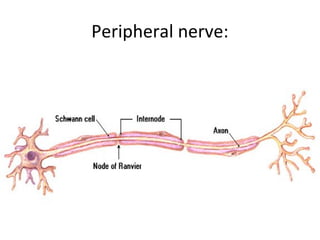
Peripheral nerve:
Cont…
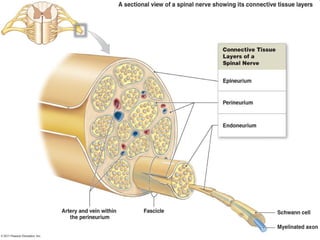
• Each nerve is a cordlike structure that contains many
axons, also called nerve fibres. Within a nerve, each
axon is surrounded by a layer of connective tissue
called the endoneurium. The axons are bundled
together into groups called fascicles, and each
fascicle is wrapped in a layer of connective tissue
called the perineurium. Finally, the entire nerve is
wrapped in a layer of connective tissue called the
epineurium.
Peripheral Neuropathy
• DEFINITION:
It is inflammation and degeneration of the
peripheral nerves and/or the cranial nerves
resulting in impairment of the conductivity of
these nerves.
Common causes include systemic diseases (such as
diabetes or leprosy), vitamin deficiency, medication (e.g.,
chemotherapy), traumatic injury, excessive alcohol
consumption, immune system disease, or infection, or it
may be inherited (present from birth)
Classification of Neuropathy
• Three main types of nerve can be involved in
peripheral neuropathy:
• Autonomic nerves (not under conscious
control, "automatic" or "involuntary" nerves)
• Motor nerves
• Sensory nerves.
Cont…
• Peripheral neuropathy may be classified according to
the number and distribution of nerves affected
(mononeuropathy, mononeuritis multiplex or
polyneuropathy), the type of nerve cell
predominantly affected (motor, sensory, autonomic),
or the process affecting the nerves; e.g.,
inflammation (neuritis), compression (compression
neuropathy), chemotherapy (chemotherapy-induced
peripheral neuropathy).
Causes:
• Genetic diseases
• Metabolic/endocrine
• Toxic causes
• Inflammatory diseases
• Vitamin deficiency
• Physical trauma
• Chemotherapy
• Others: electric shock, HIV, malignant disease,
radiation, shingles (Herpes zoster a viral infection)
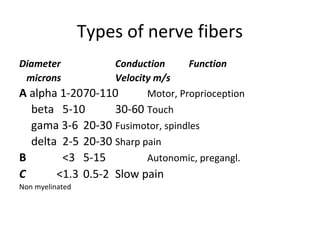
Types of nerve fibers
Diameter Conduction Function
microns Velocity m/s
A alpha 1-2070-110 Motor, Proprioception
beta 5-10 30-60 Touch
gama 3-6 20-30 Fusimotor, spindles
delta 2-5 20-30 Sharp pain
B <3 5-15 Autonomic, pregangl.
C <1.3 0.5-2 Slow pain
Non myelinated
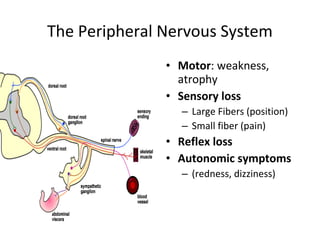
The Peripheral Nervous System
• Motor: weakness,
atrophy
• Sensory loss
– Large Fibers (position)
– Small fiber (pain)
• Reflex loss
• Autonomic symptoms
– (redness, dizziness)
Definitions
• Neuropathy
Pathological process affecting a peripheral nerve/s
• Mononeuropathy
A single nerve affected
• Mononeuritis multiplex
Multiple mononeuropathy or Multifocal neuropathy
Cont..
• Polyneuropathy
• Diffuse symmetrical disease usually
• beginning peripherally
• Acute/Chronic Static/Prog
• Relapsing/Recovering
• Motor Sensory
• Sensrimotor(Mixed)
• Autonomic
• Demyelinating Axonal
• Radiculopathy Nerve root disease
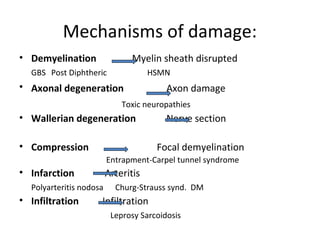
Mechanisms of damage:
• Demyelination Myelin sheath disrupted
GBS Post Diphtheric HSMN
• Axonal degeneration Axon damage
Toxic neuropathies
• Wallerian degeneration Nerve section
• Compression Focal demyelination
Entrapment-Carpel tunnel syndrome
• Infarction Arteritis
Polyarteritis nodosa Churg-Strauss synd. DM
• Infiltration Infiltration
Leprosy Sarcoidosis
Cont…
EXAMINATION FINDINGS
• Purely Motor or Sensory or Sensorimotor?
• Proximal or distal? Symmetric or asymmetric?
• Multifocal, generalized, regional?
• Upper limbs, lower limbs, neck, trunk?
TIMING
• Acute or chronic?
Cont…
• ASSOCIATED FINDINGS
• Painful or painless?
• Hereditary or sporadic?
• ELECTRODIAGNOSIS
• Axonal or demyelinating?
• LABORATORY
• Paraprotein present? Type?
• Antibody against nerve?
• CSF protein level?
• HISTOLOGY
• Inflammatory Cells
 Mononeuropathy (Involving Single Nerve)
– Carpal Tunnel Syndrome
– Facial Neuropathy
– Ulnar Neuropathy etc
 Mononeuropathy Multiplex (Multifocal dysfunction;
asymmetrical process involving two or more nerves).
• Polyneuropathy (Involving more than 2 Nerves)
– TOSS
– Polyradicuopathies
– AIDP
– CIDP etc
 Autonomic Neuropathy:
Dysfunction of Autonomic Neurons with consequent:
o Anhidrosis or Hyperhidrosis
o Orthostatic Hypotension,
o Pupillary Reflex Paralysis,
o Loss of Lacrimation & salivation,
o Bowel & Bladder Dysfunction etc
mostly occur with generalized Polyneuropathy i.e. DM,
 Riley-Day Syndrome (Autosomal Recessive Disease) also called as
“Familial Dysautonomia”.
 Shy-Drager Syndrome
Clinical assessment
Sensory Symptoms
• A sensation of wearing an invisible "glove" or "sock"
• Numbness, pins & needles
• Feeling of walking on pebbles
• Feeling of tightness & swelling
• Burning sensation or freezing pain
• Sharp, jabbing or electric shock-like pain
• Extreme sensitivity to touch
• Usually worse at night
• Loss of balance and coordination
• Cramps in the feet and calves
Motor Symptoms
• Tripping on the toes
• Loss of grip strength
• Ankle jerk reflex is classically absent in
peripheral neuropathy.
Clinical Examination & Assessment
 Signs:
 Weakness: Usually distal & symmetrical in polyneuropathy
 Muscle Atrophy: Loss of muscle bulk, reduced tone and flaccidity
 Sensory Deficit: Varies with somatotopic distribution
 Areflexia: Loss of reflexes in Lower motor neuron lesions (LMNLs)
while Hyperreflexia in Upper motor neuron lesions (UMNLs).
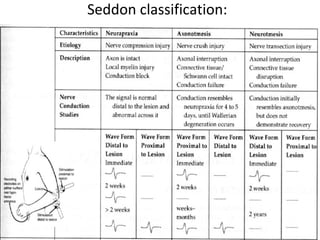
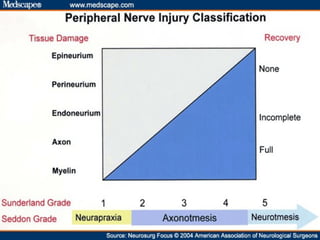
Seddon classification:
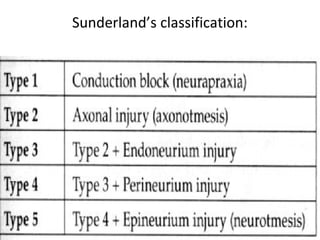
Sunderland’s classification:
Live as if you were to die
tomorrow. Learn as if you were to
live forever.Mahatma Gandhi

Neuropathy and its classification

  • 1.
    Neuropathy and itsclassification Shehzad Hussain
  • 2.
    Nerve: • A nerveis an enclosed, cable-like bundle of axons (the long, slender projections of neurons) in the peripheral nervous system. A nerve provides a common pathway for the electrochemical nerve impulses that are transmitted along each of the axons to peripheral organs.
  • 3.
  • 4.
    Cont… • Each nerveis a cordlike structure that contains many axons, also called nerve fibres. Within a nerve, each axon is surrounded by a layer of connective tissue called the endoneurium. The axons are bundled together into groups called fascicles, and each fascicle is wrapped in a layer of connective tissue called the perineurium. Finally, the entire nerve is wrapped in a layer of connective tissue called the epineurium.
  • 6.
    Peripheral Neuropathy • DEFINITION: Itis inflammation and degeneration of the peripheral nerves and/or the cranial nerves resulting in impairment of the conductivity of these nerves. Common causes include systemic diseases (such as diabetes or leprosy), vitamin deficiency, medication (e.g., chemotherapy), traumatic injury, excessive alcohol consumption, immune system disease, or infection, or it may be inherited (present from birth)
  • 7.
    Classification of Neuropathy •Three main types of nerve can be involved in peripheral neuropathy: • Autonomic nerves (not under conscious control, "automatic" or "involuntary" nerves) • Motor nerves • Sensory nerves.
  • 8.
    Cont… • Peripheral neuropathymay be classified according to the number and distribution of nerves affected (mononeuropathy, mononeuritis multiplex or polyneuropathy), the type of nerve cell predominantly affected (motor, sensory, autonomic), or the process affecting the nerves; e.g., inflammation (neuritis), compression (compression neuropathy), chemotherapy (chemotherapy-induced peripheral neuropathy).
  • 9.
    Causes: • Genetic diseases •Metabolic/endocrine • Toxic causes • Inflammatory diseases • Vitamin deficiency • Physical trauma • Chemotherapy • Others: electric shock, HIV, malignant disease, radiation, shingles (Herpes zoster a viral infection)
  • 10.
    Types of nervefibers Diameter Conduction Function microns Velocity m/s A alpha 1-2070-110 Motor, Proprioception beta 5-10 30-60 Touch gama 3-6 20-30 Fusimotor, spindles delta 2-5 20-30 Sharp pain B <3 5-15 Autonomic, pregangl. C <1.3 0.5-2 Slow pain Non myelinated
  • 11.
    The Peripheral NervousSystem • Motor: weakness, atrophy • Sensory loss – Large Fibers (position) – Small fiber (pain) • Reflex loss • Autonomic symptoms – (redness, dizziness)
  • 12.
    Definitions • Neuropathy Pathological processaffecting a peripheral nerve/s • Mononeuropathy A single nerve affected • Mononeuritis multiplex Multiple mononeuropathy or Multifocal neuropathy
  • 13.
    Cont.. • Polyneuropathy • Diffusesymmetrical disease usually • beginning peripherally • Acute/Chronic Static/Prog • Relapsing/Recovering • Motor Sensory • Sensrimotor(Mixed) • Autonomic • Demyelinating Axonal • Radiculopathy Nerve root disease
  • 14.
    Mechanisms of damage: •Demyelination Myelin sheath disrupted GBS Post Diphtheric HSMN • Axonal degeneration Axon damage Toxic neuropathies • Wallerian degeneration Nerve section • Compression Focal demyelination Entrapment-Carpel tunnel syndrome • Infarction Arteritis Polyarteritis nodosa Churg-Strauss synd. DM • Infiltration Infiltration Leprosy Sarcoidosis
  • 15.
    Cont… EXAMINATION FINDINGS • PurelyMotor or Sensory or Sensorimotor? • Proximal or distal? Symmetric or asymmetric? • Multifocal, generalized, regional? • Upper limbs, lower limbs, neck, trunk? TIMING • Acute or chronic?
  • 16.
    Cont… • ASSOCIATED FINDINGS •Painful or painless? • Hereditary or sporadic? • ELECTRODIAGNOSIS • Axonal or demyelinating? • LABORATORY • Paraprotein present? Type? • Antibody against nerve? • CSF protein level? • HISTOLOGY • Inflammatory Cells
  • 17.
     Mononeuropathy (InvolvingSingle Nerve) – Carpal Tunnel Syndrome – Facial Neuropathy – Ulnar Neuropathy etc  Mononeuropathy Multiplex (Multifocal dysfunction; asymmetrical process involving two or more nerves). • Polyneuropathy (Involving more than 2 Nerves) – TOSS – Polyradicuopathies – AIDP – CIDP etc
  • 18.
     Autonomic Neuropathy: Dysfunctionof Autonomic Neurons with consequent: o Anhidrosis or Hyperhidrosis o Orthostatic Hypotension, o Pupillary Reflex Paralysis, o Loss of Lacrimation & salivation, o Bowel & Bladder Dysfunction etc mostly occur with generalized Polyneuropathy i.e. DM,  Riley-Day Syndrome (Autosomal Recessive Disease) also called as “Familial Dysautonomia”.  Shy-Drager Syndrome
  • 19.
    Clinical assessment Sensory Symptoms •A sensation of wearing an invisible "glove" or "sock" • Numbness, pins & needles • Feeling of walking on pebbles • Feeling of tightness & swelling • Burning sensation or freezing pain • Sharp, jabbing or electric shock-like pain • Extreme sensitivity to touch • Usually worse at night • Loss of balance and coordination • Cramps in the feet and calves
  • 20.
    Motor Symptoms • Trippingon the toes • Loss of grip strength • Ankle jerk reflex is classically absent in peripheral neuropathy.
  • 21.
    Clinical Examination &Assessment  Signs:  Weakness: Usually distal & symmetrical in polyneuropathy  Muscle Atrophy: Loss of muscle bulk, reduced tone and flaccidity  Sensory Deficit: Varies with somatotopic distribution  Areflexia: Loss of reflexes in Lower motor neuron lesions (LMNLs) while Hyperreflexia in Upper motor neuron lesions (UMNLs).
  • 22.
  • 23.
  • 25.
    Live as ifyou were to die tomorrow. Learn as if you were to live forever.Mahatma Gandhi