
Dr. Sabir Kumar Khadka
Dept of Orthopedics
PERIPHERAL NEUROPATHY
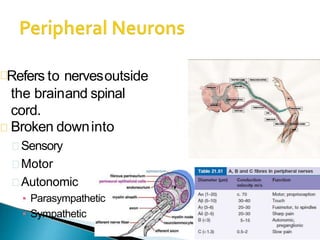
Refers to nervesoutside
the brainand spinal
cord.
Broken downinto
Sensory
Motor
Autonomic
▪ Parasympathetic
▪ Sympathetic
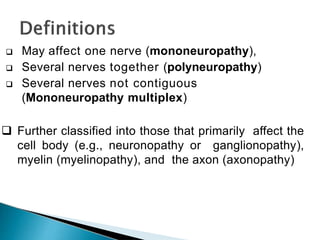
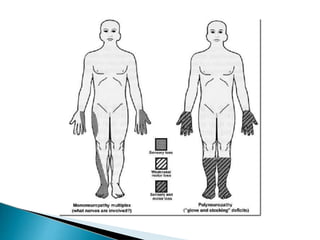
 May affect one nerve (mononeuropathy),
 Several nerves together (polyneuropathy)
 Several nerves not contiguous
(Mononeuropathy multiplex)
 Further classified into those that primarily affect the
cell body (e.g., neuronopathy or ganglionopathy),
myelin (myelinopathy), and the axon (axonopathy)
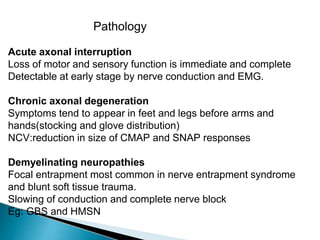
Pathology
Acute axonal interruption
Loss of motor and sensory function is immediate and complete
Detectable at early stage by nerve conduction and EMG.
Chronic axonal degeneration
Symptoms tend to appear in feet and legs before arms and
hands(stocking and glove distribution)
NCV:reduction in size of CMAP and SNAP responses
Demyelinating neuropathies
Focal entrapment most common in nerve entrapment syndrome
and blunt soft tissue trauma.
Slowing of conduction and complete nerve block
Eg: GBS and HMSN
Possible mechanisms of peripheral nervedegeneration
Demyelination –e.g. Guillain-BarreSyndrome
Axonal degeneration - e.g. toxic neuropathies
Compression –e.g. carpal tunnelsyndrome
Infarction –e.g.diabetes
Infiltration –e.g. leprosy and granulomas
Causes of polyneuropathy
Hereditary
Hereditary motor and sensory neuropathy
Friedreich ataxia
Hereditary sensory neuropathy
Infections
Viral infections
Herpes zoster
Neuralgic amyotrophy
Leprosy
Inflammatory
Acute inflammatory polyneuropathy
Guillain barre syndrome
SLE
Nutritional and metabolic
Vitamin deficiencies
Diabetes
Myxoedema
Amyloidosis
Neoplastic
Primary carcinoma
Myeloma
Toxic
Alcohol
lead
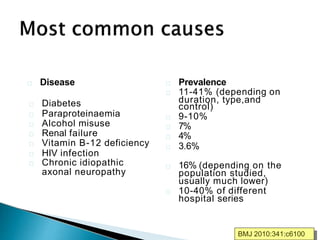
Disease
Diabetes
Paraproteinaemia
Alcohol misuse
Renal failure
Vitamin B-12 deficiency
HIV infection
Chronic idiopathic
axonal neuropathy
Prevalence
11-41% (depending on
duration, type,and
control)
9-10%
7%
4%
3.6%
16% (depending on the
population studied,
usually much lower)
10-40% of different
hospital series
BMJ 2010:341:c6100
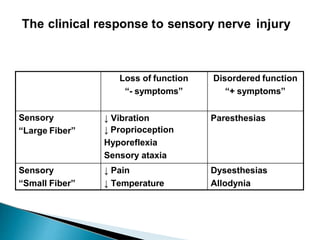
Loss of function
“- symptoms”
Disordered function
“+ symptoms”
Sensory
“Large Fiber”
↓ Vibration
↓ Proprioception
Hyporeflexia
Sensory ataxia
Paresthesias
Sensory
“Small Fiber”
↓ Pain
↓ Temperature
Dysesthesias
Allodynia
The clinical response to sensory nerve injury
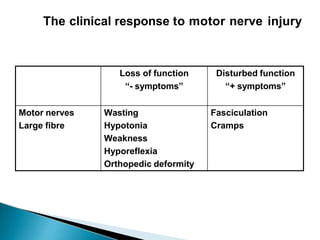
Loss of function
“- symptoms”
Disturbed function
“+ symptoms”
Motor nerves Wasting Fasciculation
Large fibre Hypotonia Cramps
Weakness
Hyporeflexia
Orthopedic deformity
The clinical response to motor nerve injury
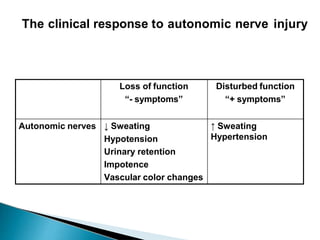
Loss of function
“- symptoms”
Disturbed function
“+ symptoms”
Autonomic nerves ↓ Sweating
Hypotension
↑ Sweating
Hypertension
Urinary retention
Impotence
Vascular color changes
The clinical response to autonomic nerve injury
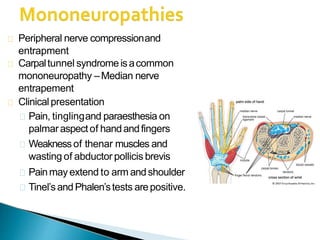
Peripheral nerve compressionand
entrapment
Carpaltunnel syndromeisacommon
mononeuropathy –Median nerve
entrapement
Clinicalpresentation
Pain, tinglingand paraesthesia on
palmaraspectof handandfingers
Weaknessof thenar muscles and
wasting of abductor pollicis brevis
Painmay extend to arm andshoulder
Tinel’sand Phalen’stests arepositive.
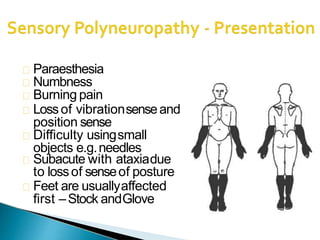
Paraesthesia
Numbness
Burning pain
Lossof vibrationsenseand
position sense
Difficulty usingsmall
objects e.g.needles
Subacute with ataxiadue
to lossof senseof posture
Feet are usuallyaffected
first –Stock andGlove
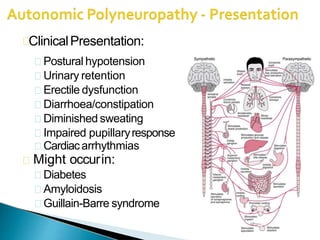
ClinicalPresentation:
Postural hypotension
Urinary retention
Erectile dysfunction
Diarrhoea/constipation
Diminished sweating
Impaired pupillaryresponse
Cardiacarrhythmias
Might occurin:
Diabetes
Amyloidosis
Guillain-Barre syndrome
Clinical presentation:
Progressive weakness orclumsiness
Difficulty walking (falling or stumbling)
Respiratory difficulties (falling vital capacity)
Wasting
Foot or wrist drop might be seen
Reflexes absent orreduced
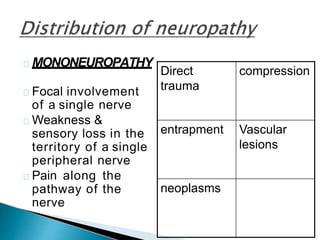
MONONEUROPATHY
Focal involvement
of a single nerve
Weakness &
sensory loss in the
territory of a single
peripheral nerve
Pain along the
pathway of the
nerve
Direct
trauma
compression
entrapment Vascular
lesions
neoplasms
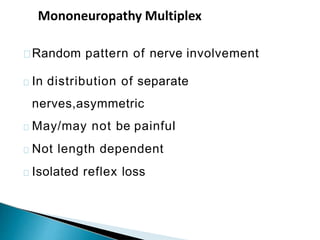
Random pattern of nerve involvement
In distribution of separate
nerves,asymmetric
May/may not be painful
Not length dependent
Isolated reflex loss
Mononeuropathy Multiplex
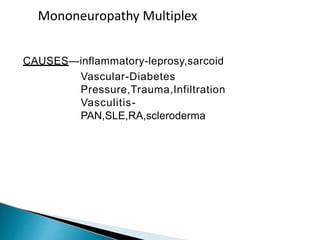
CAUSES—inflammatory-leprosy,sarcoid
Vascular-Diabetes
Pressure,Trauma,Infiltration
Vasculitis-
PAN,SLE,RA,scleroderma
Mononeuropathy Multiplex
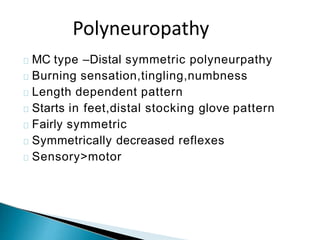
MC type –Distal symmetric polyneurpathy
Burning sensation,tingling,numbness
Length dependent pattern
Starts in feet,distal stocking glove pattern
Fairly symmetric
Symmetrically decreased reflexes
Sensory>motor
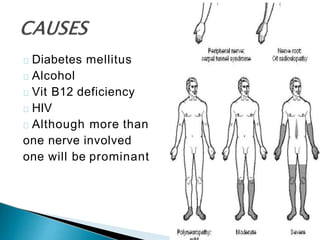
Polyneuropathy
Diabetes mellitus
Alcohol
Vit B12 deficiency
HIV
Although more than
one nerve involved
one will be prominant
POLYRADICULOPATHY
Disease of multiple peripheral nerve roots
Asymmetric with erratic distribution-proximal in
one,distal in another
Pain is a common feature
MONORADICULOPATHY
Root disease by disease of spinal column
Changes in distribution of spinal nerve root
SENSORYNEURONOPATHY
Ganglion cells predominantly affected
Both proximal & distal involvement
Sensory ataxia is common
No weakness
But awkward movement d/t sensory disturbances
MOTOR NEURONOPATHY
Disorder of ant horn cells
Weakness,fasciculation,atrophy
PLEXOPATHY
Asymmetric
Painful onset
Multiple nerves in a single limb
Rapid onset of weakness,atrophy
Isolated reflex loss
Brachial plexus traction injury
Lumbosacral plexopathy in
pelvic trauma
Compression by local
tumor(pancoast’s tumor)
Directly related to the duration and degree of
abnormal metabolic control –occurring relatively
early indisease
Due to metabolic disturbance and accumulation of
fructose and sorbitol in Scwanncells
Types of Diabeticneuropathy
Symmetrical mainly sensoryneuropathy
Acute painfulneuropathy
Mononeuropathy and mononeuritismultiplex
Diabetic amyotrophy
Autonomic Neuropathy
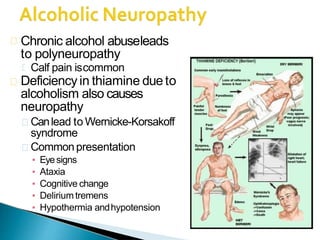
Chronic alcohol abuseleads
to polyneuropathy
Calf pain iscommon
Deficiency in thiamine dueto
alcoholism also causes
neuropathy
Canlead to Wernicke-Korsakoff
syndrome
Commonpresentation
▪ Eyesigns
▪ Ataxia
▪ Cognitive change
▪ Deliriumtremens
▪ Hypothermia andhypotension
Acute polyneuropathy –acute inflammatory or postinfective
neuropathy
Usually demyelinating but canbe axonal
Following Campylobacter jejuni and CMV infections
Infection inducesantibody responses against peripheral nerves
Paralysis 1-3weeks followinginfection
Weaknessof distal limb musclesand/or distal numbness
Symptoms progressproximally
Lossof tendonreflexes
Facial muscleweakness
Autonomic features -uncommon
Might need ventilatorysupport
SCheparin is required to reduce risk of thrombosis
Spontaneousrecovery beginsafter several weeks
DM
hypothyroidism
chronic renal failure
liver disease
intestinal
malabsorption
malignancy
connective tissue
diseases
[HIV]
drug use
Vitamin B6 toxicity
alcohol and dietary
habits
• Weight loss, malaise, and anorexia.
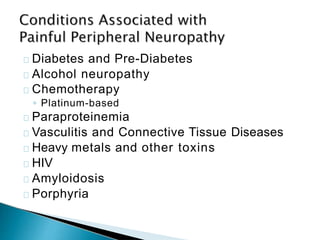
Diabetes and Pre-Diabetes
Alcohol neuropathy
Chemotherapy
◦ Platinum-based
Paraproteinemia
Vasculitis and Connective Tissue Diseases
Heavy metals and other toxins
HIV
Amyloidosis
Porphyria
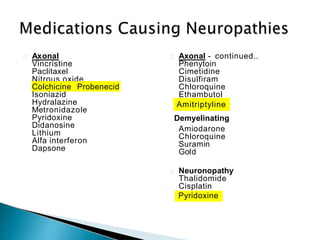
Axonal
Vincristine
Paclitaxel
Nitrous oxide
Colchicine Probenecid
Isoniazid
Hydralazine
Metronidazole
Pyridoxine
Didanosine
Lithium
Alfa interferon
Dapsone
Axonal - continued..
Phenytoin
Cimetidine
Disulfiram
Chloroquine
Ethambutol
Demyelinating
Amiodarone
Chloroquine
Suramin
Gold
Neuronopathy
Thalidomide
Cisplatin
Amitriptyline
Pyridoxine
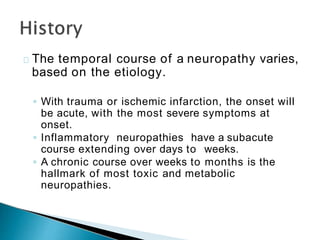
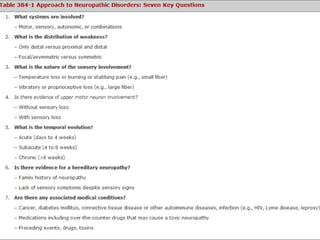
The temporal course of a neuropathy varies,
based on the etiology.
◦ With trauma or ischemic infarction, the onset will
be acute, with the most severe symptoms at
onset.
◦ Inflammatory neuropathies have a subacute
course extending over days to weeks.
◦ A chronic course over weeks to months is the
hallmark of most toxic and metabolic
neuropathies.
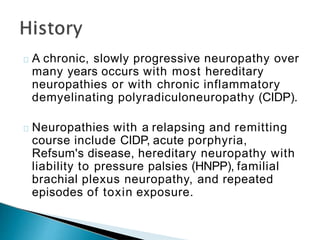
A chronic, slowly progressive neuropathy over
many years occurs with most hereditary
neuropathies or with chronic inflammatory
demyelinating polyradiculoneuropathy (CIDP).
Neuropathies with a relapsing and remitting
course include CIDP, acute porphyria,
Refsum's disease, hereditary neuropathy with
liability to pressure palsies (HNPP), familial
brachial plexus neuropathy, and repeated
episodes of toxin exposure.
Ischemic neuropathies often have pain as a
prominent feature.
Small-fiber neuropathies often present with
burning pain, lightning-like or lancinating
pain, aching, or uncomfortable paresthesias
(dysesthesias).
Peripheral neuropathy can present as restless
leg syndrome.
Proximal involvement may result in difficulty
climbing stairs, getting out of a chair, lifting
and bulbar involvement can also be seen
The clinical assessment should include:
◦ careful past medical history, looking for systemic
diseases that can be associated with neuropathy,
such as diabetes or hypothyroidism.
All patients should be questioned regarding
◦ HIV risk factors
◦ diet (nutrition)
◦ vitamin use (especially B6)
◦ possibility of a tick bite (Lyme disease)
◦ Constitutional symtoms (malignancy)
A cranial nerve examination can provide
evidence of mononeuropathies.
Funduscopic examination may show
abnormalities such as optic pallor, which can
be present in leukodystrophies and vitamin
B12 deficiency.
Tests with the highest yield of abnormality:
1. blood glucose (fasting)
2.serum B12 with metabolites
(methylmalonic acid, homocysteine)
3. SPEP(serum protein electrophoresis)
BLOOD
TC,DC,ESR
Urea,electrolytes,LFT
RBS,HbA1C
Serum protein electrophoresis
Auto Ab=ANA,Antiganglioside,Antineuronal
Vit B12 level
DNA analysis=chr 17 duplication-HMSN1&1A
=chr 17 deletion -HLPP
URINE
BJ protein
Porphyria
Heavy metals
CSFANALYSIS
NERVECONDUCTION STUDY
Variation in axonal,demyelinating neuropathy
Conduction block-CIDP,GBS
EMG-muscle denervation changes
Antibodies against Gangliosides
GM1 :
GM1, GD1a :
GQ1b :
Multifocal motor neuropathy
Guillain-Barré syndrome
Miller Fisher variant
Antibodies against Glycoproteins
Myelin- associated glycoprotein
Antibodies against RNA-binding proteins
Anti-Hu, antineuronal nuclear antibody 1: Malignant
inflammatory polyganglionopathy
(1) Confirming the presence of neuropathy,
(2) Locating focal nerve lesions,
(3) Nature of the underlying nerve pathology
The limitations of EMG/NCS should be
taken into account when interpreting the
findings.
◦ There is no reliable means of studying proximal
sensory nerves.
◦ NCS results can be normal in patients with small-
fiber neuropathies
◦ Lower extremity sensory responses can be absent
in normal elderly patients.
EMG/NCS are not substitutes for a good
clinical examination.
IMAGES
CXR-sarcoidosis,malignancy
Skeletal survey-multiple myeloma
Screening for malignancy
AUTONOMIC FUNCTION TESTS
Diagnostic tests imp in
Asymmetric,motor
predominant,rapid onset,demyelinating
neuropathy
In vasculitis, amyloid neuropathy, leprosy, CIDP,
Inherited disorders of myelin, and rare
axonopathies
The Sural nerve is selected most commonly
The superficial peroneal nerve – alternative;
:advantage of allowing simultaneous biopsy of
the peroneus brevis muscle through the same
incision.
This combined nerve and muscle biopsy
procedure increases the yield of identifying
suspected vasculitis
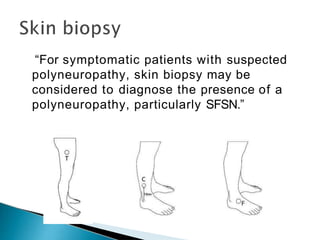
“For symptomatic patients with suspected
polyneuropathy, skin biopsy may be
considered to diagnose the presence of a
polyneuropathy, particularly SFSN.”
Slow progression
◦ Treat causative factors if possible
◦ If rapidly progressing
IVIG
Immunomodulating agents
Tricyclic antidepressants
◦ Amitryptilin, nortryptilin
Calcium channel alpha-2-delta ligands
◦ Gabapentin, pregabalin
SNRI’s
◦ Duloxetine, venlafaxine
Topical Agents
◦ Lidocaine, Capsaicin
Antiepileptic Drugs
◦ Carbamazepine, phenytoin, lacosamide
SSRI’s
Opioid analgesics
Tramadol
Miscellaneous
◦ Botulinum toxin
◦ Mexiletine
◦ Alpha lipoic acid
Physical Therapy
◦ Gait and balance training
Assistive devices
Safe environment
Footwear at all times
Foot hygiene
Thank you
REFERENCES
APLEY & SOLOMON’S SYSTEM OF ORTHOPAEDICS AND
TRAUMA, 10TH EDITION
HARRISON’S PRINCIPLE OF INTERNAL MEDICINE,20th
EDITION

Peripheral neuropathy

  • 1.
    Dr. Sabir KumarKhadka Dept of Orthopedics PERIPHERAL NEUROPATHY
  • 2.
    Refers to nervesoutside thebrainand spinal cord. Broken downinto Sensory Motor Autonomic ▪ Parasympathetic ▪ Sympathetic
  • 3.
     May affectone nerve (mononeuropathy),  Several nerves together (polyneuropathy)  Several nerves not contiguous (Mononeuropathy multiplex)  Further classified into those that primarily affect the cell body (e.g., neuronopathy or ganglionopathy), myelin (myelinopathy), and the axon (axonopathy)
  • 4.
    Pathology Acute axonal interruption Lossof motor and sensory function is immediate and complete Detectable at early stage by nerve conduction and EMG. Chronic axonal degeneration Symptoms tend to appear in feet and legs before arms and hands(stocking and glove distribution) NCV:reduction in size of CMAP and SNAP responses Demyelinating neuropathies Focal entrapment most common in nerve entrapment syndrome and blunt soft tissue trauma. Slowing of conduction and complete nerve block Eg: GBS and HMSN
  • 5.
    Possible mechanisms ofperipheral nervedegeneration Demyelination –e.g. Guillain-BarreSyndrome Axonal degeneration - e.g. toxic neuropathies Compression –e.g. carpal tunnelsyndrome Infarction –e.g.diabetes Infiltration –e.g. leprosy and granulomas
  • 6.
    Causes of polyneuropathy Hereditary Hereditarymotor and sensory neuropathy Friedreich ataxia Hereditary sensory neuropathy Infections Viral infections Herpes zoster Neuralgic amyotrophy Leprosy
  • 7.
    Inflammatory Acute inflammatory polyneuropathy Guillainbarre syndrome SLE Nutritional and metabolic Vitamin deficiencies Diabetes Myxoedema Amyloidosis Neoplastic Primary carcinoma Myeloma Toxic Alcohol lead
  • 8.
    Disease Diabetes Paraproteinaemia Alcohol misuse Renal failure VitaminB-12 deficiency HIV infection Chronic idiopathic axonal neuropathy Prevalence 11-41% (depending on duration, type,and control) 9-10% 7% 4% 3.6% 16% (depending on the population studied, usually much lower) 10-40% of different hospital series BMJ 2010:341:c6100
  • 9.
    Loss of function “-symptoms” Disordered function “+ symptoms” Sensory “Large Fiber” ↓ Vibration ↓ Proprioception Hyporeflexia Sensory ataxia Paresthesias Sensory “Small Fiber” ↓ Pain ↓ Temperature Dysesthesias Allodynia The clinical response to sensory nerve injury
  • 10.
    Loss of function “-symptoms” Disturbed function “+ symptoms” Motor nerves Wasting Fasciculation Large fibre Hypotonia Cramps Weakness Hyporeflexia Orthopedic deformity The clinical response to motor nerve injury
  • 11.
    Loss of function “-symptoms” Disturbed function “+ symptoms” Autonomic nerves ↓ Sweating Hypotension ↑ Sweating Hypertension Urinary retention Impotence Vascular color changes The clinical response to autonomic nerve injury
  • 13.
    Peripheral nerve compressionand entrapment Carpaltunnelsyndromeisacommon mononeuropathy –Median nerve entrapement Clinicalpresentation Pain, tinglingand paraesthesia on palmaraspectof handandfingers Weaknessof thenar muscles and wasting of abductor pollicis brevis Painmay extend to arm andshoulder Tinel’sand Phalen’stests arepositive.
  • 14.
    Paraesthesia Numbness Burning pain Lossof vibrationsenseand positionsense Difficulty usingsmall objects e.g.needles Subacute with ataxiadue to lossof senseof posture Feet are usuallyaffected first –Stock andGlove
  • 15.
    ClinicalPresentation: Postural hypotension Urinary retention Erectiledysfunction Diarrhoea/constipation Diminished sweating Impaired pupillaryresponse Cardiacarrhythmias Might occurin: Diabetes Amyloidosis Guillain-Barre syndrome
  • 16.
    Clinical presentation: Progressive weaknessorclumsiness Difficulty walking (falling or stumbling) Respiratory difficulties (falling vital capacity) Wasting Foot or wrist drop might be seen Reflexes absent orreduced
  • 17.
    MONONEUROPATHY Focal involvement of asingle nerve Weakness & sensory loss in the territory of a single peripheral nerve Pain along the pathway of the nerve Direct trauma compression entrapment Vascular lesions neoplasms
  • 18.
    Random pattern ofnerve involvement In distribution of separate nerves,asymmetric May/may not be painful Not length dependent Isolated reflex loss Mononeuropathy Multiplex
  • 19.
  • 20.
    MC type –Distalsymmetric polyneurpathy Burning sensation,tingling,numbness Length dependent pattern Starts in feet,distal stocking glove pattern Fairly symmetric Symmetrically decreased reflexes Sensory>motor Polyneuropathy
  • 21.
    Diabetes mellitus Alcohol Vit B12deficiency HIV Although more than one nerve involved one will be prominant
  • 22.
    POLYRADICULOPATHY Disease of multipleperipheral nerve roots Asymmetric with erratic distribution-proximal in one,distal in another Pain is a common feature MONORADICULOPATHY Root disease by disease of spinal column Changes in distribution of spinal nerve root
  • 23.
    SENSORYNEURONOPATHY Ganglion cells predominantlyaffected Both proximal & distal involvement Sensory ataxia is common No weakness But awkward movement d/t sensory disturbances MOTOR NEURONOPATHY Disorder of ant horn cells Weakness,fasciculation,atrophy
  • 24.
    PLEXOPATHY Asymmetric Painful onset Multiple nervesin a single limb Rapid onset of weakness,atrophy Isolated reflex loss Brachial plexus traction injury Lumbosacral plexopathy in pelvic trauma Compression by local tumor(pancoast’s tumor)
  • 25.
    Directly related tothe duration and degree of abnormal metabolic control –occurring relatively early indisease Due to metabolic disturbance and accumulation of fructose and sorbitol in Scwanncells Types of Diabeticneuropathy Symmetrical mainly sensoryneuropathy Acute painfulneuropathy Mononeuropathy and mononeuritismultiplex Diabetic amyotrophy Autonomic Neuropathy
  • 26.
    Chronic alcohol abuseleads topolyneuropathy Calf pain iscommon Deficiency in thiamine dueto alcoholism also causes neuropathy Canlead to Wernicke-Korsakoff syndrome Commonpresentation ▪ Eyesigns ▪ Ataxia ▪ Cognitive change ▪ Deliriumtremens ▪ Hypothermia andhypotension
  • 27.
    Acute polyneuropathy –acuteinflammatory or postinfective neuropathy Usually demyelinating but canbe axonal Following Campylobacter jejuni and CMV infections Infection inducesantibody responses against peripheral nerves Paralysis 1-3weeks followinginfection Weaknessof distal limb musclesand/or distal numbness Symptoms progressproximally Lossof tendonreflexes Facial muscleweakness Autonomic features -uncommon Might need ventilatorysupport SCheparin is required to reduce risk of thrombosis Spontaneousrecovery beginsafter several weeks
  • 29.
    DM hypothyroidism chronic renal failure liverdisease intestinal malabsorption malignancy connective tissue diseases [HIV] drug use Vitamin B6 toxicity alcohol and dietary habits • Weight loss, malaise, and anorexia.
  • 30.
    Diabetes and Pre-Diabetes Alcoholneuropathy Chemotherapy ◦ Platinum-based Paraproteinemia Vasculitis and Connective Tissue Diseases Heavy metals and other toxins HIV Amyloidosis Porphyria
  • 31.
    Axonal Vincristine Paclitaxel Nitrous oxide Colchicine Probenecid Isoniazid Hydralazine Metronidazole Pyridoxine Didanosine Lithium Alfainterferon Dapsone Axonal - continued.. Phenytoin Cimetidine Disulfiram Chloroquine Ethambutol Demyelinating Amiodarone Chloroquine Suramin Gold Neuronopathy Thalidomide Cisplatin Amitriptyline Pyridoxine
  • 32.
    The temporal courseof a neuropathy varies, based on the etiology. ◦ With trauma or ischemic infarction, the onset will be acute, with the most severe symptoms at onset. ◦ Inflammatory neuropathies have a subacute course extending over days to weeks. ◦ A chronic course over weeks to months is the hallmark of most toxic and metabolic neuropathies.
  • 33.
    A chronic, slowlyprogressive neuropathy over many years occurs with most hereditary neuropathies or with chronic inflammatory demyelinating polyradiculoneuropathy (CIDP). Neuropathies with a relapsing and remitting course include CIDP, acute porphyria, Refsum's disease, hereditary neuropathy with liability to pressure palsies (HNPP), familial brachial plexus neuropathy, and repeated episodes of toxin exposure.
  • 34.
    Ischemic neuropathies oftenhave pain as a prominent feature. Small-fiber neuropathies often present with burning pain, lightning-like or lancinating pain, aching, or uncomfortable paresthesias (dysesthesias).
  • 35.
    Peripheral neuropathy canpresent as restless leg syndrome. Proximal involvement may result in difficulty climbing stairs, getting out of a chair, lifting and bulbar involvement can also be seen
  • 36.
    The clinical assessmentshould include: ◦ careful past medical history, looking for systemic diseases that can be associated with neuropathy, such as diabetes or hypothyroidism.
  • 37.
    All patients shouldbe questioned regarding ◦ HIV risk factors ◦ diet (nutrition) ◦ vitamin use (especially B6) ◦ possibility of a tick bite (Lyme disease) ◦ Constitutional symtoms (malignancy)
  • 38.
    A cranial nerveexamination can provide evidence of mononeuropathies. Funduscopic examination may show abnormalities such as optic pallor, which can be present in leukodystrophies and vitamin B12 deficiency.
  • 39.
    Tests with thehighest yield of abnormality: 1. blood glucose (fasting) 2.serum B12 with metabolites (methylmalonic acid, homocysteine) 3. SPEP(serum protein electrophoresis)
  • 40.
    BLOOD TC,DC,ESR Urea,electrolytes,LFT RBS,HbA1C Serum protein electrophoresis AutoAb=ANA,Antiganglioside,Antineuronal Vit B12 level DNA analysis=chr 17 duplication-HMSN1&1A =chr 17 deletion -HLPP
  • 41.
  • 42.
    NERVECONDUCTION STUDY Variation inaxonal,demyelinating neuropathy Conduction block-CIDP,GBS EMG-muscle denervation changes
  • 43.
    Antibodies against Gangliosides GM1: GM1, GD1a : GQ1b : Multifocal motor neuropathy Guillain-Barré syndrome Miller Fisher variant Antibodies against Glycoproteins Myelin- associated glycoprotein Antibodies against RNA-binding proteins Anti-Hu, antineuronal nuclear antibody 1: Malignant inflammatory polyganglionopathy
  • 44.
    (1) Confirming thepresence of neuropathy, (2) Locating focal nerve lesions, (3) Nature of the underlying nerve pathology
  • 45.
    The limitations ofEMG/NCS should be taken into account when interpreting the findings. ◦ There is no reliable means of studying proximal sensory nerves. ◦ NCS results can be normal in patients with small- fiber neuropathies ◦ Lower extremity sensory responses can be absent in normal elderly patients. EMG/NCS are not substitutes for a good clinical examination.
  • 46.
    IMAGES CXR-sarcoidosis,malignancy Skeletal survey-multiple myeloma Screeningfor malignancy AUTONOMIC FUNCTION TESTS Diagnostic tests imp in Asymmetric,motor predominant,rapid onset,demyelinating neuropathy
  • 47.
    In vasculitis, amyloidneuropathy, leprosy, CIDP, Inherited disorders of myelin, and rare axonopathies The Sural nerve is selected most commonly The superficial peroneal nerve – alternative; :advantage of allowing simultaneous biopsy of the peroneus brevis muscle through the same incision. This combined nerve and muscle biopsy procedure increases the yield of identifying suspected vasculitis
  • 48.
    “For symptomatic patientswith suspected polyneuropathy, skin biopsy may be considered to diagnose the presence of a polyneuropathy, particularly SFSN.”
  • 49.
    Slow progression ◦ Treatcausative factors if possible ◦ If rapidly progressing IVIG Immunomodulating agents
  • 50.
    Tricyclic antidepressants ◦ Amitryptilin,nortryptilin Calcium channel alpha-2-delta ligands ◦ Gabapentin, pregabalin SNRI’s ◦ Duloxetine, venlafaxine Topical Agents ◦ Lidocaine, Capsaicin
  • 51.
    Antiepileptic Drugs ◦ Carbamazepine,phenytoin, lacosamide SSRI’s Opioid analgesics Tramadol Miscellaneous ◦ Botulinum toxin ◦ Mexiletine ◦ Alpha lipoic acid
  • 52.
    Physical Therapy ◦ Gaitand balance training Assistive devices Safe environment Footwear at all times Foot hygiene
  • 54.
  • 55.
    REFERENCES APLEY & SOLOMON’SSYSTEM OF ORTHOPAEDICS AND TRAUMA, 10TH EDITION HARRISON’S PRINCIPLE OF INTERNAL MEDICINE,20th EDITION