Approach to Peripheral
Neuropathy
Presenter
Dr. Kshitij Bansal
Senior Resident
Department of Neurology
GMC, Kota
Introduction
• Generalized term including disorders of any cause affecting PNS
• May involve sensory nerves, motor nerves, or both
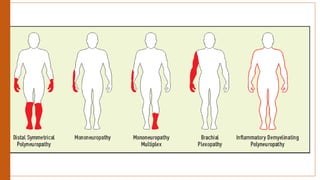
• May affect one nerve (mononeuropathy), several nerves together (polyneuropathy)
or several nerves not contiguous (Mononeuropathy multiplex)
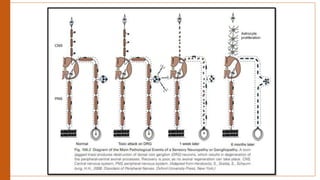
• Further classified into those that primarily affect the cell body (e.g., neuronopathy
or ganglionopathy), myelin (myelinopathy), and the axon (axonopathy)
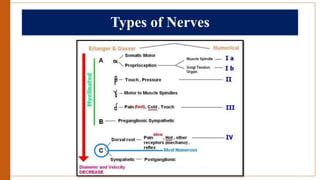
Types of Nerves
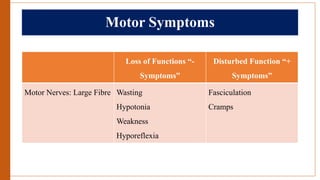
Motor Symptoms
Loss of Functions “-
Symptoms”
Disturbed Function “+
Symptoms”
Motor Nerves: Large Fibre Wasting
Hypotonia
Weakness
Hyporeflexia
Fasciculation
Cramps
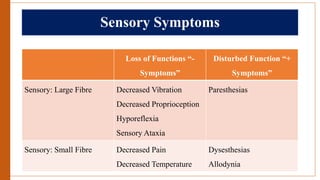
Sensory Symptoms
Loss of Functions “-
Symptoms”
Disturbed Function “+
Symptoms”
Sensory: Large Fibre Decreased Vibration
Decreased Proprioception
Hyporeflexia
Sensory Ataxia
Paresthesias
Sensory: Small Fibre Decreased Pain
Decreased Temperature
Dysesthesias
Allodynia
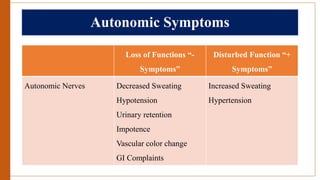
Autonomic Symptoms
Loss of Functions “-
Symptoms”
Disturbed Function “+
Symptoms”
Autonomic Nerves Decreased Sweating
Hypotension
Urinary retention
Impotence
Vascular color change
GI Complaints
Increased Sweating
Hypertension
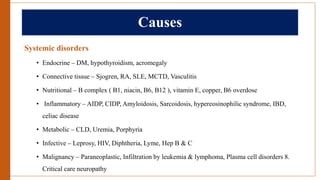
Causes
Systemic disorders
• Endocrine – DM, hypothyroidism, acromegaly
• Connective tissue – Sjogren, RA, SLE, MCTD, Vasculitis
• Nutritional – B complex ( B1, niacin, B6, B12 ), vitamin E, copper, B6 overdose
• Inflammatory – AIDP, CIDP, Amyloidosis, Sarcoidosis, hypereosinophilic syndrome, IBD,
celiac disease
• Metabolic – CLD, Uremia, Porphyria
• Infective – Leprosy, HIV, Diphtheria, Lyme, Hep B & C
• Malignancy – Paraneoplastic, Infiltration by leukemia & lymphoma, Plasma cell disorders 8.
Critical care neuropathy
Contd…
Systemic disorders
• Toxic ( Drugs/toxin )
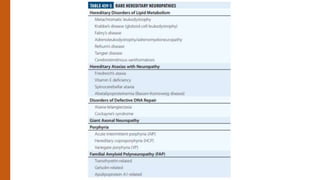
• Hereditary – CMT –M/C
• Environmental – Vibration induced, prolonged cold exposure, hypoxemia
• Idiopathic – 46%. Most cases > 50 years. Progression – slowly over months to years.
Predominant sensory symptoms. Proposed but unproven causes are HTn, dyslipidemia,
increased oxidative stress.
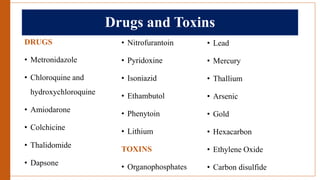
Drugs and Toxins
DRUGS
• Metronidazole
• Chloroquine and
hydroxychloroquine
• Amiodarone
• Colchicine
• Thalidomide
• Dapsone
• Nitrofurantoin
• Pyridoxine
• Isoniazid
• Ethambutol
• Phenytoin
• Lithium
TOXINS
• Organophosphates
• Lead
• Mercury
• Thallium
• Arsenic
• Gold
• Hexacarbon
• Ethylene Oxide
• Carbon disulfide
Mononeuropathy
• Focal involvement of a single nerve and implies a local process:
• Direct trauma
• Compression or entrapment
• Vascular lesions
• Neoplastic compression or infiltration
Mononeuropathy Multiplex
• Simultaneous /sequential damage to multiple noncontiguous nerves.
• Ischemia caused by vasculitis
• Microangiopathy in diabetes mellitus
• Less common causes : Granulomatous, leukemic, or neoplastic infiltration,
Hansen's disease (leprosy) and sarcoidosis.
Polyneuropathy
• Characterized by symmetrical, distal motor and sensory deficits that have a graded
increase in severity distally and by distal attenuation of reflexes,
• Rarely predominantly proximal:(E.g: acute intermittent porphyria).
• The sensory deficits generally follow a length-dependent stocking-glove pattern
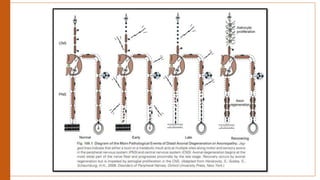
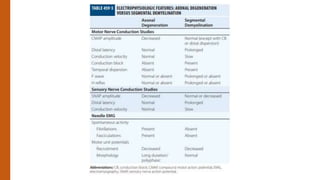
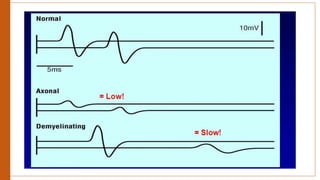
Axonopathies
• By far the majority of the toxic, metabolic and endocrine causes
• NCVs: CMAPs ↓ 80% lower limit of normal w/o or min velocity or distal motor
latency change.
• Legs>> arms.
• EMG: Signs of denervation (acute, chronic) and reinnervation
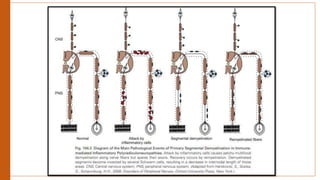
Myelinopathies
• Unusual by comparison with axonopathies
• Clues
• hypertrophic nerves on exam, global areflexia, weakness without wasting, motor >> sensory
deficits
• NCS
• Distal motor latency prolonged (>125% ULN), Conduction velocities slowed (<80% LLN)
May have conduction block
• EMG
• Reduced recruitment w/o much denervation
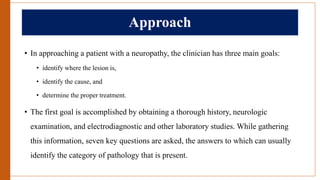
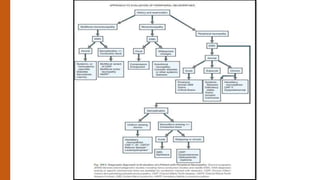
Approach
• In approaching a patient with a neuropathy, the clinician has three main goals:
• identify where the lesion is,
• identify the cause, and
• determine the proper treatment.
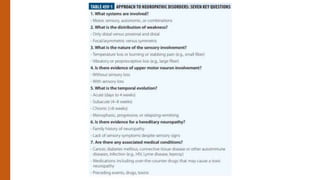
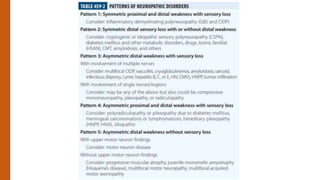
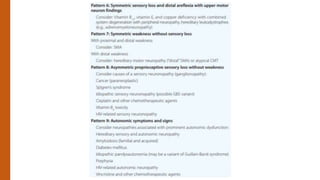
• The first goal is accomplished by obtaining a thorough history, neurologic
examination, and electrodiagnostic and other laboratory studies. While gathering
this information, seven key questions are asked, the answers to which can usually
identify the category of pathology that is present.
Evaluation
• Mild symptoms with known underlying lesion like DM, chemotherapy, alcohol
abuse – No evaluation is required
• Feature warranting a full evaluation
• Assymetry
• Non length dependence
• Motor predominance
• Acute onset
• Predominant autonomic involvement
• Rapidly progressive symptoms
• Sensory ataxia
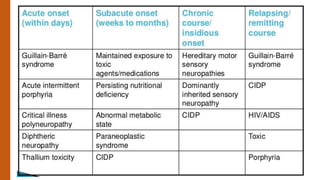
Acute / Abrupt Onset
• GBS
• Vasculitis
• Porphyria
• Infectious Disease (Lyme Disease, Diphthermia)
• Toxin / Drug- arsenic, thallium, chemotherapeutic agents, despone
Subacute / Chronic
• CIDP
• DM
• Vasculitis
• HIV
• Vitamin B12 Deficiency
• Copper Deficiency
• Paraneoplastic
• Sjogren Syndrome
• Toxin, Drug
Relapse and Remitting Course
• CIDP
• Porphyria
• HNPP
History
• The temporal course of a neuropathy varies, based on the etiology.
• With trauma or ischemic infarction, the onset will be acute, with the most severe symptoms at
onset.
• Inflammatory and some metabolic neuropathies have a subacute course extending over days to
weeks.
• A chronic course over weeks to months is the hallmark of most toxic and metabolic
neuropathies.
Contd…
• A chronic, slowly progressive neuropathy over many years occurs with most
hereditary neuropathies or with chronic inflammatory demyelinating
polyradiculoneuropathy (CIDP).
• Neuropathies with a relapsing and remitting course include CIDP, acute porphyria,
Refsum's disease, hereditary neuropathy with liability to pressure palsies (HNPP),
familial brachial plexus neuropathy, and repeated episodes of toxin exposure.
Contd…
• Ischemic neuropathies often have pain as a prominent feature.
• Small-fiber neuropathies often present with burning pain, lightning-like or
lancinating pain, aching, or uncomfortable paresthesias (dysesthesias).
• Dying-back (distal symmetric axonal) neuropathies initially involve the tips of the
toes and progress proximally in a stocking-glove distribution.
• Peripheral neuropathy can present as restless leg syndrome.
• Proximal involvement may result in difficulty climbing stairs, getting out of a
chair, lifting and bulbar involvement can also be seen
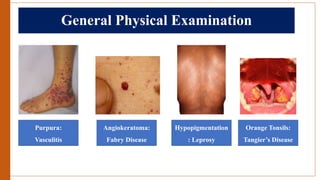
General Physical Examination
Purpura:
Vasculitis
Angiokeratoma:
Fabry Disease
Hypopigmentation
: Leprosy
Orange Tonsils:
Tangier’s Disease
Contd…
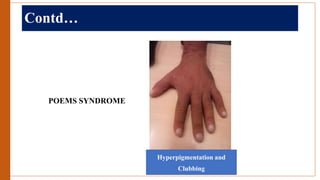
POEMS SYNDROME
Hyperpigmentation and
Clubbing
Contd…
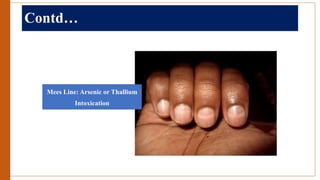
Mees Line: Arsenic or Thallium
Intoxication
Contd…
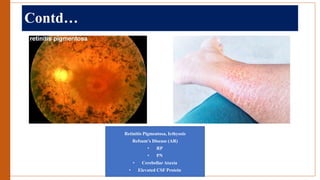
Retinitis Pigmentosa, Icthyosis
Refsum’s Disease (AR)
• RP
• PN
• Cerebellar Ataxia
• Elevated CSF Protein
Contd…
• Thickened Nerves
• Leprosy
• Neurofibromatosis
• Refsum’s Disease
• Amyloidosis
• HMSN
• DM
• Sarcoidosis
Contd…
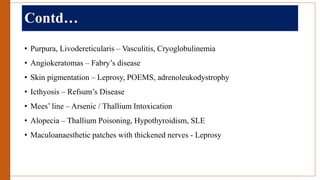
• Purpura, Livodereticularis – Vasculitis, Cryoglobulinemia
• Angiokeratomas – Fabry’s disease
• Skin pigmentation – Leprosy, POEMS, adrenoleukodystrophy
• Icthyosis – Refsum’s Disease
• Mees’ line – Arsenic / Thallium Intoxication
• Alopecia – Thallium Poisoning, Hypothyroidism, SLE
• Maculoanaesthetic patches with thickened nerves - Leprosy
Contd…
• Orange Tonsils – Tangier’s disease
• Pes cavus, high-arched feet and mutilation – Hereditary neuropathy
• Macroglossia – Amyloidosis
• Chelosis/Glossitis – Multivitamin deficiency
Recommendations for Lab Testing
• Screening laboratory tests may be considered for all patients with DSP.
• Tests with the highest yield of abnormality:
• Blood glucose (fasting)
• Serum B12 with metabolites (methylmalonic acid, homocysteine)
• SPEP(serum protein electrophoresis).
Other Laboratory Studies
• ANA, RF, Anti-dsDNA, Anti-Ro, Anti-La, ANCA screen, cryoglobulins
• Urine for heavy metals, porphyrins
• IFE/urine IFE/ plasma light chain analysis
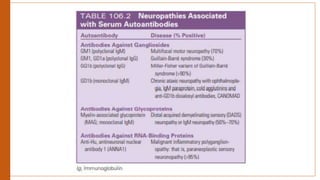
Neuropathies + Serum Autoantibodies
• Antibodies against Gangliosides
• GM1 : Multifocal motor neuropathy
• GM1, GD1a : Guillain-Barré syndrome
• GQ1b : Miller Fisher variant
• Antibodies against Glycoproteins
• Myelin-associated glycoprotein : MGUS
• Antibodies against RNA-binding proteins
• Anti-Hu, antineuronal nuclear antibody 1: Malignant inflammatory polyganglionopathy
Electrodiagnostic Studies
• Confirming the presence of neuropathy
• Locating focal nerve lesions
• Nature of the underlying nerve pathology
Laboratory Evaluation
• The limitations of EMG/NCS should be taken into account when interpreting the
findings.
• There is no reliable means of studying proximal sensory nerves.
• NCS results can be normal in patients with small-fiber neuropathies
• Lower extremity sensory responses can be absent in normal elderly patients.
• EMG/NCS are not substitutes for a good clinical examination.
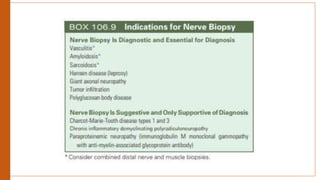
Nerve Biopsy
• In vasculitis, amyloid neuropathy, leprosy, CIDP, Inherited disorders of myelin,
and rare axonopathies
• The Sural nerve is selected most commonly
• The superficial peroneal nerve – alternative; :advantage of allowing simultaneous
biopsy of the peroneus brevis muscle through the same incision.
• This combined nerve and muscle biopsy procedure increases the yield of
identifying suspected vasculitis.
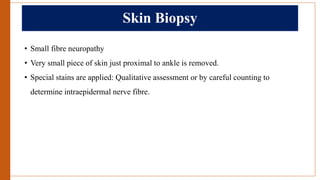
Skin Biopsy
• Small fibre neuropathy
• Very small piece of skin just proximal to ankle is removed.
• Special stains are applied: Qualitative assessment or by careful counting to
determine intraepidermal nerve fibre.
Case Study
Clinical Details
A 46 year old male presented with progressive asymmetric painful weakness of both upper limbs, 6 months
before presentation. Illness started with low grade fever and dry cough. He was evaluated, diagnosed and treated
for dengue fever and enteric fever based on his serological investigations, but there was no improvement.
Subsequently, he noticed difficulty in buttoning his shirt, beginning with the right hand and later affecting the
left hand as well. He was not able to perceive objects fully in palmer aspects of both hands. He significantly lost
weight. There is no lower limb weakness, bowel and bladder symptoms, nor any cranial nerve involvement. He
did not remember being exposed to drugs and toxins. Family history was not contributory. Examination
confirmed wasting, asymmetric sensory motor weakness, neurogenic tremor and depressed reflexes in both
upper limbs.
Clinical Details
In view of asymmetrical painful neurogenic weakness, EDX study was performed. It showed evidence of
multifocal sensory motor axonal neuropathy. His investigations showed eosinophilia. His ANA, ANA profile,
APLA, rheumatoid factor, sputum and BAL for AFB, serology for HBsAg, HCV and HIV were negative. His
blood sugar, renal function tests, thyroid function test, ECG, CSF, USG abdomen and MRI of the brain and
spine were normal. His p-ANCA was positive and CT thorax showed bronchopneumonia.
Discussion
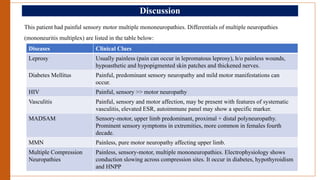
This patient had painful sensory motor multiple mononeuropathies. Differentials of multiple neuropathies
(mononeuritis multiplex) are listed in the table below:
Diseases Clinical Clues
Leprosy Usually painless (pain can occur in lepromatous leprosy), h/o painless wounds,
hypoasthetic and hypopigmented skin patches and thickened nerves.
Diabetes Mellitus Painful, predominant sensory neuropathy and mild motor manifestations can
occur.
HIV Painful, sensory >> motor neuropathy
Vasculitis Painful, sensory and motor affection, may be present with features of systematic
vasculitis, elevated ESR, autoimmune panel may show a specific marker.
MADSAM Sensory-motor, upper limb predominant, proximal + distal polyneuropathy.
Prominent sensory symptoms in extremities, more common in females fourth
decade.
MMN Painless, pure motor neuropathy affecting upper limb.
Multiple Compression
Neuropathies
Painless, sensory-motor, multiple mononeuropathies. Electrophysiology shows
conduction slowing across compression sites. It occur in diabetes, hypothyroidism
and HNPP
Contd…
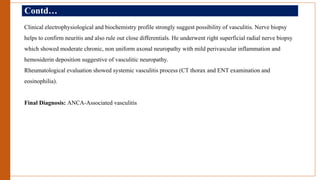
Clinical electrophysiological and biochemistry profile strongly suggest possibility of vasculitis. Nerve biopsy
helps to confirm neuritis and also rule out close differentials. He underwent right superficial radial nerve biopsy
which showed moderate chronic, non uniform axonal neuropathy with mild perivascular inflammation and
hemosiderin deposition suggestive of vasculitic neuropathy.
Rheumatological evaluation showed systemic vasculitis process (CT thorax and ENT examination and
eosinophilia).
Final Diagnosis: ANCA-Associated vasculitis
Reference List
• Bradley and Daroff’s Neurology in Clinical Practice: 8th Edition.
• Harrison’s Principles of Internal Medicine: 20th Edition.
• Amato AA, Russell J: Neuromuscular Disorder 2nd Edition, New York, Mc Graw
Hill, 2016.
• Pattern Recognition Approach to Neuropathy and Neuronopathy. Neurol Clin
31:343, 2013.
• Evaluation of Distel Symmetric Polyneuropathy: The Role of Laboratory and
Genetic Testing. Muscle Nerve 48:604, 2013.
THANK YOU

Approach to Peripheral Neuropathy

  • 1.
    Approach to Peripheral Neuropathy Presenter Dr.Kshitij Bansal Senior Resident Department of Neurology GMC, Kota
  • 2.
    Introduction • Generalized termincluding disorders of any cause affecting PNS • May involve sensory nerves, motor nerves, or both • May affect one nerve (mononeuropathy), several nerves together (polyneuropathy) or several nerves not contiguous (Mononeuropathy multiplex) • Further classified into those that primarily affect the cell body (e.g., neuronopathy or ganglionopathy), myelin (myelinopathy), and the axon (axonopathy)
  • 3.
  • 4.
    Motor Symptoms Loss ofFunctions “- Symptoms” Disturbed Function “+ Symptoms” Motor Nerves: Large Fibre Wasting Hypotonia Weakness Hyporeflexia Fasciculation Cramps
  • 5.
    Sensory Symptoms Loss ofFunctions “- Symptoms” Disturbed Function “+ Symptoms” Sensory: Large Fibre Decreased Vibration Decreased Proprioception Hyporeflexia Sensory Ataxia Paresthesias Sensory: Small Fibre Decreased Pain Decreased Temperature Dysesthesias Allodynia
  • 6.
    Autonomic Symptoms Loss ofFunctions “- Symptoms” Disturbed Function “+ Symptoms” Autonomic Nerves Decreased Sweating Hypotension Urinary retention Impotence Vascular color change GI Complaints Increased Sweating Hypertension
  • 7.
    Causes Systemic disorders • Endocrine– DM, hypothyroidism, acromegaly • Connective tissue – Sjogren, RA, SLE, MCTD, Vasculitis • Nutritional – B complex ( B1, niacin, B6, B12 ), vitamin E, copper, B6 overdose • Inflammatory – AIDP, CIDP, Amyloidosis, Sarcoidosis, hypereosinophilic syndrome, IBD, celiac disease • Metabolic – CLD, Uremia, Porphyria • Infective – Leprosy, HIV, Diphtheria, Lyme, Hep B & C • Malignancy – Paraneoplastic, Infiltration by leukemia & lymphoma, Plasma cell disorders 8. Critical care neuropathy
  • 8.
    Contd… Systemic disorders • Toxic( Drugs/toxin ) • Hereditary – CMT –M/C • Environmental – Vibration induced, prolonged cold exposure, hypoxemia • Idiopathic – 46%. Most cases > 50 years. Progression – slowly over months to years. Predominant sensory symptoms. Proposed but unproven causes are HTn, dyslipidemia, increased oxidative stress.
  • 9.
    Drugs and Toxins DRUGS •Metronidazole • Chloroquine and hydroxychloroquine • Amiodarone • Colchicine • Thalidomide • Dapsone • Nitrofurantoin • Pyridoxine • Isoniazid • Ethambutol • Phenytoin • Lithium TOXINS • Organophosphates • Lead • Mercury • Thallium • Arsenic • Gold • Hexacarbon • Ethylene Oxide • Carbon disulfide
  • 11.
    Mononeuropathy • Focal involvementof a single nerve and implies a local process: • Direct trauma • Compression or entrapment • Vascular lesions • Neoplastic compression or infiltration
  • 12.
    Mononeuropathy Multiplex • Simultaneous/sequential damage to multiple noncontiguous nerves. • Ischemia caused by vasculitis • Microangiopathy in diabetes mellitus • Less common causes : Granulomatous, leukemic, or neoplastic infiltration, Hansen's disease (leprosy) and sarcoidosis.
  • 13.
    Polyneuropathy • Characterized bysymmetrical, distal motor and sensory deficits that have a graded increase in severity distally and by distal attenuation of reflexes, • Rarely predominantly proximal:(E.g: acute intermittent porphyria). • The sensory deficits generally follow a length-dependent stocking-glove pattern
  • 15.
    Axonopathies • By farthe majority of the toxic, metabolic and endocrine causes • NCVs: CMAPs ↓ 80% lower limit of normal w/o or min velocity or distal motor latency change. • Legs>> arms. • EMG: Signs of denervation (acute, chronic) and reinnervation
  • 16.
    Myelinopathies • Unusual bycomparison with axonopathies • Clues • hypertrophic nerves on exam, global areflexia, weakness without wasting, motor >> sensory deficits • NCS • Distal motor latency prolonged (>125% ULN), Conduction velocities slowed (<80% LLN) May have conduction block • EMG • Reduced recruitment w/o much denervation
  • 20.
    Approach • In approachinga patient with a neuropathy, the clinician has three main goals: • identify where the lesion is, • identify the cause, and • determine the proper treatment. • The first goal is accomplished by obtaining a thorough history, neurologic examination, and electrodiagnostic and other laboratory studies. While gathering this information, seven key questions are asked, the answers to which can usually identify the category of pathology that is present.
  • 25.
    Evaluation • Mild symptomswith known underlying lesion like DM, chemotherapy, alcohol abuse – No evaluation is required • Feature warranting a full evaluation • Assymetry • Non length dependence • Motor predominance • Acute onset • Predominant autonomic involvement • Rapidly progressive symptoms • Sensory ataxia
  • 26.
    Acute / AbruptOnset • GBS • Vasculitis • Porphyria • Infectious Disease (Lyme Disease, Diphthermia) • Toxin / Drug- arsenic, thallium, chemotherapeutic agents, despone
  • 27.
    Subacute / Chronic •CIDP • DM • Vasculitis • HIV • Vitamin B12 Deficiency • Copper Deficiency • Paraneoplastic • Sjogren Syndrome • Toxin, Drug
  • 28.
    Relapse and RemittingCourse • CIDP • Porphyria • HNPP
  • 29.
    History • The temporalcourse of a neuropathy varies, based on the etiology. • With trauma or ischemic infarction, the onset will be acute, with the most severe symptoms at onset. • Inflammatory and some metabolic neuropathies have a subacute course extending over days to weeks. • A chronic course over weeks to months is the hallmark of most toxic and metabolic neuropathies.
  • 30.
    Contd… • A chronic,slowly progressive neuropathy over many years occurs with most hereditary neuropathies or with chronic inflammatory demyelinating polyradiculoneuropathy (CIDP). • Neuropathies with a relapsing and remitting course include CIDP, acute porphyria, Refsum's disease, hereditary neuropathy with liability to pressure palsies (HNPP), familial brachial plexus neuropathy, and repeated episodes of toxin exposure.
  • 31.
    Contd… • Ischemic neuropathiesoften have pain as a prominent feature. • Small-fiber neuropathies often present with burning pain, lightning-like or lancinating pain, aching, or uncomfortable paresthesias (dysesthesias). • Dying-back (distal symmetric axonal) neuropathies initially involve the tips of the toes and progress proximally in a stocking-glove distribution. • Peripheral neuropathy can present as restless leg syndrome. • Proximal involvement may result in difficulty climbing stairs, getting out of a chair, lifting and bulbar involvement can also be seen
  • 33.
    General Physical Examination Purpura: Vasculitis Angiokeratoma: FabryDisease Hypopigmentation : Leprosy Orange Tonsils: Tangier’s Disease
  • 34.
  • 35.
    Contd… Mees Line: Arsenicor Thallium Intoxication
  • 36.
    Contd… Retinitis Pigmentosa, Icthyosis Refsum’sDisease (AR) • RP • PN • Cerebellar Ataxia • Elevated CSF Protein
  • 37.
    Contd… • Thickened Nerves •Leprosy • Neurofibromatosis • Refsum’s Disease • Amyloidosis • HMSN • DM • Sarcoidosis
  • 38.
    Contd… • Purpura, Livodereticularis– Vasculitis, Cryoglobulinemia • Angiokeratomas – Fabry’s disease • Skin pigmentation – Leprosy, POEMS, adrenoleukodystrophy • Icthyosis – Refsum’s Disease • Mees’ line – Arsenic / Thallium Intoxication • Alopecia – Thallium Poisoning, Hypothyroidism, SLE • Maculoanaesthetic patches with thickened nerves - Leprosy
  • 39.
    Contd… • Orange Tonsils– Tangier’s disease • Pes cavus, high-arched feet and mutilation – Hereditary neuropathy • Macroglossia – Amyloidosis • Chelosis/Glossitis – Multivitamin deficiency
  • 40.
    Recommendations for LabTesting • Screening laboratory tests may be considered for all patients with DSP. • Tests with the highest yield of abnormality: • Blood glucose (fasting) • Serum B12 with metabolites (methylmalonic acid, homocysteine) • SPEP(serum protein electrophoresis).
  • 41.
    Other Laboratory Studies •ANA, RF, Anti-dsDNA, Anti-Ro, Anti-La, ANCA screen, cryoglobulins • Urine for heavy metals, porphyrins • IFE/urine IFE/ plasma light chain analysis
  • 42.
    Neuropathies + SerumAutoantibodies • Antibodies against Gangliosides • GM1 : Multifocal motor neuropathy • GM1, GD1a : Guillain-Barré syndrome • GQ1b : Miller Fisher variant • Antibodies against Glycoproteins • Myelin-associated glycoprotein : MGUS • Antibodies against RNA-binding proteins • Anti-Hu, antineuronal nuclear antibody 1: Malignant inflammatory polyganglionopathy
  • 43.
    Electrodiagnostic Studies • Confirmingthe presence of neuropathy • Locating focal nerve lesions • Nature of the underlying nerve pathology
  • 46.
    Laboratory Evaluation • Thelimitations of EMG/NCS should be taken into account when interpreting the findings. • There is no reliable means of studying proximal sensory nerves. • NCS results can be normal in patients with small-fiber neuropathies • Lower extremity sensory responses can be absent in normal elderly patients. • EMG/NCS are not substitutes for a good clinical examination.
  • 47.
    Nerve Biopsy • Invasculitis, amyloid neuropathy, leprosy, CIDP, Inherited disorders of myelin, and rare axonopathies • The Sural nerve is selected most commonly • The superficial peroneal nerve – alternative; :advantage of allowing simultaneous biopsy of the peroneus brevis muscle through the same incision. • This combined nerve and muscle biopsy procedure increases the yield of identifying suspected vasculitis.
  • 49.
    Skin Biopsy • Smallfibre neuropathy • Very small piece of skin just proximal to ankle is removed. • Special stains are applied: Qualitative assessment or by careful counting to determine intraepidermal nerve fibre.
  • 51.
  • 52.
    Clinical Details A 46year old male presented with progressive asymmetric painful weakness of both upper limbs, 6 months before presentation. Illness started with low grade fever and dry cough. He was evaluated, diagnosed and treated for dengue fever and enteric fever based on his serological investigations, but there was no improvement. Subsequently, he noticed difficulty in buttoning his shirt, beginning with the right hand and later affecting the left hand as well. He was not able to perceive objects fully in palmer aspects of both hands. He significantly lost weight. There is no lower limb weakness, bowel and bladder symptoms, nor any cranial nerve involvement. He did not remember being exposed to drugs and toxins. Family history was not contributory. Examination confirmed wasting, asymmetric sensory motor weakness, neurogenic tremor and depressed reflexes in both upper limbs.
  • 53.
    Clinical Details In viewof asymmetrical painful neurogenic weakness, EDX study was performed. It showed evidence of multifocal sensory motor axonal neuropathy. His investigations showed eosinophilia. His ANA, ANA profile, APLA, rheumatoid factor, sputum and BAL for AFB, serology for HBsAg, HCV and HIV were negative. His blood sugar, renal function tests, thyroid function test, ECG, CSF, USG abdomen and MRI of the brain and spine were normal. His p-ANCA was positive and CT thorax showed bronchopneumonia.
  • 54.
    Discussion This patient hadpainful sensory motor multiple mononeuropathies. Differentials of multiple neuropathies (mononeuritis multiplex) are listed in the table below: Diseases Clinical Clues Leprosy Usually painless (pain can occur in lepromatous leprosy), h/o painless wounds, hypoasthetic and hypopigmented skin patches and thickened nerves. Diabetes Mellitus Painful, predominant sensory neuropathy and mild motor manifestations can occur. HIV Painful, sensory >> motor neuropathy Vasculitis Painful, sensory and motor affection, may be present with features of systematic vasculitis, elevated ESR, autoimmune panel may show a specific marker. MADSAM Sensory-motor, upper limb predominant, proximal + distal polyneuropathy. Prominent sensory symptoms in extremities, more common in females fourth decade. MMN Painless, pure motor neuropathy affecting upper limb. Multiple Compression Neuropathies Painless, sensory-motor, multiple mononeuropathies. Electrophysiology shows conduction slowing across compression sites. It occur in diabetes, hypothyroidism and HNPP
  • 55.
    Contd… Clinical electrophysiological andbiochemistry profile strongly suggest possibility of vasculitis. Nerve biopsy helps to confirm neuritis and also rule out close differentials. He underwent right superficial radial nerve biopsy which showed moderate chronic, non uniform axonal neuropathy with mild perivascular inflammation and hemosiderin deposition suggestive of vasculitic neuropathy. Rheumatological evaluation showed systemic vasculitis process (CT thorax and ENT examination and eosinophilia). Final Diagnosis: ANCA-Associated vasculitis
  • 56.
    Reference List • Bradleyand Daroff’s Neurology in Clinical Practice: 8th Edition. • Harrison’s Principles of Internal Medicine: 20th Edition. • Amato AA, Russell J: Neuromuscular Disorder 2nd Edition, New York, Mc Graw Hill, 2016. • Pattern Recognition Approach to Neuropathy and Neuronopathy. Neurol Clin 31:343, 2013. • Evaluation of Distel Symmetric Polyneuropathy: The Role of Laboratory and Genetic Testing. Muscle Nerve 48:604, 2013.
  • 57.