

APPROACH TO PERIPHERAL NEUROPATHY
By Mohamed A. Tarek
Assistant lecturer of Neurology
Master of Neuropsychiatry
Sohag university
By Mohamed A. Tarek
Assistant lecturer of Neurology
Master of Neuropsychiatry
Sohag university
Agenda:
◦ 1-Definition
◦ 2-classification
◦ 3-causes
◦ 4-c.p
◦ 5-investigations
◦ 6-management
◦ 7-Examples
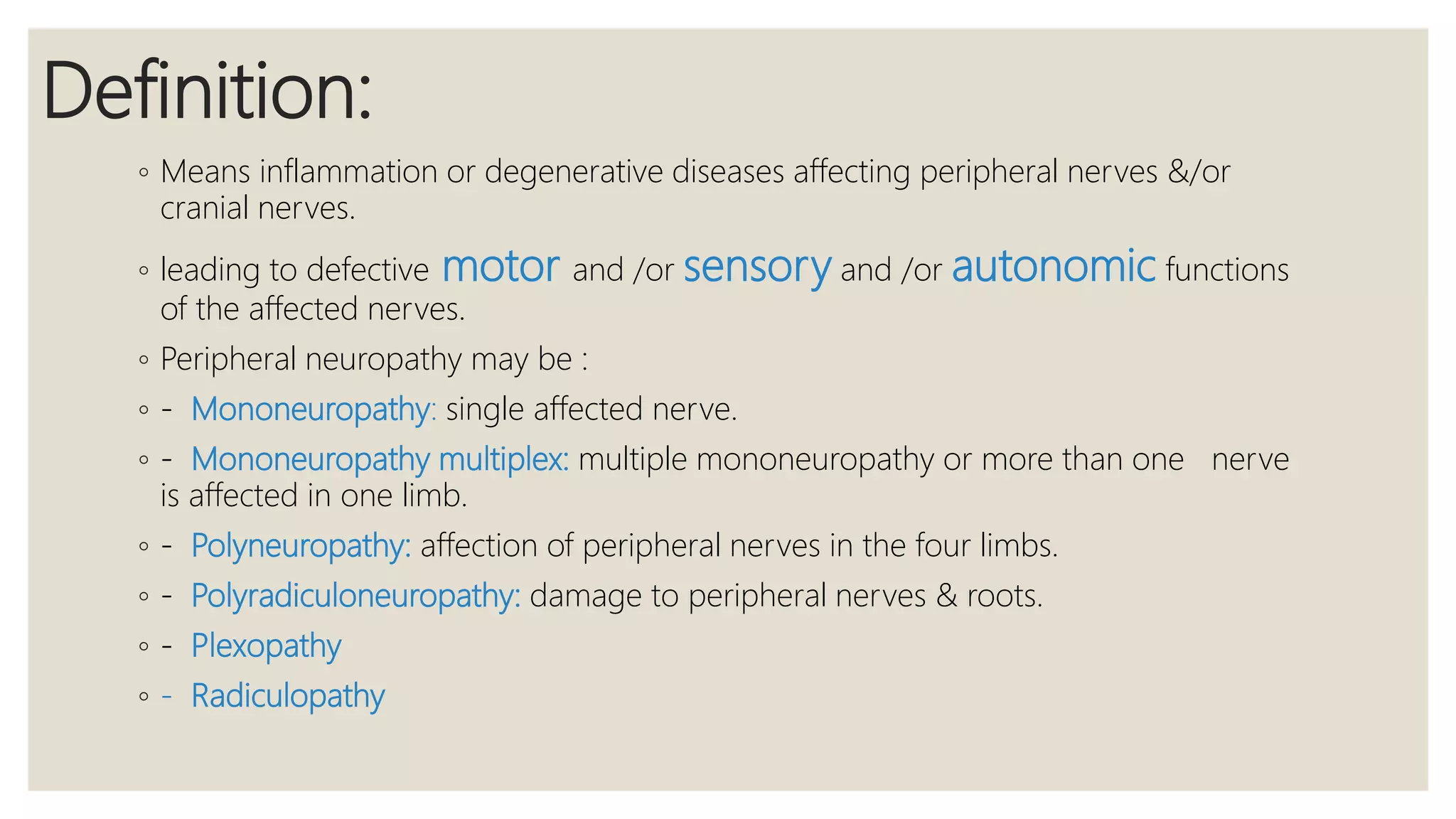
Definition:
◦ Means inflammation or degenerative diseases affecting peripheral nerves &/or
cranial nerves.
◦ leading to defective motor and /or sensory and /or autonomic functions
of the affected nerves.
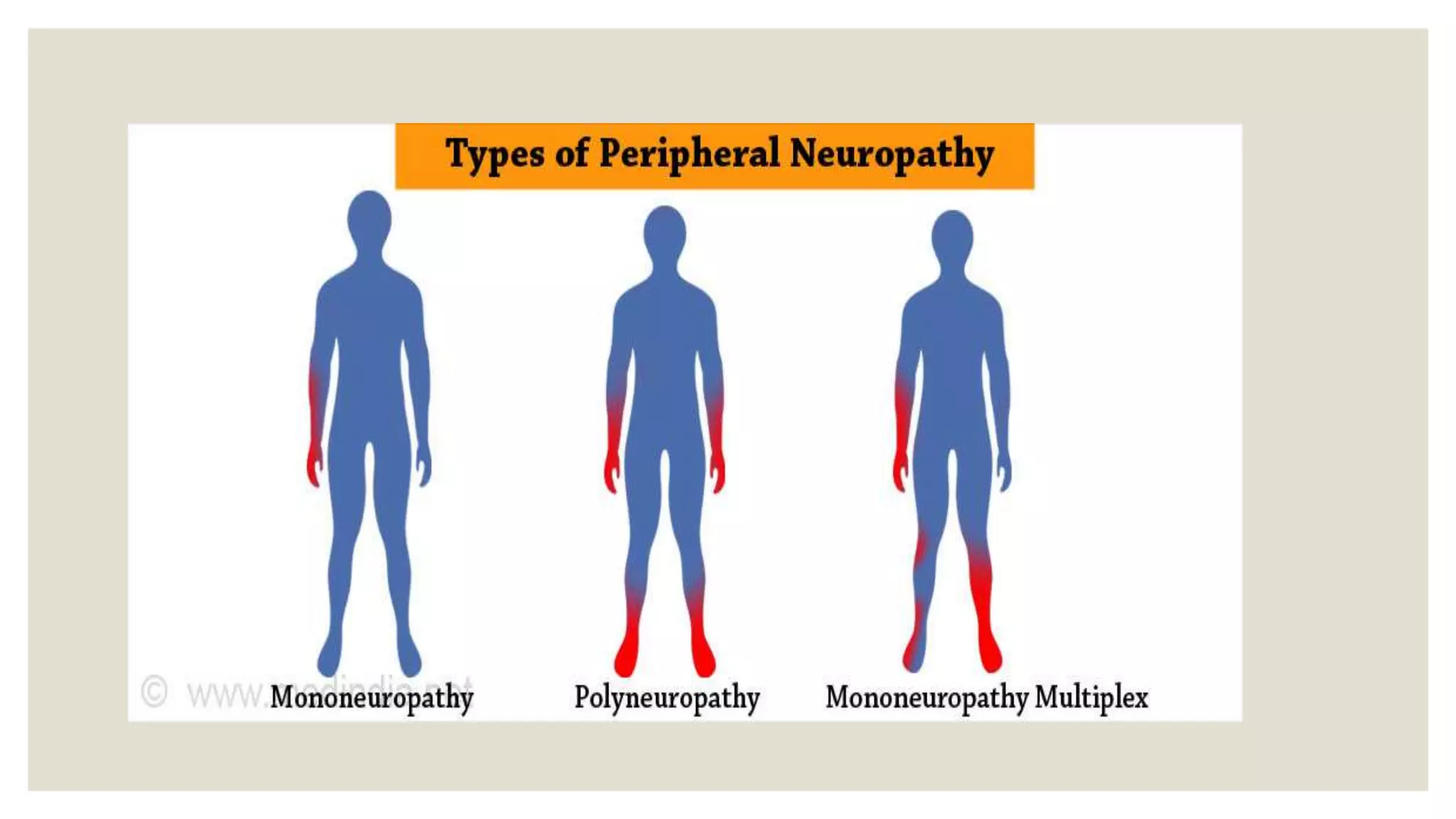
◦ Peripheral neuropathy may be :
◦ - Mononeuropathy: single affected nerve.
◦ - Mononeuropathy multiplex: multiple mononeuropathy or more than one nerve
is affected in one limb.
◦ - Polyneuropathy: affection of peripheral nerves in the four limbs.
◦ - Polyradiculoneuropathy: damage to peripheral nerves & roots.
◦ - Plexopathy
◦ - Radiculopathy
Classification:
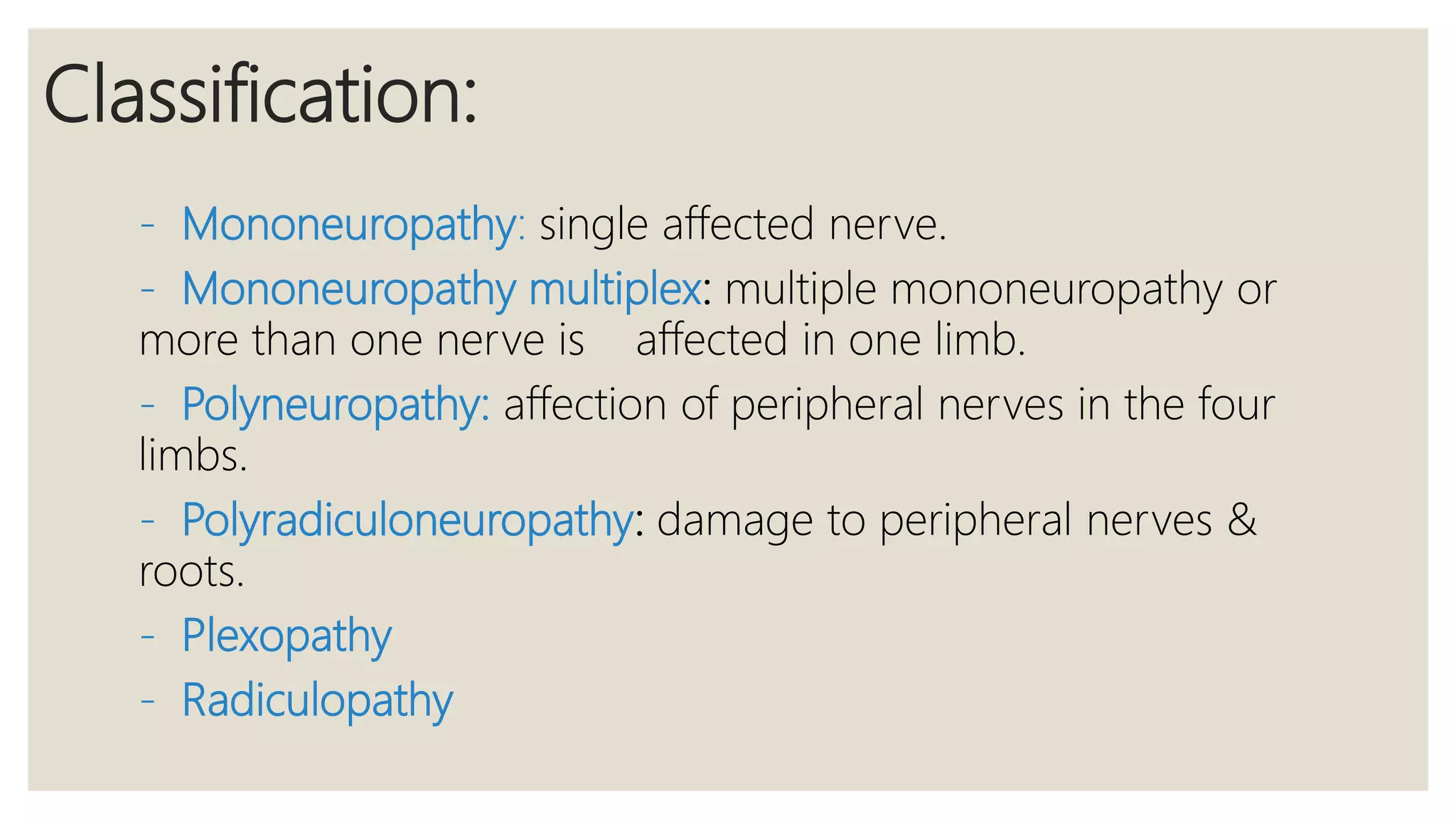
◦ There are 3 types of peripheral nerves :
◦Motor
◦Sensory
◦Autonomic
Classification:
- Mononeuropathy: single affected nerve.
- Mononeuropathy multiplex: multiple mononeuropathy or
more than one nerve is affected in one limb.
- Polyneuropathy: affection of peripheral nerves in the four
limbs.
- Polyradiculoneuropathy: damage to peripheral nerves &
roots.
- Plexopathy
- Radiculopathy
Classification:
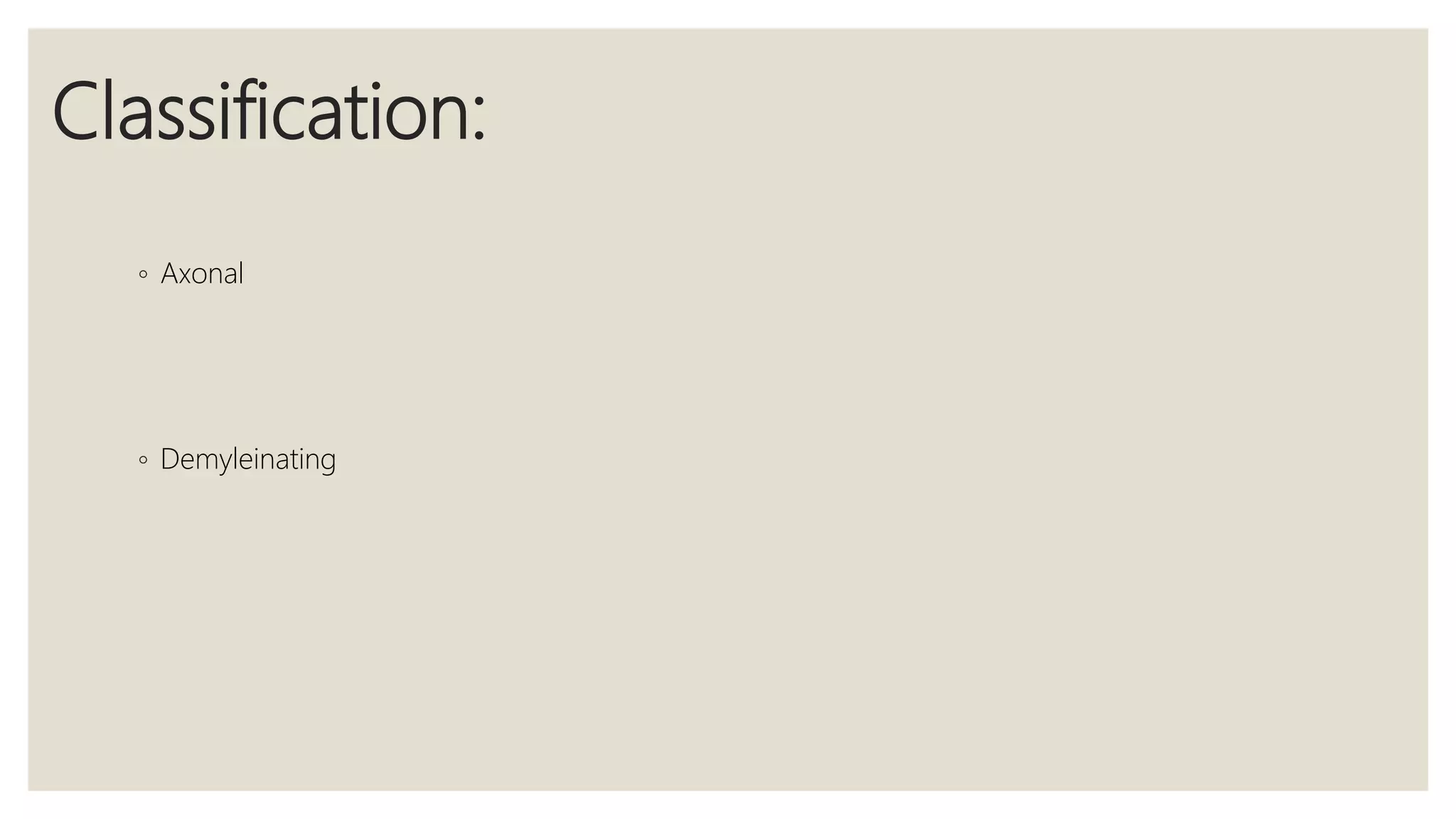
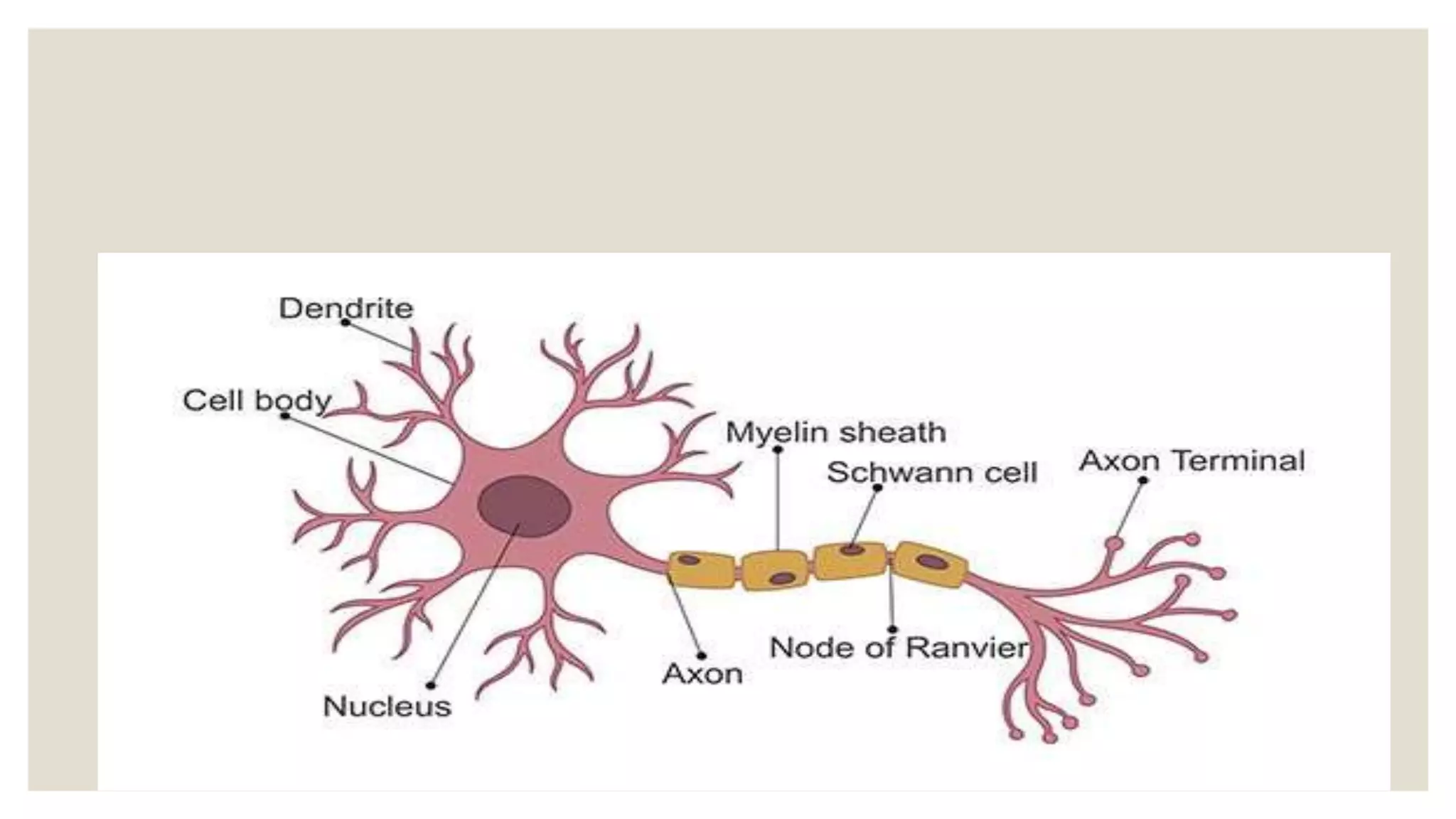
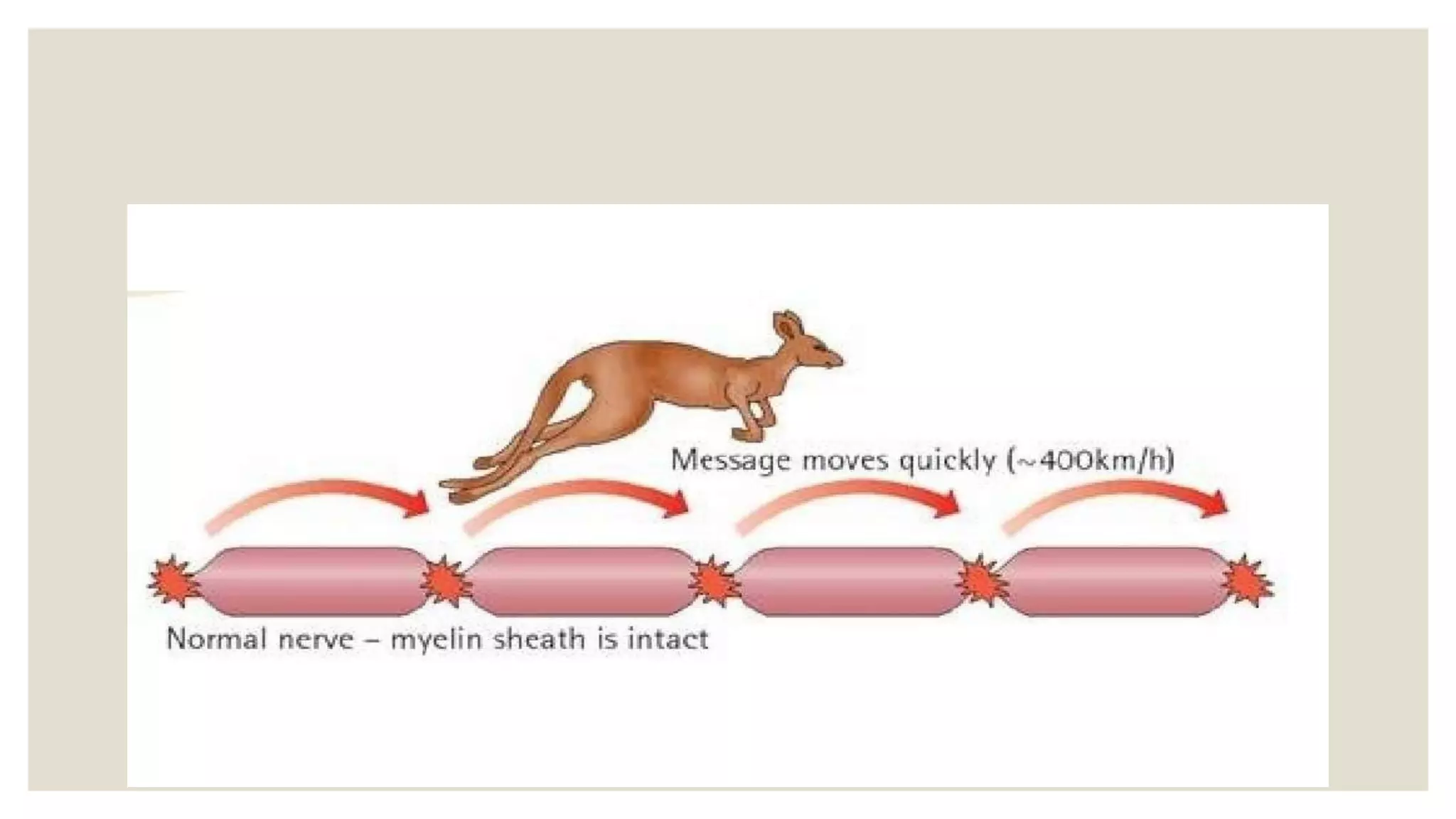
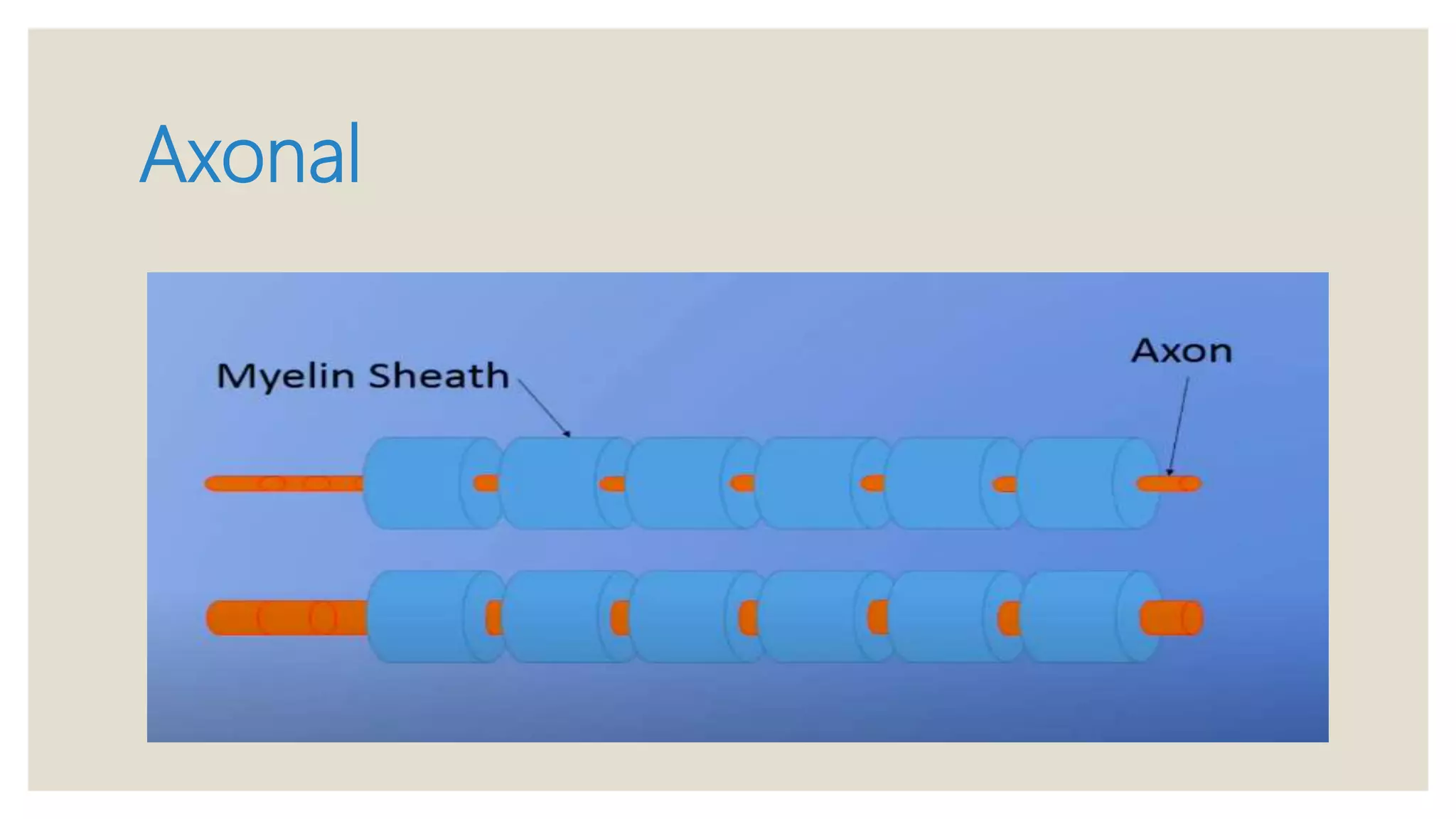
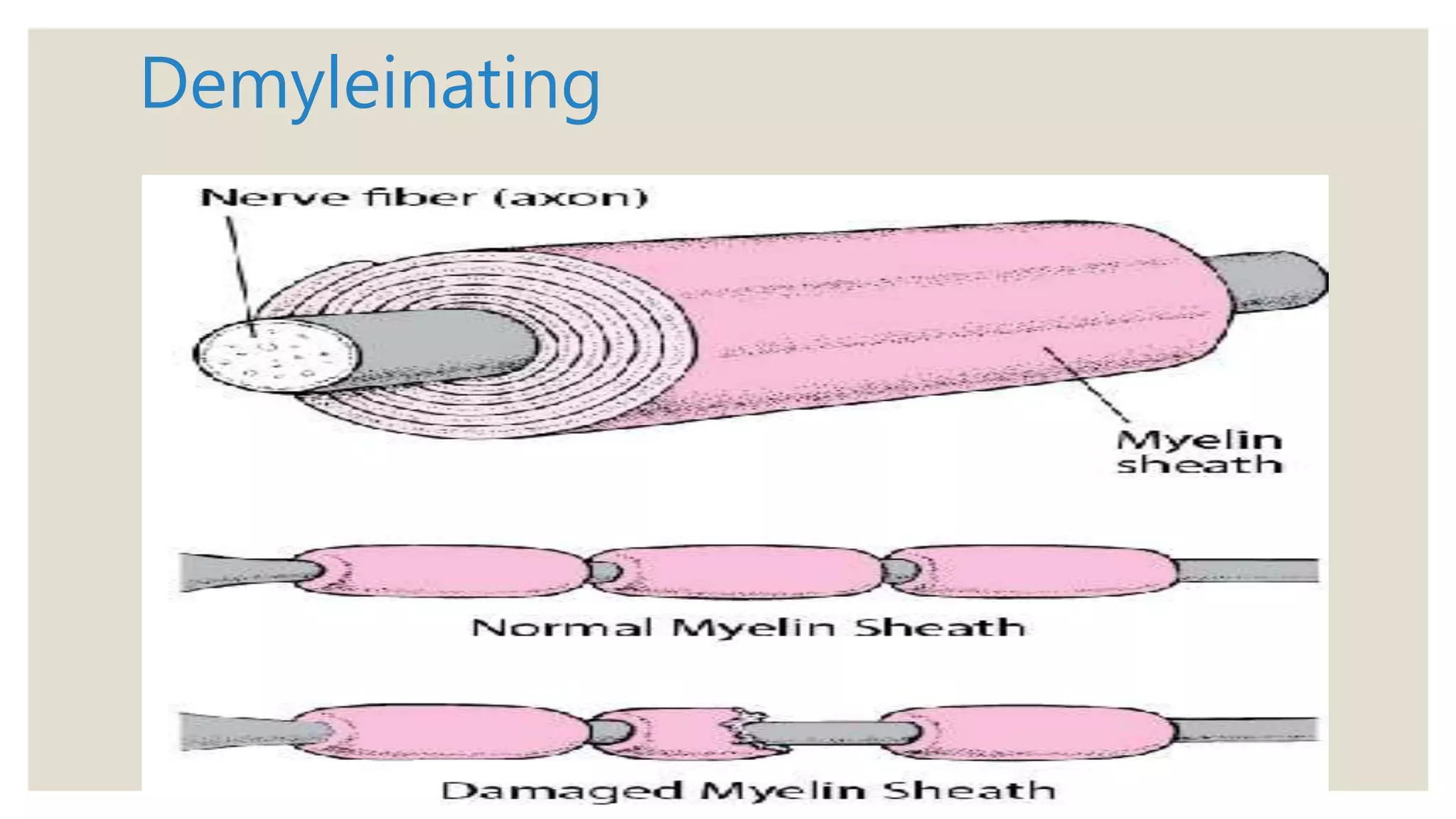
◦ Axonal
◦ Demyleinating
Axonal
Demyleinating
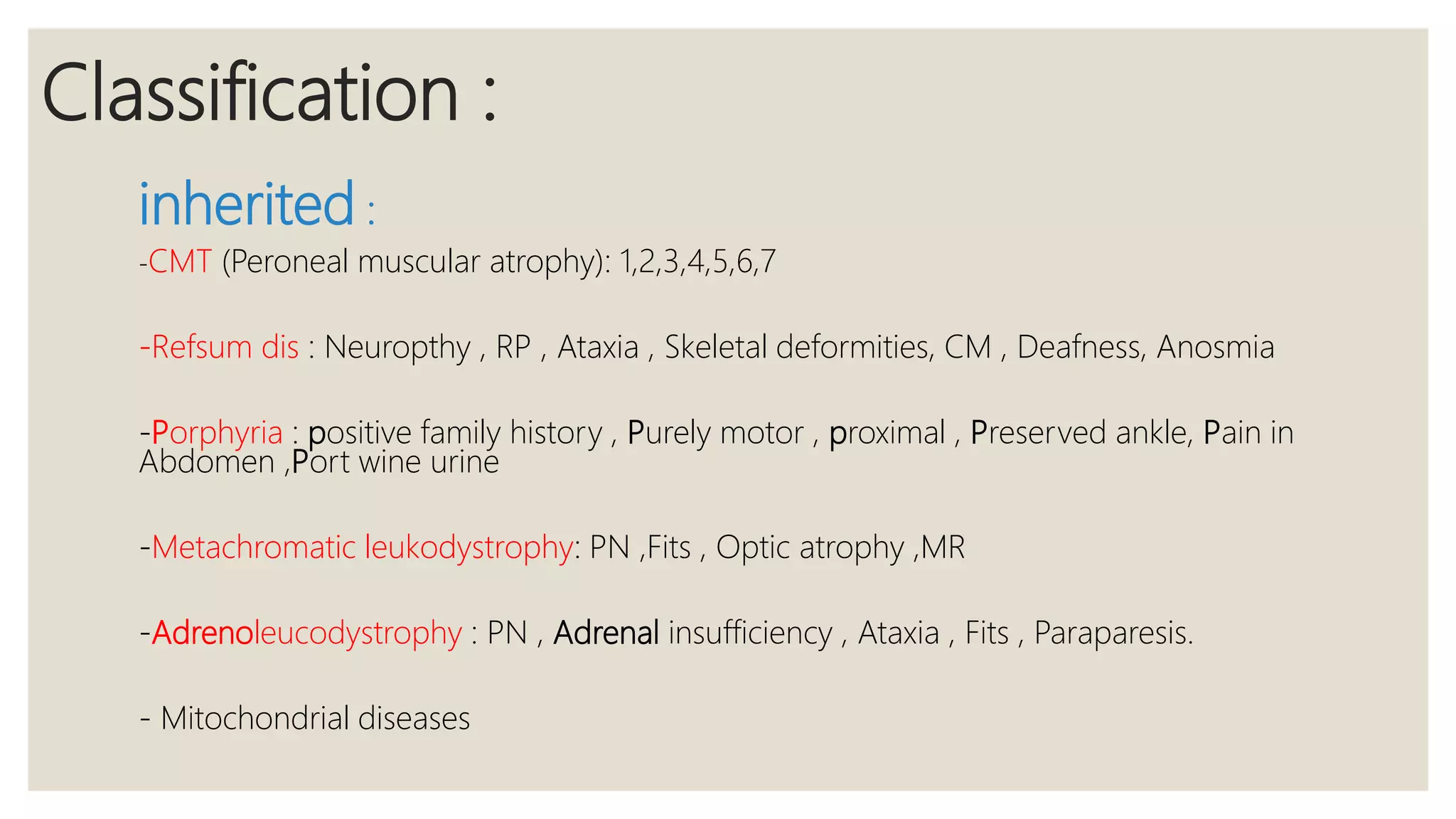
Classification :
inherited :
-CMT (Peroneal muscular atrophy): 1,2,3,4,5,6,7
-Refsum dis : Neuropthy , RP , Ataxia , Skeletal deformities, CM , Deafness, Anosmia
-Porphyria : positive family history , Purely motor , proximal , Preserved ankle, Pain in
Abdomen ,Port wine urine
-Metachromatic leukodystrophy: PN ,Fits , Optic atrophy ,MR
-Adrenoleucodystrophy : PN , Adrenal insufficiency , Ataxia , Fits , Paraparesis.
- Mitochondrial diseases
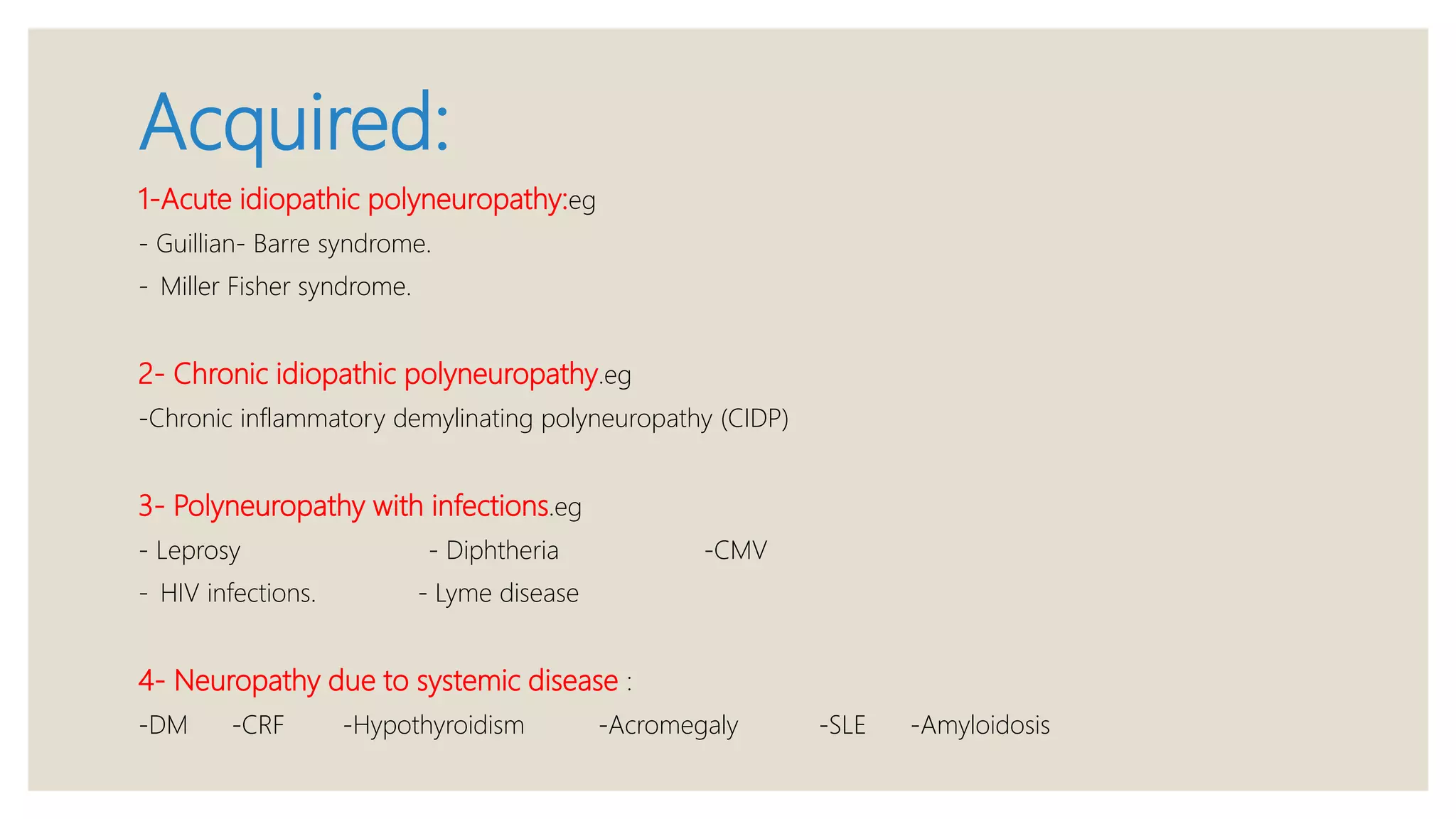
Acquired:
1-Acute idiopathic polyneuropathy:eg
- Guillian- Barre syndrome.
- Miller Fisher syndrome.
2- Chronic idiopathic polyneuropathy.eg
-Chronic inflammatory demylinating polyneuropathy (CIDP)
3- Polyneuropathy with infections.eg
- Leprosy - Diphtheria -CMV
- HIV infections. - Lyme disease
4- Neuropathy due to systemic disease :
-DM -CRF -Hypothyroidism -Acromegaly -SLE -Amyloidosis
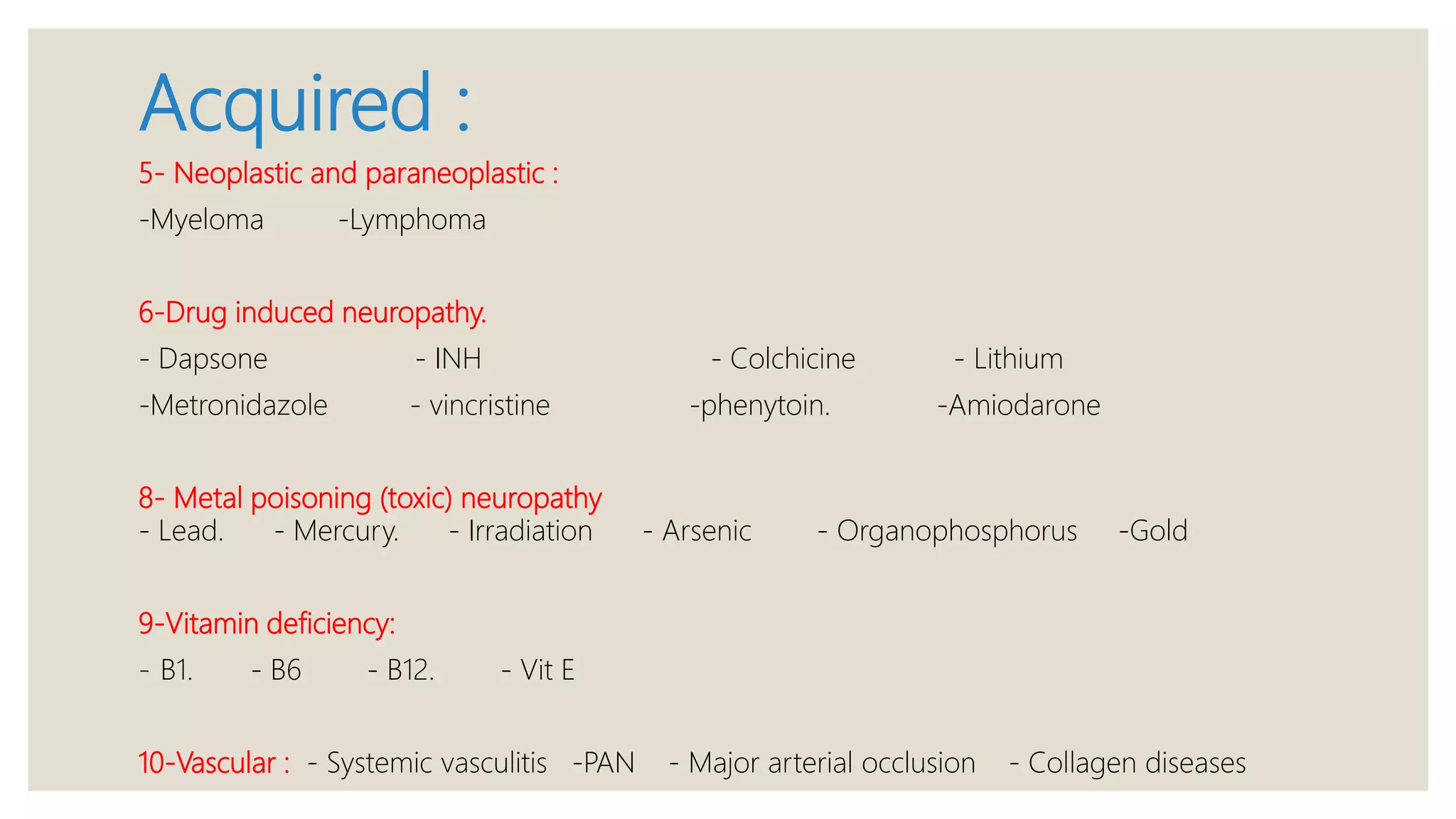
Acquired :
5- Neoplastic and paraneoplastic :
-Myeloma -Lymphoma
6-Drug induced neuropathy.
- Dapsone - INH - Colchicine - Lithium
-Metronidazole - vincristine -phenytoin. -Amiodarone
8- Metal poisoning (toxic) neuropathy
- Lead. - Mercury. - Irradiation - Arsenic - Organophosphorus -Gold
9-Vitamin deficiency:
- B1. - B6 - B12. - Vit E
10-Vascular : - Systemic vasculitis -PAN - Major arterial occlusion - Collagen diseases
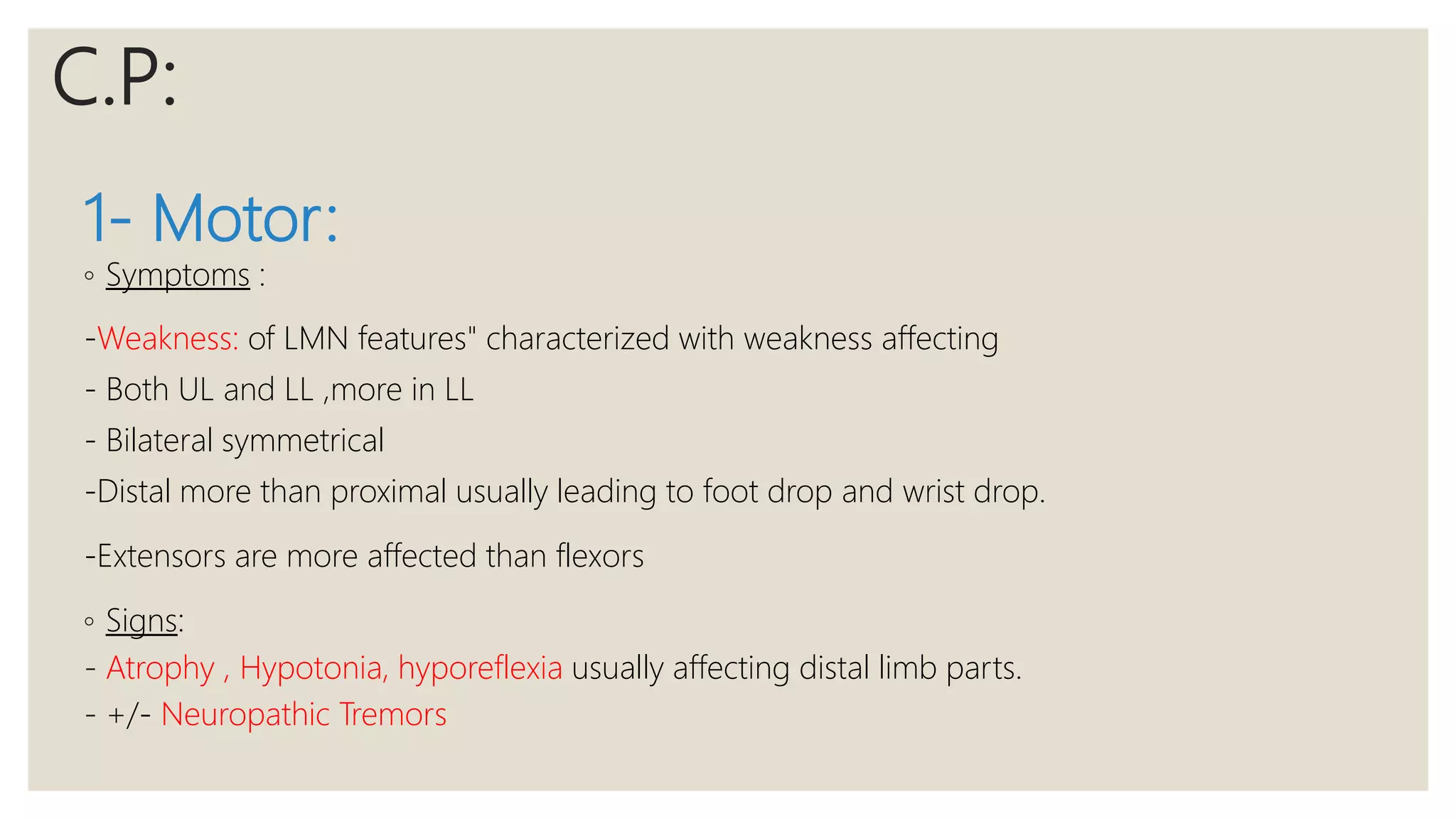
1- Motor:
◦ Symptoms :
-Weakness: of LMN features" characterized with weakness affecting
- Both UL and LL ,more in LL
- Bilateral symmetrical
-Distal more than proximal usually leading to foot drop and wrist drop.
-Extensors are more affected than flexors
◦ Signs:
- Atrophy , Hypotonia, hyporeflexia usually affecting distal limb parts.
- +/- Neuropathic Tremors
C.P:
C.P :
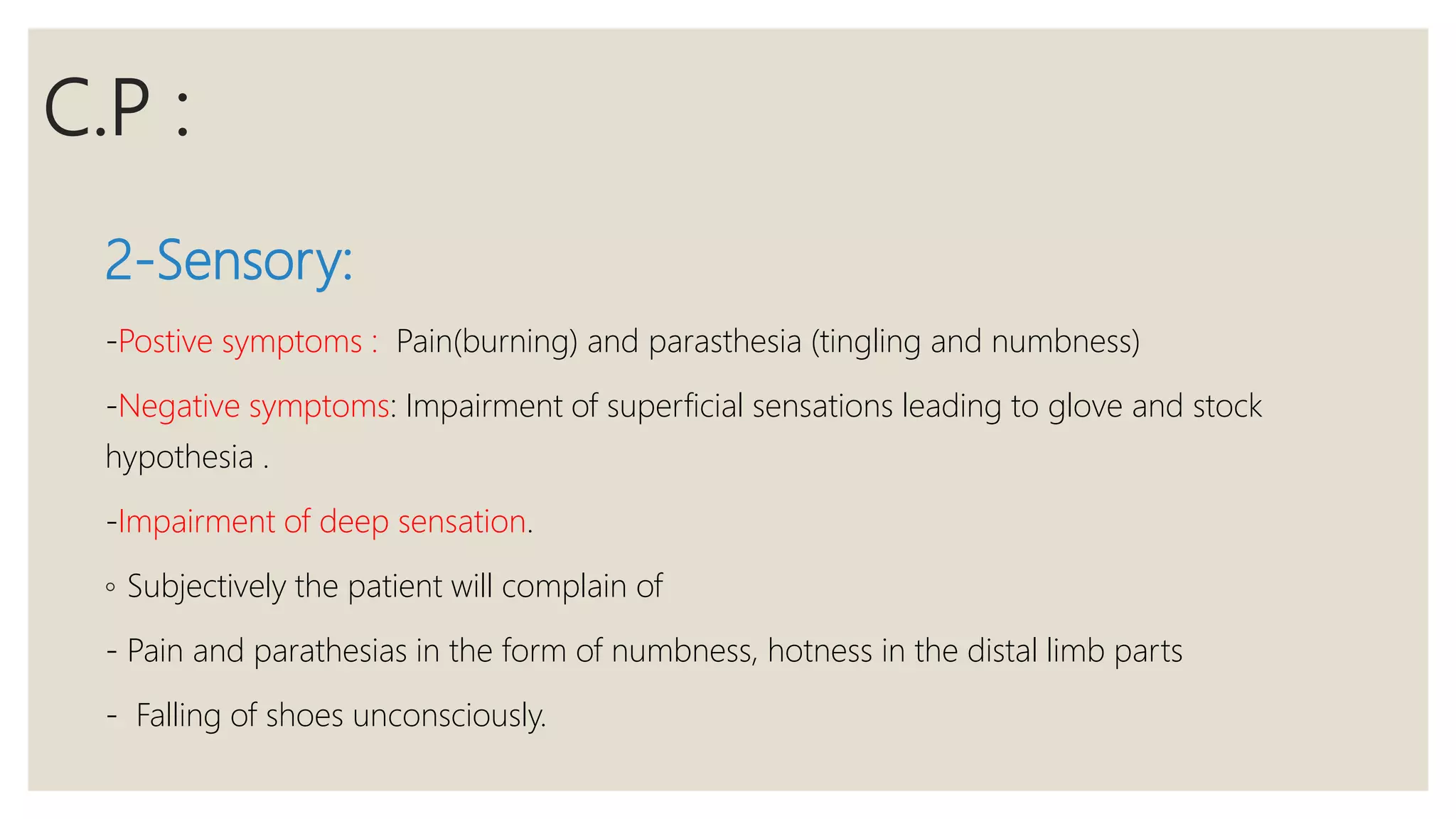
2-Sensory:
-Postive symptoms : Pain(burning) and parasthesia (tingling and numbness)
-Negative symptoms: Impairment of superficial sensations leading to glove and stock
hypothesia .
-Impairment of deep sensation.
◦ Subjectively the patient will complain of
- Pain and parathesias in the form of numbness, hotness in the distal limb parts
- Falling of shoes unconsciously.
C.P:
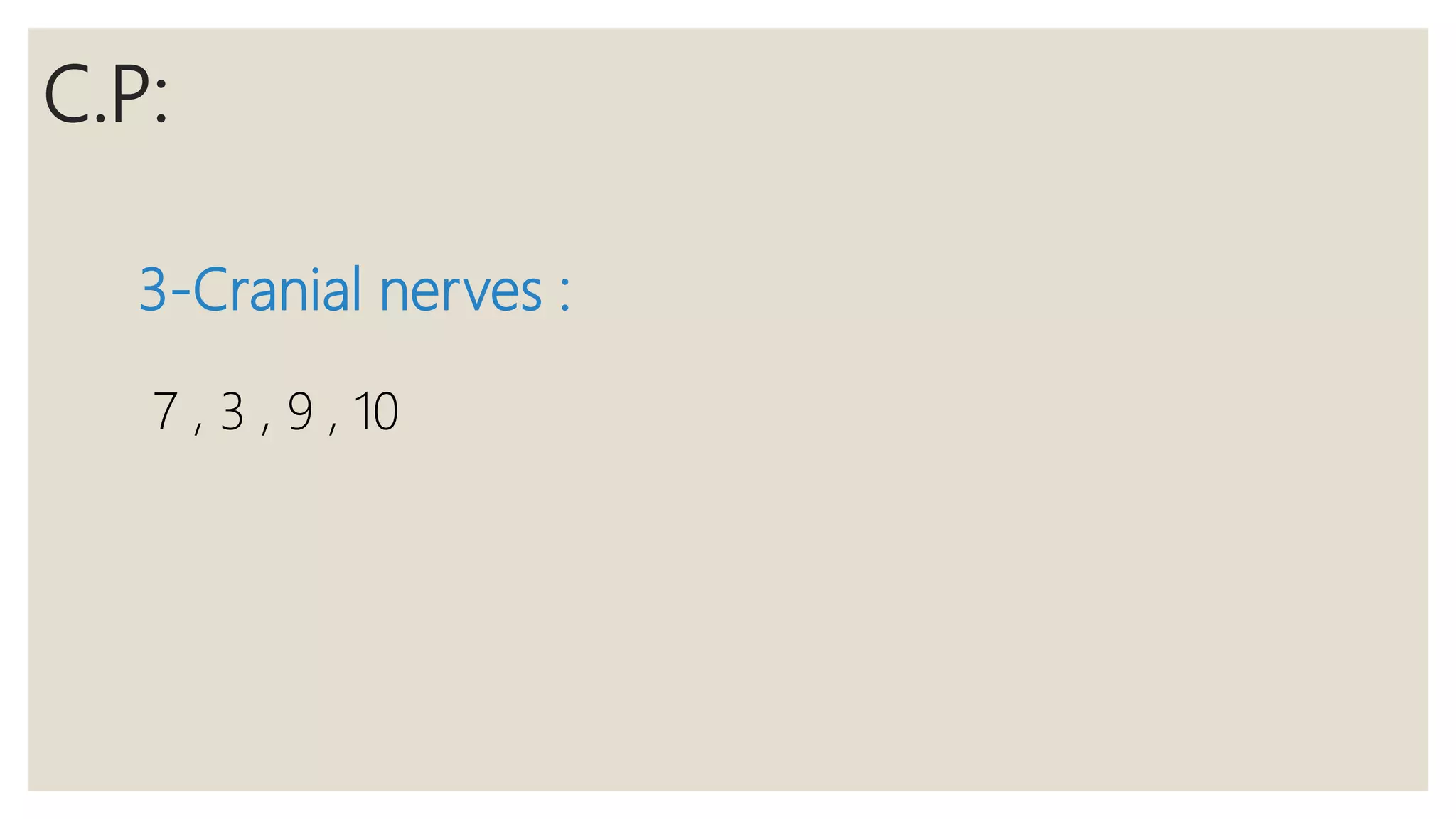
3-Cranial nerves :
7 , 3 , 9 , 10
C.P :
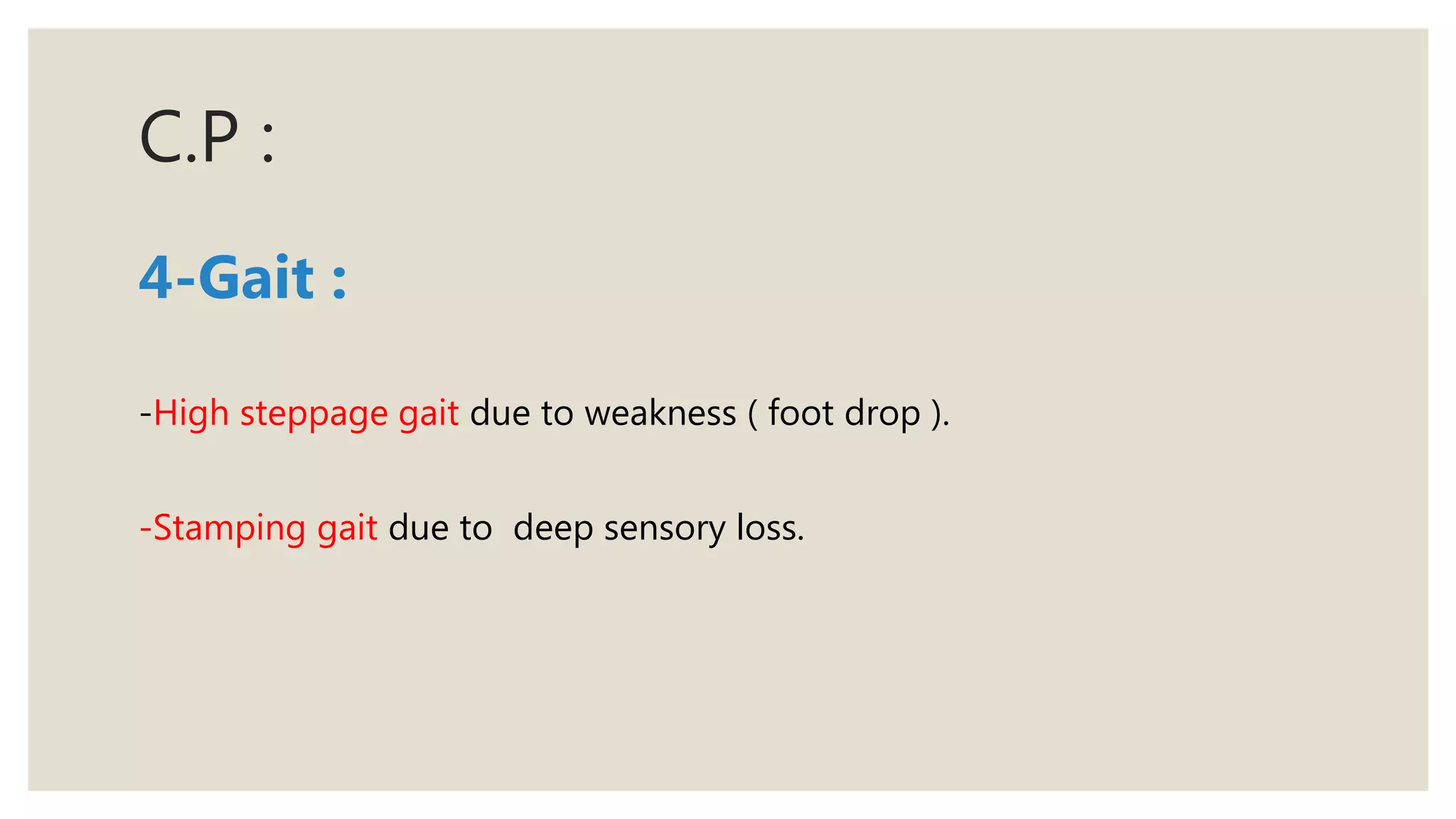
4-Gait :
-High steppage gait due to weakness ( foot drop ).
-Stamping gait due to deep sensory loss.
C.P :
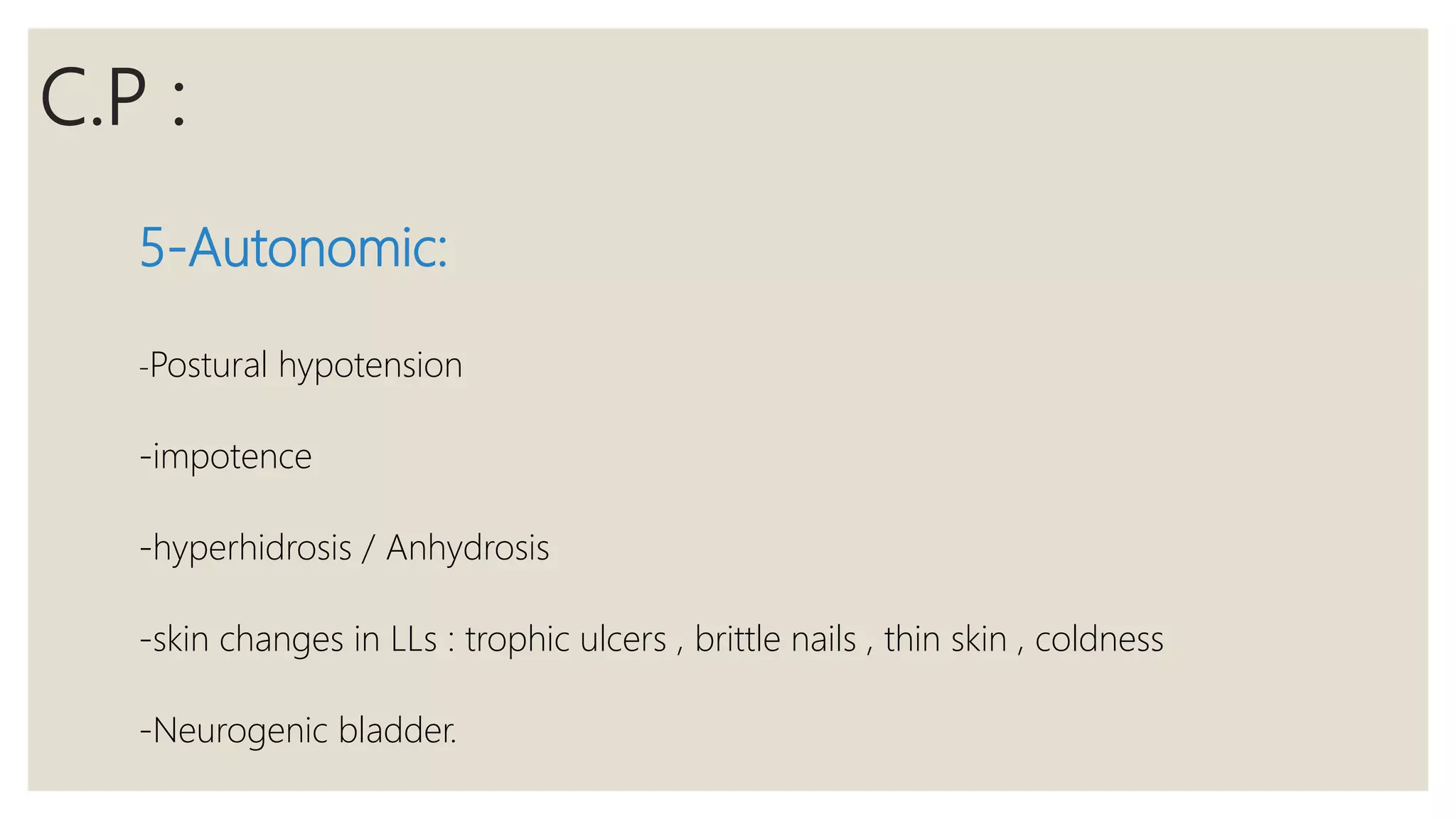
5-Autonomic:
-Postural hypotension
-impotence
-hyperhidrosis / Anhydrosis
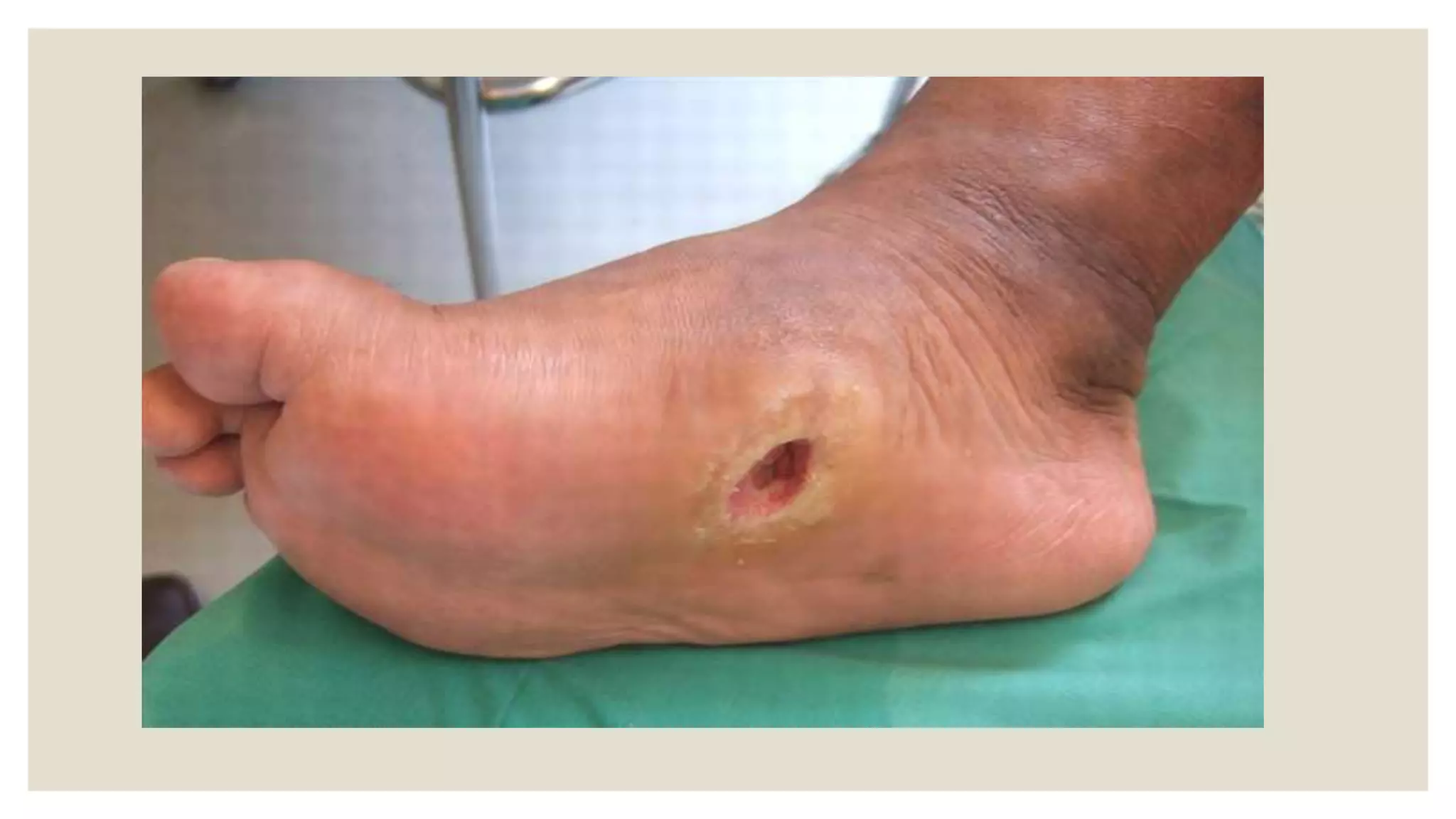
-skin changes in LLs : trophic ulcers , brittle nails , thin skin , coldness
-Neurogenic bladder.
Important clinical Points :
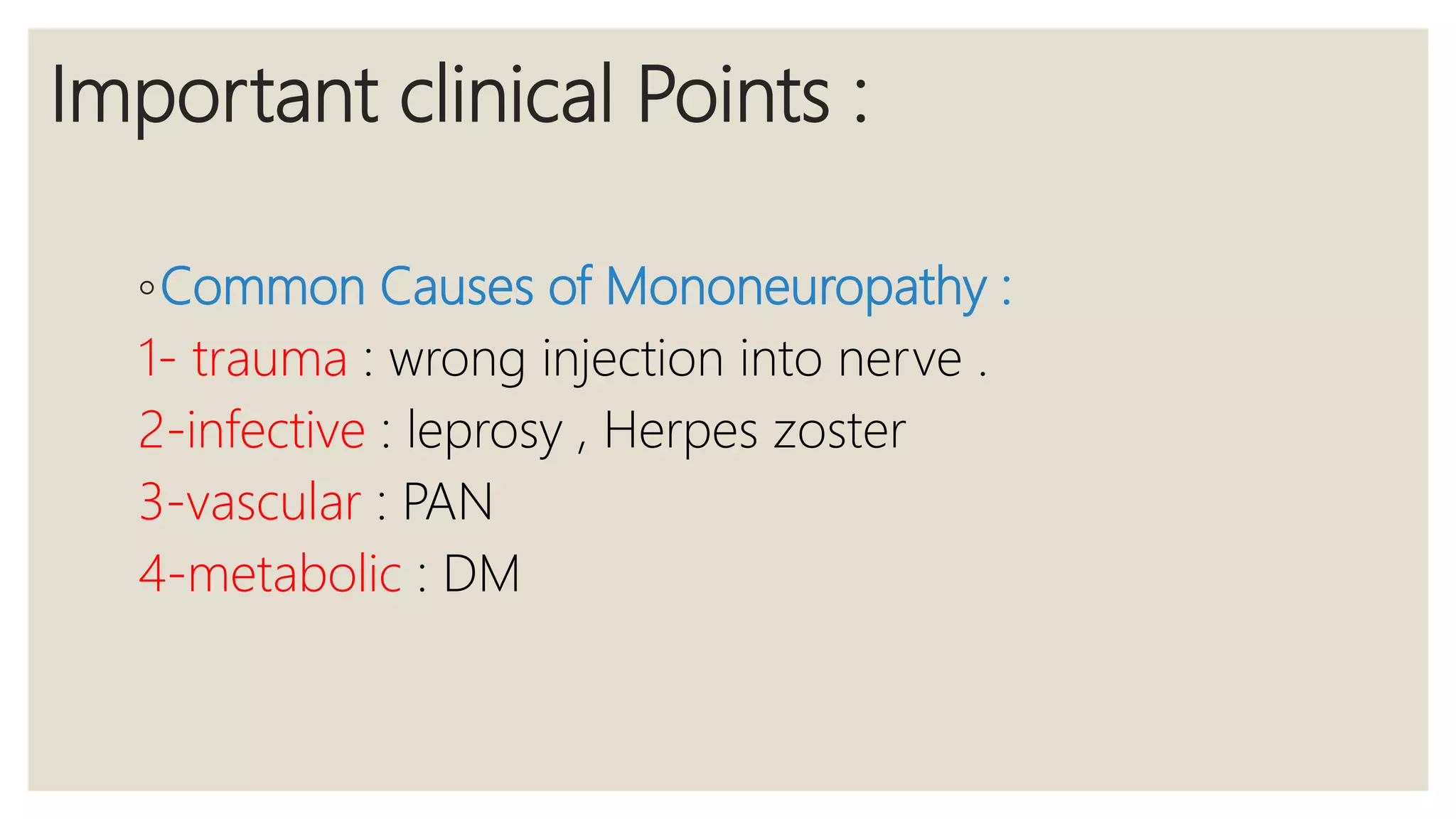
◦Common Causes of Mononeuropathy :
1- trauma : wrong injection into nerve .
2-infective : leprosy , Herpes zoster
3-vascular : PAN
4-metabolic : DM
Important clinical Points :
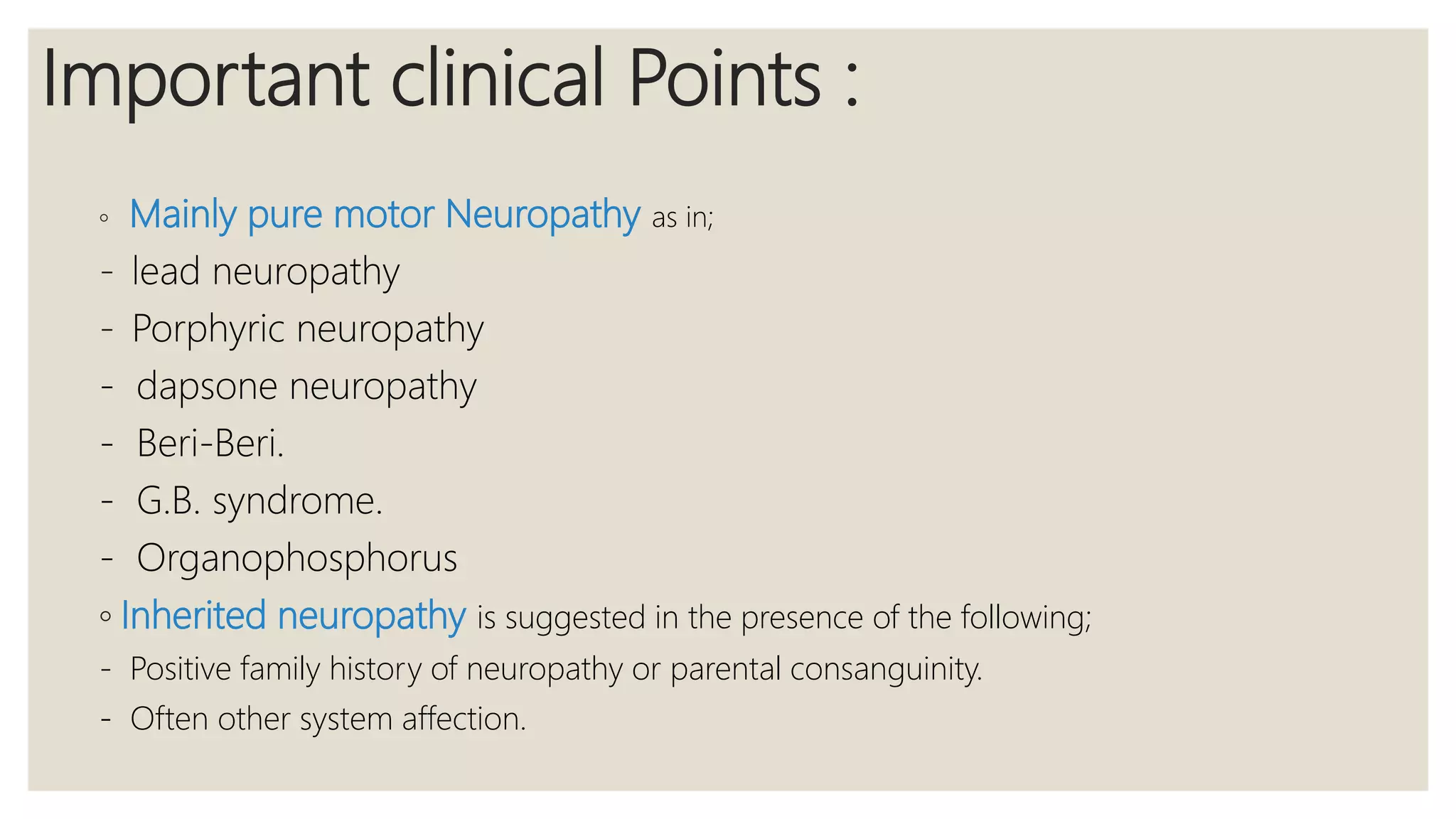
◦ Mainly pure motor Neuropathy as in;
- lead neuropathy
- Porphyric neuropathy
- dapsone neuropathy
- Beri-Beri.
- G.B. syndrome.
- Organophosphorus
◦ Inherited neuropathy is suggested in the presence of the following;
- Positive family history of neuropathy or parental consanguinity.
- Often other system affection.
Important clinical Points :
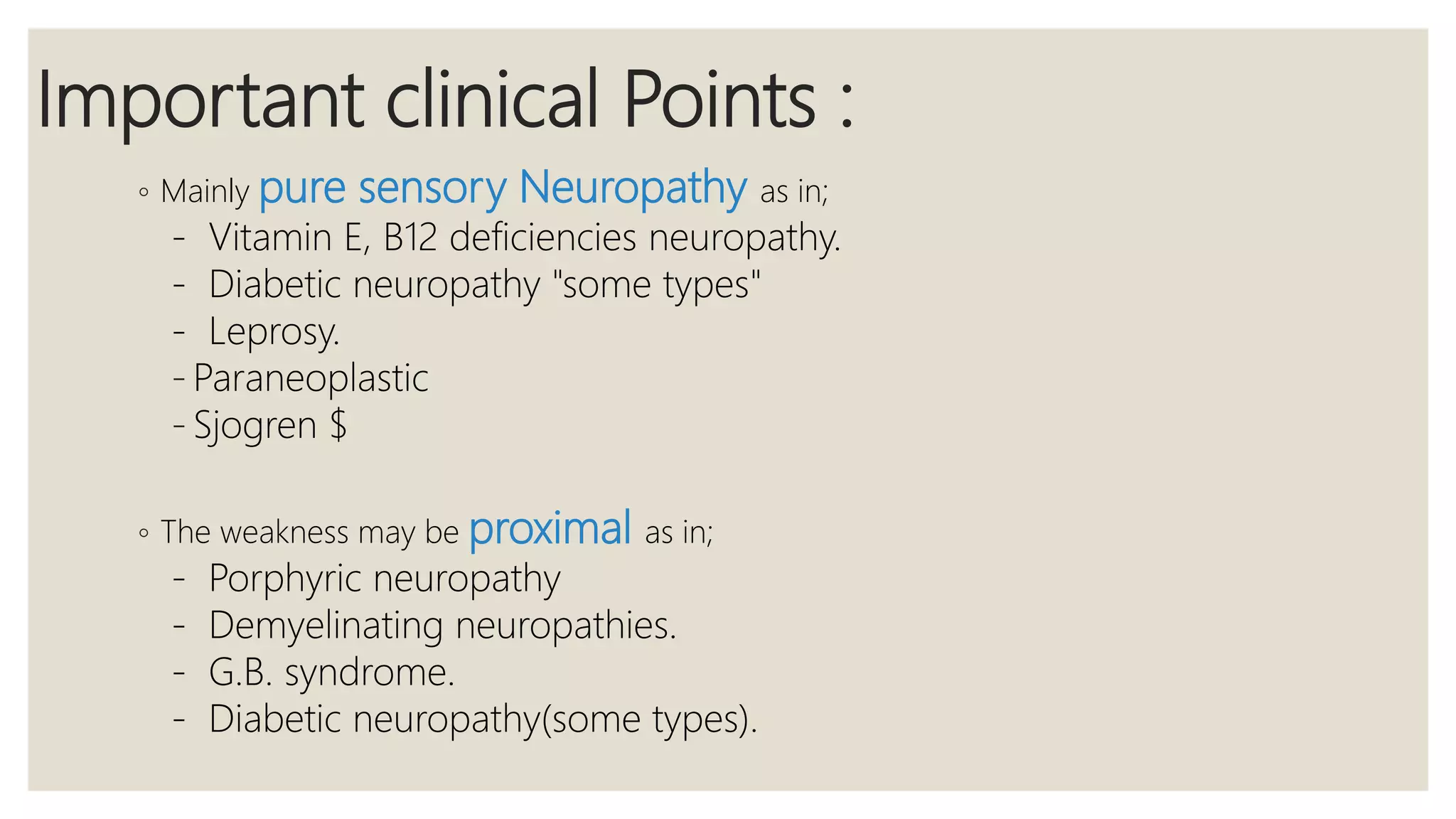
◦ Mainly pure sensory Neuropathy as in;
- Vitamin E, B12 deficiencies neuropathy.
- Diabetic neuropathy "some types"
- Leprosy.
- Paraneoplastic
- Sjogren $
◦ The weakness may be proximal as in;
- Porphyric neuropathy
- Demyelinating neuropathies.
- G.B. syndrome.
- Diabetic neuropathy(some types).
Important clinical Points :
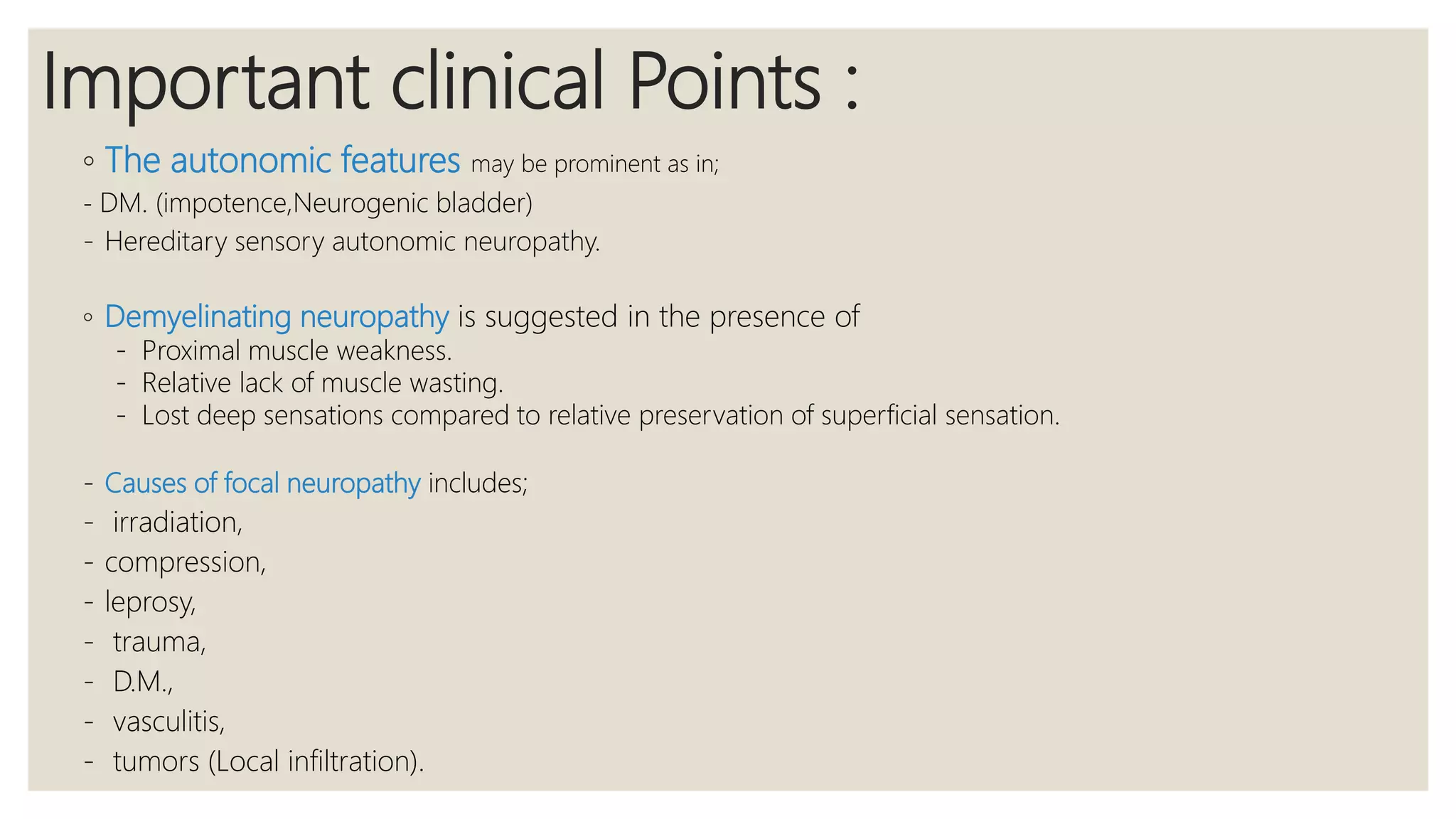
◦ The autonomic features may be prominent as in;
- DM. (impotence,Neurogenic bladder)
- Hereditary sensory autonomic neuropathy.
◦ Demyelinating neuropathy is suggested in the presence of
- Proximal muscle weakness.
- Relative lack of muscle wasting.
- Lost deep sensations compared to relative preservation of superficial sensation.
- Causes of focal neuropathy includes;
- irradiation,
- compression,
- leprosy,
- trauma,
- D.M.,
- vasculitis,
- tumors (Local infiltration).
Investigations :
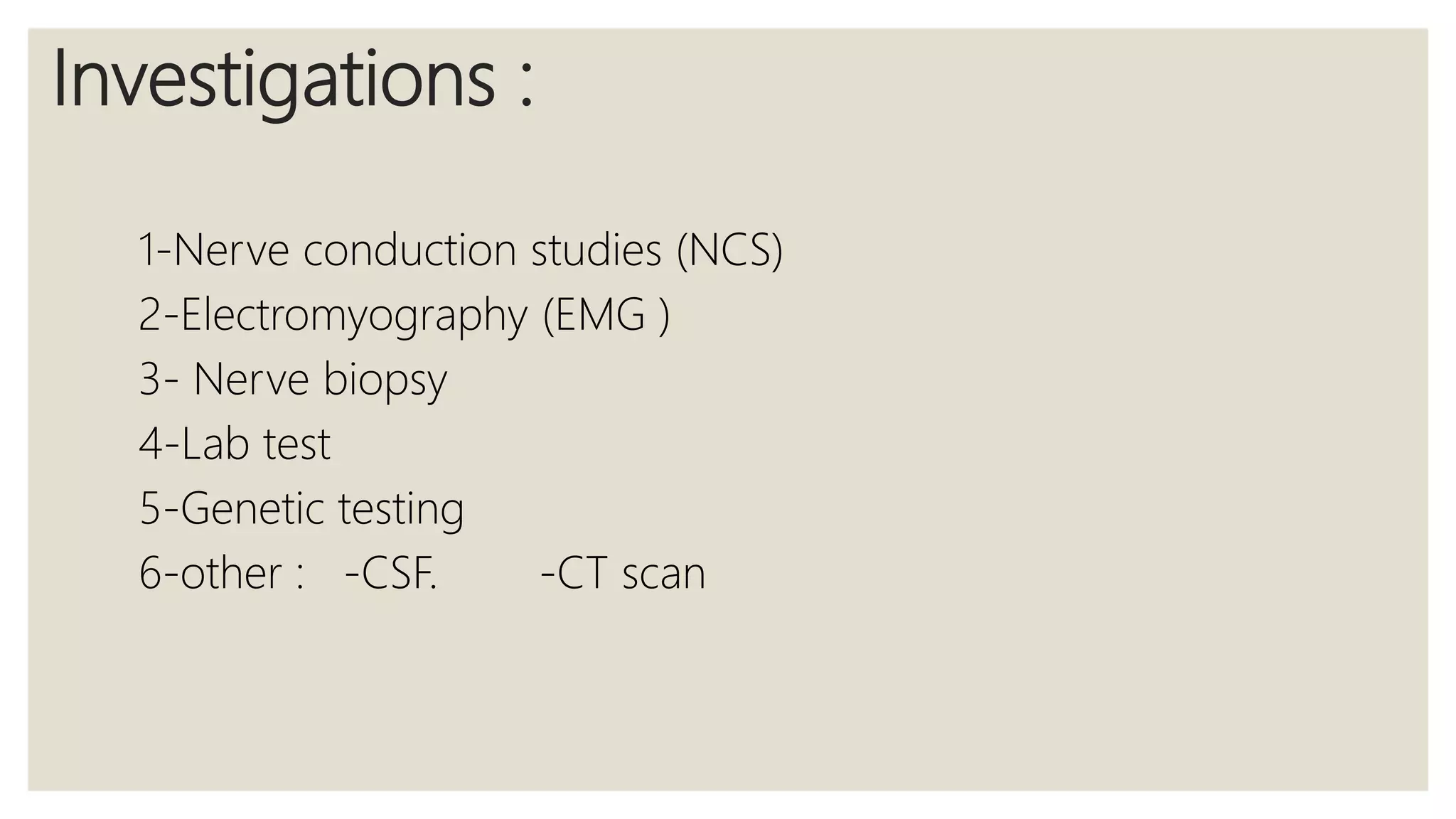
1-Nerve conduction studies (NCS)
2-Electromyography (EMG )
3- Nerve biopsy
4-Lab test
5-Genetic testing
6-other : -CSF. -CT scan
Management:
◦ According to the cause
◦ Drugs for neuropathic pain :
Ex: anticonvulsants :
Carbamazepine- Gabapentin- Lamotrigine-Pregabalin.
Antidepressants :
TCA - Duloxetine – venlafaxine.
Diabetic polyneuropathy
◦ D.M., is one of the most common causes of disabling polyneuropathy world wide .
◦ Length dependant diabetic Polyneuropathy.
◦ More than 80% of patients with clinical diabetic neuropathy have the distal
symmetrical form of the disorder.
Neuropathy may be the 1st symptom of D.M.
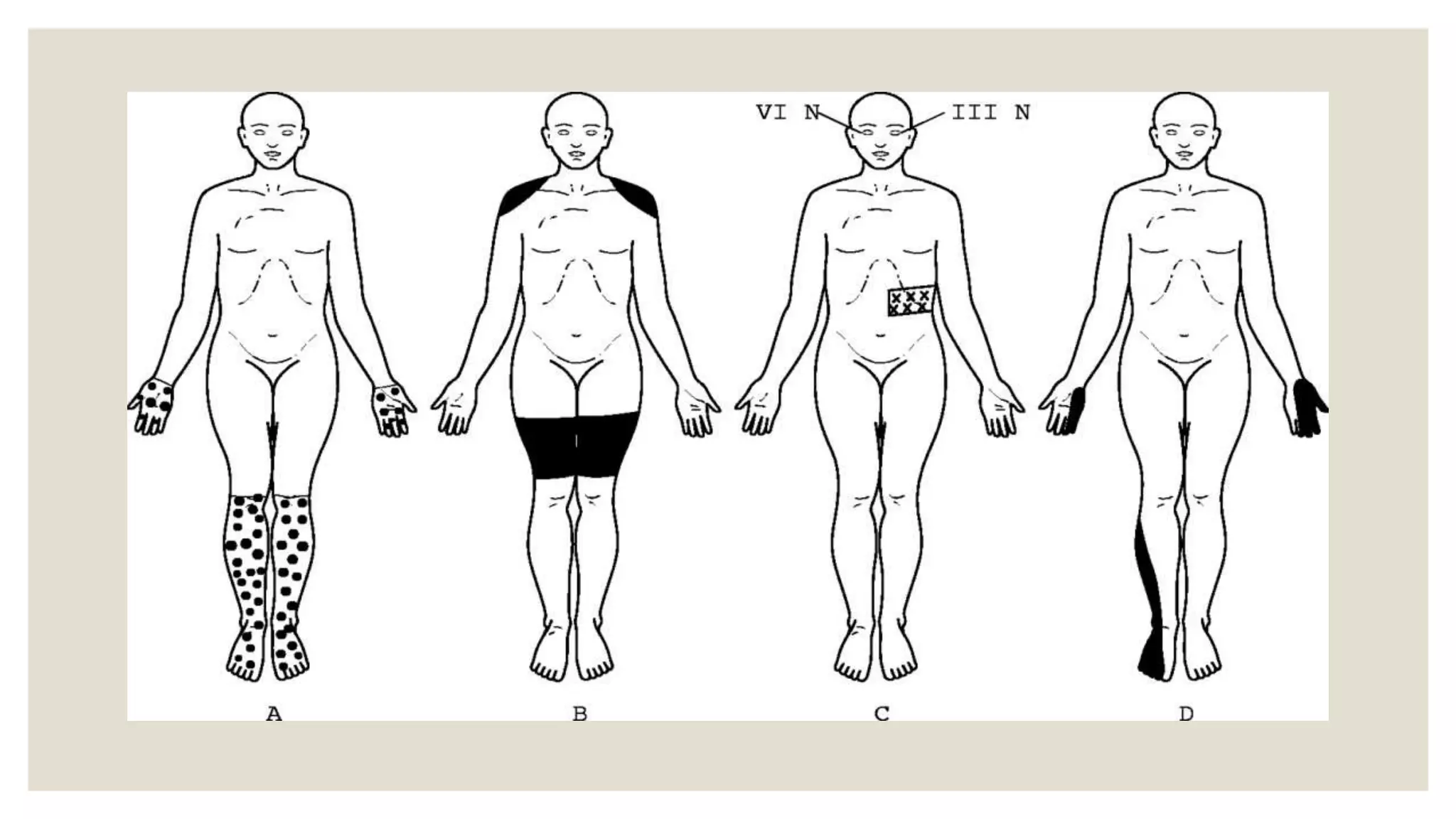
◦ Patterns of DPN:
-Diabetic sensori-motor neuropathy.
- Diabetic autonomic neuropathy.
- Diabetic proximal neuropathy.
- Diabetic mononeuropathy (cranial or peripheral)
- Diabetic trunkal neuropathy.
The same patient may develop two or more of these types.
Diabetic polyneuropathy
Management :
1- Strict control of blood sugar.
2- Aldose reductase inhibitors " sorbinol"
3- Vasodilators and tonics.
4- Carbamazepine, gabapentin, amitriptyline, duloxetine may help in sensory
discomfort.
5- Skin care is very essential.
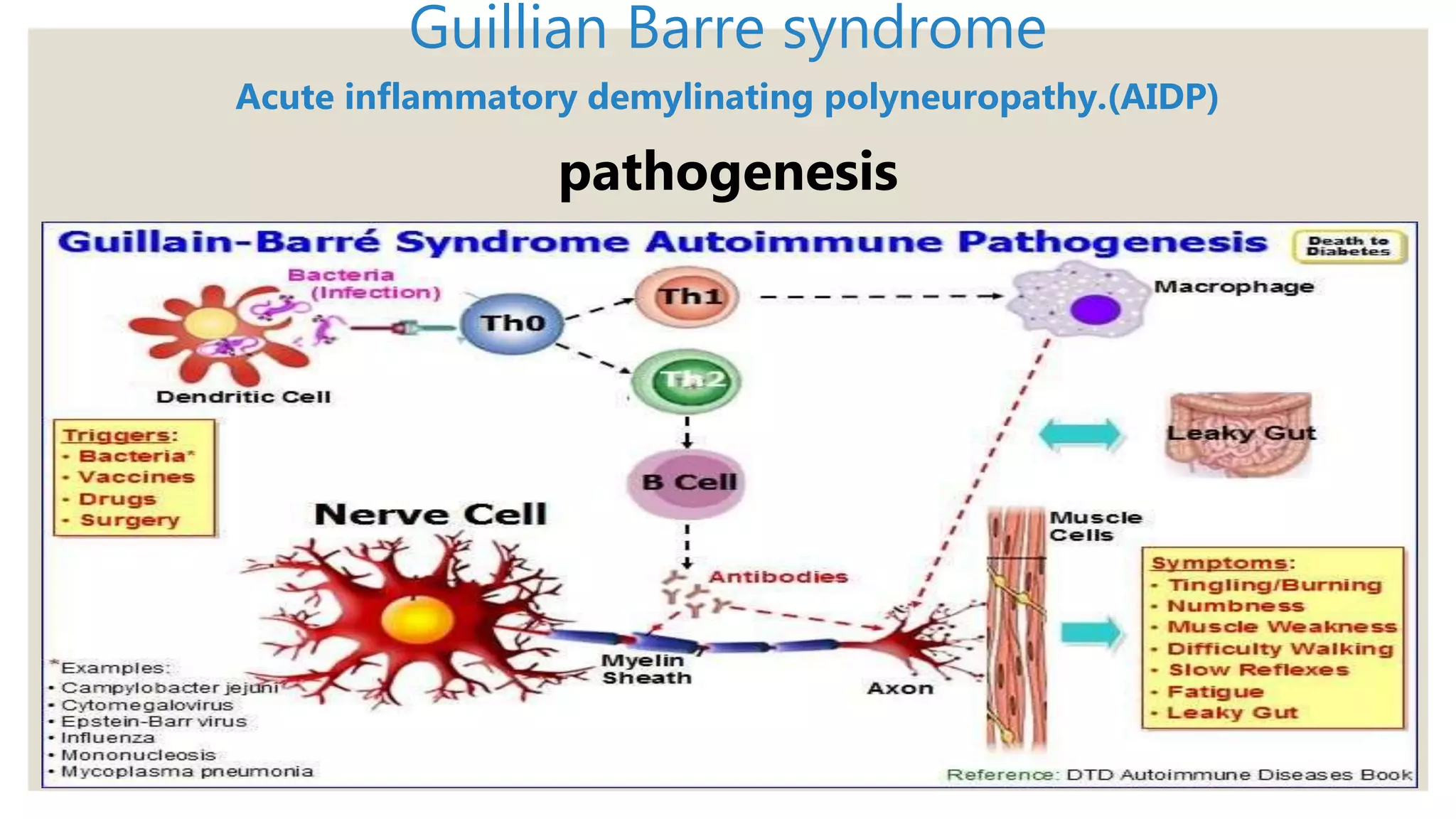
Guillian Barre syndrome
Acute inflammatory demylinating polyneuropathy.(AIDP)
pathogenesis
C.P:
-URTI or GIT infections is usually reported days before the disease with
backache.
-Paraesthia is often the 1st heralding symptom for the disease and LL are
more commonly affected.
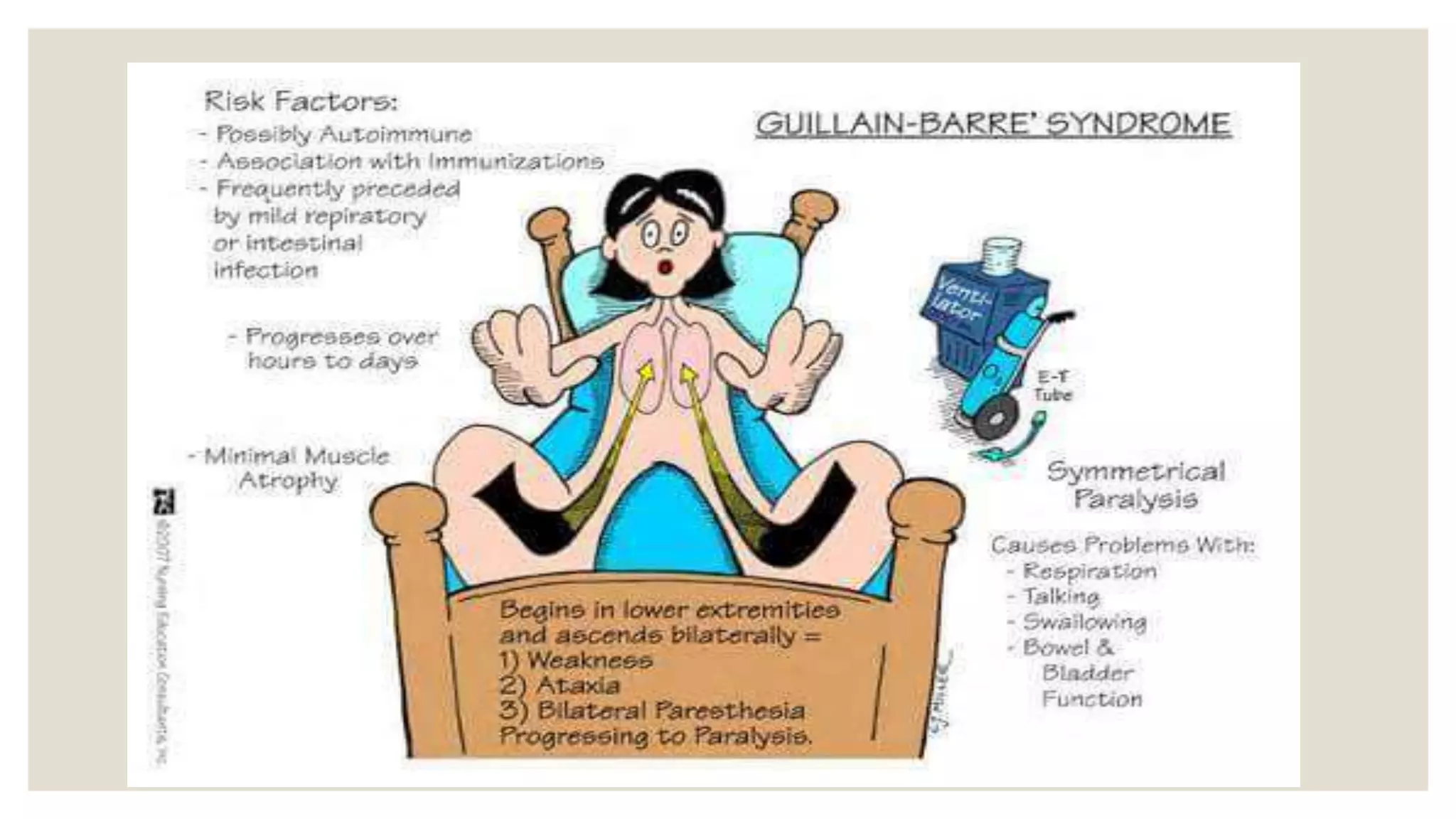
- Hours or days later, acute or subacute onset and progressive course of
weakness or paralysis starting in both LL, usually ascends to involve trunk,
respiratory, and both upper limbs muscles.
- Weakness is usually symmetrical, more proximal of LMN features with
areflexia, hypotonia, or flaccidity. Progress of weakness takes usually takes1-4
weeks for maximum.
C.P:
- Sensory affection is mainly subjective, e.g. parathesias, pain in calf muscles, but objective
sensory changes as mild glove and stoke hypothesia may be present.
- The presence of sensory level will cast doubt on the diagnosis.
- No definite or persistant sphincteric disturbance can be detected, except in minority of
cases and usually transient, but persistent &definite sphincter disturbance will rule out
the diagnosis.
- Cranial nerves affection is common e.g. III, VII, X.
- Involvment of UL and trunk muscles may herald the occurrence of chest infection and
respiratory failure and ventilation may be required.
- Hyponatremia, papillodema, and autonomic disturbances, may develop .
- Prognosis is usually good, and mortality rate is about 5%.
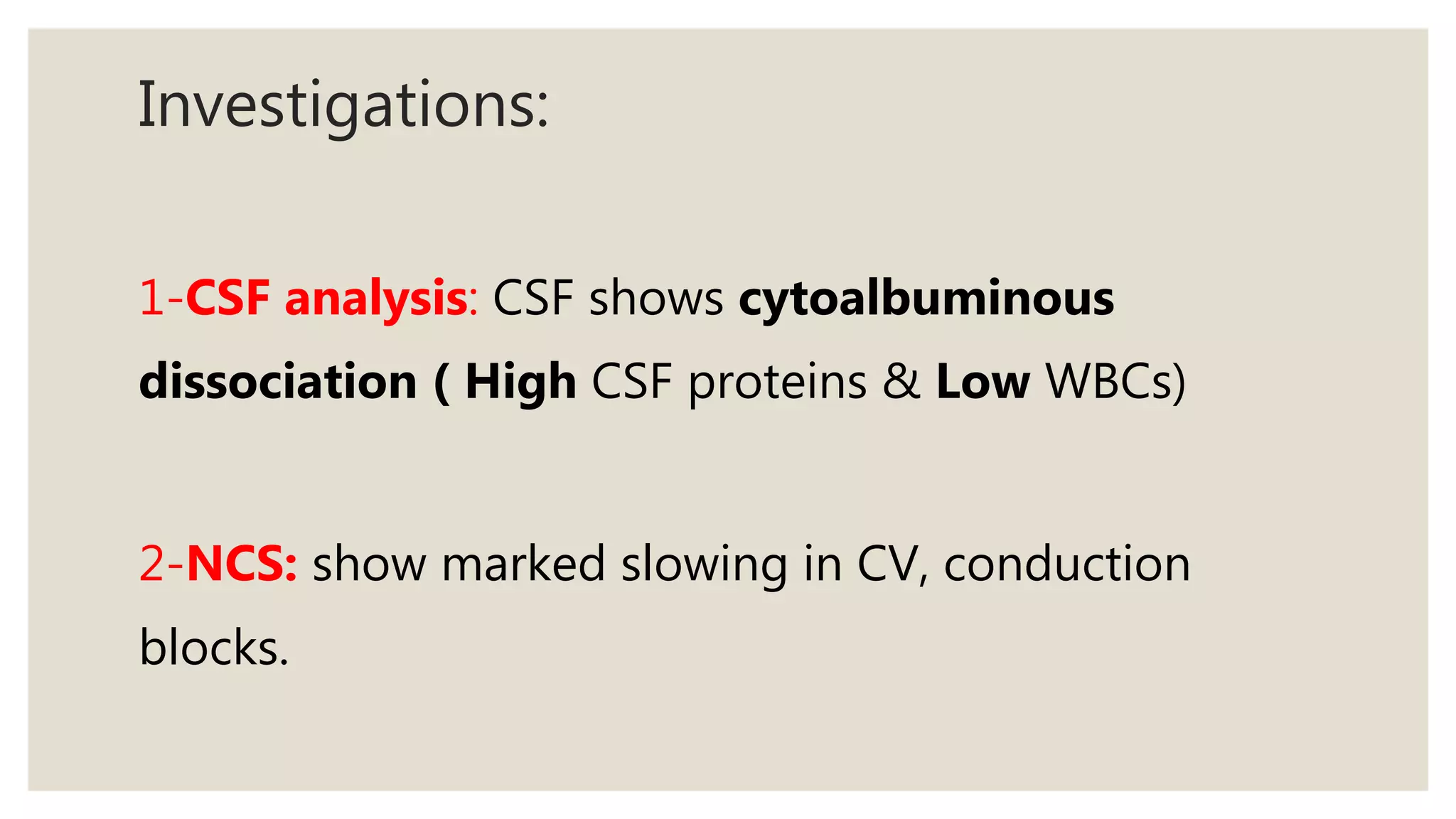
Investigations:
1-CSF analysis: CSF shows cytoalbuminous
dissociation ( High CSF proteins & Low WBCs)
2-NCS: show marked slowing in CV, conduction
blocks.
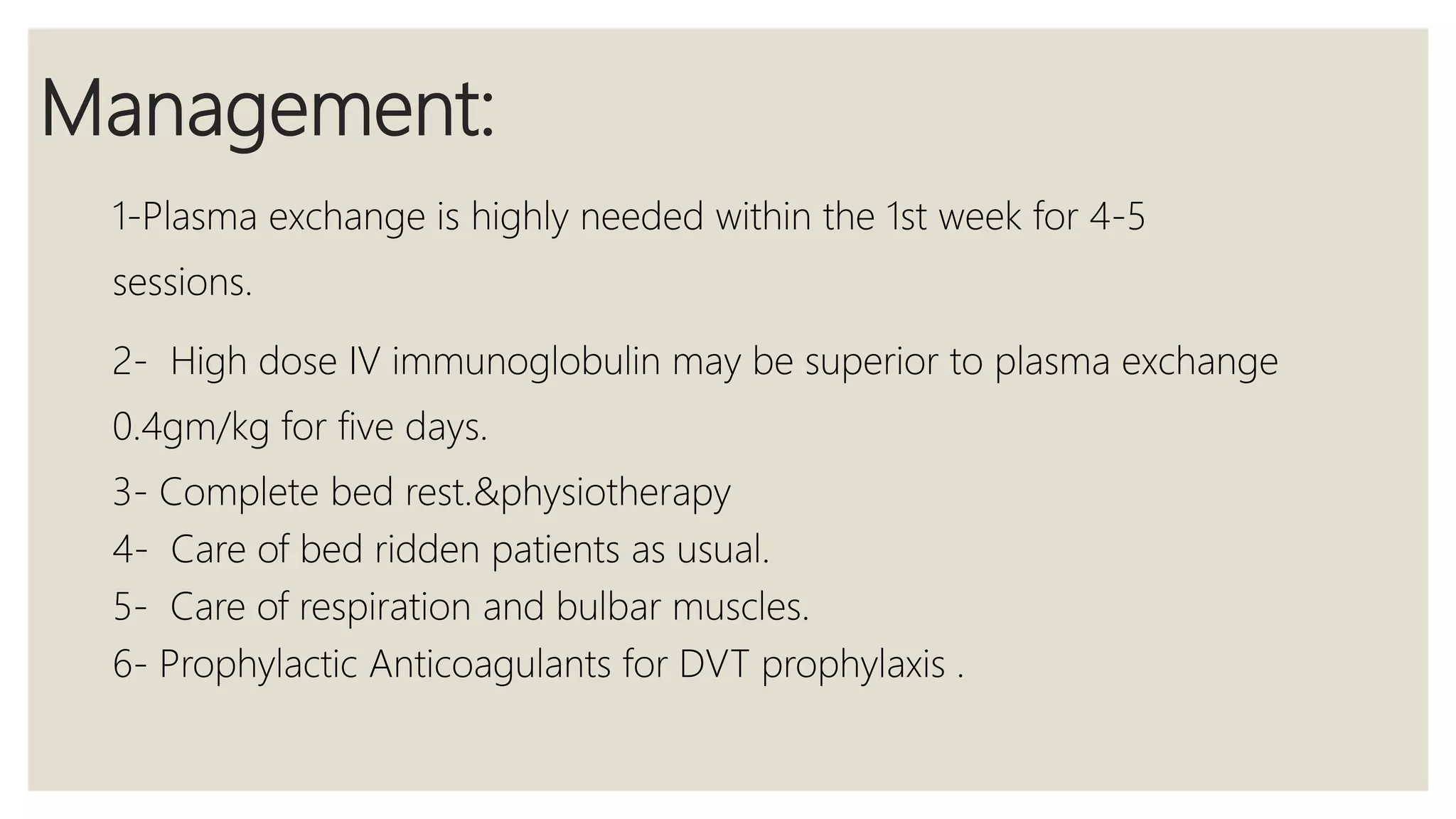
Management:
1-Plasma exchange is highly needed within the 1st week for 4-5
sessions.
2- High dose IV immunoglobulin may be superior to plasma exchange
0.4gm/kg for five days.
3- Complete bed rest.&physiotherapy
4- Care of bed ridden patients as usual.
5- Care of respiration and bulbar muscles.
6- Prophylactic Anticoagulants for DVT prophylaxis .
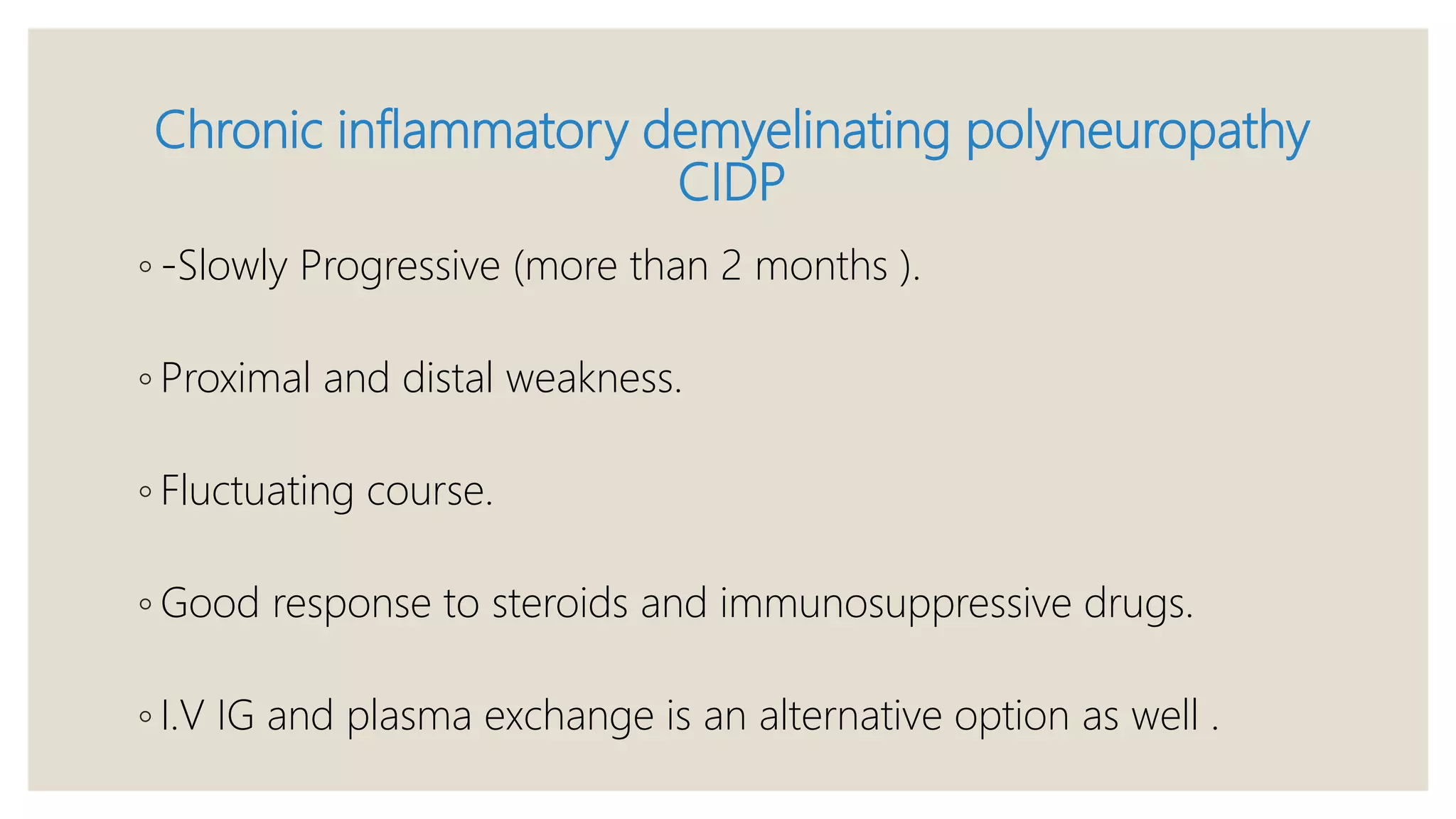
Chronic inflammatory demyelinating polyneuropathy
CIDP
◦ -Slowly Progressive (more than 2 months ).
◦ Proximal and distal weakness.
◦ Fluctuating course.
◦ Good response to steroids and immunosuppressive drugs.
◦ I.V IG and plasma exchange is an alternative option as well .
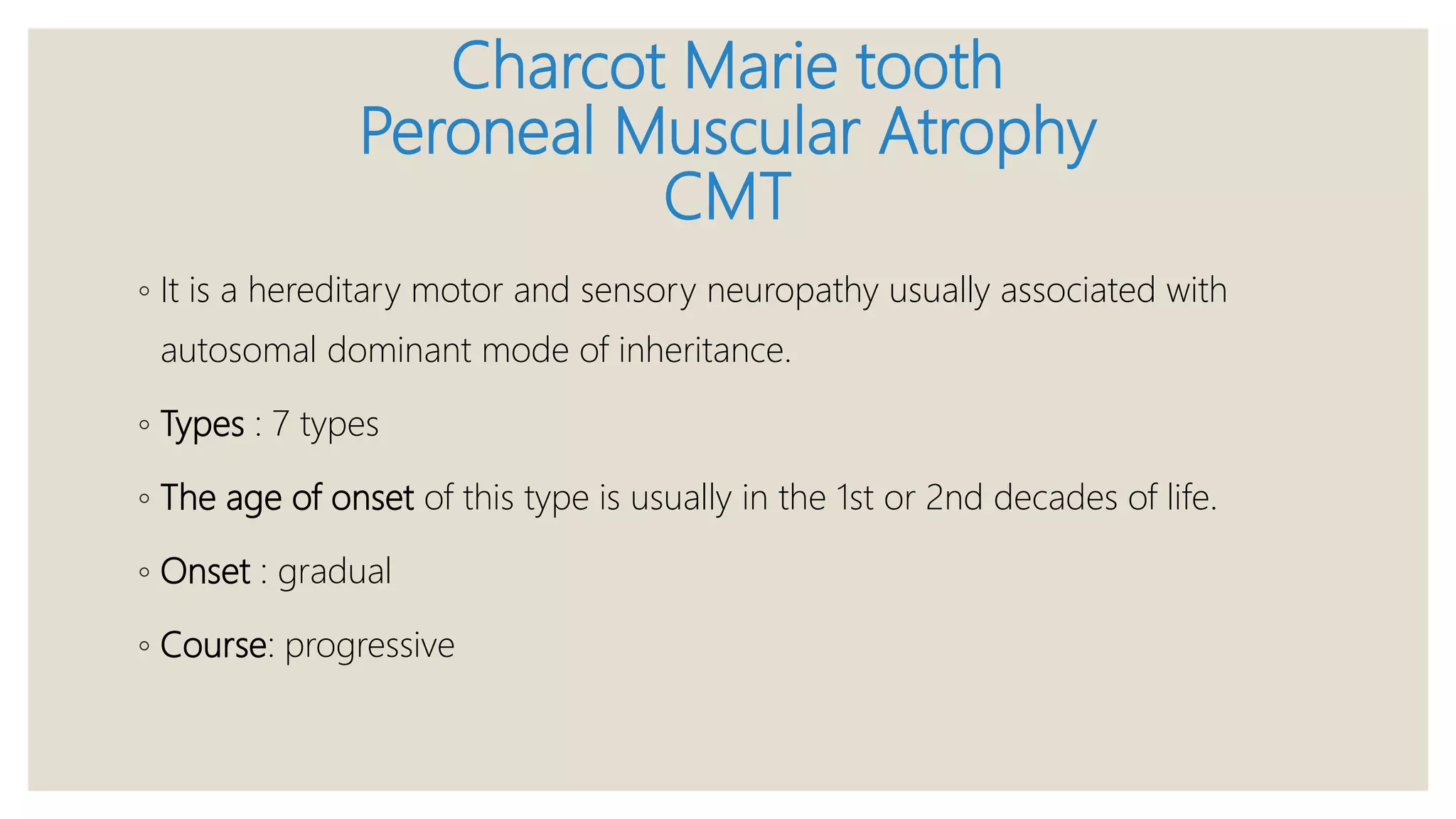
Charcot Marie tooth
Peroneal Muscular Atrophy
CMT
◦ It is a hereditary motor and sensory neuropathy usually associated with
autosomal dominant mode of inheritance.
◦ Types : 7 types
◦ The age of onset of this type is usually in the 1st or 2nd decades of life.
◦ Onset : gradual
◦ Course: progressive
C.P:
Motor :
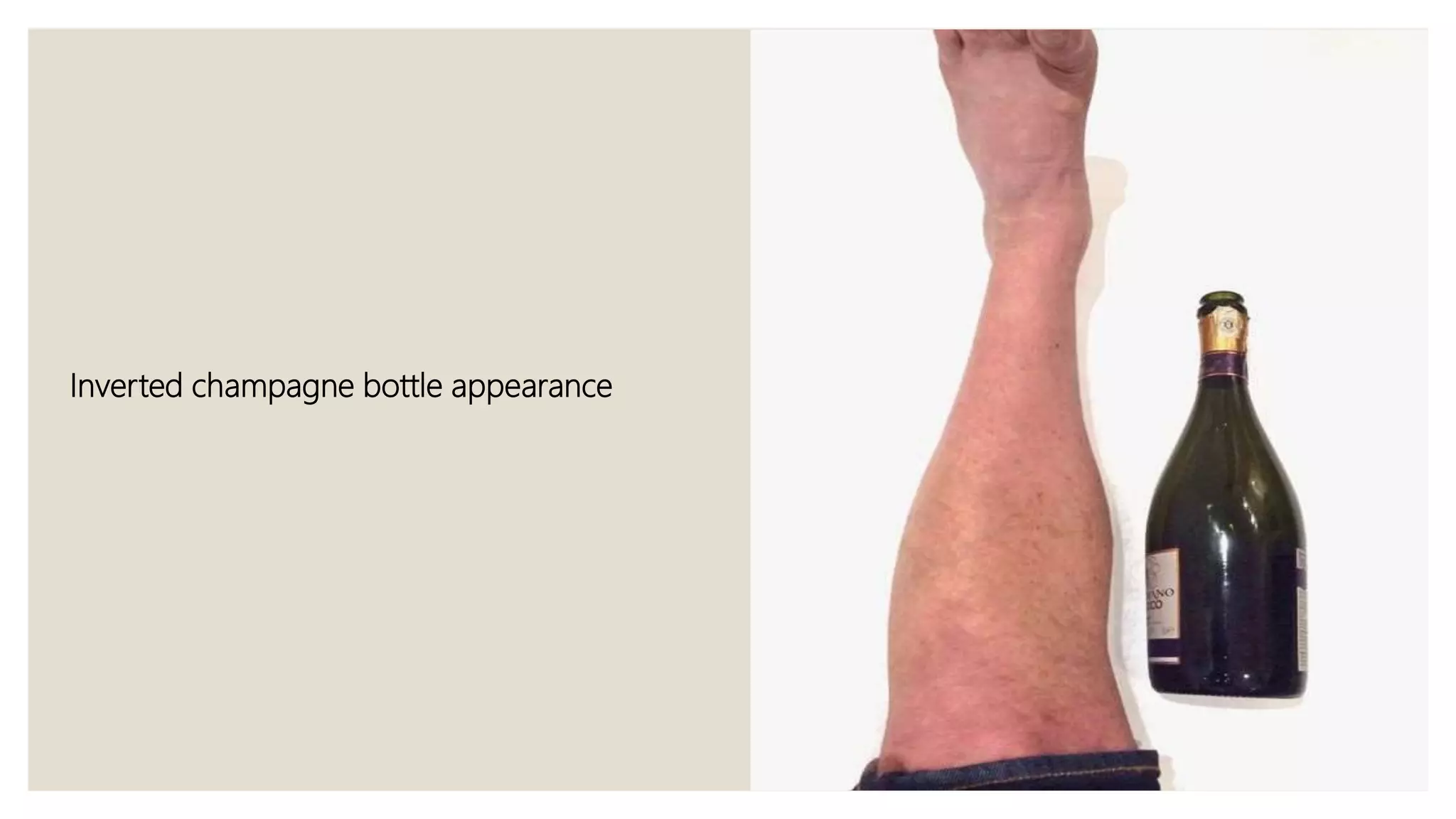
◦Distal leg muscle wasting and weakness up to the
lower third of the thigh giving the leg
picture of inverted champagne bottle appearance.
-Areflexia especially at the ankles.
Inverted champagne bottle appearance
C.P:
Sensory:
◦ All modalities of sensations may be impaired distally.
◦ Glove and stock hypothesia
◦ Loss of vibration sense (Early)
◦ No pain and parasthesia is rare.
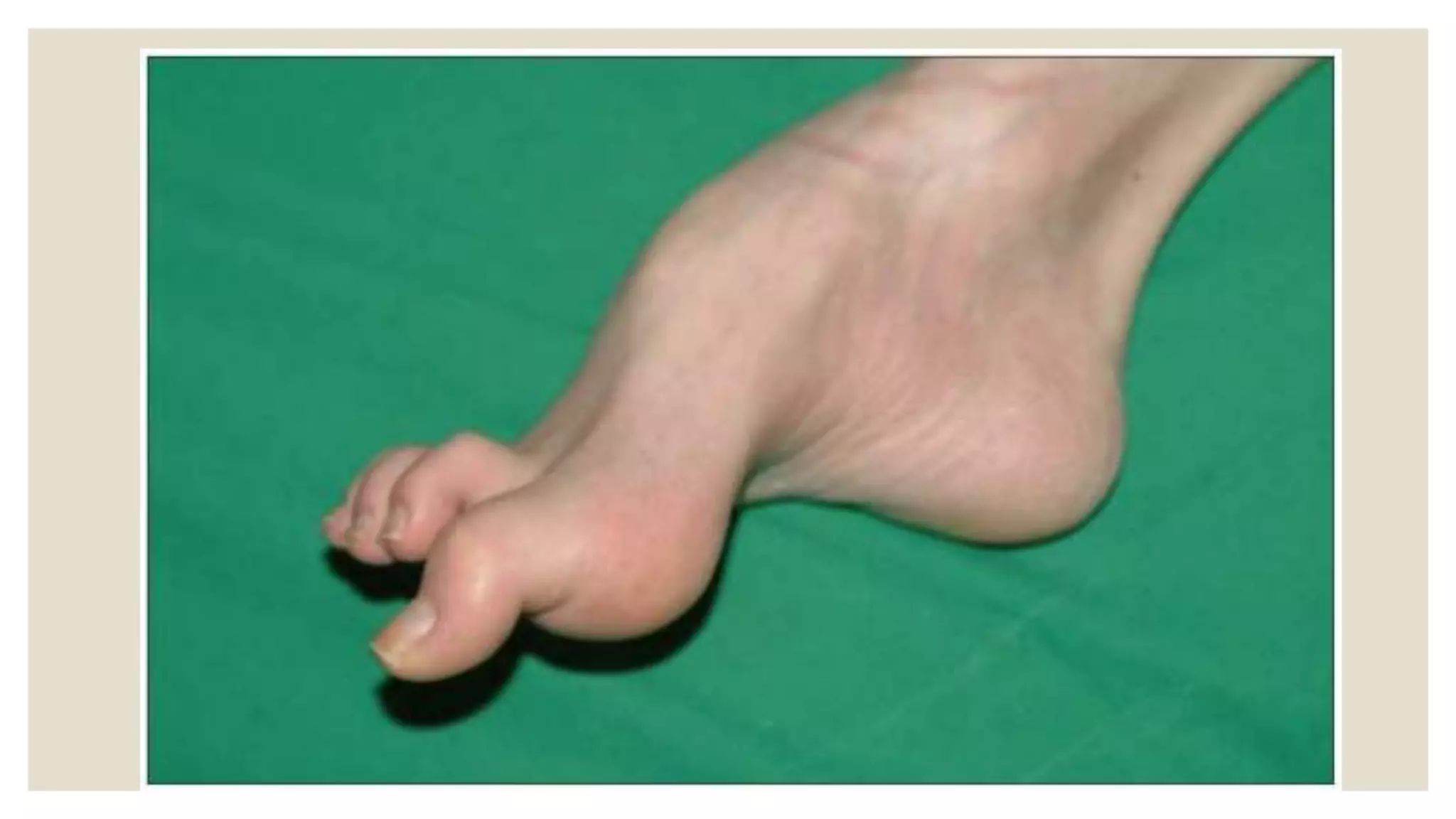
Skeletal deformities :
scoliosis , Pes cavus , thickened nerves
Management :
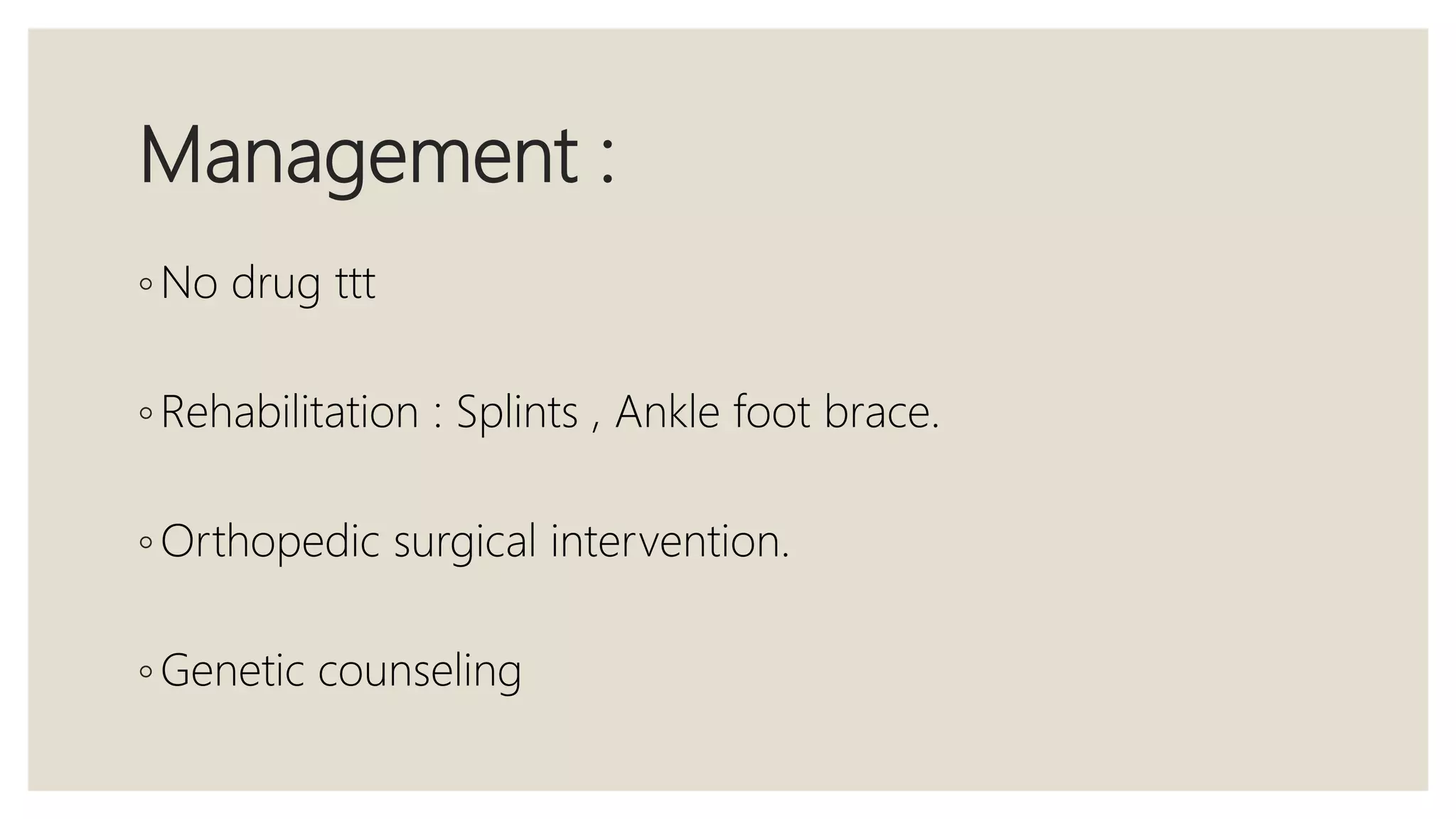
◦ No drug ttt
◦ Rehabilitation : Splints , Ankle foot brace.
◦ Orthopedic surgical intervention.
◦ Genetic counseling
Vitamin B12 deficiency
Subacute Combined degeneration
SCD
◦ Degeneration of →
-Spinal cord leading to paraparesis, spasticity, sensory ataxia with late
sphincteric disturbances. - Optic nerves >>bilateral optic atrophy.
-Peripheral nerves >> mainly sensory neuropathy with glove stoke
hypothesia.
- Brain >> leading to dementia, impaired memory, confusion, and
psychiatric disorders.
+ Pernicious Anemia
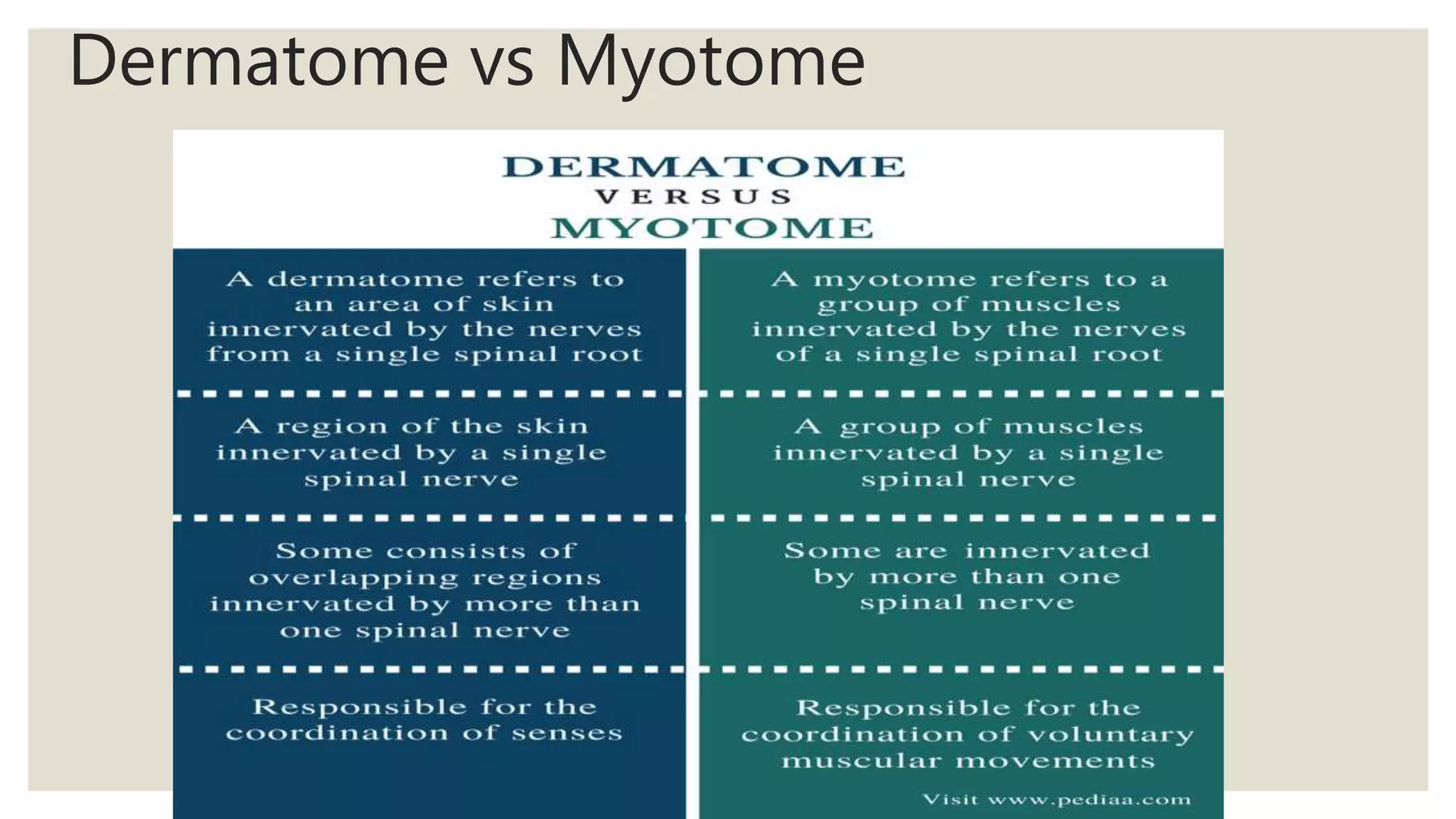
Dermatome vs Myotome
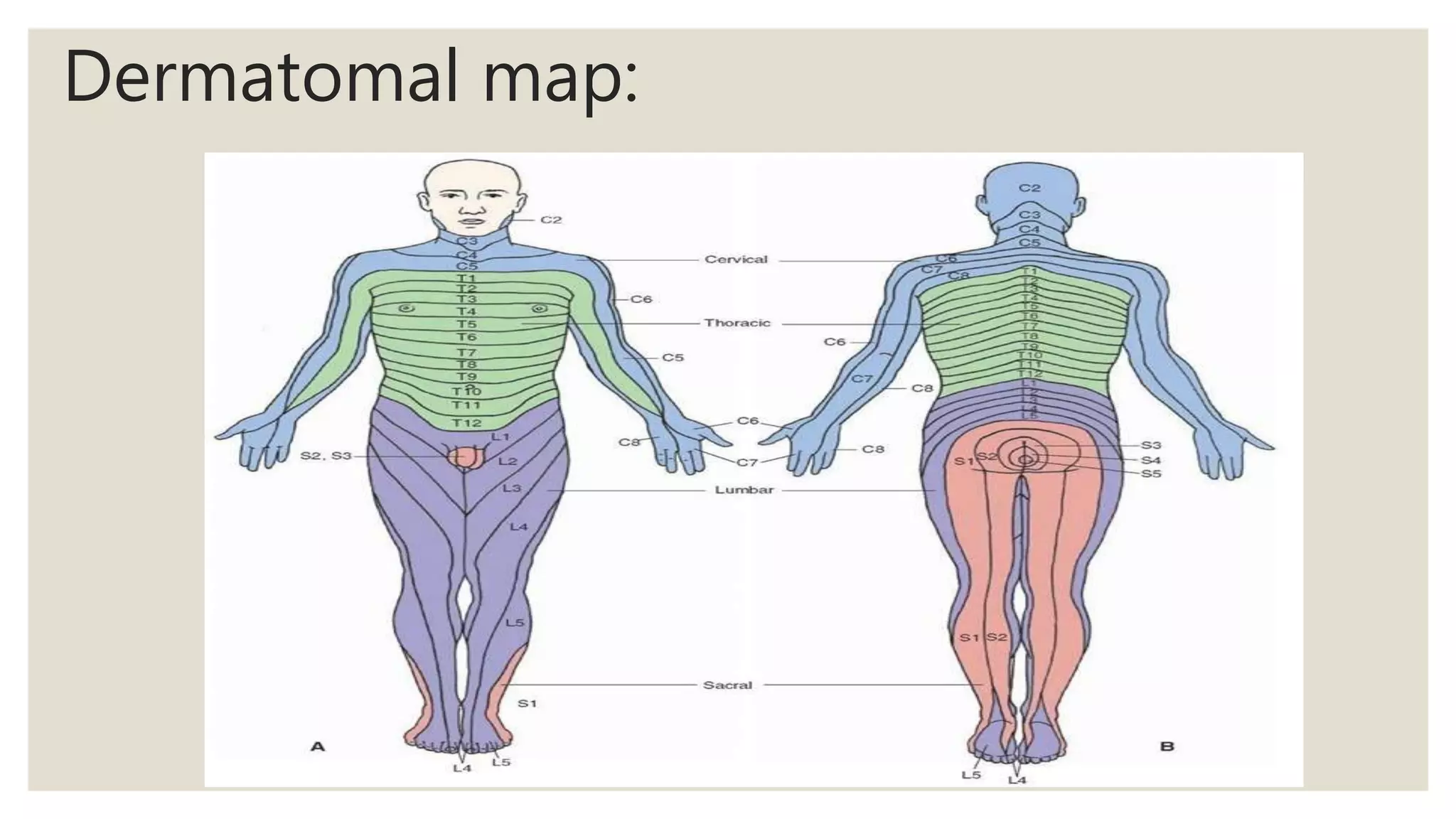
Dermatomal map:
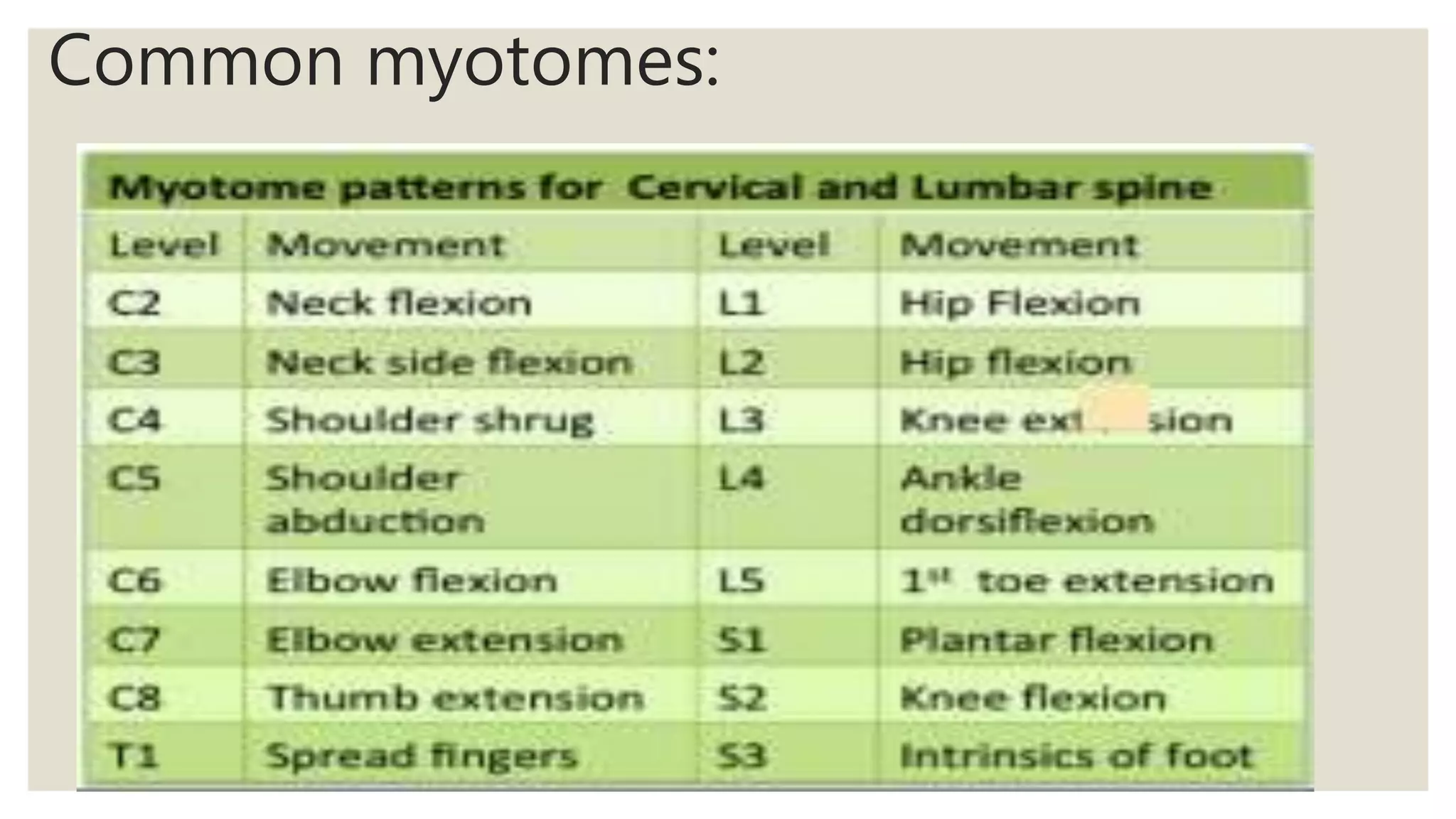
Common myotomes:
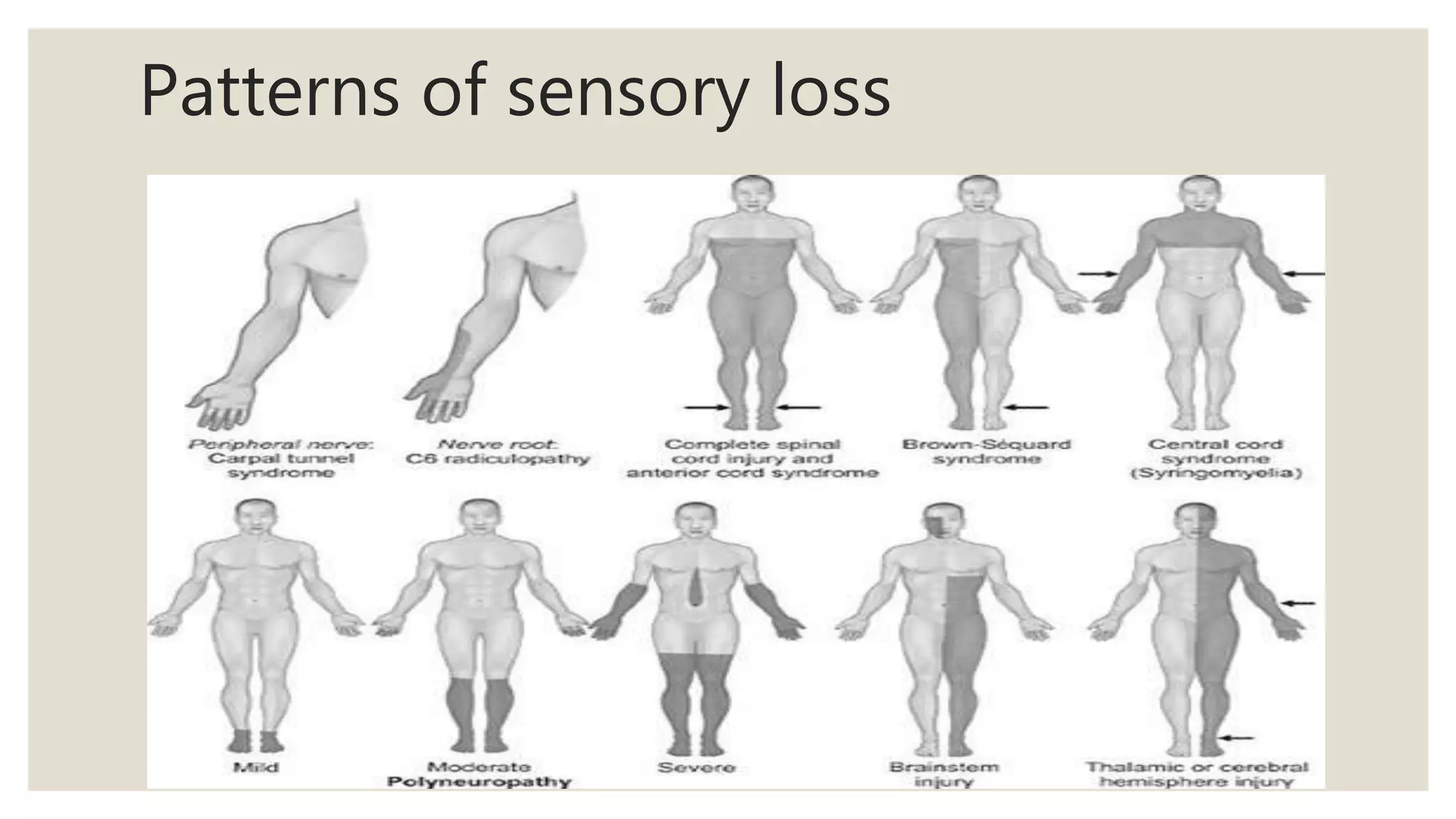
Patterns of sensory loss
Email: m.a.tarek91@gmail.com
Slide share account : Mohamed Ahmed Tarek

Approach to peripheral neuropathy

  • 1.
    APPROACH TO PERIPHERALNEUROPATHY By Mohamed A. Tarek Assistant lecturer of Neurology Master of Neuropsychiatry Sohag university By Mohamed A. Tarek Assistant lecturer of Neurology Master of Neuropsychiatry Sohag university
  • 2.
    Agenda: ◦ 1-Definition ◦ 2-classification ◦3-causes ◦ 4-c.p ◦ 5-investigations ◦ 6-management ◦ 7-Examples
  • 3.
    Definition: ◦ Means inflammationor degenerative diseases affecting peripheral nerves &/or cranial nerves. ◦ leading to defective motor and /or sensory and /or autonomic functions of the affected nerves. ◦ Peripheral neuropathy may be : ◦ - Mononeuropathy: single affected nerve. ◦ - Mononeuropathy multiplex: multiple mononeuropathy or more than one nerve is affected in one limb. ◦ - Polyneuropathy: affection of peripheral nerves in the four limbs. ◦ - Polyradiculoneuropathy: damage to peripheral nerves & roots. ◦ - Plexopathy ◦ - Radiculopathy
  • 6.
    Classification: ◦ There are3 types of peripheral nerves : ◦Motor ◦Sensory ◦Autonomic
  • 7.
    Classification: - Mononeuropathy: singleaffected nerve. - Mononeuropathy multiplex: multiple mononeuropathy or more than one nerve is affected in one limb. - Polyneuropathy: affection of peripheral nerves in the four limbs. - Polyradiculoneuropathy: damage to peripheral nerves & roots. - Plexopathy - Radiculopathy
  • 8.
  • 11.
  • 12.
  • 13.
    Classification : inherited : -CMT(Peroneal muscular atrophy): 1,2,3,4,5,6,7 -Refsum dis : Neuropthy , RP , Ataxia , Skeletal deformities, CM , Deafness, Anosmia -Porphyria : positive family history , Purely motor , proximal , Preserved ankle, Pain in Abdomen ,Port wine urine -Metachromatic leukodystrophy: PN ,Fits , Optic atrophy ,MR -Adrenoleucodystrophy : PN , Adrenal insufficiency , Ataxia , Fits , Paraparesis. - Mitochondrial diseases
  • 14.
    Acquired: 1-Acute idiopathic polyneuropathy:eg -Guillian- Barre syndrome. - Miller Fisher syndrome. 2- Chronic idiopathic polyneuropathy.eg -Chronic inflammatory demylinating polyneuropathy (CIDP) 3- Polyneuropathy with infections.eg - Leprosy - Diphtheria -CMV - HIV infections. - Lyme disease 4- Neuropathy due to systemic disease : -DM -CRF -Hypothyroidism -Acromegaly -SLE -Amyloidosis
  • 15.
    Acquired : 5- Neoplasticand paraneoplastic : -Myeloma -Lymphoma 6-Drug induced neuropathy. - Dapsone - INH - Colchicine - Lithium -Metronidazole - vincristine -phenytoin. -Amiodarone 8- Metal poisoning (toxic) neuropathy - Lead. - Mercury. - Irradiation - Arsenic - Organophosphorus -Gold 9-Vitamin deficiency: - B1. - B6 - B12. - Vit E 10-Vascular : - Systemic vasculitis -PAN - Major arterial occlusion - Collagen diseases
  • 16.
    1- Motor: ◦ Symptoms: -Weakness: of LMN features" characterized with weakness affecting - Both UL and LL ,more in LL - Bilateral symmetrical -Distal more than proximal usually leading to foot drop and wrist drop. -Extensors are more affected than flexors ◦ Signs: - Atrophy , Hypotonia, hyporeflexia usually affecting distal limb parts. - +/- Neuropathic Tremors C.P:
  • 17.
    C.P : 2-Sensory: -Postive symptoms: Pain(burning) and parasthesia (tingling and numbness) -Negative symptoms: Impairment of superficial sensations leading to glove and stock hypothesia . -Impairment of deep sensation. ◦ Subjectively the patient will complain of - Pain and parathesias in the form of numbness, hotness in the distal limb parts - Falling of shoes unconsciously.
  • 18.
  • 19.
    C.P : 4-Gait : -Highsteppage gait due to weakness ( foot drop ). -Stamping gait due to deep sensory loss.
  • 20.
    C.P : 5-Autonomic: -Postural hypotension -impotence -hyperhidrosis/ Anhydrosis -skin changes in LLs : trophic ulcers , brittle nails , thin skin , coldness -Neurogenic bladder.
  • 21.
    Important clinical Points: ◦Common Causes of Mononeuropathy : 1- trauma : wrong injection into nerve . 2-infective : leprosy , Herpes zoster 3-vascular : PAN 4-metabolic : DM
  • 22.
    Important clinical Points: ◦ Mainly pure motor Neuropathy as in; - lead neuropathy - Porphyric neuropathy - dapsone neuropathy - Beri-Beri. - G.B. syndrome. - Organophosphorus ◦ Inherited neuropathy is suggested in the presence of the following; - Positive family history of neuropathy or parental consanguinity. - Often other system affection.
  • 23.
    Important clinical Points: ◦ Mainly pure sensory Neuropathy as in; - Vitamin E, B12 deficiencies neuropathy. - Diabetic neuropathy "some types" - Leprosy. - Paraneoplastic - Sjogren $ ◦ The weakness may be proximal as in; - Porphyric neuropathy - Demyelinating neuropathies. - G.B. syndrome. - Diabetic neuropathy(some types).
  • 24.
    Important clinical Points: ◦ The autonomic features may be prominent as in; - DM. (impotence,Neurogenic bladder) - Hereditary sensory autonomic neuropathy. ◦ Demyelinating neuropathy is suggested in the presence of - Proximal muscle weakness. - Relative lack of muscle wasting. - Lost deep sensations compared to relative preservation of superficial sensation. - Causes of focal neuropathy includes; - irradiation, - compression, - leprosy, - trauma, - D.M., - vasculitis, - tumors (Local infiltration).
  • 25.
    Investigations : 1-Nerve conductionstudies (NCS) 2-Electromyography (EMG ) 3- Nerve biopsy 4-Lab test 5-Genetic testing 6-other : -CSF. -CT scan
  • 26.
    Management: ◦ According tothe cause ◦ Drugs for neuropathic pain : Ex: anticonvulsants : Carbamazepine- Gabapentin- Lamotrigine-Pregabalin. Antidepressants : TCA - Duloxetine – venlafaxine.
  • 27.
    Diabetic polyneuropathy ◦ D.M.,is one of the most common causes of disabling polyneuropathy world wide . ◦ Length dependant diabetic Polyneuropathy. ◦ More than 80% of patients with clinical diabetic neuropathy have the distal symmetrical form of the disorder. Neuropathy may be the 1st symptom of D.M. ◦ Patterns of DPN: -Diabetic sensori-motor neuropathy. - Diabetic autonomic neuropathy. - Diabetic proximal neuropathy. - Diabetic mononeuropathy (cranial or peripheral) - Diabetic trunkal neuropathy. The same patient may develop two or more of these types.
  • 29.
    Diabetic polyneuropathy Management : 1-Strict control of blood sugar. 2- Aldose reductase inhibitors " sorbinol" 3- Vasodilators and tonics. 4- Carbamazepine, gabapentin, amitriptyline, duloxetine may help in sensory discomfort. 5- Skin care is very essential.
  • 31.
    Guillian Barre syndrome Acuteinflammatory demylinating polyneuropathy.(AIDP) pathogenesis
  • 32.
    C.P: -URTI or GITinfections is usually reported days before the disease with backache. -Paraesthia is often the 1st heralding symptom for the disease and LL are more commonly affected. - Hours or days later, acute or subacute onset and progressive course of weakness or paralysis starting in both LL, usually ascends to involve trunk, respiratory, and both upper limbs muscles. - Weakness is usually symmetrical, more proximal of LMN features with areflexia, hypotonia, or flaccidity. Progress of weakness takes usually takes1-4 weeks for maximum.
  • 33.
    C.P: - Sensory affectionis mainly subjective, e.g. parathesias, pain in calf muscles, but objective sensory changes as mild glove and stoke hypothesia may be present. - The presence of sensory level will cast doubt on the diagnosis. - No definite or persistant sphincteric disturbance can be detected, except in minority of cases and usually transient, but persistent &definite sphincter disturbance will rule out the diagnosis. - Cranial nerves affection is common e.g. III, VII, X. - Involvment of UL and trunk muscles may herald the occurrence of chest infection and respiratory failure and ventilation may be required. - Hyponatremia, papillodema, and autonomic disturbances, may develop . - Prognosis is usually good, and mortality rate is about 5%.
  • 35.
    Investigations: 1-CSF analysis: CSFshows cytoalbuminous dissociation ( High CSF proteins & Low WBCs) 2-NCS: show marked slowing in CV, conduction blocks.
  • 36.
    Management: 1-Plasma exchange ishighly needed within the 1st week for 4-5 sessions. 2- High dose IV immunoglobulin may be superior to plasma exchange 0.4gm/kg for five days. 3- Complete bed rest.&physiotherapy 4- Care of bed ridden patients as usual. 5- Care of respiration and bulbar muscles. 6- Prophylactic Anticoagulants for DVT prophylaxis .
  • 37.
    Chronic inflammatory demyelinatingpolyneuropathy CIDP ◦ -Slowly Progressive (more than 2 months ). ◦ Proximal and distal weakness. ◦ Fluctuating course. ◦ Good response to steroids and immunosuppressive drugs. ◦ I.V IG and plasma exchange is an alternative option as well .
  • 38.
    Charcot Marie tooth PeronealMuscular Atrophy CMT ◦ It is a hereditary motor and sensory neuropathy usually associated with autosomal dominant mode of inheritance. ◦ Types : 7 types ◦ The age of onset of this type is usually in the 1st or 2nd decades of life. ◦ Onset : gradual ◦ Course: progressive
  • 39.
    C.P: Motor : ◦Distal legmuscle wasting and weakness up to the lower third of the thigh giving the leg picture of inverted champagne bottle appearance. -Areflexia especially at the ankles.
  • 40.
  • 42.
    C.P: Sensory: ◦ All modalitiesof sensations may be impaired distally. ◦ Glove and stock hypothesia ◦ Loss of vibration sense (Early) ◦ No pain and parasthesia is rare. Skeletal deformities : scoliosis , Pes cavus , thickened nerves
  • 43.
    Management : ◦ Nodrug ttt ◦ Rehabilitation : Splints , Ankle foot brace. ◦ Orthopedic surgical intervention. ◦ Genetic counseling
  • 44.
    Vitamin B12 deficiency SubacuteCombined degeneration SCD ◦ Degeneration of → -Spinal cord leading to paraparesis, spasticity, sensory ataxia with late sphincteric disturbances. - Optic nerves >>bilateral optic atrophy. -Peripheral nerves >> mainly sensory neuropathy with glove stoke hypothesia. - Brain >> leading to dementia, impaired memory, confusion, and psychiatric disorders. + Pernicious Anemia
  • 45.
  • 46.
  • 47.
  • 48.
  • 49.
    Email: m.a.tarek91@gmail.com Slide shareaccount : Mohamed Ahmed Tarek