DR VINAYAK RODGE
 Peripheral nerve disorders are common
neurological problems caused by dysfunction of
peripheral motor, sensory, or autonomic nerves.
 The “shotgun” approach of ordering several panels
of diagnostic tests without an adequate
understanding of their significance and usefulness
should be avoided.
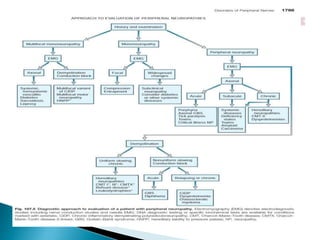
 A systematic diagnostic approach consists of a
detailed history, comprehensive physical and
neurological examinations, detailed
electrodiagnostic (EDX) studies, and possibly
additional testing (such as autonomic testing, skin
biopsy and nerve biopsy).
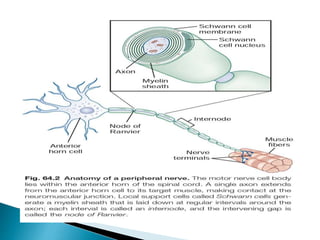
 The peripheral nerve is a cable-like structure containing
bundles of both unmyelinated and myelinated fibers and their
supporting elements.
 The unmyelinated axons are surrounded only by the plasma
membrane of a Schwann cell.
 The myelinated axons are surrounded completely by myelin
and Schwann cells except at regular gaps called the nodes of
Ranvier, which measure approximately 1 μm in adults.
 The propagation of action potentials from one node of
Ranvier to the next (saltatory conduction) is maintained by a
thick myelin sheath with low capacitance and high resistance
to electric current and by a high concentration of voltage-
gated sodium channels at the nodes of Ranvier.
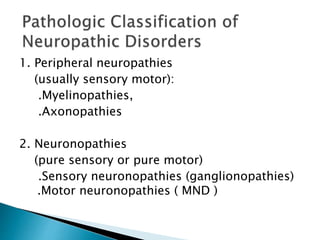
1. Peripheral neuropathies
(usually sensory motor):
.Myelinopathies,
.Axonopathies
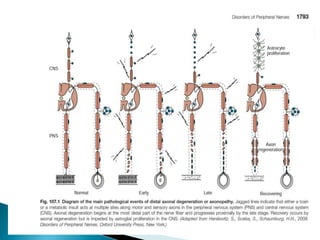
2. Neuronopathies
(pure sensory or pure motor)
.Sensory neuronopathies (ganglionopathies)
.Motor neuronopathies ( MND )
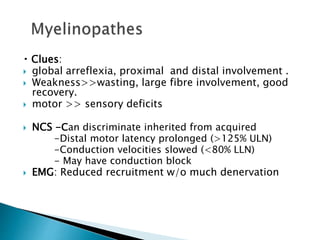
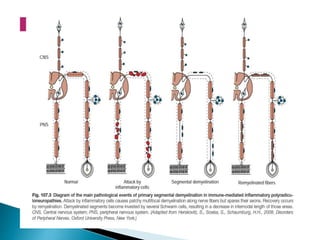
Clues:
 global arreflexia, proximal and distal involvement .
 Weakness>>wasting, large fibre involvement, good
recovery.
 motor >> sensory deficits
 NCS -Can discriminate inherited from acquired
-Distal motor latency prolonged (>125% ULN)
-Conduction velocities slowed (<80% LLN)
- May have conduction block
 EMG: Reduced recruitment w/o much denervation
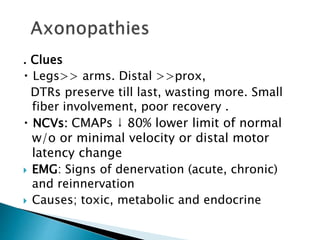
. Clues
Legs>> arms. Distal >>prox,
DTRs preserve till last, wasting more. Small
fiber involvement, poor recovery .
NCVs: CMAPs ↓ 80% lower limit of normal
w/o or minimal velocity or distal motor
latency change
 EMG: Signs of denervation (acute, chronic)
and reinnervation
 Causes; toxic, metabolic and endocrine
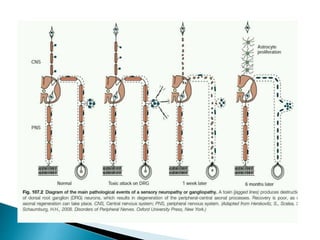
1. Sensory neuronopathies (polyganglionopathies)
 Paraneoplastic sensory neuronopathy (malignant
inflammatory sensory polyganglionopathy):
 Sjögren syndrome, Sarcoidosis, HIV.
 Idiopathic
 Toxic (cisplatin , vitamin B6 excess)
2. Chronic immune sensory polyradiculopathy
3. Demyelinating polyradiculoneuropathies:
 Guillain–Barré syndrome (Miller Fisher variant)
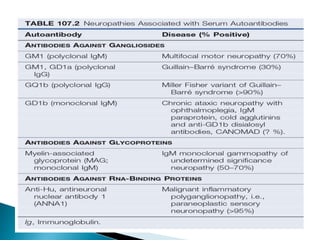
 Immunoglobulin M monoclonal gammopathy of
undetermined significance
4. CANOMAD*
5. Tabes dorsalis
*Chronic ataxic neuropathy with ophthalmoplegia, IgM
paraprotein, cold agglutinins and anti-GD1b disialosyl antibodies.
 Mononeuropathies;-
..At Entrapment site(median, ulnar, commen
peroneal nerve ) leprosy, DM, pregnency,
myxedema, acromegaly, RA, or
..as a part of more generalized disorder like (
HNPP, Amyloidosis )
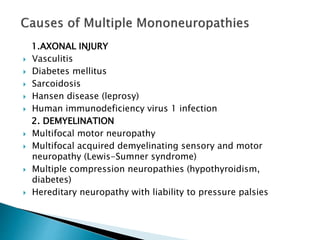
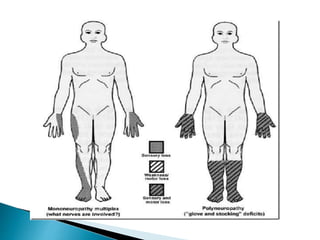
 Multiple mononeuropathy (mononeuritis
multiplex)-
..if two or more isolated nerves in separate areas
of the body are affected pattern is called as
mononeuritic multiplex.
1.AXONAL INJURY
 Vasculitis
 Diabetes mellitus
 Sarcoidosis
 Hansen disease (leprosy)
 Human immunodeficiency virus 1 infection
2. DEMYELINATION
 Multifocal motor neuropathy
 Multifocal acquired demyelinating sensory and motor
neuropathy (Lewis-Sumner syndrome)
 Multiple compression neuropathies (hypothyroidism,
diabetes)
 Hereditary neuropathy with liability to pressure palsies
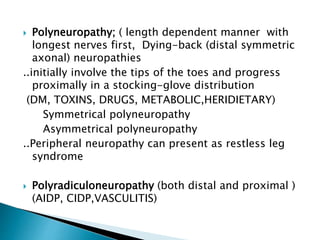
 Polyneuropathy; ( length dependent manner with
longest nerves first, Dying-back (distal symmetric
axonal) neuropathies
..initially involve the tips of the toes and progress
proximally in a stocking-glove distribution
(DM, TOXINS, DRUGS, METABOLIC,HERIDIETARY)
Symmetrical polyneuropathy
Asymmetrical polyneuropathy
..Peripheral neuropathy can present as restless leg
syndrome
 Polyradiculoneuropathy (both distal and proximal )
(AIDP, CIDP,VASCULITIS)
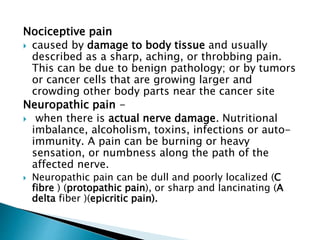
Nociceptive pain
 caused by damage to body tissue and usually
described as a sharp, aching, or throbbing pain.
This can be due to benign pathology; or by tumors
or cancer cells that are growing larger and
crowding other body parts near the cancer site
Neuropathic pain -
 when there is actual nerve damage. Nutritional
imbalance, alcoholism, toxins, infections or auto-
immunity. A pain can be burning or heavy
sensation, or numbness along the path of the
affected nerve.
 Neuropathic pain can be dull and poorly localized (C
fibre ) (protopathic pain), or sharp and lancinating (A
delta fiber )(epicritic pain).
 Diabetes and Pre-Diabetes
 Guillain-Barré syndrome
 Vitamin B12 deficiency
 Alcohol neuropathy
 Heavy metals poisoning
 Chemotherapy
 Vasculitis and Connective Tissue Diseases
 HIV
 Amyloidosis
 Porphyria
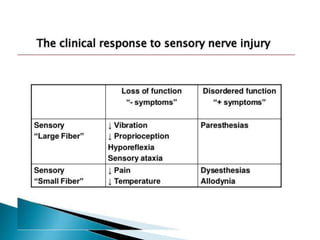
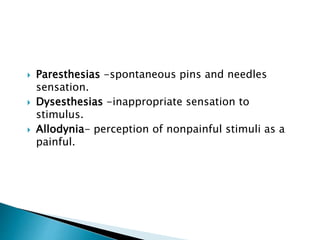
 Paresthesias -spontaneous pins and needles
sensation.
 Dysesthesias -inappropriate sensation to
stimulus.
 Allodynia- perception of nonpainful stimuli as a
painful.
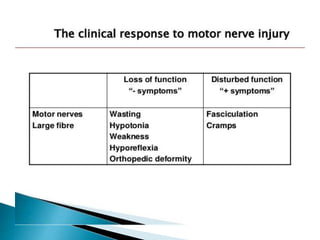
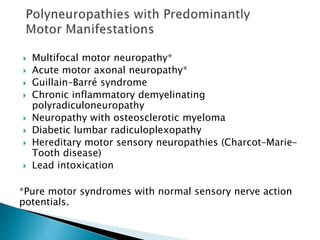
 Multifocal motor neuropathy*
 Acute motor axonal neuropathy*
 Guillain–Barré syndrome
 Chronic inflammatory demyelinating
polyradiculoneuropathy
 Neuropathy with osteosclerotic myeloma
 Diabetic lumbar radiculoplexopathy
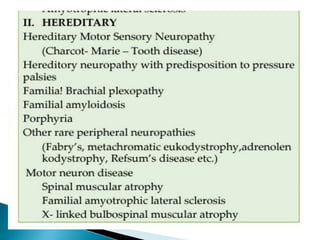
 Hereditary motor sensory neuropathies (Charcot–Marie–
Tooth disease)
 Lead intoxication
*Pure motor syndromes with normal sensory nerve action
potentials.
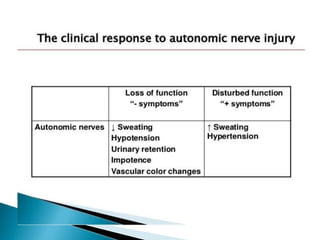
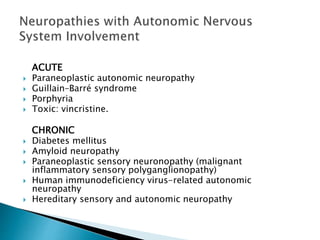
ACUTE
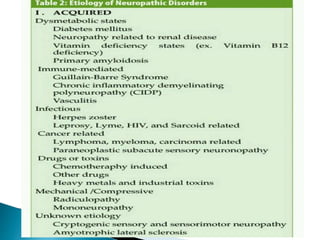
 Paraneoplastic autonomic neuropathy
 Guillain–Barré syndrome
 Porphyria
 Toxic: vincristine.
CHRONIC
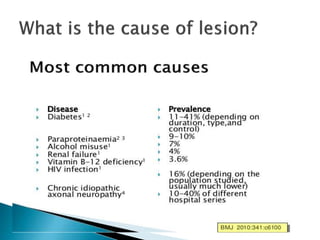
 Diabetes mellitus
 Amyloid neuropathy
 Paraneoplastic sensory neuronopathy (malignant
inflammatory sensory polyganglionopathy)
 Human immunodeficiency virus-related autonomic
neuropathy
 Hereditary sensory and autonomic neuropathy
 DM, hypothyroidism
 Metabolic- chronic renal failure , liver disease
 Nutritional- malabsorption, gastric surgery,
pancreatitis.
 Drug use
 HIV risk factors
 Diet (nutrition), alcohol, vitamin use (especially B6)
 Tick bite (Lyme disease)
 Constitutional symtoms (malignancy)
 Leprosy (hypo/hyperpigmeted anesthetic patches over
the body)
 Autoimmune (CTD, vasculitis )- joint pain , rash
 Toxin exposure- OP, lead, arsenic, thallium)
 Denctures –fixaives contain zinc lead to copper
deficiency.
 Axonal
 Vincristine, Paclitaxel, Nitrous oxide, Colchicine
Probenecid, Isoniazid, Hydralazine,
Metronidazole, Pyridoxine, Didanosine, Lithium,
Alfa-interferon, Dapsone, Phenytoin, Cimetidine,
Disulfiram, Chloroquine, Ethambutol,
Amitriptyline.
 Demyelinating
 Amiodarone, Chloroquine, Gold
 Neuronopathy
 Thalidomide, Cisplatin, Pyridoxine
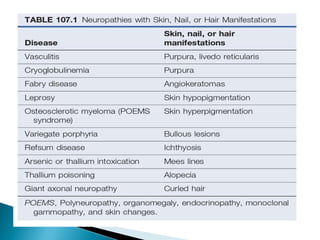
 Pallor- B12 deficincy,
 clubbing-paraneoplastic ,HTN- AIDP, poephyria ,PAN,
CKD,
 Knuckle hyperpigmentation- b12 deficiency
 Mees line , rain drop pigmentation- arsenic poisoning
 Bartolin lines over gum s- lead exposure
 Scoliosis, high arched feet, hammer toes , inverted
champagne bottle appearance –HSMN
 Diarrhea /steatorrhea –gluten ataxia , celiac disease
,abetalipoproteinemia .
 h/o stroke- fabry disease (painful paresthesia, small
fibre neuropathy ,angiokeratoma aroung ambilicus )
 Mental retardation- CMTX2,CMTX4
 DEAFNESS-CMT2A, CMTX4, mitocondrial , refsums
 Painless ulcers- leprosy, CMT2B ( SEVERE SENSORY LOSS, SEVERE
FOOT ULCERS , HYPERKERATOSIS)
 UPPER LIMB PREDOMINENT –CMT2D
 Seizures- mitocindrial diseaSES
 ORANGE TONSIL –TANGIERS DISEASE
 Cranial nerve (3,4 & 6)-miller fisher, botulism, mitochondrial
neuropathies .
 Funduscopic examination may show abnormalities such as optic
pallor, which can be present in vitamin B12 deficiency, alcohol,
cisplatin, ethambutol and heridietary .
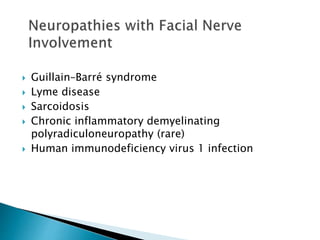
 Guillain–Barré syndrome
 Lyme disease
 Sarcoidosis
 Chronic inflammatory demyelinating
polyradiculoneuropathy (rare)
 Human immunodeficiency virus 1 infection
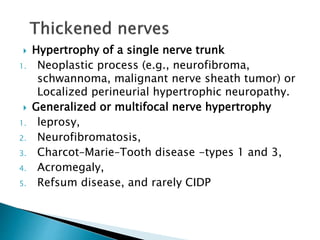
 Hypertrophy of a single nerve trunk
1. Neoplastic process (e.g., neurofibroma,
schwannoma, malignant nerve sheath tumor) or
Localized perineurial hypertrophic neuropathy.
 Generalized or multifocal nerve hypertrophy
1. leprosy,
2. Neurofibromatosis,
3. Charcot–Marie–Tooth disease -types 1 and 3,
4. Acromegaly,
5. Refsum disease, and rarely CIDP
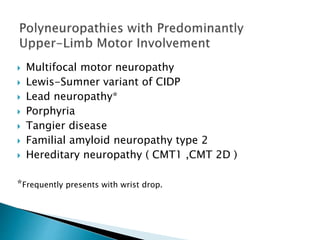
 Multifocal motor neuropathy
 Lewis-Sumner variant of CIDP
 Lead neuropathy*
 Porphyria
 Tangier disease
 Familial amyloid neuropathy type 2
 Hereditary neuropathy ( CMT1 ,CMT 2D )
*Frequently presents with wrist drop.
 Screening laboratory tests.
Tests with the highest yield of abnormality:
 1. blood glucose (fasting)
 2. serum B12 level
 3. SPEP (serum protein electrophoresis).
 ANA, RF, Anti-dsDNA, Anti-Ro, Anti-La,
 ANCA screen, cryoglobulins
 Urine for heavy metals, porphyrins
 IFE/urine IFE/ plasma light chain analysis
 CBC, ESR, HIV, HBsAg, and Anti HCV .
 Csf study-
..Csf protein raised (albuminocytological
dissociation) –AIDP,CIDP
..Significant pleocytosis-HIV, Borrelia, sarcoidosis
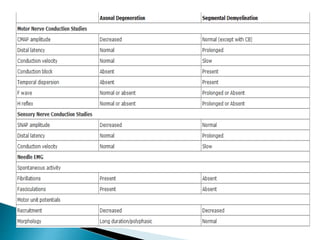
 (1) Confirming the presence of neuropathy,
 (2) Locating focal nerve lesions,
 (3) Nature of the underlying nerve pathology
 The limitations of EMG/NCS should be taken
into account when interpreting the findings.
◦ There is no reliable means of studying
proximal sensory nerves.
◦ NCS results can be normal in patients with
small fiber neuropathies
◦ Lower extremity sensory responses can be
absent in normal elderly patients.
EMG/NCS are not substitutes for a good
clinical examination.
 Diabetes mellitus and impaired glucose tolerance
 Amyloid neuropathy (early familial and primary)
 HIV-associated distal sensory neuropathy
 Hereditary sensory and autonomic neuropathies
 Fabry disease
 Tangier disease
 Sjögren (sicca) syndrome
 Cryptogenic small-fiber neuropathy
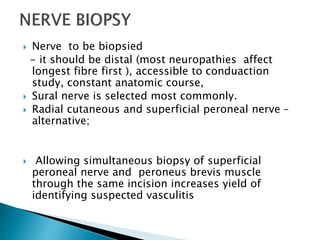
 Nerve to be biopsied
- it should be distal (most neuropathies affect
longest fibre first ), accessible to conduaction
study, constant anatomic course,
 Sural nerve is selected most commonly.
 Radial cutaneous and superficial peroneal nerve –
alternative;
 Allowing simultaneous biopsy of superficial
peroneal nerve and peroneus brevis muscle
through the same incision increases yield of
identifying suspected vasculitis
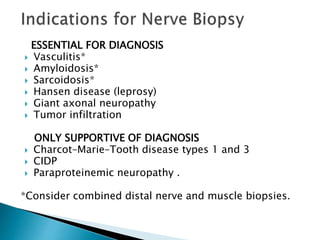
ESSENTIAL FOR DIAGNOSIS
 Vasculitis*
 Amyloidosis*
 Sarcoidosis*
 Hansen disease (leprosy)
 Giant axonal neuropathy
 Tumor infiltration
ONLY SUPPORTIVE OF DIAGNOSIS
 Charcot–Marie–Tooth disease types 1 and 3
 CIDP
 Paraproteinemic neuropathy .
*Consider combined distal nerve and muscle biopsies.
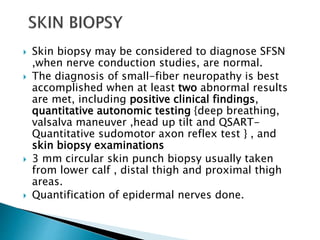
 Skin biopsy may be considered to diagnose SFSN
,when nerve conduction studies, are normal.
 The diagnosis of small-fiber neuropathy is best
accomplished when at least two abnormal results
are met, including positive clinical findings,
quantitative autonomic testing {deep breathing,
valsalva maneuver ,head up tilt and QSART-
Quantitative sudomotor axon reflex test } , and
skin biopsy examinations
 3 mm circular skin punch biopsy usually taken
from lower calf , distal thigh and proximal thigh
areas.
 Quantification of epidermal nerves done.
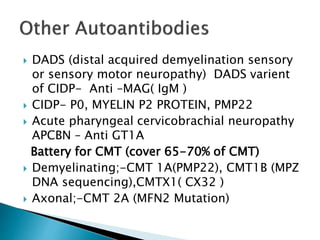
 DADS (distal acquired demyelination sensory
or sensory motor neuropathy) DADS varient
of CIDP- Anti –MAG( IgM )
 CIDP- P0, MYELIN P2 PROTEIN, PMP22
 Acute pharyngeal cervicobrachial neuropathy
APCBN – Anti GT1A
Battery for CMT (cover 65-70% of CMT)
 Demyelinating;-CMT 1A(PMP22), CMT1B (MPZ
DNA sequencing),CMTX1( CX32 )
 Axonal;-CMT 2A (MFN2 Mutation)
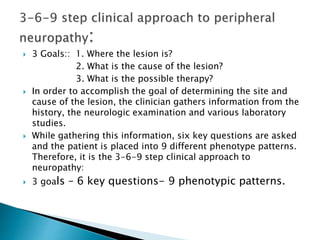
 3 Goals:: 1. Where the lesion is?
2. What is the cause of the lesion?
3. What is the possible therapy?
 In order to accomplish the goal of determining the site and
cause of the lesion, the clinician gathers information from the
history, the neurologic examination and various laboratory
studies.
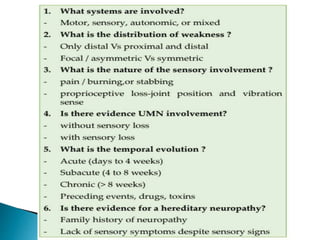
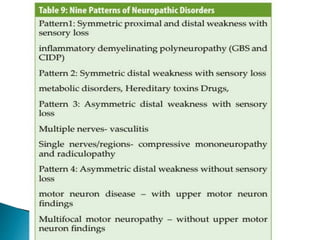
 While gathering this information, six key questions are asked
and the patient is placed into 9 different phenotype patterns.
Therefore, it is the 3-6-9 step clinical approach to
neuropathy:
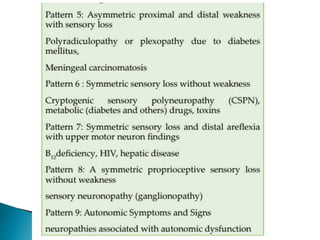
 3 goals – 6 key questions- 9 phenotypic patterns.
 Slow progression
Treat causative factors if possible
 If rapidly progressing
IVIG
Immunomodulating agents
Symptomatic
Tricyclic antidepressants
 ◦ Amitryptilin, nortryptilin
Calcium channel alpha-2-delta ligands
 ◦ Gabapentin, pregabalin
SNRI’s
 ◦ Duloxetine, venlafaxine
Topical Agents
 ◦ Lidocaine, Capsaicin
 Antiepileptic Drugs- Carbamazepine,
phenytoin,
 SSRI’s
 Opioid analgesics- Tramadol
 First line drugs
 • Tricyclic antidepressants
 • Gabapentin
 • Pregabalin p.o.
 • Duloxetine
 Second line
 • Carbamazepine
 • Phenytoin
 • Venlafaxine
 • Tramadol
 Physical Therapy
 ◦ Gait and balance training
 Assistive devices
 Safe environment
 Footwear at all times
 Foot hygiene
THANKS

Approach to PERIPHERAL NEUROPATHY

  • 1.
  • 2.
     Peripheral nervedisorders are common neurological problems caused by dysfunction of peripheral motor, sensory, or autonomic nerves.  The “shotgun” approach of ordering several panels of diagnostic tests without an adequate understanding of their significance and usefulness should be avoided.  A systematic diagnostic approach consists of a detailed history, comprehensive physical and neurological examinations, detailed electrodiagnostic (EDX) studies, and possibly additional testing (such as autonomic testing, skin biopsy and nerve biopsy).
  • 3.
     The peripheralnerve is a cable-like structure containing bundles of both unmyelinated and myelinated fibers and their supporting elements.  The unmyelinated axons are surrounded only by the plasma membrane of a Schwann cell.  The myelinated axons are surrounded completely by myelin and Schwann cells except at regular gaps called the nodes of Ranvier, which measure approximately 1 μm in adults.  The propagation of action potentials from one node of Ranvier to the next (saltatory conduction) is maintained by a thick myelin sheath with low capacitance and high resistance to electric current and by a high concentration of voltage- gated sodium channels at the nodes of Ranvier.
  • 5.
    1. Peripheral neuropathies (usuallysensory motor): .Myelinopathies, .Axonopathies 2. Neuronopathies (pure sensory or pure motor) .Sensory neuronopathies (ganglionopathies) .Motor neuronopathies ( MND )
  • 6.
    Clues:  global arreflexia,proximal and distal involvement .  Weakness>>wasting, large fibre involvement, good recovery.  motor >> sensory deficits  NCS -Can discriminate inherited from acquired -Distal motor latency prolonged (>125% ULN) -Conduction velocities slowed (<80% LLN) - May have conduction block  EMG: Reduced recruitment w/o much denervation
  • 8.
    . Clues Legs>> arms.Distal >>prox, DTRs preserve till last, wasting more. Small fiber involvement, poor recovery . NCVs: CMAPs ↓ 80% lower limit of normal w/o or minimal velocity or distal motor latency change  EMG: Signs of denervation (acute, chronic) and reinnervation  Causes; toxic, metabolic and endocrine
  • 10.
    1. Sensory neuronopathies(polyganglionopathies)  Paraneoplastic sensory neuronopathy (malignant inflammatory sensory polyganglionopathy):  Sjögren syndrome, Sarcoidosis, HIV.  Idiopathic  Toxic (cisplatin , vitamin B6 excess) 2. Chronic immune sensory polyradiculopathy 3. Demyelinating polyradiculoneuropathies:  Guillain–Barré syndrome (Miller Fisher variant)  Immunoglobulin M monoclonal gammopathy of undetermined significance 4. CANOMAD* 5. Tabes dorsalis *Chronic ataxic neuropathy with ophthalmoplegia, IgM paraprotein, cold agglutinins and anti-GD1b disialosyl antibodies.
  • 12.
     Mononeuropathies;- ..At Entrapmentsite(median, ulnar, commen peroneal nerve ) leprosy, DM, pregnency, myxedema, acromegaly, RA, or ..as a part of more generalized disorder like ( HNPP, Amyloidosis )  Multiple mononeuropathy (mononeuritis multiplex)- ..if two or more isolated nerves in separate areas of the body are affected pattern is called as mononeuritic multiplex.
  • 13.
    1.AXONAL INJURY  Vasculitis Diabetes mellitus  Sarcoidosis  Hansen disease (leprosy)  Human immunodeficiency virus 1 infection 2. DEMYELINATION  Multifocal motor neuropathy  Multifocal acquired demyelinating sensory and motor neuropathy (Lewis-Sumner syndrome)  Multiple compression neuropathies (hypothyroidism, diabetes)  Hereditary neuropathy with liability to pressure palsies
  • 14.
     Polyneuropathy; (length dependent manner with longest nerves first, Dying-back (distal symmetric axonal) neuropathies ..initially involve the tips of the toes and progress proximally in a stocking-glove distribution (DM, TOXINS, DRUGS, METABOLIC,HERIDIETARY) Symmetrical polyneuropathy Asymmetrical polyneuropathy ..Peripheral neuropathy can present as restless leg syndrome  Polyradiculoneuropathy (both distal and proximal ) (AIDP, CIDP,VASCULITIS)
  • 16.
    Nociceptive pain  causedby damage to body tissue and usually described as a sharp, aching, or throbbing pain. This can be due to benign pathology; or by tumors or cancer cells that are growing larger and crowding other body parts near the cancer site Neuropathic pain -  when there is actual nerve damage. Nutritional imbalance, alcoholism, toxins, infections or auto- immunity. A pain can be burning or heavy sensation, or numbness along the path of the affected nerve.  Neuropathic pain can be dull and poorly localized (C fibre ) (protopathic pain), or sharp and lancinating (A delta fiber )(epicritic pain).
  • 17.
     Diabetes andPre-Diabetes  Guillain-Barré syndrome  Vitamin B12 deficiency  Alcohol neuropathy  Heavy metals poisoning  Chemotherapy  Vasculitis and Connective Tissue Diseases  HIV  Amyloidosis  Porphyria
  • 19.
     Paresthesias -spontaneouspins and needles sensation.  Dysesthesias -inappropriate sensation to stimulus.  Allodynia- perception of nonpainful stimuli as a painful.
  • 21.
     Multifocal motorneuropathy*  Acute motor axonal neuropathy*  Guillain–Barré syndrome  Chronic inflammatory demyelinating polyradiculoneuropathy  Neuropathy with osteosclerotic myeloma  Diabetic lumbar radiculoplexopathy  Hereditary motor sensory neuropathies (Charcot–Marie– Tooth disease)  Lead intoxication *Pure motor syndromes with normal sensory nerve action potentials.
  • 23.
    ACUTE  Paraneoplastic autonomicneuropathy  Guillain–Barré syndrome  Porphyria  Toxic: vincristine. CHRONIC  Diabetes mellitus  Amyloid neuropathy  Paraneoplastic sensory neuronopathy (malignant inflammatory sensory polyganglionopathy)  Human immunodeficiency virus-related autonomic neuropathy  Hereditary sensory and autonomic neuropathy
  • 25.
     DM, hypothyroidism Metabolic- chronic renal failure , liver disease  Nutritional- malabsorption, gastric surgery, pancreatitis.  Drug use  HIV risk factors  Diet (nutrition), alcohol, vitamin use (especially B6)  Tick bite (Lyme disease)  Constitutional symtoms (malignancy)  Leprosy (hypo/hyperpigmeted anesthetic patches over the body)  Autoimmune (CTD, vasculitis )- joint pain , rash  Toxin exposure- OP, lead, arsenic, thallium)  Denctures –fixaives contain zinc lead to copper deficiency.
  • 26.
     Axonal  Vincristine,Paclitaxel, Nitrous oxide, Colchicine Probenecid, Isoniazid, Hydralazine, Metronidazole, Pyridoxine, Didanosine, Lithium, Alfa-interferon, Dapsone, Phenytoin, Cimetidine, Disulfiram, Chloroquine, Ethambutol, Amitriptyline.  Demyelinating  Amiodarone, Chloroquine, Gold  Neuronopathy  Thalidomide, Cisplatin, Pyridoxine
  • 27.
     Pallor- B12deficincy,  clubbing-paraneoplastic ,HTN- AIDP, poephyria ,PAN, CKD,  Knuckle hyperpigmentation- b12 deficiency  Mees line , rain drop pigmentation- arsenic poisoning  Bartolin lines over gum s- lead exposure  Scoliosis, high arched feet, hammer toes , inverted champagne bottle appearance –HSMN  Diarrhea /steatorrhea –gluten ataxia , celiac disease ,abetalipoproteinemia .  h/o stroke- fabry disease (painful paresthesia, small fibre neuropathy ,angiokeratoma aroung ambilicus )
  • 28.
     Mental retardation-CMTX2,CMTX4  DEAFNESS-CMT2A, CMTX4, mitocondrial , refsums  Painless ulcers- leprosy, CMT2B ( SEVERE SENSORY LOSS, SEVERE FOOT ULCERS , HYPERKERATOSIS)  UPPER LIMB PREDOMINENT –CMT2D  Seizures- mitocindrial diseaSES  ORANGE TONSIL –TANGIERS DISEASE  Cranial nerve (3,4 & 6)-miller fisher, botulism, mitochondrial neuropathies .  Funduscopic examination may show abnormalities such as optic pallor, which can be present in vitamin B12 deficiency, alcohol, cisplatin, ethambutol and heridietary .
  • 29.
     Guillain–Barré syndrome Lyme disease  Sarcoidosis  Chronic inflammatory demyelinating polyradiculoneuropathy (rare)  Human immunodeficiency virus 1 infection
  • 31.
     Hypertrophy ofa single nerve trunk 1. Neoplastic process (e.g., neurofibroma, schwannoma, malignant nerve sheath tumor) or Localized perineurial hypertrophic neuropathy.  Generalized or multifocal nerve hypertrophy 1. leprosy, 2. Neurofibromatosis, 3. Charcot–Marie–Tooth disease -types 1 and 3, 4. Acromegaly, 5. Refsum disease, and rarely CIDP
  • 32.
     Multifocal motorneuropathy  Lewis-Sumner variant of CIDP  Lead neuropathy*  Porphyria  Tangier disease  Familial amyloid neuropathy type 2  Hereditary neuropathy ( CMT1 ,CMT 2D ) *Frequently presents with wrist drop.
  • 33.
     Screening laboratorytests. Tests with the highest yield of abnormality:  1. blood glucose (fasting)  2. serum B12 level  3. SPEP (serum protein electrophoresis).
  • 34.
     ANA, RF,Anti-dsDNA, Anti-Ro, Anti-La,  ANCA screen, cryoglobulins  Urine for heavy metals, porphyrins  IFE/urine IFE/ plasma light chain analysis  CBC, ESR, HIV, HBsAg, and Anti HCV .  Csf study- ..Csf protein raised (albuminocytological dissociation) –AIDP,CIDP ..Significant pleocytosis-HIV, Borrelia, sarcoidosis
  • 35.
     (1) Confirmingthe presence of neuropathy,  (2) Locating focal nerve lesions,  (3) Nature of the underlying nerve pathology
  • 37.
     The limitationsof EMG/NCS should be taken into account when interpreting the findings. ◦ There is no reliable means of studying proximal sensory nerves. ◦ NCS results can be normal in patients with small fiber neuropathies ◦ Lower extremity sensory responses can be absent in normal elderly patients. EMG/NCS are not substitutes for a good clinical examination.
  • 38.
     Diabetes mellitusand impaired glucose tolerance  Amyloid neuropathy (early familial and primary)  HIV-associated distal sensory neuropathy  Hereditary sensory and autonomic neuropathies  Fabry disease  Tangier disease  Sjögren (sicca) syndrome  Cryptogenic small-fiber neuropathy
  • 40.
     Nerve tobe biopsied - it should be distal (most neuropathies affect longest fibre first ), accessible to conduaction study, constant anatomic course,  Sural nerve is selected most commonly.  Radial cutaneous and superficial peroneal nerve – alternative;  Allowing simultaneous biopsy of superficial peroneal nerve and peroneus brevis muscle through the same incision increases yield of identifying suspected vasculitis
  • 41.
    ESSENTIAL FOR DIAGNOSIS Vasculitis*  Amyloidosis*  Sarcoidosis*  Hansen disease (leprosy)  Giant axonal neuropathy  Tumor infiltration ONLY SUPPORTIVE OF DIAGNOSIS  Charcot–Marie–Tooth disease types 1 and 3  CIDP  Paraproteinemic neuropathy . *Consider combined distal nerve and muscle biopsies.
  • 42.
     Skin biopsymay be considered to diagnose SFSN ,when nerve conduction studies, are normal.  The diagnosis of small-fiber neuropathy is best accomplished when at least two abnormal results are met, including positive clinical findings, quantitative autonomic testing {deep breathing, valsalva maneuver ,head up tilt and QSART- Quantitative sudomotor axon reflex test } , and skin biopsy examinations  3 mm circular skin punch biopsy usually taken from lower calf , distal thigh and proximal thigh areas.  Quantification of epidermal nerves done.
  • 44.
     DADS (distalacquired demyelination sensory or sensory motor neuropathy) DADS varient of CIDP- Anti –MAG( IgM )  CIDP- P0, MYELIN P2 PROTEIN, PMP22  Acute pharyngeal cervicobrachial neuropathy APCBN – Anti GT1A Battery for CMT (cover 65-70% of CMT)  Demyelinating;-CMT 1A(PMP22), CMT1B (MPZ DNA sequencing),CMTX1( CX32 )  Axonal;-CMT 2A (MFN2 Mutation)
  • 45.
     3 Goals::1. Where the lesion is? 2. What is the cause of the lesion? 3. What is the possible therapy?  In order to accomplish the goal of determining the site and cause of the lesion, the clinician gathers information from the history, the neurologic examination and various laboratory studies.  While gathering this information, six key questions are asked and the patient is placed into 9 different phenotype patterns. Therefore, it is the 3-6-9 step clinical approach to neuropathy:  3 goals – 6 key questions- 9 phenotypic patterns.
  • 52.
     Slow progression Treatcausative factors if possible  If rapidly progressing IVIG Immunomodulating agents Symptomatic
  • 53.
    Tricyclic antidepressants  ◦Amitryptilin, nortryptilin Calcium channel alpha-2-delta ligands  ◦ Gabapentin, pregabalin SNRI’s  ◦ Duloxetine, venlafaxine Topical Agents  ◦ Lidocaine, Capsaicin
  • 54.
     Antiepileptic Drugs-Carbamazepine, phenytoin,  SSRI’s  Opioid analgesics- Tramadol
  • 55.
     First linedrugs  • Tricyclic antidepressants  • Gabapentin  • Pregabalin p.o.  • Duloxetine  Second line  • Carbamazepine  • Phenytoin  • Venlafaxine  • Tramadol
  • 56.
     Physical Therapy ◦ Gait and balance training  Assistive devices  Safe environment  Footwear at all times  Foot hygiene
  • 57.

Editor's Notes