Hypersensitivity
Reactions
Roshina Rabail
Hypersensitivity reactions
 The immune system is an integral part of
human protection against disease, but the
normally protective immune mechanisms can
sometimes cause detrimental reactions in the
host.
 Such reactions are known as hypersensitivity
reactions/Allergy, and the study of these is
termed immunopathology.
Hypersensitivity
 Hypersensitivity refers to the undesirable or
abnormal, sometimes fatal immune reactions
produced by the normal immune system.
Results from:
 repeated exposure to an antigen/allergen
 response of adaptive immune system to self
antigens (Auto immune diseases)
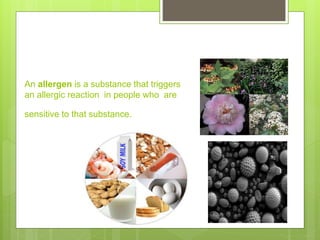
An allergen is a substance that triggers
an allergic reaction in people who are
sensitive to that substance.
Types of Hypersensitivity
Reactions
 Hypersensitivity reactions can be divided into four
types: based on the mechanisms involved and time
taken for the reaction. (by R. Coombs and P. Gell)
1. (type I) Immediate hypersensitivity
2. (type II) Antibody-mediated hypersensitivity
3. (type III) Immune complex-mediated hypersensitivity
4. (type IV) Cell-mediated hypersensitivity
 Type V: (Autoimmune disease, receptor mediated)
This is an additional type that is sometimes (often
in Britain) used as a distinction from Type 2.
Type I Hypersensitivity
 Type I hypersensitivity is also known as immediate
or anaphylactic hypersensitivity
 Commonly called Allergy
 Occurs within minutes to the exposure to antigen
 mediated by IgE (rarely by IgG4)
 IgE produced by plasma cells in response to T cells by
antigens
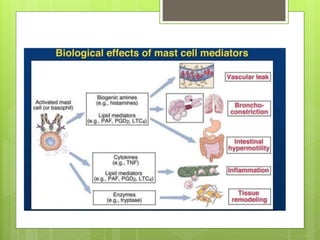
 IgE binds to mast cell or basophil causing them to result in
degranulation and release several mediators:
 Histamine: Increase permeability, mucous secretion and smooth
muscle contraction
 Prostaglandins: Contraction of smooth muscles
 Leukotrienes: Bronchial spasms
 Further reaction is amplified by platelets, neutrophils and
eosinophils
Type I Hypersensitivity
 Mast cells are triggered by some other stimuli such as:
 exercise, emotional stress, chemicals, anaphylotoxins (e.g.,
C4a, C3a, C5a, etc.).
 Anaphylactic Shock: Massive Drop in Blood Pressure, can
be fatal in minutes
 Cytokines that contribute to HS I are: IL-4,IL-5,IL-6, TNF-α
 The reaction may involve
 skin (urticaria and eczema),
 eyes (conjunctivitis),
 nasopharynx (rhinorrhea, rhinitis),
 bronchopulmonary tissues (asthma)
 gastrointestinal tract (gastroenteritis).
Type I Hypersensitivity
 Antigens that stimulate Type I HS are called Allergens
 Examples are: House dust, pollens, cosmetics, Insects,
Clothing, Drugs etc.
 Atopic people tend to mount IgE responces
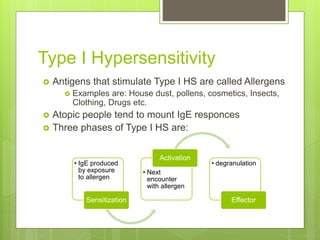
 Three phases of Type I HS are:
• IgE produced
by exposure
to allergen
Sensitization
• Next
encounter
with allergen
Activation
• degranulation
Effector
Anaphylactic shock
 Anaphylaxis is a severe, whole-body allergic reaction to a
chemicals that has become an allergen.
 This reaction is quick and involves the whole body.
 Tissues in different parts of the body release histamine and
other substances.
 This causes the airways to tighten and leads to other symptoms.
 Anaphylaxis can occur in response to any allergen. Common
causes include:
 - Drug allergies
 - Food allergies
 - Insect bites/stings
 Anaphylaxis is life-threatening and can occur at any time.
 Risks include a history of any type of allergic reaction.
Anaphylactic shock
 Anaphylactoid reaction:
 Some drugs (morphine, x-ray dye, Aspirin and others) may cause an
anaphylactic-like reaction when people are first exposed to them.
 These reactions are not the same as the immune system response that occurs
with "true" anaphylaxis. However, the symptoms, risk for complications, and
treatment are the same for both types of reactions.
 Symptoms:
 develop rapidly, often within seconds or minutes. They may include the
following:
 Abdominal pain or cramping
 Abnormal breathing sounds, wheezing, Difficulty breathing
 Anxiety, Palpitations
 Cough
 Difficulty swallowing
 Fainting, light-headedness, dizziness, Confusion
 Skin redness, Hives, itchiness
 Nasal congestion
 Nausea, vomiting, Diarrhoea
 Slurred speech
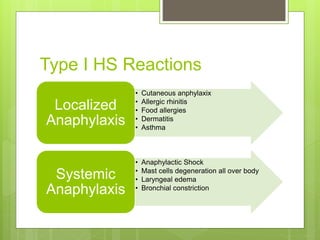
Type I HS Reactions
• Cutaneous anphylaxix
• Allergic rhinitis
• Food allergies
• Dermatitis
• Asthma
Localized
Anaphylaxis
• Anaphylactic Shock
• Mast cells degeneration all over body
• Laryngeal edema
• Bronchial constriction
Systemic
Anaphylaxis
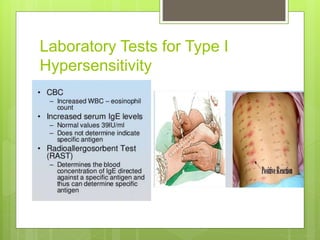
Laboratory Tests for Type I
Hypersensitivity
Treatment of Type I HS
 Avoid Allergens
 Drugs:
 Anti-histamines: Compete histamine for its receptors
 Epinephrine : best for anaphylactic shock, (reverse
effects of granules) quick but short duration.
 Cortisone: Blocks histamine synthesis
 Hyposensitization: repeated injections of allergens
may shift from IgE to IgG
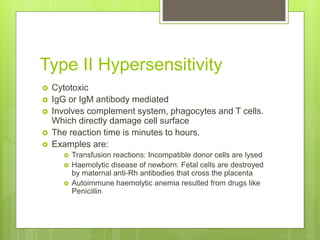
Type II Hypersensitivity
 Cytotoxic
 IgG or IgM antibody mediated
 Involves complement system, phagocytes and T cells.
Which directly damage cell surface
 The reaction time is minutes to hours.
 Examples are:
 Transfusion reactions: Incompatible donor cells are lysed
 Haemolytic disease of newborn: Fetal cells are destroyed
by maternal anti-Rh antibodies that cross the placenta
 Autoimmune haemolytic anemia resulted from drugs like
Penicillin
Type II Hypersensitivity
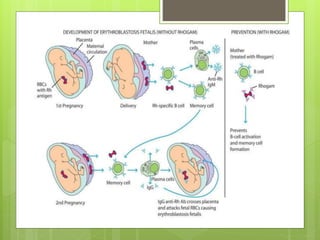
 Haemolytic Disease of newborn:
 Involves Rh blood group system
 Rh- mom with Rh+ fetus, makes antibodies that enter
mom’s circulation at birth
 Next pregnancy: IgG antibodies cross placenta, destroy
fetal RBC, leading to jaundice and brain damage.
 Diagnosis:
 include detection of circulating antibody against the
tissues involved
 the presence of antibody and complement in the lesion
(biopsy) by immunofluorescence.
 The immunofluorescent staining in type II HS is linear
 Prevention:
 Giving mother RhoGAM right after birth
Type III Hypersensitivity
Reactions
 Antigen Antibody immune complex hypersensitivity
 3 - 10 hours after exposure to the antigen
 Mediated by soluble immune complexes, IgG/IgM
antibodies and complement (C3a, 4a and 5a)
 Large amounts of Antigen-Antibody complexes are
accumulated in blood
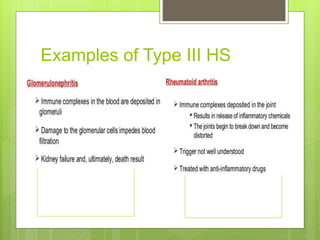
 When deposited in organs can cause inflammatory
damages like:
 Rheumatoid arthritis
 Glomerulonephritis
Type III Hypersensitivity
Reactions
 The damage is caused by platelets and
neutrophils.
 Diagnosis involves examination of tissue biopsies
for deposits of immunoglobulin and complement
by immunofluorescence microscopy
 The immunofluorescent staining in type III
hypersensitivity is granular
 Examples are:
 Serum Sickness from circulating complexes e.g;
Glomerulonephritis, RA, Chronic infections
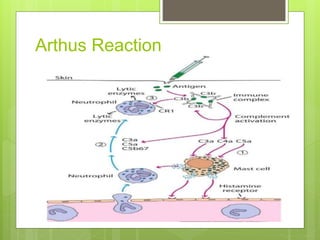
 Arthus Reaction from localized complexes e.g insect
bite, hypersensitivity pneumonitis
Arthus Reaction
Examples of Type III HS
Type IV Hypersensitivity
 Delayed Hypersensitivity
 T Cell mediated cytotoxicity
 Start after hours to days of exposure
 Release of cytokines, NK cells and
macrophage activation
 No antibodies involved
 Localized reactions at site of antigen
 Examples are: TB. Leprosy. Poison IVY
Type IV Hypersensitivity
 Sensitization stage:
 Memory T cells are generated by dendritic cells
 Effector stage:
 On secondary contact, T memory cells are
activated and produce cytokines which cause
tissue destruction and inflammation
 Continued exposure can cause chronic
inflammation and result in granuloma formation
 Tuberculin Skin Test
 An injection of tuberculin beneath skin
 Identifies Human being infected with
Mycobacterium tuberculosis
 No response when individual is not infected
 Red hard swelling in infected individuals
 Contact Dermatitis:
 Small molecules act as hapten and combine
with complex protein in skin
 Taken up by antigen presenting cells
 Activate T cells
 T memory cells are generated
 Next exposure T memory cells cause Delayed
Type Hypersensitivity (DTH)
 Intense irritating skin rash, fluid filled blisters,
 Graft Rejection:
 Rejection of tissues or organs transplanted
 Grafts are perceived as foreign by immune system
 MHC involved
Table - Comparison of Different Types of hypersensitivity
Characteristics
Type-I
(anaphylactic)
Type-II
(cytotoxic)
Type-III
(immune
complex)
Type-IV
(delayed type)
Antibody IgE IgG, IgM IgG, IgM None
Antigen Exogenous Cell surface Soluble
Tissues and
organs
Response time 15-30 minutes Minutes-hours 3-8 hours 48-72 hours
Appearance Weal and flare Lysis and necrosis
Erythema and
edema, necrosis
Erythema and
induration
Histology
Basophils and
eosinophil
Antibody and
complement
Complement
and neutrophils
Monocytes and
lymphocytes
Transferred with Antibody Antibody Antibody T-cells
Examples
Allergic asthma,
hay fever
Erythroblastosis
fetalis
Goodpasture's
nephritis
SLE, farmer's
lung disease
Tuberculin test,
poison ivy,
granuloma
Type V Hypersensitivity
 This is an additional type that is sometimes (often in
Britain) used as a distinction from Type 2.
 Instead of binding to cell surface components, the
antibodies recognize and bind to the cell
surface receptors
 This either prevents the intended ligand binding with
the receptor or mimics the effects of the ligand, thus
impairing cell signaling.
 Some clinical examples:
 - Graves' disease
 - Myasthenia gravis
 The use of Type 5 is rare. These conditions are more
frequently classified as Type 2,
Hypersensitivity reactions

Hypersensitivity reactions

  • 1.
  • 2.
    Hypersensitivity reactions  Theimmune system is an integral part of human protection against disease, but the normally protective immune mechanisms can sometimes cause detrimental reactions in the host.  Such reactions are known as hypersensitivity reactions/Allergy, and the study of these is termed immunopathology.
  • 3.
    Hypersensitivity  Hypersensitivity refersto the undesirable or abnormal, sometimes fatal immune reactions produced by the normal immune system. Results from:  repeated exposure to an antigen/allergen  response of adaptive immune system to self antigens (Auto immune diseases)
  • 4.
    An allergen isa substance that triggers an allergic reaction in people who are sensitive to that substance.
  • 5.
    Types of Hypersensitivity Reactions Hypersensitivity reactions can be divided into four types: based on the mechanisms involved and time taken for the reaction. (by R. Coombs and P. Gell) 1. (type I) Immediate hypersensitivity 2. (type II) Antibody-mediated hypersensitivity 3. (type III) Immune complex-mediated hypersensitivity 4. (type IV) Cell-mediated hypersensitivity  Type V: (Autoimmune disease, receptor mediated) This is an additional type that is sometimes (often in Britain) used as a distinction from Type 2.
  • 7.
    Type I Hypersensitivity Type I hypersensitivity is also known as immediate or anaphylactic hypersensitivity  Commonly called Allergy  Occurs within minutes to the exposure to antigen  mediated by IgE (rarely by IgG4)  IgE produced by plasma cells in response to T cells by antigens  IgE binds to mast cell or basophil causing them to result in degranulation and release several mediators:  Histamine: Increase permeability, mucous secretion and smooth muscle contraction  Prostaglandins: Contraction of smooth muscles  Leukotrienes: Bronchial spasms  Further reaction is amplified by platelets, neutrophils and eosinophils
  • 9.
    Type I Hypersensitivity Mast cells are triggered by some other stimuli such as:  exercise, emotional stress, chemicals, anaphylotoxins (e.g., C4a, C3a, C5a, etc.).  Anaphylactic Shock: Massive Drop in Blood Pressure, can be fatal in minutes  Cytokines that contribute to HS I are: IL-4,IL-5,IL-6, TNF-α  The reaction may involve  skin (urticaria and eczema),  eyes (conjunctivitis),  nasopharynx (rhinorrhea, rhinitis),  bronchopulmonary tissues (asthma)  gastrointestinal tract (gastroenteritis).
  • 10.
    Type I Hypersensitivity Antigens that stimulate Type I HS are called Allergens  Examples are: House dust, pollens, cosmetics, Insects, Clothing, Drugs etc.  Atopic people tend to mount IgE responces  Three phases of Type I HS are: • IgE produced by exposure to allergen Sensitization • Next encounter with allergen Activation • degranulation Effector
  • 11.
    Anaphylactic shock  Anaphylaxisis a severe, whole-body allergic reaction to a chemicals that has become an allergen.  This reaction is quick and involves the whole body.  Tissues in different parts of the body release histamine and other substances.  This causes the airways to tighten and leads to other symptoms.  Anaphylaxis can occur in response to any allergen. Common causes include:  - Drug allergies  - Food allergies  - Insect bites/stings  Anaphylaxis is life-threatening and can occur at any time.  Risks include a history of any type of allergic reaction.
  • 12.
    Anaphylactic shock  Anaphylactoidreaction:  Some drugs (morphine, x-ray dye, Aspirin and others) may cause an anaphylactic-like reaction when people are first exposed to them.  These reactions are not the same as the immune system response that occurs with "true" anaphylaxis. However, the symptoms, risk for complications, and treatment are the same for both types of reactions.  Symptoms:  develop rapidly, often within seconds or minutes. They may include the following:  Abdominal pain or cramping  Abnormal breathing sounds, wheezing, Difficulty breathing  Anxiety, Palpitations  Cough  Difficulty swallowing  Fainting, light-headedness, dizziness, Confusion  Skin redness, Hives, itchiness  Nasal congestion  Nausea, vomiting, Diarrhoea  Slurred speech
  • 13.
    Type I HSReactions • Cutaneous anphylaxix • Allergic rhinitis • Food allergies • Dermatitis • Asthma Localized Anaphylaxis • Anaphylactic Shock • Mast cells degeneration all over body • Laryngeal edema • Bronchial constriction Systemic Anaphylaxis
  • 14.
    Laboratory Tests forType I Hypersensitivity
  • 15.
    Treatment of TypeI HS  Avoid Allergens  Drugs:  Anti-histamines: Compete histamine for its receptors  Epinephrine : best for anaphylactic shock, (reverse effects of granules) quick but short duration.  Cortisone: Blocks histamine synthesis  Hyposensitization: repeated injections of allergens may shift from IgE to IgG
  • 16.
    Type II Hypersensitivity Cytotoxic  IgG or IgM antibody mediated  Involves complement system, phagocytes and T cells. Which directly damage cell surface  The reaction time is minutes to hours.  Examples are:  Transfusion reactions: Incompatible donor cells are lysed  Haemolytic disease of newborn: Fetal cells are destroyed by maternal anti-Rh antibodies that cross the placenta  Autoimmune haemolytic anemia resulted from drugs like Penicillin
  • 17.
    Type II Hypersensitivity Haemolytic Disease of newborn:  Involves Rh blood group system  Rh- mom with Rh+ fetus, makes antibodies that enter mom’s circulation at birth  Next pregnancy: IgG antibodies cross placenta, destroy fetal RBC, leading to jaundice and brain damage.  Diagnosis:  include detection of circulating antibody against the tissues involved  the presence of antibody and complement in the lesion (biopsy) by immunofluorescence.  The immunofluorescent staining in type II HS is linear  Prevention:  Giving mother RhoGAM right after birth
  • 19.
    Type III Hypersensitivity Reactions Antigen Antibody immune complex hypersensitivity  3 - 10 hours after exposure to the antigen  Mediated by soluble immune complexes, IgG/IgM antibodies and complement (C3a, 4a and 5a)  Large amounts of Antigen-Antibody complexes are accumulated in blood  When deposited in organs can cause inflammatory damages like:  Rheumatoid arthritis  Glomerulonephritis
  • 20.
    Type III Hypersensitivity Reactions The damage is caused by platelets and neutrophils.  Diagnosis involves examination of tissue biopsies for deposits of immunoglobulin and complement by immunofluorescence microscopy  The immunofluorescent staining in type III hypersensitivity is granular  Examples are:  Serum Sickness from circulating complexes e.g; Glomerulonephritis, RA, Chronic infections  Arthus Reaction from localized complexes e.g insect bite, hypersensitivity pneumonitis
  • 21.
  • 23.
  • 24.
    Type IV Hypersensitivity Delayed Hypersensitivity  T Cell mediated cytotoxicity  Start after hours to days of exposure  Release of cytokines, NK cells and macrophage activation  No antibodies involved  Localized reactions at site of antigen  Examples are: TB. Leprosy. Poison IVY
  • 25.
    Type IV Hypersensitivity Sensitization stage:  Memory T cells are generated by dendritic cells  Effector stage:  On secondary contact, T memory cells are activated and produce cytokines which cause tissue destruction and inflammation  Continued exposure can cause chronic inflammation and result in granuloma formation
  • 27.
     Tuberculin SkinTest  An injection of tuberculin beneath skin  Identifies Human being infected with Mycobacterium tuberculosis  No response when individual is not infected  Red hard swelling in infected individuals
  • 28.
     Contact Dermatitis: Small molecules act as hapten and combine with complex protein in skin  Taken up by antigen presenting cells  Activate T cells  T memory cells are generated  Next exposure T memory cells cause Delayed Type Hypersensitivity (DTH)  Intense irritating skin rash, fluid filled blisters,
  • 29.
     Graft Rejection: Rejection of tissues or organs transplanted  Grafts are perceived as foreign by immune system  MHC involved
  • 30.
    Table - Comparisonof Different Types of hypersensitivity Characteristics Type-I (anaphylactic) Type-II (cytotoxic) Type-III (immune complex) Type-IV (delayed type) Antibody IgE IgG, IgM IgG, IgM None Antigen Exogenous Cell surface Soluble Tissues and organs Response time 15-30 minutes Minutes-hours 3-8 hours 48-72 hours Appearance Weal and flare Lysis and necrosis Erythema and edema, necrosis Erythema and induration Histology Basophils and eosinophil Antibody and complement Complement and neutrophils Monocytes and lymphocytes Transferred with Antibody Antibody Antibody T-cells Examples Allergic asthma, hay fever Erythroblastosis fetalis Goodpasture's nephritis SLE, farmer's lung disease Tuberculin test, poison ivy, granuloma
  • 31.
    Type V Hypersensitivity This is an additional type that is sometimes (often in Britain) used as a distinction from Type 2.  Instead of binding to cell surface components, the antibodies recognize and bind to the cell surface receptors  This either prevents the intended ligand binding with the receptor or mimics the effects of the ligand, thus impairing cell signaling.  Some clinical examples:  - Graves' disease  - Myasthenia gravis  The use of Type 5 is rare. These conditions are more frequently classified as Type 2,