PRESENTED BY
AKSHAYA ANIL
S 3 M.Sc BIOCHEMISTRY
DEPT.OF BIOCHEMISTRY
KERALA UNIVERSITY
ORGAN SPECIFIC
AUTOIMMUNE
DISORDERS
AUTO IMMUNITY
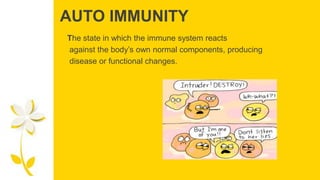
The state in which the immune system reacts
against the body’s own normal components, producing
disease or functional changes.
AUTOIMMUNE DISEASES
Autoimmune diseases are divided into two classes:
 Organ-specific.
 Systemic.
 Organ-specific disease is one in which an immune response is
directed toward antigens in a single organ or a gland.
Systemic diseases the immune system attacks self antigens in
several organs.
ORGAN SPECIFIC AUTOIMMUNE DISEASES
Immune responses is directed towards a target antigen unique
to that organ
Manifestations are largely limited to that organ
Humoral/cell mediated
Antibody may over stimulate/block
AUTOIMMUNE DISEASES MEDIATED BY
DIRECTED BY
DIRECT CELLULAR DAMAGE
Lymphocytes or antibodies bind to the cell membrane
antigens
Causes cellular lysis & or inflammatory responses
Gradually the damaged cellular structure is replaced by
connective tissue (fibrosis)
Function of the organ declines
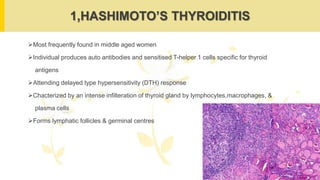
1,HASHIMOTO’S THYROIDITIS
Most frequently found in middle aged women
Individual produces auto antibodies and sensitised T-helper 1 cells specific for thyroid
antigens
Attending delayed type hypersensitivity (DTH) response
Chacterized by an intense infilteration of thyroid gland by lymphocytes,macrophages, &
plasma cells
Forms lymphatic follicles & germinal centres
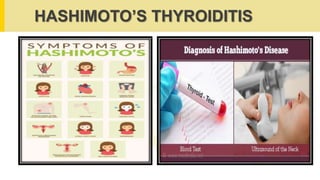
HASHIMOTO’S THYROIDITIS
Ensuing inflammatory response causes goitre, or visible enlargement of the thyroid gland
A physiological response to hypothyroidism
Autoantibodies binds to the proteins including thyroglobulin, & thyroid peroxidase which
are involved in the uptake of iodine
Interferes with the uptake of iodine
HASHIMOTO’S THYROIDITIS
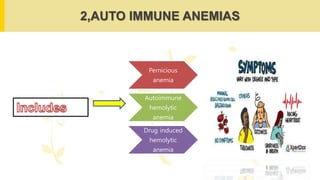
2,AUTO IMMUNE ANEMIAS
Pernicious
anemia
Autoimmune
hemolytic
anemia
Drug induced
hemolytic
anemia
AUTO IMMUNE ANEMIAS
PERNICIOUS ANEMIA
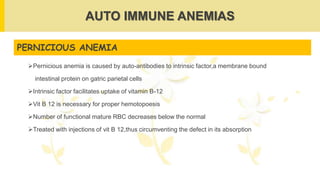
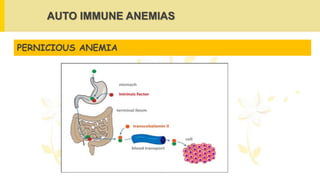
Pernicious anemia is caused by auto-antibodies to intrinsic factor,a membrane bound
intestinal protein on gatric parietal cells
Intrinsic factor facilitates uptake of vitamin B-12
Vit B 12 is necessary for proper hemotopoesis
Number of functional mature RBC decreases below the normal
Treated with injections of vit B 12,thus circumventing the defect in its absorption
AUTO IMMUNE ANEMIAS
PERNICIOUS ANEMIA
AUTO IMMUNE ANEMIAS
AUTOIMMUNE HEMOLYTIC ANEMIA
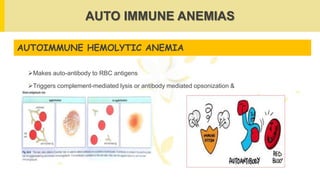
Makes auto-antibody to RBC antigens
Triggers complement-mediated lysis or antibody mediated opsonization &
phagocytosis of RBC
AUTO IMMUNE ANEMIAS
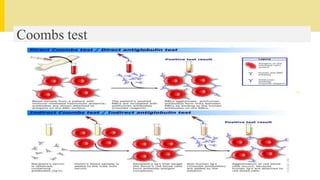
DRUG INDUCED HEMOLYTIC ANEMIA
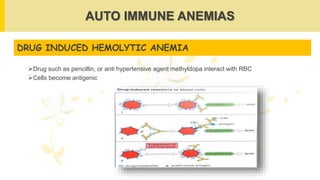
Drug such as pencillin, or anti hypertensive agent methyldopa interact with RBC
Cells become antigenic
Coombs test
3,GOODPASTURE’S SYNDROME
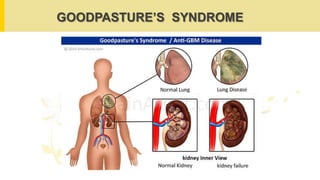
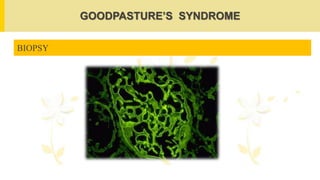
Auto-antibodies specific for certain basement membrane antigens binds to the
basement membranes of kidney glomeruli & the alveoli of the lungs
Compliment activation leads to direct cellular damage
 Ensuing inflammatory response mediated by a buildup of complement splits products
Damage to glomerular & alveolar basement membranes leads to progressive
kidney damage & pulmonary hemorrhage
Death may ensue within several month of the onset of symptoms
GOODPASTURE’S SYNDROME
BIOPSY
4,INSULIN DEPENDENT DIABETES MELLITUS
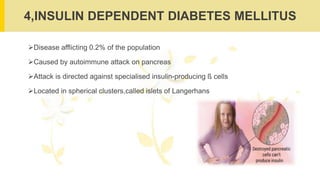
Disease afflicting 0.2% of the population
Caused by autoimmune attack on pancreas
Attack is directed against specialised insulin-producing ß cells
Located in spherical clusters,called islets of Langerhans
INSULIN DEPENDENT DIABETES MELLITUS
Autoimmune attack destroys ß cells
Results in decreased level of insulin
Consequently increased levels of blood glucose
 Activated CTLs(cytotoxic T lymphocytes) migrate into islet
begin to attack the insulin producing cells
Local cytokine production during this response includes IFN-gamma,
TNF-alpha, & IL-1
INSULIN DEPENDENT DIABETES MELLITUS
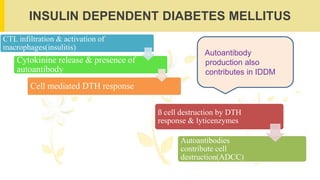
CTL infiltration & activation of
macrophages(insulitis)
Cytokinine release & presence of
autoantibody
Cell mediated DTH response
ß cell destruction by DTH
response & lyticenzymes
Autoantibodies
contribute cell
destruction(ADCC)
Autoantibody
production also
contributes in IDDM
INSULIN DEPENDENT DIABETES MELLITUS
Destruction of ßcells results in serious metabolic problems that include ketoacidosis
& increased urine production
Later stages are characterised by atherosclerotic vascular lesions
In turn cause gangrene of the extremities due to impeded vacular flow
Renal failure
Blindness
If untreated death
INSULIN DEPENDENT DIABETES MELLITUS
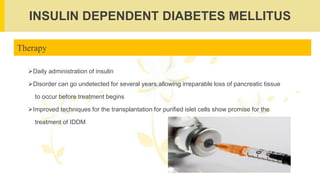
Therapy
Daily administration of insulin
Disorder can go undetected for several years,allowing irreparable loss of pancreatic tissue
to occur before treatment begins
Improved techniques for the transplantation for purified islet cells show promise for the
treatment of IDDM
AUTOIMMUNE DISEASES MEDIATED BY
STIMULATING OR BLOCKING AUTO-ANTIBODIES
Antibodies act as agonist
Binds to the hormone receptors
Stimulates the inappropriate activity
Usually leads to an over production of mediators or in
increase in cell growth
Conversely auto-antibody may act as antagonist
Binds to hormone receptors
Blocks the receptor function
Impaired secretion of mediators
Gradual atropy of the affected organ
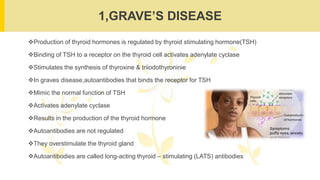
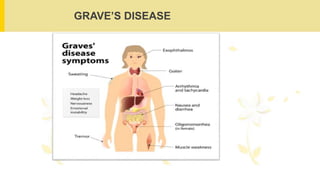
1,GRAVE’S DISEASE
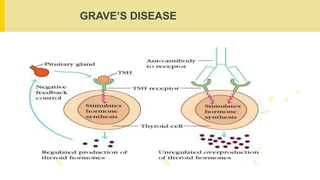
Production of thyroid hormones is regulated by thyroid stimulating hormone(TSH)
Binding of TSH to a receptor on the thyroid cell activates adenylate cyclase
Stimulates the synthesis of thyroxine & triiodothyroninie
In graves disease,autoantibodies that binds the receptor for TSH
Mimic the normal function of TSH
Activates adenylate cyclase
Results in the production of the thyroid hormone
Autoantibodies are not regulated
They overstimulate the thyroid gland
Autoantibodies are called long-acting thyroid – stimulating (LATS) antibodies
GRAVE’S DISEASE
GRAVE’S DISEASE
2,MYASTHENIA GRAVIS
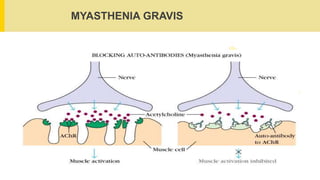
Prototype autoimmune disease mediated blocking antibody
Autoantibodies binds with the acetylcholine receptors on the motor end plates
of muscles
Blocks the normal binding of acetylcholine
Induce compliment –mediated lysis of the cell
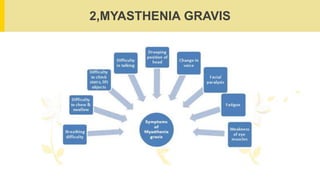
Result in progressive weaking of the skeletal muscles
Ultimately, the autoantibodies causes the destruction of the cell bearing the receptors
MYASTHENIA GRAVIS
2,MYASTHENIA GRAVIS
REFERENCES
KUBY IMMUMOLOGY,THOMAS J.KINDT,RICHARD A.GOLDSBY,BARBARA A.OSBO
RNE
ROITTI’S ESSENTIAL IMMUNOLOGY,IVAN M.ROITT
CELLULAR & MOLECULAR IMMUNOLOGY,ABUL K.ABBAS,ANDREW H.LICHTMA
N
T
H
A
N
K
Y
O
U
U
U…..

Organ specific autoimmune disorders

  • 1.
    PRESENTED BY AKSHAYA ANIL S3 M.Sc BIOCHEMISTRY DEPT.OF BIOCHEMISTRY KERALA UNIVERSITY ORGAN SPECIFIC AUTOIMMUNE DISORDERS
  • 2.
    AUTO IMMUNITY The statein which the immune system reacts against the body’s own normal components, producing disease or functional changes.
  • 3.
    AUTOIMMUNE DISEASES Autoimmune diseasesare divided into two classes:  Organ-specific.  Systemic.  Organ-specific disease is one in which an immune response is directed toward antigens in a single organ or a gland. Systemic diseases the immune system attacks self antigens in several organs.
  • 4.
    ORGAN SPECIFIC AUTOIMMUNEDISEASES Immune responses is directed towards a target antigen unique to that organ Manifestations are largely limited to that organ Humoral/cell mediated Antibody may over stimulate/block
  • 5.
    AUTOIMMUNE DISEASES MEDIATEDBY DIRECTED BY DIRECT CELLULAR DAMAGE Lymphocytes or antibodies bind to the cell membrane antigens Causes cellular lysis & or inflammatory responses Gradually the damaged cellular structure is replaced by connective tissue (fibrosis) Function of the organ declines
  • 6.
    1,HASHIMOTO’S THYROIDITIS Most frequentlyfound in middle aged women Individual produces auto antibodies and sensitised T-helper 1 cells specific for thyroid antigens Attending delayed type hypersensitivity (DTH) response Chacterized by an intense infilteration of thyroid gland by lymphocytes,macrophages, & plasma cells Forms lymphatic follicles & germinal centres
  • 7.
    HASHIMOTO’S THYROIDITIS Ensuing inflammatoryresponse causes goitre, or visible enlargement of the thyroid gland A physiological response to hypothyroidism Autoantibodies binds to the proteins including thyroglobulin, & thyroid peroxidase which are involved in the uptake of iodine Interferes with the uptake of iodine
  • 8.
  • 9.
  • 10.
    AUTO IMMUNE ANEMIAS PERNICIOUSANEMIA Pernicious anemia is caused by auto-antibodies to intrinsic factor,a membrane bound intestinal protein on gatric parietal cells Intrinsic factor facilitates uptake of vitamin B-12 Vit B 12 is necessary for proper hemotopoesis Number of functional mature RBC decreases below the normal Treated with injections of vit B 12,thus circumventing the defect in its absorption
  • 11.
  • 12.
    AUTO IMMUNE ANEMIAS AUTOIMMUNEHEMOLYTIC ANEMIA Makes auto-antibody to RBC antigens Triggers complement-mediated lysis or antibody mediated opsonization & phagocytosis of RBC
  • 13.
    AUTO IMMUNE ANEMIAS DRUGINDUCED HEMOLYTIC ANEMIA Drug such as pencillin, or anti hypertensive agent methyldopa interact with RBC Cells become antigenic
  • 14.
  • 15.
    3,GOODPASTURE’S SYNDROME Auto-antibodies specificfor certain basement membrane antigens binds to the basement membranes of kidney glomeruli & the alveoli of the lungs Compliment activation leads to direct cellular damage  Ensuing inflammatory response mediated by a buildup of complement splits products Damage to glomerular & alveolar basement membranes leads to progressive kidney damage & pulmonary hemorrhage Death may ensue within several month of the onset of symptoms
  • 16.
  • 17.
  • 18.
    4,INSULIN DEPENDENT DIABETESMELLITUS Disease afflicting 0.2% of the population Caused by autoimmune attack on pancreas Attack is directed against specialised insulin-producing ß cells Located in spherical clusters,called islets of Langerhans
  • 19.
    INSULIN DEPENDENT DIABETESMELLITUS Autoimmune attack destroys ß cells Results in decreased level of insulin Consequently increased levels of blood glucose  Activated CTLs(cytotoxic T lymphocytes) migrate into islet begin to attack the insulin producing cells Local cytokine production during this response includes IFN-gamma, TNF-alpha, & IL-1
  • 20.
    INSULIN DEPENDENT DIABETESMELLITUS CTL infiltration & activation of macrophages(insulitis) Cytokinine release & presence of autoantibody Cell mediated DTH response ß cell destruction by DTH response & lyticenzymes Autoantibodies contribute cell destruction(ADCC) Autoantibody production also contributes in IDDM
  • 21.
    INSULIN DEPENDENT DIABETESMELLITUS Destruction of ßcells results in serious metabolic problems that include ketoacidosis & increased urine production Later stages are characterised by atherosclerotic vascular lesions In turn cause gangrene of the extremities due to impeded vacular flow Renal failure Blindness If untreated death
  • 22.
    INSULIN DEPENDENT DIABETESMELLITUS Therapy Daily administration of insulin Disorder can go undetected for several years,allowing irreparable loss of pancreatic tissue to occur before treatment begins Improved techniques for the transplantation for purified islet cells show promise for the treatment of IDDM
  • 23.
    AUTOIMMUNE DISEASES MEDIATEDBY STIMULATING OR BLOCKING AUTO-ANTIBODIES Antibodies act as agonist Binds to the hormone receptors Stimulates the inappropriate activity Usually leads to an over production of mediators or in increase in cell growth Conversely auto-antibody may act as antagonist Binds to hormone receptors Blocks the receptor function Impaired secretion of mediators Gradual atropy of the affected organ
  • 24.
    1,GRAVE’S DISEASE Production ofthyroid hormones is regulated by thyroid stimulating hormone(TSH) Binding of TSH to a receptor on the thyroid cell activates adenylate cyclase Stimulates the synthesis of thyroxine & triiodothyroninie In graves disease,autoantibodies that binds the receptor for TSH Mimic the normal function of TSH Activates adenylate cyclase Results in the production of the thyroid hormone Autoantibodies are not regulated They overstimulate the thyroid gland Autoantibodies are called long-acting thyroid – stimulating (LATS) antibodies
  • 25.
  • 26.
  • 27.
    2,MYASTHENIA GRAVIS Prototype autoimmunedisease mediated blocking antibody Autoantibodies binds with the acetylcholine receptors on the motor end plates of muscles Blocks the normal binding of acetylcholine Induce compliment –mediated lysis of the cell Result in progressive weaking of the skeletal muscles Ultimately, the autoantibodies causes the destruction of the cell bearing the receptors
  • 28.
  • 29.
  • 30.
    REFERENCES KUBY IMMUMOLOGY,THOMAS J.KINDT,RICHARDA.GOLDSBY,BARBARA A.OSBO RNE ROITTI’S ESSENTIAL IMMUNOLOGY,IVAN M.ROITT CELLULAR & MOLECULAR IMMUNOLOGY,ABUL K.ABBAS,ANDREW H.LICHTMA N
  • 31.