

Autoimmune
Disorders
Autoimmunity
 Autoimmunity is the system of immune responses of an
organism against its own cells and tissues.
 Any disease that results from such an aberrant immune
response is termed an autoimmune disease.
History
 In the 1960s, it was believed that all self-reactive lymphocytes
were eliminated during their development in the bone marrow
and thymus and that a failure to eliminate these lymphocytes led
to autoimmune consequences.
 In 1970s ,experimental reveal that not all self-reactive
lymphocytes are deleted during T-cell and B-cell maturation.
normal healthy individuals have been shown to possess mature, ,
self-reactive lymphocytes. their activity must be regulated in
normal individuals through clonal anergy .A breakdown in this
regulation can lead to activation of self-reactive clones of T or B
cells, generating humoral or cell-mediated responses against
selfantigens. which can cause serious damage to cells and organs.
.
(AARDA)
According to the American Autommunity Related Disease
Association (AARDA) an autoimmune disease develops when
our immune system, which defends our body against disease
decide our healthy cells are forigen ,as a result immune
system attacks healthy cells.
Autoimmunity
• Diseases often run in families.
• 75% are women are effected.
• 4th largest disease class in females.
• African Americans, Native Americans also have
an increased risk of developing an autoimmune disease.
Classification of autoimmune
disease:
• 1: Organ specific
• 2: Systemic diseases.
Organ specific
The organ-specific diseases involve an autoimmune response
directed primarily against a single organ or gland.
The normal function of the organ is blocked.
 eg. Autoimmune Hemolytic Anemia, Pernicious Anemia etc
Systemic diseases:
The systemic diseases are directed against a broad spectrum
of tissues and have manifestations in a variety of organs
resulting from cell-mediated responses and cellular damage
caused by auto-antibodies.(an antibody produced by an
organism in response to a constituent of its own tissues)
eg. Systemic Lupus Erythematous, Arthritis
rheumatoid arthritis
• A chronic progressive disease causing inflammation in the
joints and resulting in painful deformity and immobility,
especially in the fingers, wrists, feet, and ankles
• Rheumatoid arthritis is a common autoimmune disorder, most
often affecting women from 40 to 60 years old.
• The major symptoms:
• chronic inflammation of the joints
• although the hematologic, cardiovascular, and respiratory
systems are also frequently affected
overview
• Many individuals with rheumatoid arthritis produce a group
of auto-antibodies called rheumatoid factors that are reactive
with determinants in the Fc region of IgG. The classic
rheumatoid factor is an IgM antibody with that reactivity.Such
auto-antibodies bind to normal circulating IgG,forming IgM-
IgG complexes that are deposited in the joints. These immune
complexes can activate hypersensitive reaction,which leads to
chronic inflammation of the joints.
• The immune system produces antibodies that attach to the
linings of joints. Immune system cells then attack the joints,
causing inflammation, swelling, and pain.
• If untreated, rheumatoid arthritis causes gradually causes
permanent joint damage.
• Treatments for rheumatoid arthritis can include various oral or
injectable medications that reduce immune system over
activity.
What Causes Rheumatoid
Arthritis?
• rheumatoid arthritis
• happens when your immune system targets your joint linings.
It’s a long-term condition that also affects other tissue, but the
joints are usually the most severely affected.
• It may be a combination of genes and other things.
• Some researchers think an infection with a bacteria or virus
can trigger the disease in some people.
• As rheumatoid arthritis develops, some of the body's immune
cells start to attack healthy tissue, mistaking it for an invader.
This triggers a chain reaction that leads to more inflammation
and damage.
• The main target of RA's inflammation is the synovium, the thin
layer of tissue that lines the joints. The inflammation also
spreads to other areas in the body, which can cause ongoing
pain, fatigue, and other problems.
What Are the Symptoms of
Rheumatoid Arthritis?
• When It’s in Your Joints
• RA always affects the joints. It makes them inflamed. The
classic signs are:
• Stiffness. The joint is harder to use and doesn't move as well
as it should. It’s especially common in the morning
• Swelling. Fluid enters the joint and makes it puffy.
• Pain . Inflammation inside a joint makes it sensitive and
tender. Over time, it causes damage and pain.
• Redness and warmth. The joints may be warmer and more
pink or red than skin around it.
Rheumatoid Arthritis That
Affect the Entire Body
• Rheumatoid Arthritis can go beyond your joints. You may feel:
• Fatigue
• Sickness
• Less appetite than normal, which can lead to weight loss
• Muscle aches
• Some people with RA also get rheumatoid nodules, which are
bumps under the skin that most often appear on the elbows.
Sometimes they are painful.
Treatment
• Drugs:
• (NSAID). nonsteroidal anti-inflammatory drug. These
medications reduce pain and inflammation but do not slow
down RA.
• “DMARDs” stands for disease-modifying anti rheumatic drugs.
They help slow or stop RA from getting worse
• Surgery for Rheumatoid Arthritis
• Physical and Occupational Therapy
Systematic lupus erthymatosus
• It typically appears in women between 20 and 40 years of age.
• In this the human immune system becomes hyperactive and
attacks normal, healthy tissues.
• Although “lupus” actually includes a number of different
diseases, SLE is the most common type of lupus.
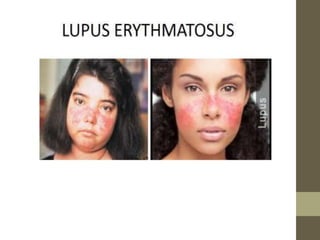
SYMPTOMS OF LUPUS
• SLE is characterized by
• fever.
• weakness.
• Arthritis.
• skin rashes.
• pleurisy.( an inflammation of the pleura, which is the moist
double-layered membrane that surrounds the lungs)
• and kidney dysfunction
CAUSES OF LUPUS
• Is is not linked to a certain gene.
• Ultraviolet rays.
• Certain medications.
• A virus, physical or emotional stress, and trauma.
MECHANISM
• Affected individuals may produce autoantibodies to a vast
array of tissue antigens, such as DNA
• When immune complexes of auto-antibodies
• are deposited along the walls of small blood vessels.
• hypersensitive reaction develops.
• The complexes activate the complement system
• And damage the wall of the blood vessel.
• Excessive complement activation in patients with severe SLE
produces elevated serum levels of the complement split
products C3a and C5a.
• This lead to tissue damage
DIAGNOSIS
• blood tests, such as antibody tests
• a complete blood count
• chest X-ray
TREATMENT
• Treatment for SLE is not curative. But Treatments may include:
• anti-inflammatory medications for joint pain.
• steroid creams for rashes
• corticosteroids of varying doses to minimize the immune
response
Autoimmune disorders

Autoimmune disorders

  • 1.
  • 2.
    Autoimmunity  Autoimmunity isthe system of immune responses of an organism against its own cells and tissues.  Any disease that results from such an aberrant immune response is termed an autoimmune disease.
  • 3.
    History  In the1960s, it was believed that all self-reactive lymphocytes were eliminated during their development in the bone marrow and thymus and that a failure to eliminate these lymphocytes led to autoimmune consequences.  In 1970s ,experimental reveal that not all self-reactive lymphocytes are deleted during T-cell and B-cell maturation. normal healthy individuals have been shown to possess mature, , self-reactive lymphocytes. their activity must be regulated in normal individuals through clonal anergy .A breakdown in this regulation can lead to activation of self-reactive clones of T or B cells, generating humoral or cell-mediated responses against selfantigens. which can cause serious damage to cells and organs. .
  • 4.
    (AARDA) According to theAmerican Autommunity Related Disease Association (AARDA) an autoimmune disease develops when our immune system, which defends our body against disease decide our healthy cells are forigen ,as a result immune system attacks healthy cells.
  • 5.
    Autoimmunity • Diseases oftenrun in families. • 75% are women are effected. • 4th largest disease class in females. • African Americans, Native Americans also have an increased risk of developing an autoimmune disease.
  • 6.
    Classification of autoimmune disease: •1: Organ specific • 2: Systemic diseases. Organ specific The organ-specific diseases involve an autoimmune response directed primarily against a single organ or gland. The normal function of the organ is blocked.  eg. Autoimmune Hemolytic Anemia, Pernicious Anemia etc
  • 7.
    Systemic diseases: The systemicdiseases are directed against a broad spectrum of tissues and have manifestations in a variety of organs resulting from cell-mediated responses and cellular damage caused by auto-antibodies.(an antibody produced by an organism in response to a constituent of its own tissues) eg. Systemic Lupus Erythematous, Arthritis
  • 8.
    rheumatoid arthritis • Achronic progressive disease causing inflammation in the joints and resulting in painful deformity and immobility, especially in the fingers, wrists, feet, and ankles
  • 9.
    • Rheumatoid arthritisis a common autoimmune disorder, most often affecting women from 40 to 60 years old. • The major symptoms: • chronic inflammation of the joints • although the hematologic, cardiovascular, and respiratory systems are also frequently affected
  • 10.
    overview • Many individualswith rheumatoid arthritis produce a group of auto-antibodies called rheumatoid factors that are reactive with determinants in the Fc region of IgG. The classic rheumatoid factor is an IgM antibody with that reactivity.Such auto-antibodies bind to normal circulating IgG,forming IgM- IgG complexes that are deposited in the joints. These immune complexes can activate hypersensitive reaction,which leads to chronic inflammation of the joints.
  • 11.
    • The immunesystem produces antibodies that attach to the linings of joints. Immune system cells then attack the joints, causing inflammation, swelling, and pain. • If untreated, rheumatoid arthritis causes gradually causes permanent joint damage. • Treatments for rheumatoid arthritis can include various oral or injectable medications that reduce immune system over activity.
  • 12.
    What Causes Rheumatoid Arthritis? •rheumatoid arthritis • happens when your immune system targets your joint linings. It’s a long-term condition that also affects other tissue, but the joints are usually the most severely affected. • It may be a combination of genes and other things. • Some researchers think an infection with a bacteria or virus can trigger the disease in some people.
  • 13.
    • As rheumatoidarthritis develops, some of the body's immune cells start to attack healthy tissue, mistaking it for an invader. This triggers a chain reaction that leads to more inflammation and damage. • The main target of RA's inflammation is the synovium, the thin layer of tissue that lines the joints. The inflammation also spreads to other areas in the body, which can cause ongoing pain, fatigue, and other problems.
  • 14.
    What Are theSymptoms of Rheumatoid Arthritis? • When It’s in Your Joints • RA always affects the joints. It makes them inflamed. The classic signs are: • Stiffness. The joint is harder to use and doesn't move as well as it should. It’s especially common in the morning
  • 15.
    • Swelling. Fluidenters the joint and makes it puffy. • Pain . Inflammation inside a joint makes it sensitive and tender. Over time, it causes damage and pain. • Redness and warmth. The joints may be warmer and more pink or red than skin around it.
  • 16.
    Rheumatoid Arthritis That Affectthe Entire Body • Rheumatoid Arthritis can go beyond your joints. You may feel: • Fatigue • Sickness • Less appetite than normal, which can lead to weight loss • Muscle aches • Some people with RA also get rheumatoid nodules, which are bumps under the skin that most often appear on the elbows. Sometimes they are painful.
  • 17.
    Treatment • Drugs: • (NSAID).nonsteroidal anti-inflammatory drug. These medications reduce pain and inflammation but do not slow down RA. • “DMARDs” stands for disease-modifying anti rheumatic drugs. They help slow or stop RA from getting worse • Surgery for Rheumatoid Arthritis • Physical and Occupational Therapy
  • 18.
    Systematic lupus erthymatosus •It typically appears in women between 20 and 40 years of age. • In this the human immune system becomes hyperactive and attacks normal, healthy tissues. • Although “lupus” actually includes a number of different diseases, SLE is the most common type of lupus.
  • 19.
    SYMPTOMS OF LUPUS •SLE is characterized by • fever. • weakness. • Arthritis. • skin rashes. • pleurisy.( an inflammation of the pleura, which is the moist double-layered membrane that surrounds the lungs) • and kidney dysfunction
  • 20.
    CAUSES OF LUPUS •Is is not linked to a certain gene. • Ultraviolet rays. • Certain medications. • A virus, physical or emotional stress, and trauma.
  • 21.
    MECHANISM • Affected individualsmay produce autoantibodies to a vast array of tissue antigens, such as DNA • When immune complexes of auto-antibodies • are deposited along the walls of small blood vessels. • hypersensitive reaction develops. • The complexes activate the complement system
  • 22.
    • And damagethe wall of the blood vessel. • Excessive complement activation in patients with severe SLE produces elevated serum levels of the complement split products C3a and C5a. • This lead to tissue damage
  • 23.
    DIAGNOSIS • blood tests,such as antibody tests • a complete blood count • chest X-ray
  • 24.
    TREATMENT • Treatment forSLE is not curative. But Treatments may include: • anti-inflammatory medications for joint pain. • steroid creams for rashes • corticosteroids of varying doses to minimize the immune response