ATOPY, ALLERGY&
ANAPHYLAXIS.
-Dr.Naveen Paila
ATOPY
 Atopy is the genetic predilection to produce specific IgE
following exposure to allergens.
 The term atopy was coined by Coca and Cooke in 1923.
 The term is from Geek meaning "the state of being out of
place", "absurdity".
 Genes for atopy = SATA6, HLA-B/MICA,HLA-DQB-1
 C11orf30 seems to be the most relevant for atopy as it
may increase susceptibility to poly-sensitization.
 FLG GENE -filaggrin mutations are associated with atopic
eczema and may contribute to the excessive dryness of
the skin and the loss of the barrier function of normal skin.
A hallmark indicator of atopic eczema is a positive “wheal-
and-flare” reaction to a skin test of S. aureus antigens.
ALLERGY.
 Individuals are considered to have clinically
significant allergy or allergic disease when
they have both allergen-specific
IgE and develop symptoms upon exposure to
substances containing that allergen.
ANAPHYLAXIS.
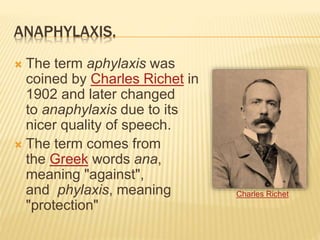
 The term aphylaxis was
coined by Charles Richet in
1902 and later changed
to anaphylaxis due to its
nicer quality of speech.
 The term comes from
the Greek words ana,
meaning "against",
and phylaxis, meaning
"protection"
Charles Richet
GELL AND COOMBS CLASSIFICATION OF
IMMUNE REACTIONS
 TYPE I: IMMEDIATE HYPERSENSITIVITY
 TYPE II: CYTOTOXIC ANTIBODY
REACTION
 TYPE III: IMMUNE COMPLEX–MEDIATED
REACTION
 TYPE IV: CELL-MEDIATED DELAYED
HYPERSENSITIVITY
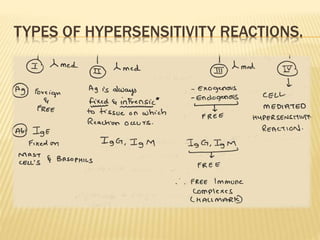
TYPES OF HYPERSENSITIVITY REACTIONS.
ANTIGE
N
T I S S U
MEDIATORS
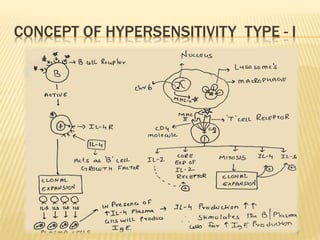
CONCEPT OF HYPERSENSITIVITY TYPE - I
MAST CELL (THE MINISTER)
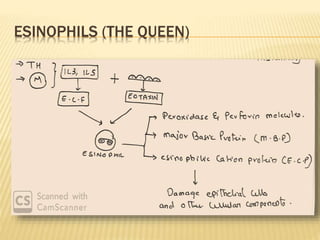
ESINOPHILS (THE QUEEN)
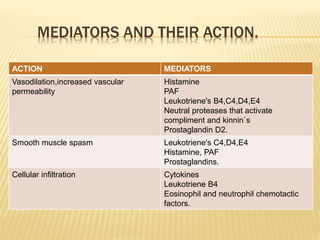
MEDIATORS AND THEIR ACTION.
ACTION MEDIATORS
Vasodilation,increased vascular
permeability
Histamine
PAF
Leukotriene's B4,C4,D4,E4
Neutral proteases that activate
compliment and kinnin`s
Prostaglandin D2.
Smooth muscle spasm Leukotriene's C4,D4,E4
Histamine, PAF
Prostaglandins.
Cellular infiltration Cytokines
Leukotriene B4
Eosinophil and neutrophil chemotactic
factors.
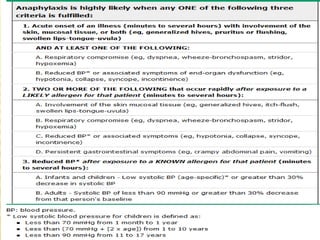
ANAPHYLAXIS DEFINITION.
 Anaphylaxis is a severe, life-
threatening, generalised or systemic
hypersensitivity reaction
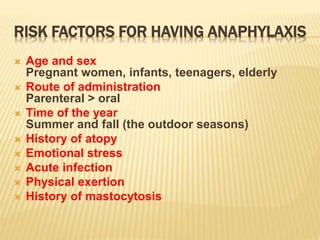
RISK FACTORS FOR HAVING ANAPHYLAXIS
 Age and sex
Pregnant women, infants, teenagers, elderly
 Route of administration
Parenteral > oral
 Time of the year
Summer and fall (the outdoor seasons)
 History of atopy
 Emotional stress
 Acute infection
 Physical exertion
 History of mastocytosis
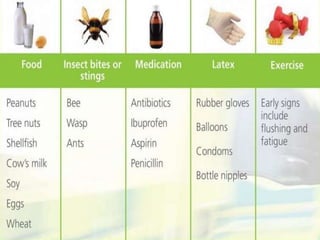
TRIGGERS
 FOOD TRIGGERS
 DRUG TRIGGERS
 INSECT VENOM TRIGGERS
 OTHERS-Other triggers
• Latex
• Seminal proteins/human PSA
• Horse-derived antitoxins (e.g. snake antivenoms)
• Helminths
NON IG-E MEDIATED TRIGGERS.
 1. Immune complex – complement mediated
 • This includes reactions to blood products,
immunoglobulin's and dextran's and occurs due to
immune complexes activating complement which leads to
mast cell degranulation.
 2. Non-immunological mast cell activators
• Radio contrast media (e.g. iodine and other medical
dyes) as do narcotics, cold, heat, sunlight and alcohol.
 3. Modulators of arachidonic acid metabolism
• This includes aspirin and NSAIDs and is thought to
relate to the acetyl group
 4. Idiopathic
 5. Exercise.
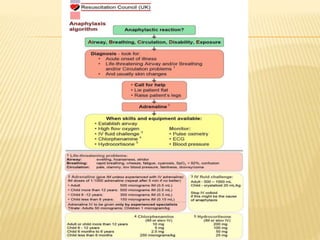
LIFE-THREATENING AIRWAY AND/OR BREATHING
AND/OR CIRCULATION PROBLEMS
 Patients can have either an A or B or C problem or any
combination. Use the
 ABCDE approach to recognise these.
 Airway problems:
 • Airway swelling, e.g., throat and tongue swelling (pharyngeal/laryngeal
oedema). The patient has difficulty in breathing and swallowing and
feels that the throat is closing up.
 • Hoarse voice.
 • Stridor – this is a high-pitched inspiratory noise caused by upper
airway
 obstruction.
 Breathing problems:
 • Shortness of breath – increased respiratory rate.
 • Wheeze.
 • Patient becoming tired.
 • Confusion caused by hypoxia.
 • Cyanosis (appears blue) – this is usually a late sign.
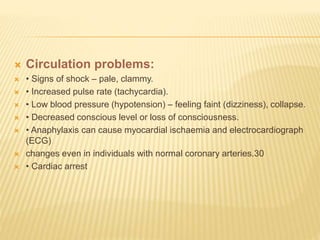
 Circulation problems:
 • Signs of shock – pale, clammy.
 • Increased pulse rate (tachycardia).
 • Low blood pressure (hypotension) – feeling faint (dizziness), collapse.
 • Decreased conscious level or loss of consciousness.
 • Anaphylaxis can cause myocardial ischaemia and electrocardiograph
(ECG)
 changes even in individuals with normal coronary arteries.30
 • Cardiac arrest
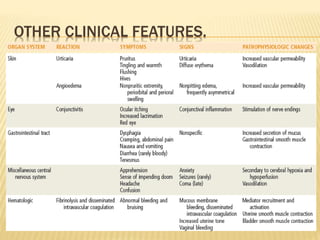
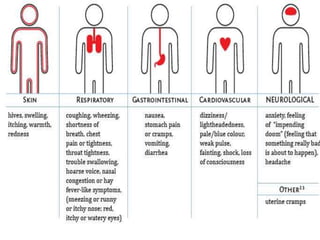
OTHER CLINICAL FEATURES.
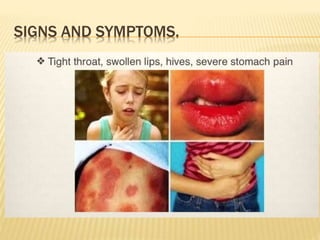
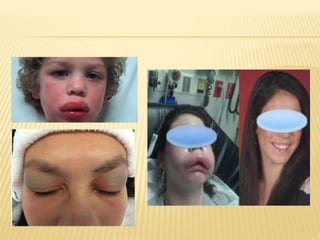
SIGNS AND SYMPTOMS.
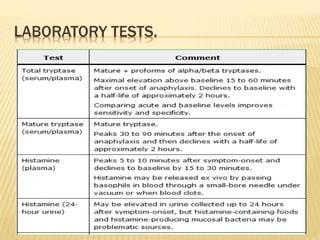
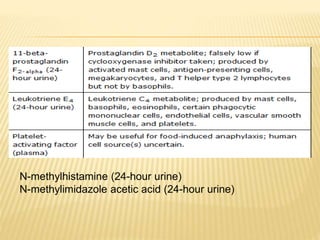
LABORATORY TESTS.
N-methylhistamine (24-hour urine)
N-methylimidazole acetic acid (24-hour urine)
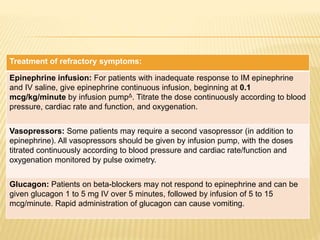
Treatment of refractory symptoms:
Epinephrine infusion: For patients with inadequate response to IM epinephrine
and IV saline, give epinephrine continuous infusion, beginning at 0.1
mcg/kg/minute by infusion pumpΔ. Titrate the dose continuously according to blood
pressure, cardiac rate and function, and oxygenation.
Vasopressors: Some patients may require a second vasopressor (in addition to
epinephrine). All vasopressors should be given by infusion pump, with the doses
titrated continuously according to blood pressure and cardiac rate/function and
oxygenation monitored by pulse oximetry.
Glucagon: Patients on beta-blockers may not respond to epinephrine and can be
given glucagon 1 to 5 mg IV over 5 minutes, followed by infusion of 5 to 15
mcg/minute. Rapid administration of glucagon can cause vomiting.
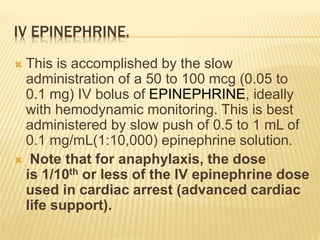
IV EPINEPHRINE.
 This is accomplished by the slow
administration of a 50 to 100 mcg (0.05 to
0.1 mg) IV bolus of EPINEPHRINE, ideally
with hemodynamic monitoring. This is best
administered by slow push of 0.5 to 1 mL of
0.1 mg/mL(1:10,000) epinephrine solution.
 Note that for anaphylaxis, the dose
is 1/10th or less of the IV epinephrine dose
used in cardiac arrest (advanced cardiac
life support).
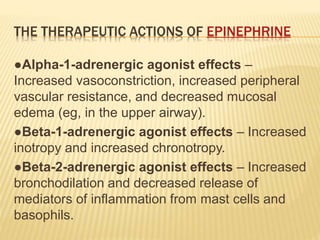
THE THERAPEUTIC ACTIONS OF EPINEPHRINE
●Alpha-1-adrenergic agonist effects –
Increased vasoconstriction, increased peripheral
vascular resistance, and decreased mucosal
edema (eg, in the upper airway).
●Beta-1-adrenergic agonist effects – Increased
inotropy and increased chronotropy.
●Beta-2-adrenergic agonist effects – Increased
bronchodilation and decreased release of
mediators of inflammation from mast cells and
basophils.
CAUTION.
1. Monoamine oxidase inhibitors
2. Tricyclic antidepressants
3. Pre-existing conditions, such as recent
intracranial surgery, aortic aneurysm,
uncontrolled hyperthyroidism or
hypertension.
4. Patients receiving stimulant medications
(eg, amphetamines
or methylphenidate used in the treatment of
attention deficit hyperactivity disorder) or
abusing cocaine.
 Glucagon for patients taking beta-blockers
●Adult dosing is 1 to 5 mg slow IV bolus over five
minutes. May be followed by an infusion of 5 to
15 mcg/minute titrated to effect.
●Pediatric dosing is 20 to 30 mcg/kg (maximum 1
mg) slow IV bolus over five minutes. May be
followed by an infusion of 5 to 15 mcg/minute.
MAO-cyclic AMP-dependent phosphorylation of
L-type calcium channels.

Anaphylaxis

  • 1.
  • 2.
    ATOPY  Atopy isthe genetic predilection to produce specific IgE following exposure to allergens.  The term atopy was coined by Coca and Cooke in 1923.  The term is from Geek meaning "the state of being out of place", "absurdity".  Genes for atopy = SATA6, HLA-B/MICA,HLA-DQB-1  C11orf30 seems to be the most relevant for atopy as it may increase susceptibility to poly-sensitization.  FLG GENE -filaggrin mutations are associated with atopic eczema and may contribute to the excessive dryness of the skin and the loss of the barrier function of normal skin. A hallmark indicator of atopic eczema is a positive “wheal- and-flare” reaction to a skin test of S. aureus antigens.
  • 3.
    ALLERGY.  Individuals areconsidered to have clinically significant allergy or allergic disease when they have both allergen-specific IgE and develop symptoms upon exposure to substances containing that allergen.
  • 5.
    ANAPHYLAXIS.  The termaphylaxis was coined by Charles Richet in 1902 and later changed to anaphylaxis due to its nicer quality of speech.  The term comes from the Greek words ana, meaning "against", and phylaxis, meaning "protection" Charles Richet
  • 6.
    GELL AND COOMBSCLASSIFICATION OF IMMUNE REACTIONS  TYPE I: IMMEDIATE HYPERSENSITIVITY  TYPE II: CYTOTOXIC ANTIBODY REACTION  TYPE III: IMMUNE COMPLEX–MEDIATED REACTION  TYPE IV: CELL-MEDIATED DELAYED HYPERSENSITIVITY
  • 7.
  • 8.
    ANTIGE N T I SS U MEDIATORS
  • 9.
  • 10.
    MAST CELL (THEMINISTER)
  • 11.
  • 12.
    MEDIATORS AND THEIRACTION. ACTION MEDIATORS Vasodilation,increased vascular permeability Histamine PAF Leukotriene's B4,C4,D4,E4 Neutral proteases that activate compliment and kinnin`s Prostaglandin D2. Smooth muscle spasm Leukotriene's C4,D4,E4 Histamine, PAF Prostaglandins. Cellular infiltration Cytokines Leukotriene B4 Eosinophil and neutrophil chemotactic factors.
  • 13.
    ANAPHYLAXIS DEFINITION.  Anaphylaxisis a severe, life- threatening, generalised or systemic hypersensitivity reaction
  • 14.
    RISK FACTORS FORHAVING ANAPHYLAXIS  Age and sex Pregnant women, infants, teenagers, elderly  Route of administration Parenteral > oral  Time of the year Summer and fall (the outdoor seasons)  History of atopy  Emotional stress  Acute infection  Physical exertion  History of mastocytosis
  • 15.
    TRIGGERS  FOOD TRIGGERS DRUG TRIGGERS  INSECT VENOM TRIGGERS  OTHERS-Other triggers • Latex • Seminal proteins/human PSA • Horse-derived antitoxins (e.g. snake antivenoms) • Helminths
  • 17.
    NON IG-E MEDIATEDTRIGGERS.  1. Immune complex – complement mediated  • This includes reactions to blood products, immunoglobulin's and dextran's and occurs due to immune complexes activating complement which leads to mast cell degranulation.  2. Non-immunological mast cell activators • Radio contrast media (e.g. iodine and other medical dyes) as do narcotics, cold, heat, sunlight and alcohol.  3. Modulators of arachidonic acid metabolism • This includes aspirin and NSAIDs and is thought to relate to the acetyl group  4. Idiopathic  5. Exercise.
  • 18.
    LIFE-THREATENING AIRWAY AND/ORBREATHING AND/OR CIRCULATION PROBLEMS  Patients can have either an A or B or C problem or any combination. Use the  ABCDE approach to recognise these.  Airway problems:  • Airway swelling, e.g., throat and tongue swelling (pharyngeal/laryngeal oedema). The patient has difficulty in breathing and swallowing and feels that the throat is closing up.  • Hoarse voice.  • Stridor – this is a high-pitched inspiratory noise caused by upper airway  obstruction.  Breathing problems:  • Shortness of breath – increased respiratory rate.  • Wheeze.  • Patient becoming tired.  • Confusion caused by hypoxia.  • Cyanosis (appears blue) – this is usually a late sign.
  • 19.
     Circulation problems: • Signs of shock – pale, clammy.  • Increased pulse rate (tachycardia).  • Low blood pressure (hypotension) – feeling faint (dizziness), collapse.  • Decreased conscious level or loss of consciousness.  • Anaphylaxis can cause myocardial ischaemia and electrocardiograph (ECG)  changes even in individuals with normal coronary arteries.30  • Cardiac arrest
  • 20.
  • 22.
  • 25.
  • 26.
  • 28.
    Treatment of refractorysymptoms: Epinephrine infusion: For patients with inadequate response to IM epinephrine and IV saline, give epinephrine continuous infusion, beginning at 0.1 mcg/kg/minute by infusion pumpΔ. Titrate the dose continuously according to blood pressure, cardiac rate and function, and oxygenation. Vasopressors: Some patients may require a second vasopressor (in addition to epinephrine). All vasopressors should be given by infusion pump, with the doses titrated continuously according to blood pressure and cardiac rate/function and oxygenation monitored by pulse oximetry. Glucagon: Patients on beta-blockers may not respond to epinephrine and can be given glucagon 1 to 5 mg IV over 5 minutes, followed by infusion of 5 to 15 mcg/minute. Rapid administration of glucagon can cause vomiting.
  • 29.
    IV EPINEPHRINE.  Thisis accomplished by the slow administration of a 50 to 100 mcg (0.05 to 0.1 mg) IV bolus of EPINEPHRINE, ideally with hemodynamic monitoring. This is best administered by slow push of 0.5 to 1 mL of 0.1 mg/mL(1:10,000) epinephrine solution.  Note that for anaphylaxis, the dose is 1/10th or less of the IV epinephrine dose used in cardiac arrest (advanced cardiac life support).
  • 30.
    THE THERAPEUTIC ACTIONSOF EPINEPHRINE ●Alpha-1-adrenergic agonist effects – Increased vasoconstriction, increased peripheral vascular resistance, and decreased mucosal edema (eg, in the upper airway). ●Beta-1-adrenergic agonist effects – Increased inotropy and increased chronotropy. ●Beta-2-adrenergic agonist effects – Increased bronchodilation and decreased release of mediators of inflammation from mast cells and basophils.
  • 31.
    CAUTION. 1. Monoamine oxidaseinhibitors 2. Tricyclic antidepressants 3. Pre-existing conditions, such as recent intracranial surgery, aortic aneurysm, uncontrolled hyperthyroidism or hypertension. 4. Patients receiving stimulant medications (eg, amphetamines or methylphenidate used in the treatment of attention deficit hyperactivity disorder) or abusing cocaine.
  • 32.
     Glucagon forpatients taking beta-blockers ●Adult dosing is 1 to 5 mg slow IV bolus over five minutes. May be followed by an infusion of 5 to 15 mcg/minute titrated to effect. ●Pediatric dosing is 20 to 30 mcg/kg (maximum 1 mg) slow IV bolus over five minutes. May be followed by an infusion of 5 to 15 mcg/minute. MAO-cyclic AMP-dependent phosphorylation of L-type calcium channels.