HYPERSENSITIVITY REACTIONS
Introduction
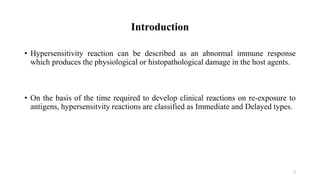
• Hypersensitivity reaction can be described as an abnormal immune response
which produces the physiological or histopathological damage in the host agents.
• On the basis of the time required to develop clinical reactions on re-exposure to
antigens, hypersensitvity reactions are classified as Immediate and Delayed types.
2
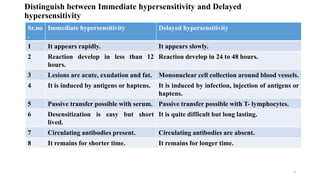
Distinguish between Immediate hypersensitivity and Delayed
hypersensitivity
Sr.no
.
Immediate hypersensitivity Delayed hypersensitivity
1 It appears rapidly. It appears slowly.
2 Reaction develop in less than 12
hours.
Reaction develop in 24 to 48 hours.
3 Lesions are acute, exudation and fat. Mononuclear cell collection around blood vessels.
4 It is induced by antigens or haptens. It is induced by infection, injection of antigens or
haptens.
5 Passive transfer possible with serum. Passive transfer possible with T- lymphocytes.
6 Desensitization is easy but short
lived.
It is quite difficult but long lasting.
7 Circulating antibodies present. Circulating antibodies are absent.
8 It remains for shorter time. It remains for longer time.
3
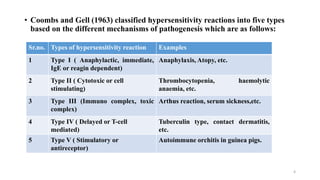
• Coombs and Gell (1963) classified hypersensitivity reactions into five types
based on the different mechanisms of pathogenesis which are as follows:
Sr.no. Types of hypersensitivity reaction Examples
1 Type I ( Anaphylactic, immediate,
IgE or reagin dependent)
Anaphylaxis, Atopy, etc.
2 Type II ( Cytotoxic or cell
stimulating)
Thrombocytopenia, haemolytic
anaemia, etc.
3 Type III (Immuno complex, toxic
complex)
Arthus reaction, serum sickness,etc.
4 Type IV ( Delayed or T-cell
mediated)
Tuberculin type, contact dermatitis,
etc.
5 Type V ( Stimulatory or
antireceptor)
Autoimmune orchitis in guinea pigs.
4
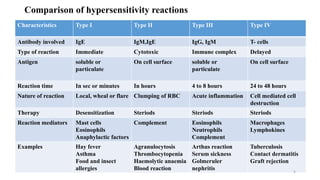
Comparison of hypersensitivity reactions
Characteristics Type I Type II Type III Type IV
Antibody involved IgE IgM,IgE IgG, IgM T- cells
Type of reaction Immediate Cytotoxic Immune complex Delayed
Antigen soluble or
particulate
On cell surface soluble or
particulate
On cell surface
Reaction time In sec or minutes In hours 4 to 8 hours 24 to 48 hours
Nature of reaction Local, wheal or flare Clumping of RBC Acute inflammation Cell mediated cell
destruction
Therapy Desensitization Steriods Steriods Steriods
Reaction mediators Mast cells
Eosinophils
Anaphylactic factors
Complement Eosinophils
Neutrophils
Complement
Macrophages
Lymphokines
Examples Hay fever
Asthma
Food and insect
allergies
Agranulocytosis
Thrombocytopenia
Haemolytic anaemia
Blood reaction
Arthus reaction
Serum sickness
Golmeruler
nephritis
Tuberculosis
Contact dermatitis
Graft rejection
5
6

Hypersensitivity reactions

  • 1.
  • 2.
    Introduction • Hypersensitivity reactioncan be described as an abnormal immune response which produces the physiological or histopathological damage in the host agents. • On the basis of the time required to develop clinical reactions on re-exposure to antigens, hypersensitvity reactions are classified as Immediate and Delayed types. 2
  • 3.
    Distinguish between Immediatehypersensitivity and Delayed hypersensitivity Sr.no . Immediate hypersensitivity Delayed hypersensitivity 1 It appears rapidly. It appears slowly. 2 Reaction develop in less than 12 hours. Reaction develop in 24 to 48 hours. 3 Lesions are acute, exudation and fat. Mononuclear cell collection around blood vessels. 4 It is induced by antigens or haptens. It is induced by infection, injection of antigens or haptens. 5 Passive transfer possible with serum. Passive transfer possible with T- lymphocytes. 6 Desensitization is easy but short lived. It is quite difficult but long lasting. 7 Circulating antibodies present. Circulating antibodies are absent. 8 It remains for shorter time. It remains for longer time. 3
  • 4.
    • Coombs andGell (1963) classified hypersensitivity reactions into five types based on the different mechanisms of pathogenesis which are as follows: Sr.no. Types of hypersensitivity reaction Examples 1 Type I ( Anaphylactic, immediate, IgE or reagin dependent) Anaphylaxis, Atopy, etc. 2 Type II ( Cytotoxic or cell stimulating) Thrombocytopenia, haemolytic anaemia, etc. 3 Type III (Immuno complex, toxic complex) Arthus reaction, serum sickness,etc. 4 Type IV ( Delayed or T-cell mediated) Tuberculin type, contact dermatitis, etc. 5 Type V ( Stimulatory or antireceptor) Autoimmune orchitis in guinea pigs. 4
  • 5.
    Comparison of hypersensitivityreactions Characteristics Type I Type II Type III Type IV Antibody involved IgE IgM,IgE IgG, IgM T- cells Type of reaction Immediate Cytotoxic Immune complex Delayed Antigen soluble or particulate On cell surface soluble or particulate On cell surface Reaction time In sec or minutes In hours 4 to 8 hours 24 to 48 hours Nature of reaction Local, wheal or flare Clumping of RBC Acute inflammation Cell mediated cell destruction Therapy Desensitization Steriods Steriods Steriods Reaction mediators Mast cells Eosinophils Anaphylactic factors Complement Eosinophils Neutrophils Complement Macrophages Lymphokines Examples Hay fever Asthma Food and insect allergies Agranulocytosis Thrombocytopenia Haemolytic anaemia Blood reaction Arthus reaction Serum sickness Golmeruler nephritis Tuberculosis Contact dermatitis Graft rejection 5
  • 6.