
Hypersensitivity and
autoimmune diseases
• Medical news reports a rise of
hypersensitivity reactions to various
foodstuffs, particles and even personal
stuff. In what 3 ways do you think would
help you as well as the patient in
preventing catastrophic events arising
from hypersensitivity reactions in the
dental clinic?
Hypersensitivity
• The phenomenon of damage caused by
the immune system while trying to combat
an insult.
• Precipitating factor (external), instead of
the immune system coping and restoring
the body’s homeostasis, the immune
response is altered and becomes the
“internal” cause of disease.
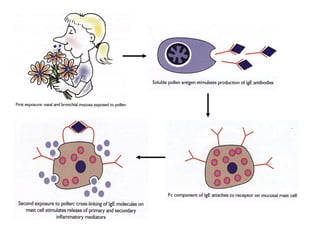
Type I hypersensitivity
• Anaphylactic
• Release of allergic mediators
• Asthma, eczema, hay fever and reactions
to certain food
• Grass pollen, house dust mite feces or
seafoods
• Immediate injections of epinephrine
• Antihistamine or steroids as back up
medications
• Avoidance of allergens
Type II hypersensitivity
• Antibody dependent cytotoxic
hypersensitivity
• Antibodies react with antigens fixed to the
surface of various types of cells and cause
damage
• Complement fixing (the antibodies cause
the destruction of the target cell or
damage the surrounding cells)
• Functional fixing (antibodies interfere
with cell function)
• Drug reactions where a binding of a drug
may alter a normal self antigen and thus
produce something that can no longer be
tolerated
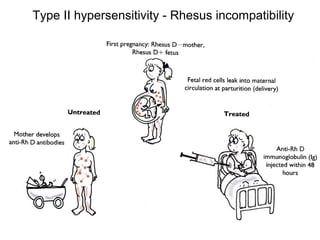
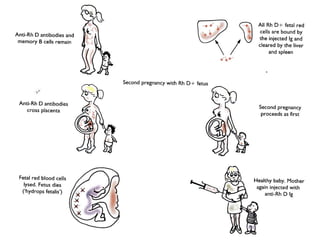
Type II hypersensitivity - Rhesus incompatibility
Type III hypersensitivity
• Immune complex mediated
hypersensitivity
• Antibody driven process
• The antibodies react with free antigen and
under the right circumstances they form
soluble immune complexes that circulate
in the blood giving rise to “serum sickness”
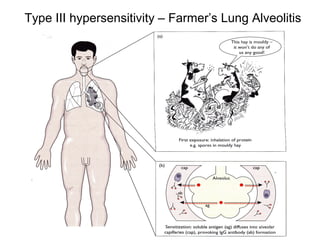
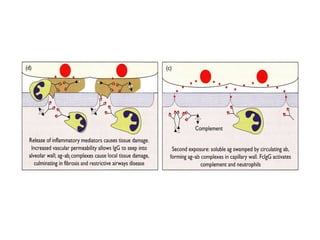
Type III hypersensitivity – Farmer’s Lung Alveolitis
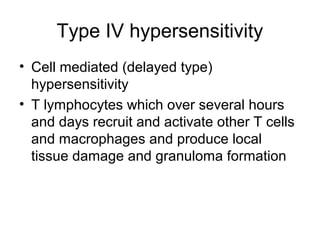
Type IV hypersensitivity
• Cell mediated (delayed type)
hypersensitivity
• T lymphocytes which over several hours
and days recruit and activate other T cells
and macrophages and produce local
tissue damage and granuloma formation
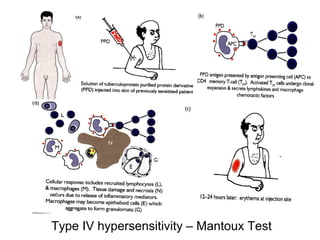
Type IV hypersensitivity – Mantoux Test
Autoimmune Diseases
General Principles
• Autoimmunity arises through some
combination of susceptibility genes
(causing loss of self tolerance) and
environmental triggers (specially infection)
• Self antigens or abnormal immune cells
develop that incite the immune response
into abnormal or excessive activity of T or
B lymphocytes
• Once induced tend to be progressive,
albeit with occasional relapses and
remissions
• Most autoimmune disorders are complex
multigenic disorders
- associated with specific
histocompatibility molecule HLA alleles
- defects in pathways that normally
regulate either peripheral or central
tolerance
- polymorphisms in other genes
(PTPN- 22, NOD-2, IL-2 and IL-7)
• Role of infection
• GI: primary biliary cirrhosis, ulcerative colitis and
atrophic gastritis
• Cardiovascular: pernicious anemia, hemolytic
anemia, idiopathic thrombocytopenia and
leukopenia
• Endocrine: insulin dependent diabetes,
thyrotoxicosis and Hashimoto’s thyroiditis
• Musculoskeletal: mixed connective tissue
diseases, rheumatoid arthritis, systemic lupus
erythematosus, myasthenia gravis
• Dermatology: dermatomyositis and
scleroderma
Rejection of Tissue Transplants
• Mechanisms of recognition:
- Class I molecules are expressed on
all nucleated cells. Class I molecules
bind peptide fragments derived from
endogenous proteins
- Class II molecules are confined to
APC including dendritic cells,
macrophages, B cells and activated T
cells
- Class II molecules bind peptide
fragments derived from exogenous
proteins and presents these processed
antigens to CD4+ T lymphocytes
• Host T cells recognize either by direct or
indirect pathways
Rejection of solid organs:
• Following lymphocyte activation, rejection
is mediated by the following:
- direct CTL-mediated parenchymal
and endothelial cytolysis
- macrophage mediated damage
- cytokine mediated vascular and
parenchymal dysfunction
- microvasccular injury
- antibody mediated responses
• Rejection:
- hyperacute
- acute
- chronic
Immunodeficiency Syndrome
• Primary immunodeficiencies
- are usually hereditary and manifest
between 6 months and 2 years of life
as maternal protection is lost
• Secondary immunodeficiencies
- result from altered immune function
due to infections, malnutrition, aging,
immunosuppression, irradiation,
chemotherapy and autoimmunity
• Acquired immunodeficiency syndrome
- retrovirus human immunodeficiency
virus (HIV) characterized by profound
suppression of T cell mediated
immunity leading to opportunistic
infections, secondary neoplasms and
neurologic disorders
Amyloidosis
• Amyloid is a heterogenous group of
fibrillar proteins that share the ability to
aggregate into an insoluble, cross-beta
pleated sheet tertiary conformation
• Amyloid fibrils accumulate extracellularly
in tissues due either to excess synthesis
or resistance to catabolism
• As amyloid accumulates, it produces
pressure atrophy of adjacent parenchyma
• Depending on tissue distribution and
degree of involvement, the clinical effects
of amyloid can range from life threatening
to an asymptomatic incidental finding at
autopsy
Do you have any questions?

Hypersensitivity and autoimmune diseases

  • 1.
  • 2.
    • Medical newsreports a rise of hypersensitivity reactions to various foodstuffs, particles and even personal stuff. In what 3 ways do you think would help you as well as the patient in preventing catastrophic events arising from hypersensitivity reactions in the dental clinic?
  • 3.
    Hypersensitivity • The phenomenonof damage caused by the immune system while trying to combat an insult. • Precipitating factor (external), instead of the immune system coping and restoring the body’s homeostasis, the immune response is altered and becomes the “internal” cause of disease.
  • 4.
    Type I hypersensitivity •Anaphylactic • Release of allergic mediators • Asthma, eczema, hay fever and reactions to certain food • Grass pollen, house dust mite feces or seafoods
  • 6.
    • Immediate injectionsof epinephrine • Antihistamine or steroids as back up medications • Avoidance of allergens
  • 7.
    Type II hypersensitivity •Antibody dependent cytotoxic hypersensitivity • Antibodies react with antigens fixed to the surface of various types of cells and cause damage • Complement fixing (the antibodies cause the destruction of the target cell or damage the surrounding cells)
  • 8.
    • Functional fixing(antibodies interfere with cell function) • Drug reactions where a binding of a drug may alter a normal self antigen and thus produce something that can no longer be tolerated
  • 9.
    Type II hypersensitivity- Rhesus incompatibility
  • 11.
    Type III hypersensitivity •Immune complex mediated hypersensitivity • Antibody driven process • The antibodies react with free antigen and under the right circumstances they form soluble immune complexes that circulate in the blood giving rise to “serum sickness”
  • 12.
    Type III hypersensitivity– Farmer’s Lung Alveolitis
  • 14.
    Type IV hypersensitivity •Cell mediated (delayed type) hypersensitivity • T lymphocytes which over several hours and days recruit and activate other T cells and macrophages and produce local tissue damage and granuloma formation
  • 15.
    Type IV hypersensitivity– Mantoux Test
  • 16.
    Autoimmune Diseases General Principles •Autoimmunity arises through some combination of susceptibility genes (causing loss of self tolerance) and environmental triggers (specially infection)
  • 17.
    • Self antigensor abnormal immune cells develop that incite the immune response into abnormal or excessive activity of T or B lymphocytes • Once induced tend to be progressive, albeit with occasional relapses and remissions
  • 18.
    • Most autoimmunedisorders are complex multigenic disorders - associated with specific histocompatibility molecule HLA alleles - defects in pathways that normally regulate either peripheral or central tolerance - polymorphisms in other genes (PTPN- 22, NOD-2, IL-2 and IL-7) • Role of infection
  • 19.
    • GI: primarybiliary cirrhosis, ulcerative colitis and atrophic gastritis • Cardiovascular: pernicious anemia, hemolytic anemia, idiopathic thrombocytopenia and leukopenia • Endocrine: insulin dependent diabetes, thyrotoxicosis and Hashimoto’s thyroiditis • Musculoskeletal: mixed connective tissue diseases, rheumatoid arthritis, systemic lupus erythematosus, myasthenia gravis • Dermatology: dermatomyositis and scleroderma
  • 20.
    Rejection of TissueTransplants • Mechanisms of recognition: - Class I molecules are expressed on all nucleated cells. Class I molecules bind peptide fragments derived from endogenous proteins - Class II molecules are confined to APC including dendritic cells, macrophages, B cells and activated T cells
  • 21.
    - Class IImolecules bind peptide fragments derived from exogenous proteins and presents these processed antigens to CD4+ T lymphocytes • Host T cells recognize either by direct or indirect pathways
  • 22.
    Rejection of solidorgans: • Following lymphocyte activation, rejection is mediated by the following: - direct CTL-mediated parenchymal and endothelial cytolysis - macrophage mediated damage - cytokine mediated vascular and parenchymal dysfunction - microvasccular injury - antibody mediated responses
  • 23.
  • 24.
    Immunodeficiency Syndrome • Primaryimmunodeficiencies - are usually hereditary and manifest between 6 months and 2 years of life as maternal protection is lost • Secondary immunodeficiencies - result from altered immune function due to infections, malnutrition, aging, immunosuppression, irradiation, chemotherapy and autoimmunity
  • 25.
    • Acquired immunodeficiencysyndrome - retrovirus human immunodeficiency virus (HIV) characterized by profound suppression of T cell mediated immunity leading to opportunistic infections, secondary neoplasms and neurologic disorders
  • 26.
    Amyloidosis • Amyloid isa heterogenous group of fibrillar proteins that share the ability to aggregate into an insoluble, cross-beta pleated sheet tertiary conformation • Amyloid fibrils accumulate extracellularly in tissues due either to excess synthesis or resistance to catabolism
  • 27.
    • As amyloidaccumulates, it produces pressure atrophy of adjacent parenchyma • Depending on tissue distribution and degree of involvement, the clinical effects of amyloid can range from life threatening to an asymptomatic incidental finding at autopsy
  • 28.
    Do you haveany questions?