Chapter   THREE


            Perception
           and Individual
           Decision Making
What Is Perception, and Why Is It Important?

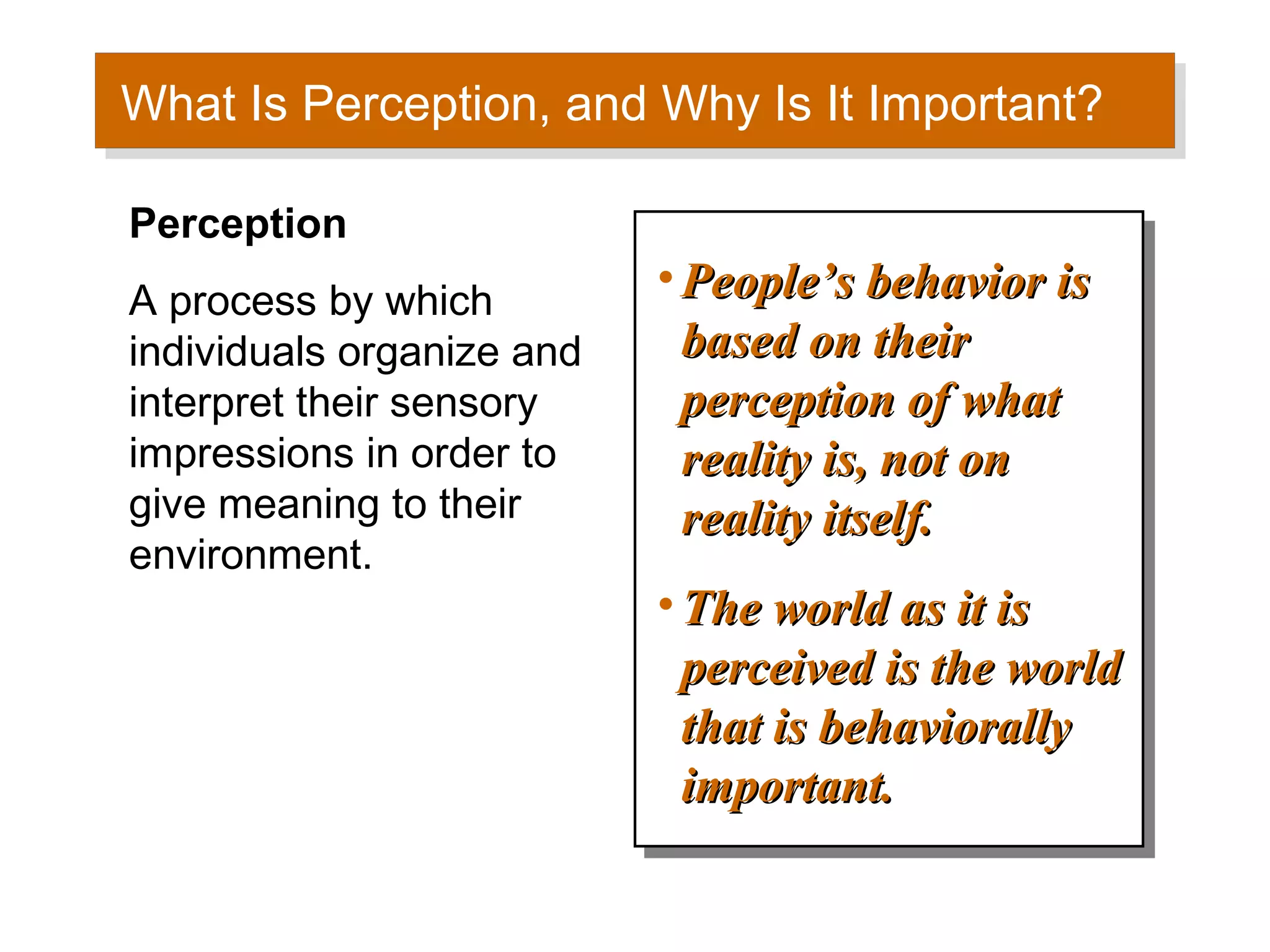
Perception
A process by which
                           ••People’s behavior is
                              People’s behavior is
individuals organize and     based on their
                              based on their
interpret their sensory      perception of what
                              perception of what
impressions in order to      reality is, not on
                              reality is, not on
give meaning to their        reality itself.
                              reality itself.
environment.
                           ••The world as it is
                              The world as it is
                             perceived is the world
                              perceived is the world
                             that is behaviorally
                              that is behaviorally
                             important.
                              important.
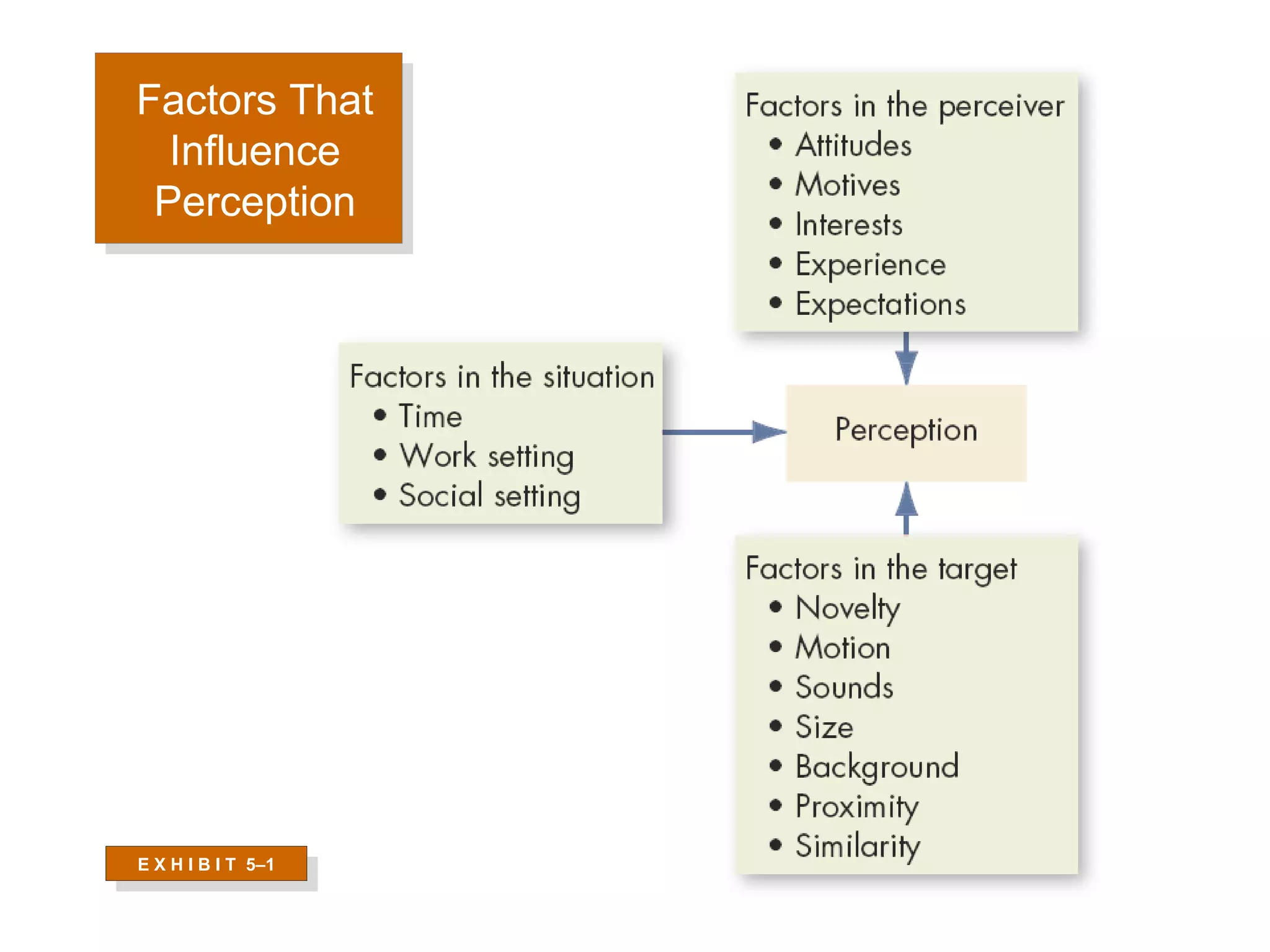
Factors That
Factors That
  Influence
   Influence
 Perception
 Perception


E X H I B I T 5–1
 E X H I B I T 5–1
Person Perception: Making Judgments About
Others
Others

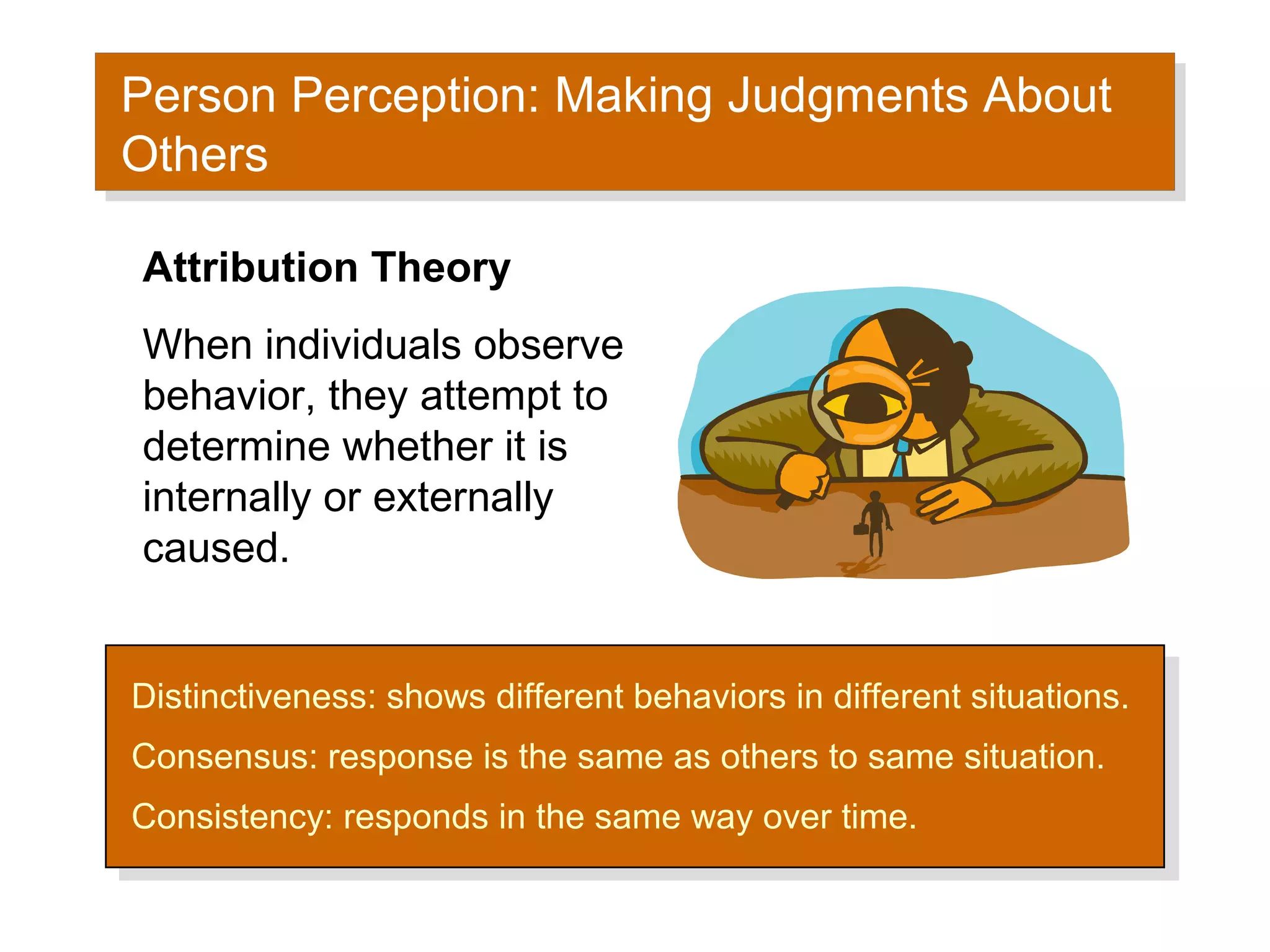
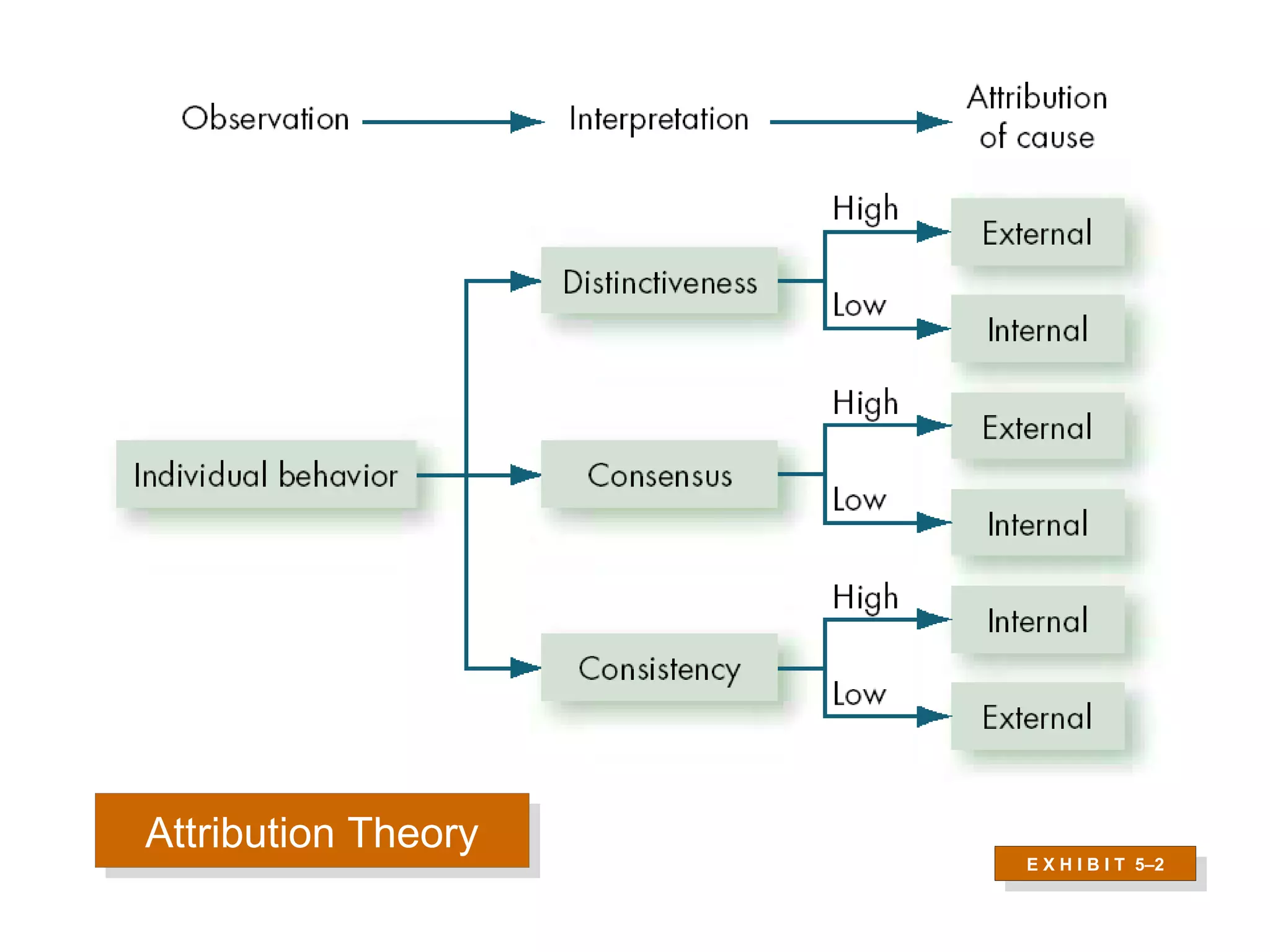
Attribution Theory
When individuals observe
behavior, they attempt to
determine whether it is
internally or externally
caused.


Distinctiveness: shows different behaviors in different situations.
 Distinctiveness: shows different behaviors in different situations.
Consensus: response is the same as others to same situation.
 Consensus: response is the same as others to same situation.
Consistency: responds in the same way over time.
 Consistency: responds in the same way over time.
Attribution Theory
Attribution Theory   E X H I B I T 5–2
                      E X H I B I T 5–2
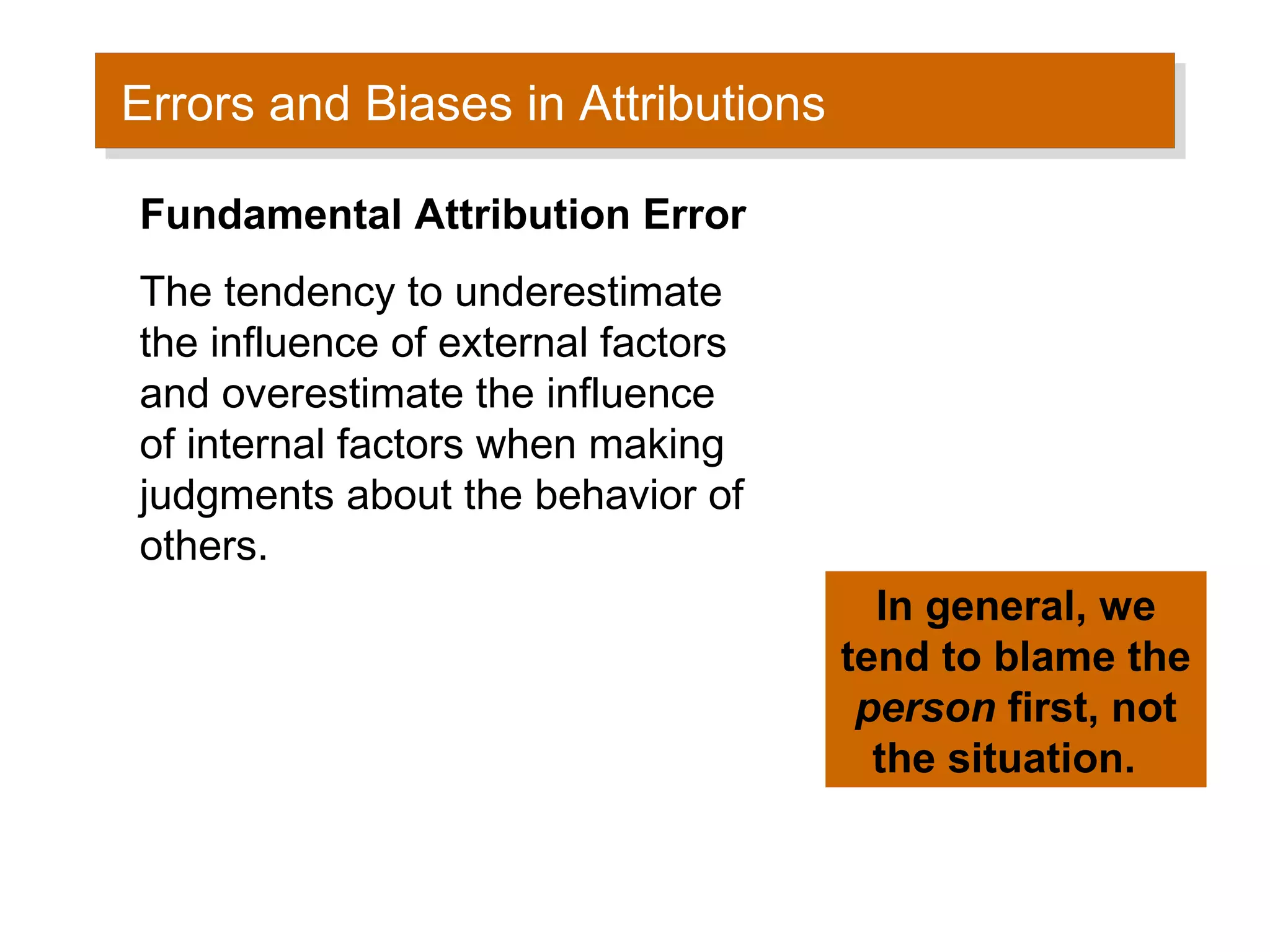
Errors and Biases in Attributions
Fundamental Attribution Error
The tendency to underestimate
the influence of external factors
and overestimate the influence
of internal factors when making
judgments about the behavior of
others.
                                      In general, we
                                    tend to blame the
                                     person first, not
                                      the situation.
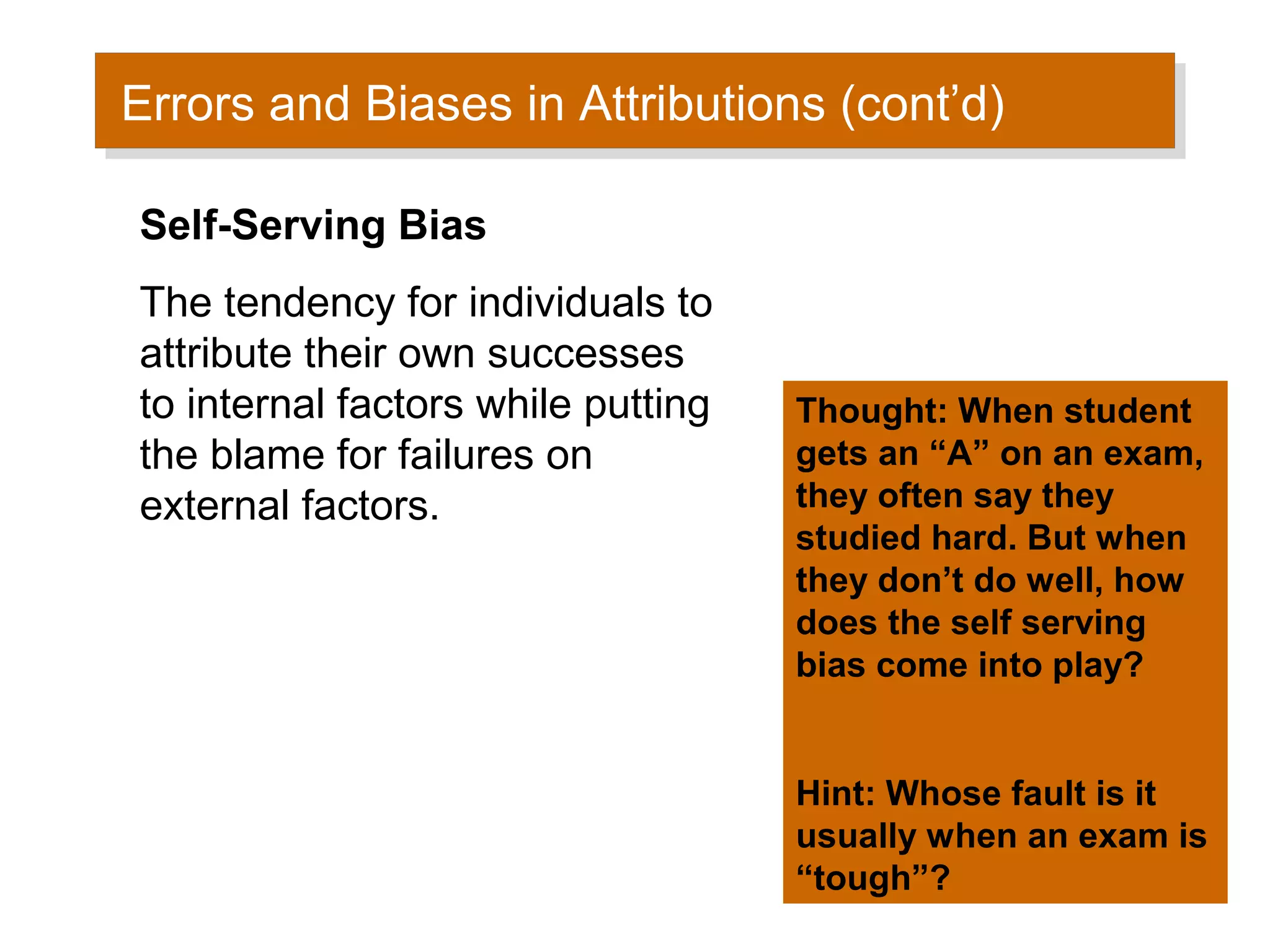
Errors and Biases in Attributions (cont’d)

Self-Serving Bias
The tendency for individuals to
attribute their own successes
to internal factors while putting   Thought: When student
the blame for failures on           gets an “A” on an exam,
external factors.                   they often say they
                                    studied hard. But when
                                    they don’t do well, how
                                    does the self serving
                                    bias come into play?


                                    Hint: Whose fault is it
                                    usually when an exam is
                                    “tough”?
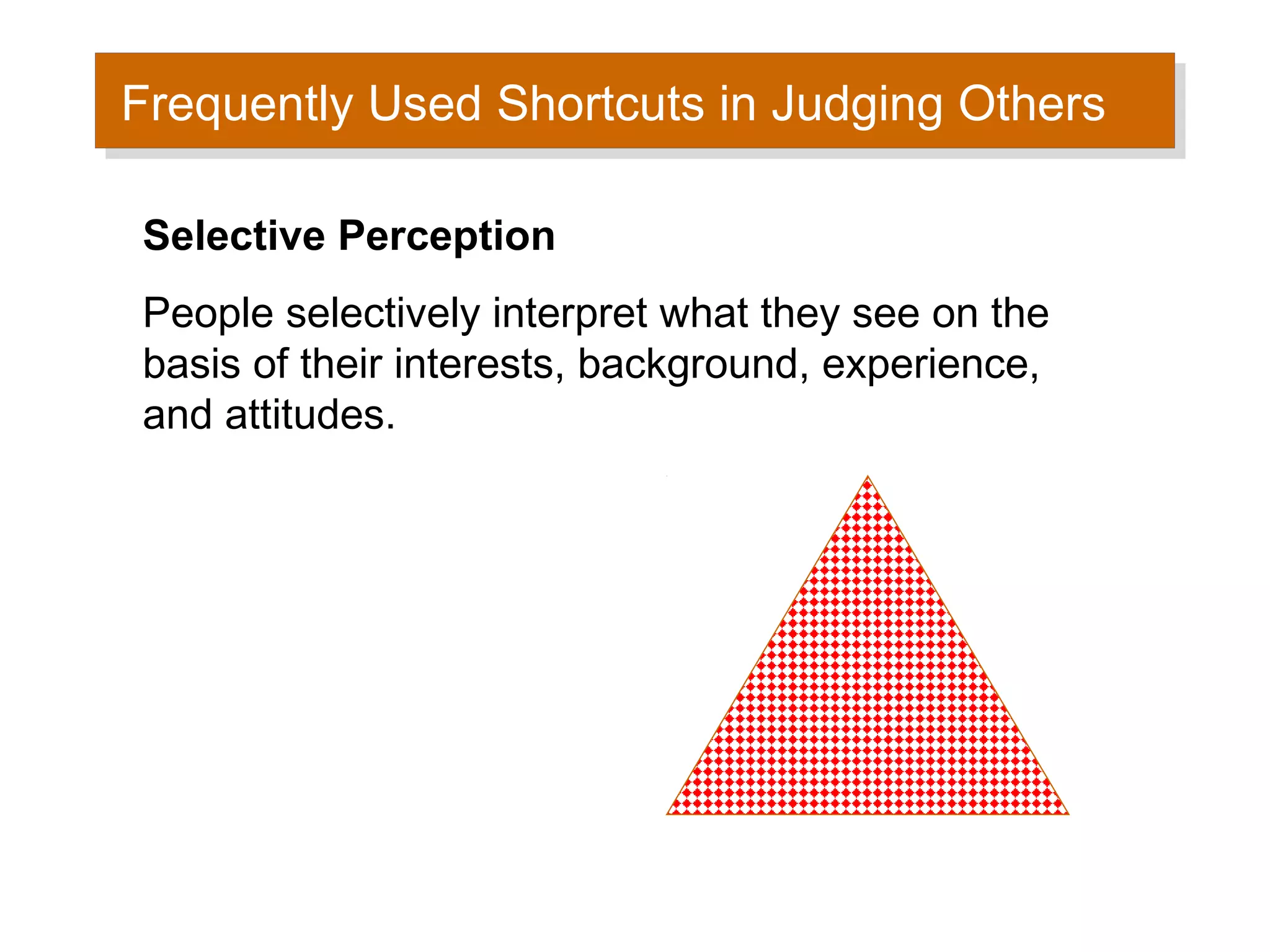
Frequently Used Shortcuts in Judging Others

Selective Perception
People selectively interpret what they see on the
basis of their interests, background, experience,
and attitudes.
Frequently Used Shortcuts in Judging Others
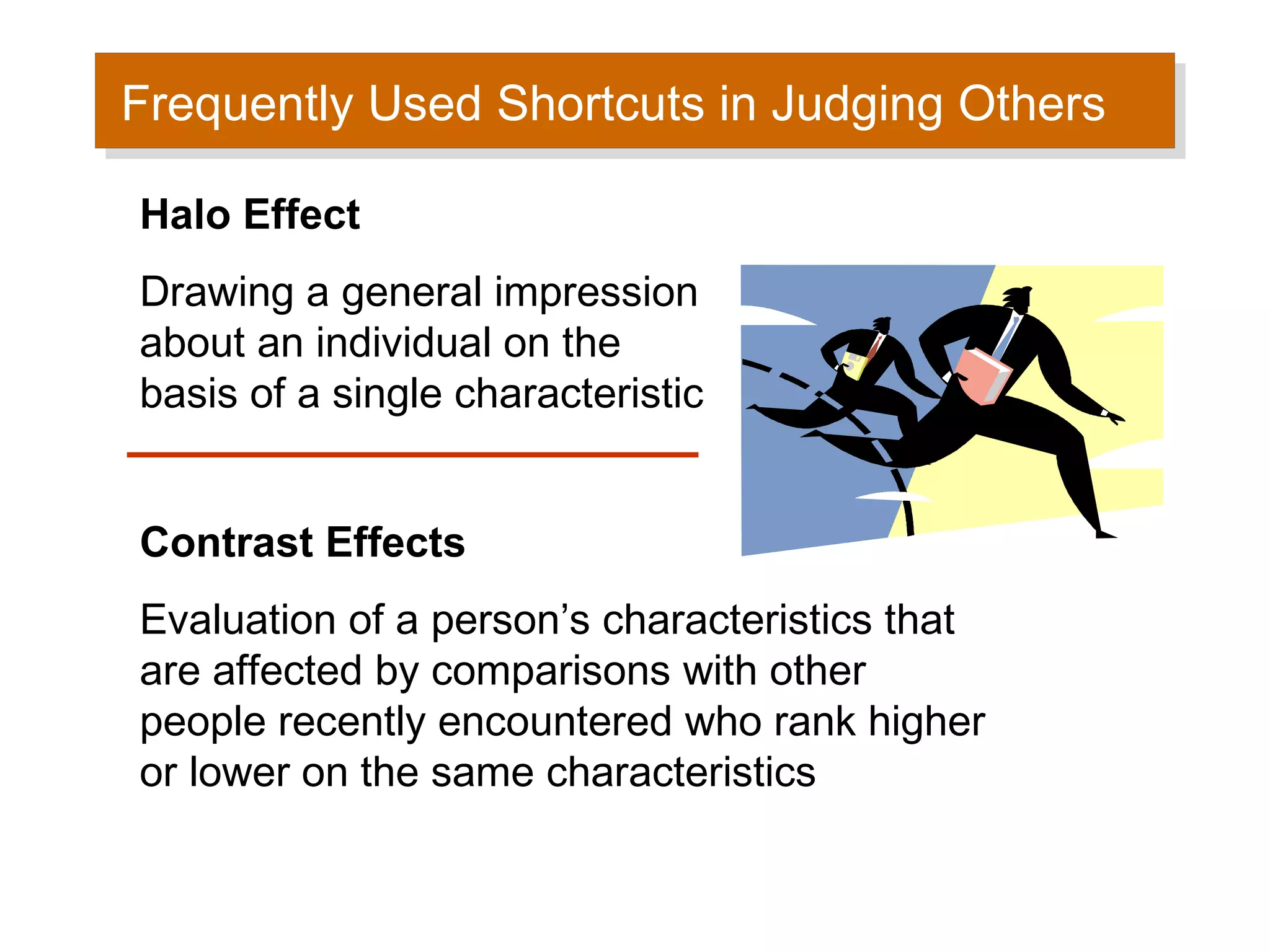
Halo Effect
Drawing a general impression
about an individual on the
basis of a single characteristic


Contrast Effects
Evaluation of a person’s characteristics that
are affected by comparisons with other
people recently encountered who rank higher
or lower on the same characteristics
Frequently Used Shortcuts in Judging Others
 Frequently Used Shortcuts in Judging Others


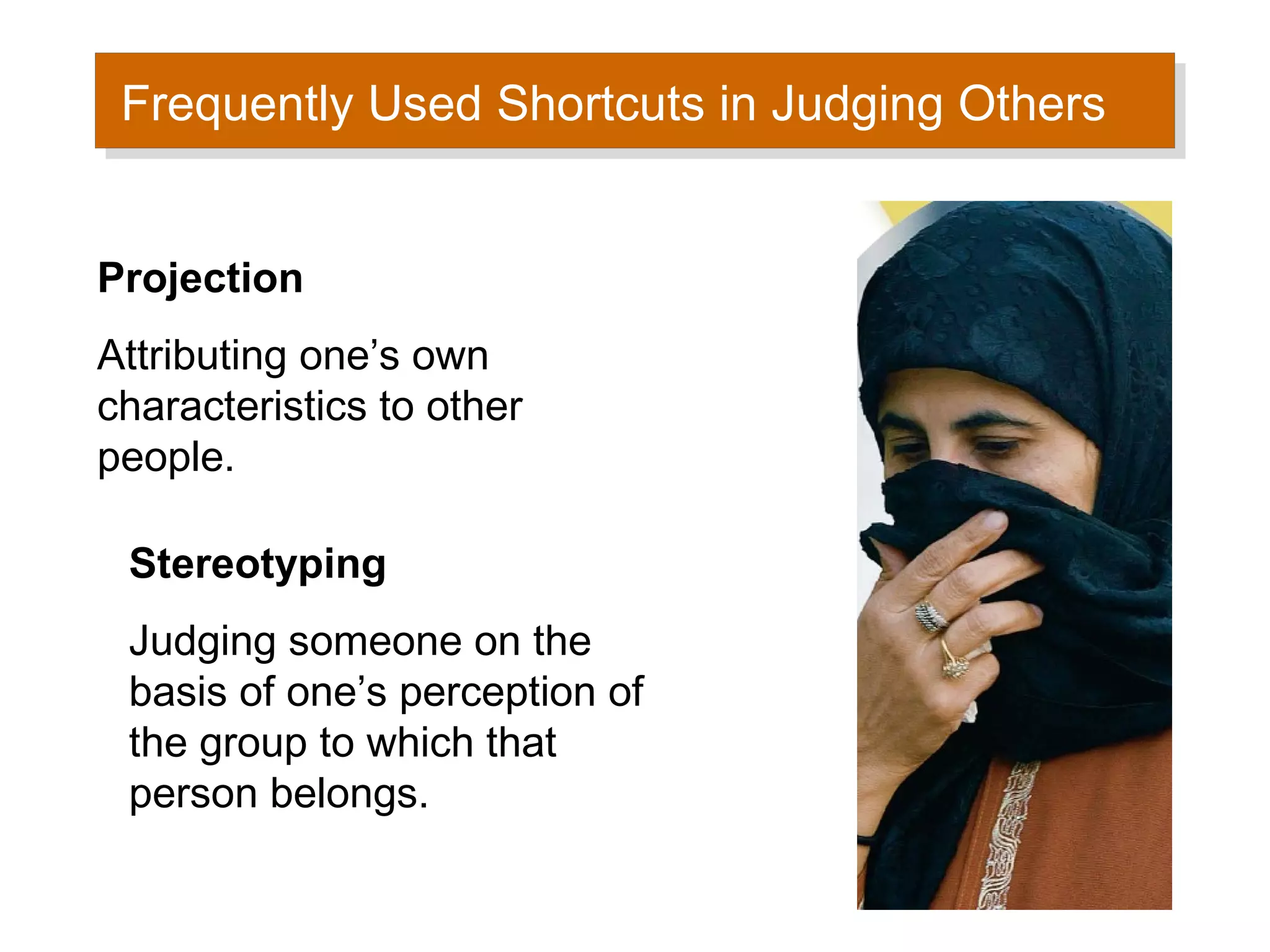
Projection
Attributing one’s own
characteristics to other
people.

 Stereotyping
 Judging someone on the
 basis of one’s perception of
 the group to which that
 person belongs.
Specific Applications in Organizations
 Employment Interview
   – Perceptual biases of raters affect the accuracy of
     interviewers’ judgments of applicants.
 Performance Expectations
   – Self-fulfilling prophecy (Pygmalion effect): The lower or
     higher performance of employees reflects
     preconceived leader expectations about employee
     capabilities.
 Ethnic Profiling
   – A form of stereotyping in which a group of individuals is
     singled out—typically on the basis of race or ethnicity
     —for intensive inquiry, scrutinizing, or investigation.
Specific Applications in Organizations (cont’d)
 Performance Evaluations
  – Appraisals are often the subjective (judgmental)
    perceptions of appraisers of another employee’s job
    performance.
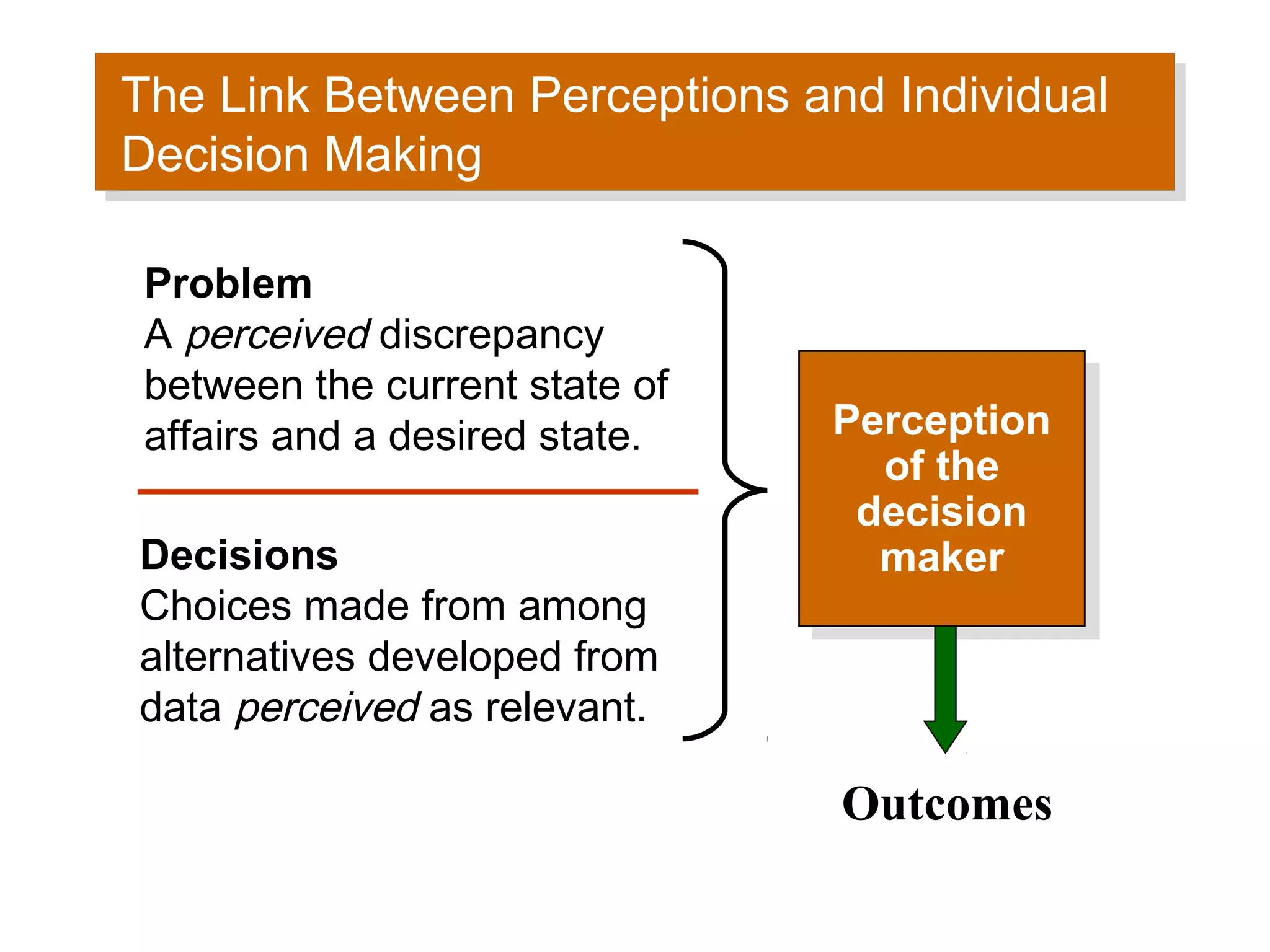
The Link Between Perceptions and Individual
Decision Making
Decision Making

 Problem
 A perceived discrepancy
 between the current state of
 affairs and a desired state.   Perception
                                 Perception
                                   of the
                                    of the
                                 decision
                                  decision
Decisions                         maker
                                   maker
Choices made from among
alternatives developed from
data perceived as relevant.

                                Outcomes
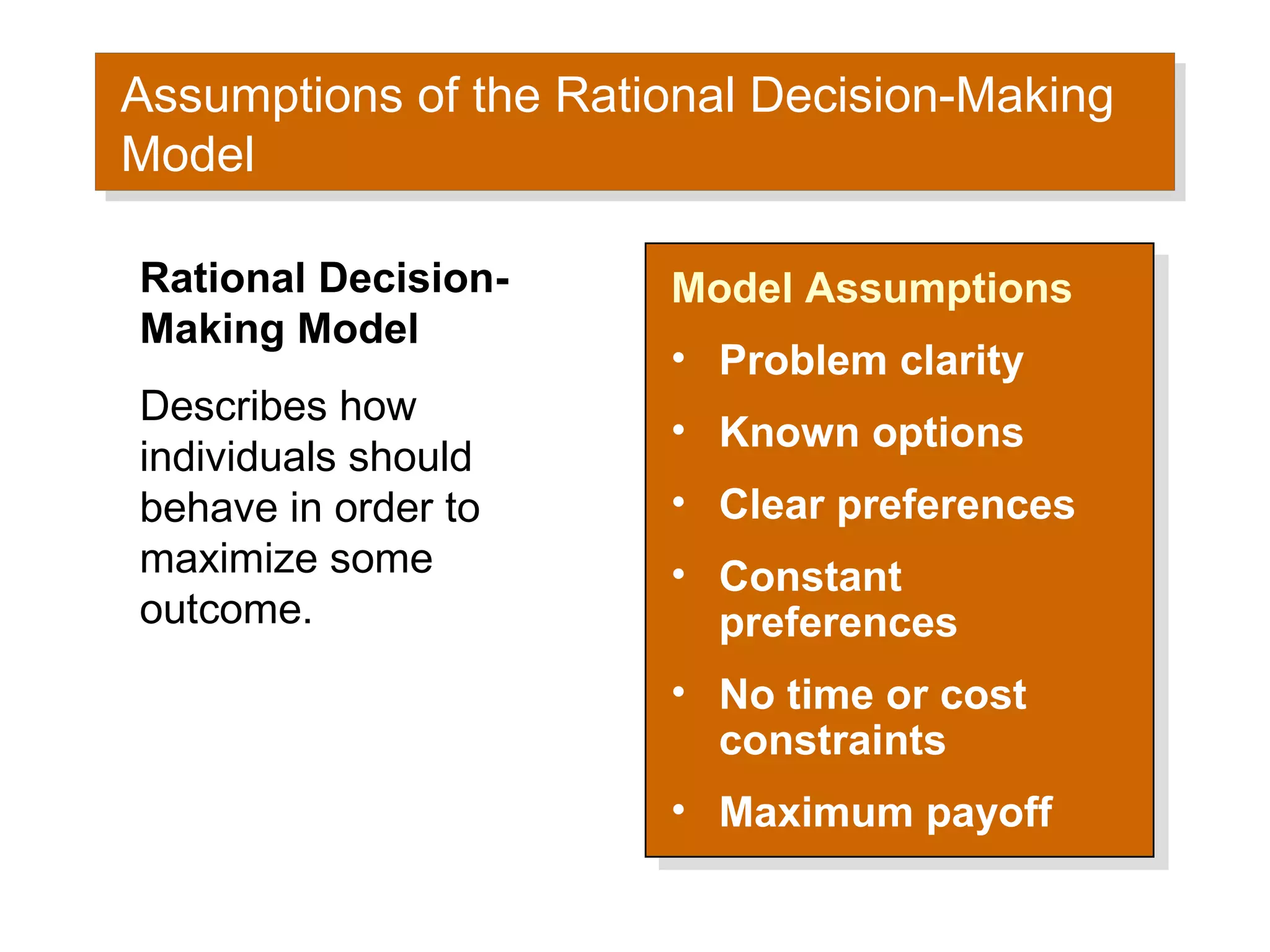
Assumptions of the Rational Decision-Making
Model
Model

Rational Decision-     Model Assumptions
                        Model Assumptions
Making Model
                       •• Problem clarity
                           Problem clarity
Describes how
                       ••   Known options
                            Known options
individuals should
behave in order to     ••   Clear preferences
                            Clear preferences
maximize some          •• Constant
outcome.                   Constant
                          preferences
                           preferences
                       •• No time or cost
                           No time or cost
                          constraints
                           constraints
                       •• Maximum payoff
                           Maximum payoff
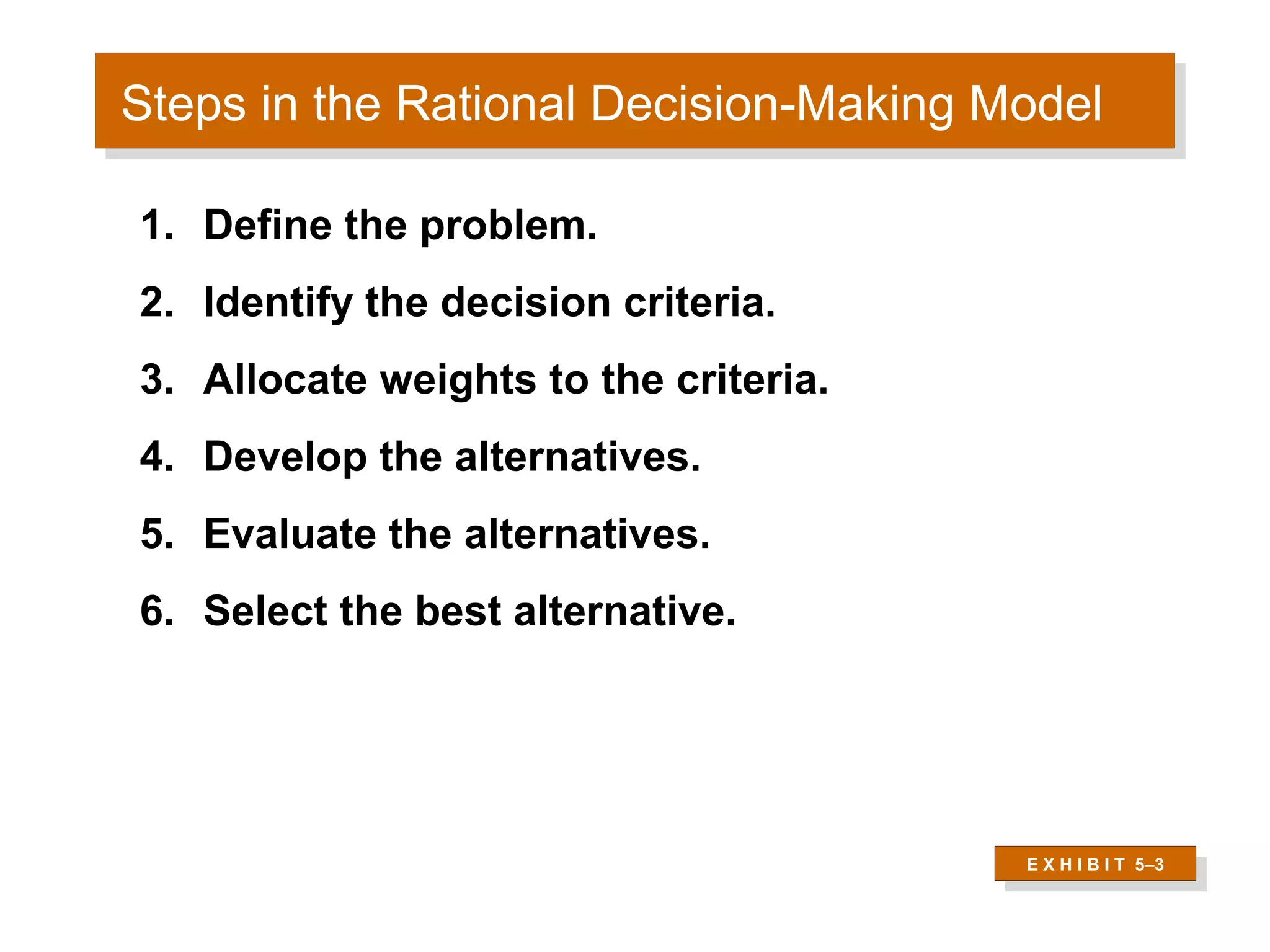
Steps in the Rational Decision-Making Model

1. Define the problem.
2. Identify the decision criteria.
3. Allocate weights to the criteria.
4. Develop the alternatives.
5. Evaluate the alternatives.
6. Select the best alternative.


                                       E X H I B I T 5–3
                                        E X H I B I T 5–3
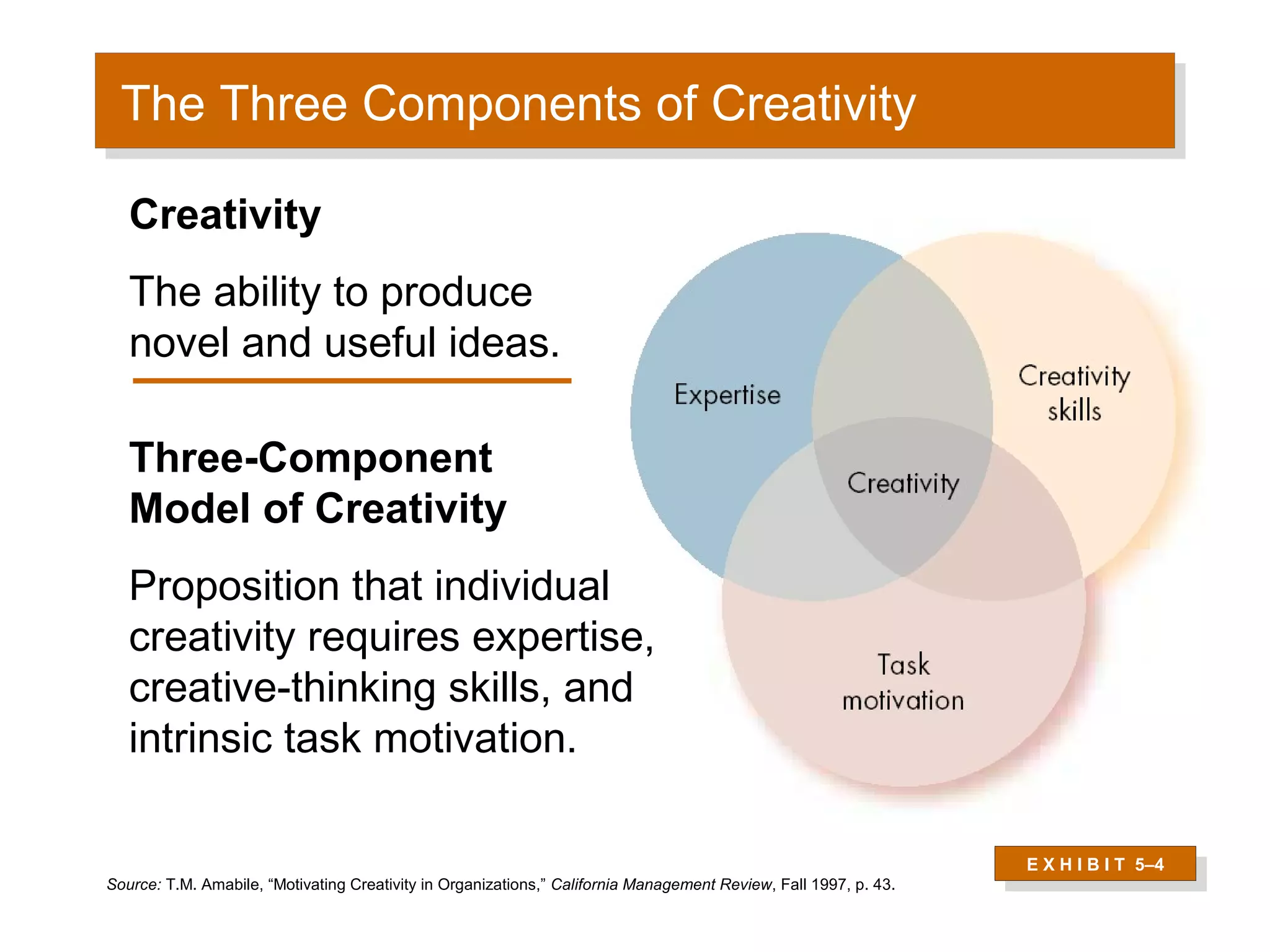
The Three Components of Creativity
  The Three Components of Creativity
   Creativity
   The ability to produce
   novel and useful ideas.

   Three-Component
   Model of Creativity
   Proposition that individual
   creativity requires expertise,
   creative-thinking skills, and
   intrinsic task motivation.

                                                                                                                  E X H I B I T 5–4
Source: T.M. Amabile, “Motivating Creativity in Organizations,” California Management Review, Fall 1997, p. 43.
                                                                                                                   E X H I B I T 5–4
How Are Decisions Actually Made in
Organizations?
Organizations?

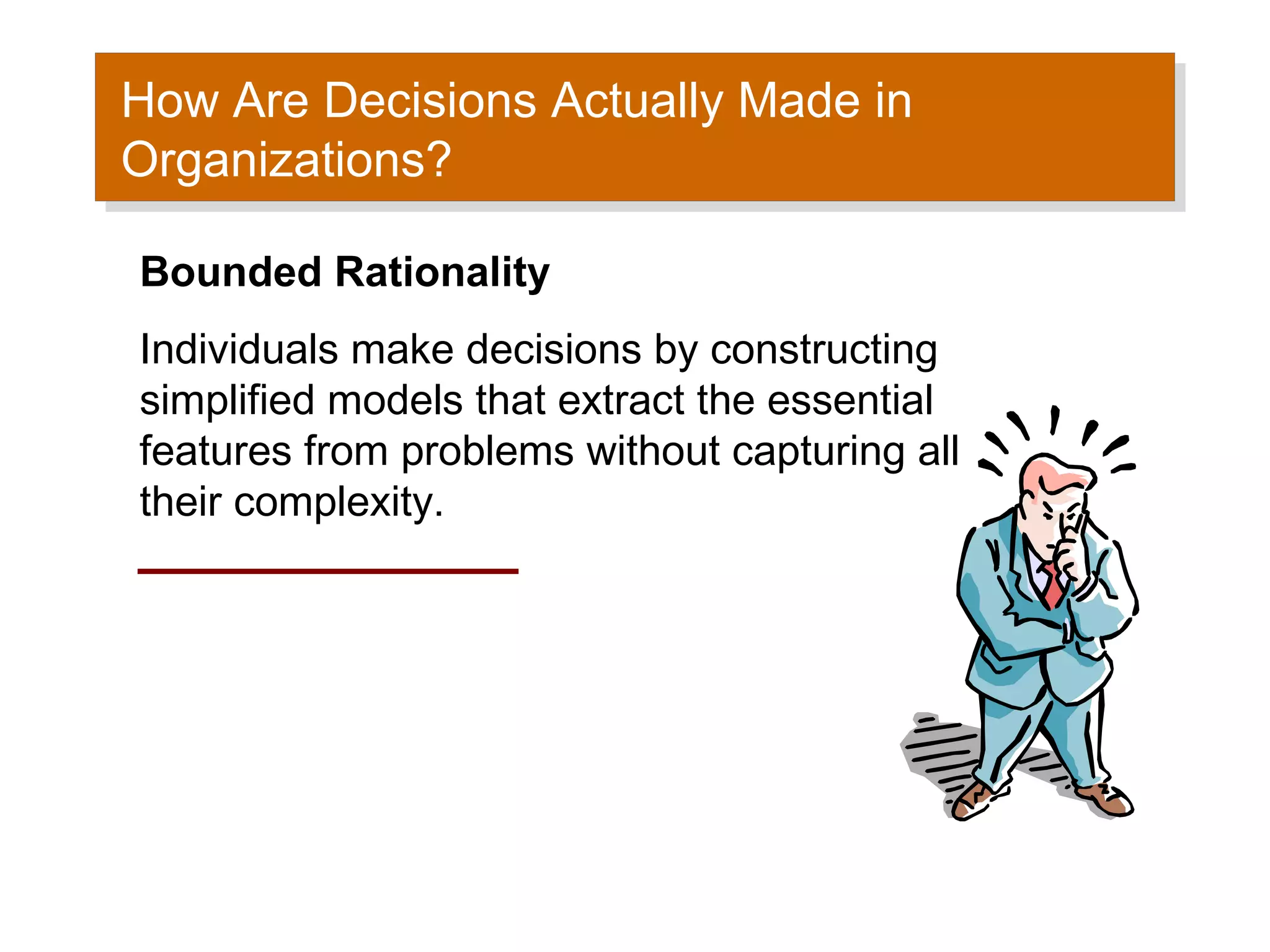
Bounded Rationality
Individuals make decisions by constructing
simplified models that extract the essential
features from problems without capturing all
their complexity.
How Are Decisions Actually Made in
Organizations? (cont’d)
 How/Why problems are Identified
  – Visibility over importance of problem
     • Attention-catching, high profile problems
     • Desire to “solve problems”
  – Self-interest (if problem concerns decision maker)
 Alternative Development
  – Satisficing: seeking the first alternative that solves
    problem.
  – Engaging in incremental rather than unique problem
    solving through successive limited comparison of
    alternatives to the current alternative in effect.
Common Biases and Errors
 Common Biases and Errors

 Overconfidence Bias
  – Believing too much in our own ability to make good
    decisions.

 Anchoring Bias
  – Using early, first received information as the basis for
    making subsequent judgments.

 Confirmation Bias
  – Using only the facts that support our decision.
Common Biases and Errors
 Availability Bias
   – Using information that is most readily at hand.
        • Recent
        • Vivid

 Representative Bias
   – “Mixing apples with oranges”
   – Assessing the likelihood of an occurrence by trying to match
     it with a preexisting category using only the facts that
     support our decision.

 Winner’s Curse
  – Highest bidder pays too much
  – Likelihood of “winner’s curse” increases with the number of
     people in auction.
Common Biases and Errors
 Escalation of Commitment
  – In spite of new negative information, commitment
    actually increases!

 Randomness Error
  – Creating meaning out of random events


 Hindsight Bias
  – Looking back, once the outcome has occurred, and
    believing that you accurately predicted the outcome of
    an event
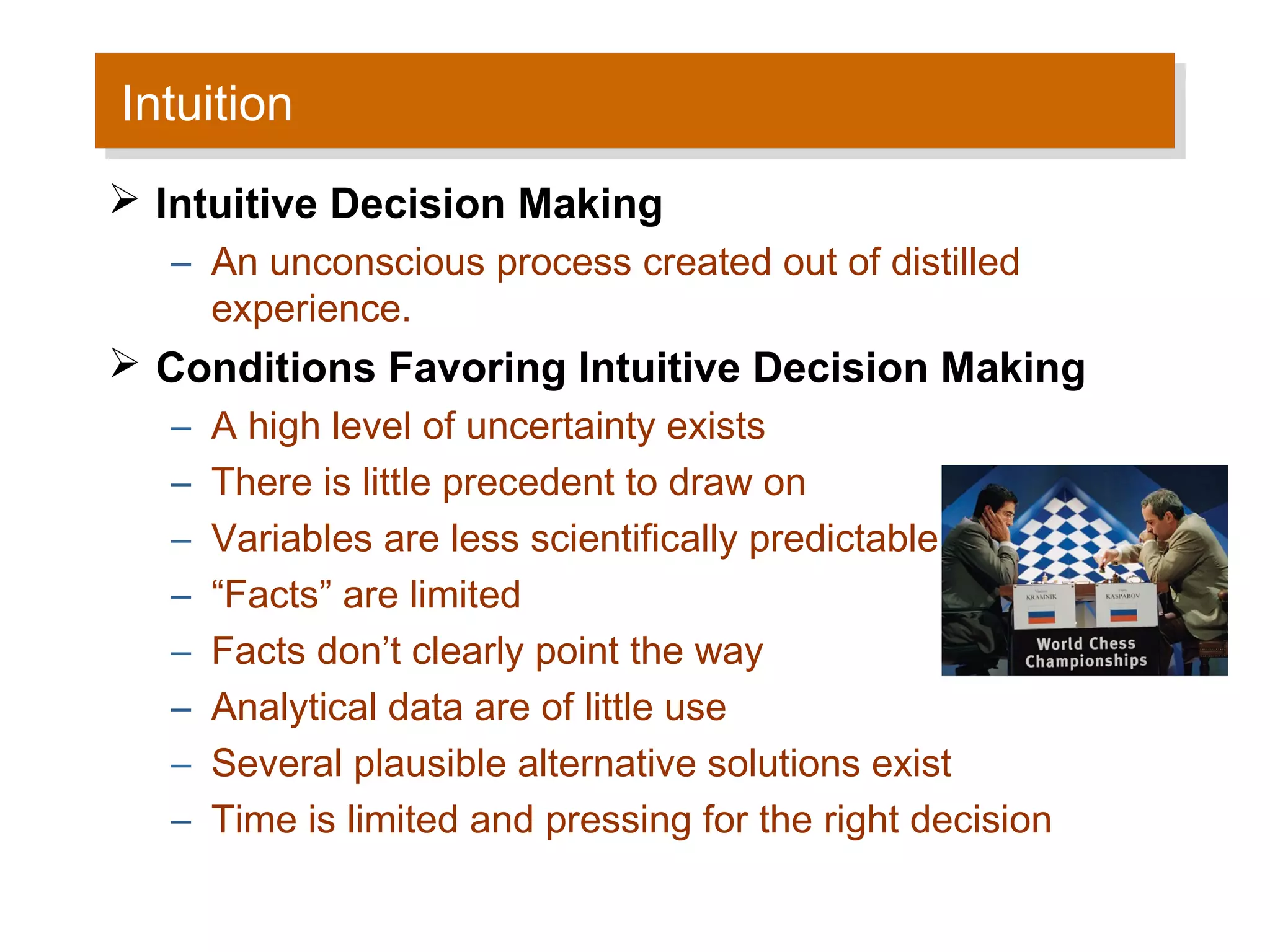
Intuition
 Intuition
 Intuitive Decision Making
   – An unconscious process created out of distilled
     experience.
 Conditions Favoring Intuitive Decision Making
   –   A high level of uncertainty exists
   –   There is little precedent to draw on
   –   Variables are less scientifically predictable
   –   “Facts” are limited
   –   Facts don’t clearly point the way
   –   Analytical data are of little use
   –   Several plausible alternative solutions exist
   –   Time is limited and pressing for the right decision
Individual Differences in Decision Making
  Individual Differences in Decision Making
 Personality
          Aspects of conscientiousness and escalation of
           commitment.
 Self Esteem                                           High self serving bias
 Gender
          Women tend to analyze decisions more than men.


Source: A.J. Rowe and J.D. Boulgarides, Managerial Decision
Making, (Upper Saddle River, NJ: Prentice Hall, 1992), p. 29.
Organizational Constraints on Decision Makers
 Performance Evaluation
   – Evaluation criteria influence the choice of actions.
 Reward Systems
   – Decision makers make action choices that are favored
     by the organization.
 Formal Regulations
   – Organizational rules and policies limit the alternative
     choices of decision makers.
 System-imposed Time Constraints
   – Organizations require decisions by specific deadlines.
 Historical Precedents
   – Past decisions influence current decisions.
Cultural Differences in Decision Making
   Problems selected
   Time orientation
   Importance of logic and rationality
   Belief in the ability of people to solve problems
   Preference for collective decision making
Ethics in Decision Making
 Ethical Decision Criteria
   – Utilitarianism
      • Seeking the greatest good for the greatest number.
   – Rights
      • Respecting and protecting basic rights of individuals
        such as whistleblowers.
   – Justice
      • Imposing and enforcing rules fairly and impartially.
Ethics in Decision Making
 Ethics and National Culture
   – There are no global ethical standards.
   – The ethical principles of global organizations that
     reflect and respect local cultural norms are necessary
     for high standards and consistent practices.
Ways to Improve Decision Making
1. Analyze the situation and adjust your decision
   making style to fit the situation.
2. Be aware of biases and try to limit their impact.
3. Combine rational analysis with intuition to
   increase decision-making effectiveness.
4. Don’t assume that your specific decision style is
   appropriate to every situation.
5. Enhance personal creativity by looking for novel
   solutions or seeing problems in new ways, and
   using analogies.
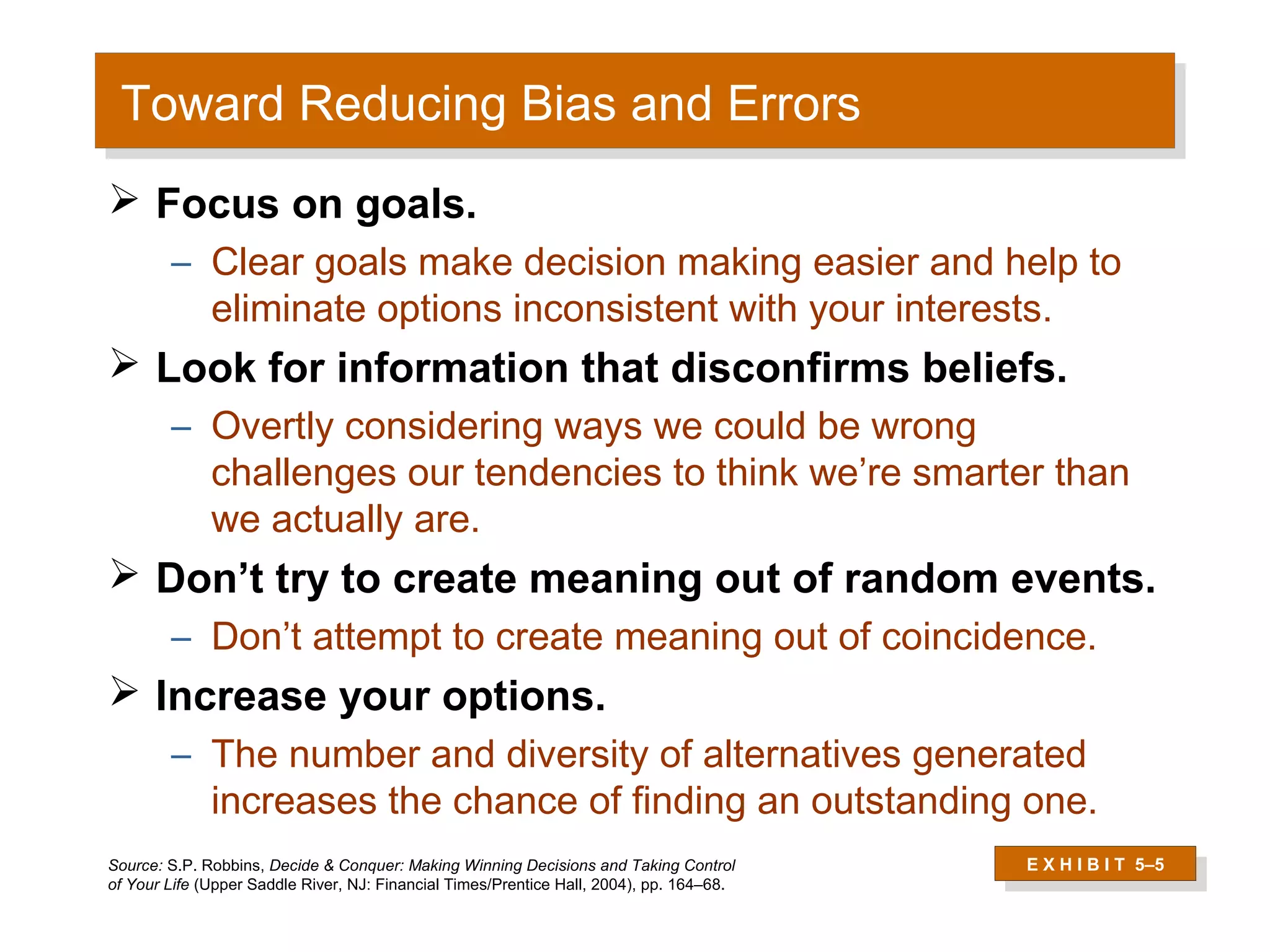
Toward Reducing Bias and Errors
 Toward Reducing Bias and Errors
 Focus on goals.
        – Clear goals make decision making easier and help to
          eliminate options inconsistent with your interests.
 Look for information that disconfirms beliefs.
        – Overtly considering ways we could be wrong
          challenges our tendencies to think we’re smarter than
          we actually are.
 Don’t try to create meaning out of random events.
        – Don’t attempt to create meaning out of coincidence.
 Increase your options.
        – The number and diversity of alternatives generated
          increases the chance of finding an outstanding one.
Source: S.P. Robbins, Decide & Conquer: Making Winning Decisions and Taking Control       E X H I B I T 5–5
of Your Life (Upper Saddle River, NJ: Financial Times/Prentice Hall, 2004), pp. 164–68.
                                                                                           E X H I B I T 5–5

Perception and individual decisionmaking

  • 1.
    Chapter THREE Perception and Individual Decision Making
  • 2.
    What Is Perception,and Why Is It Important? What Is Perception, and Why Is It Important? Perception A process by which ••People’s behavior is People’s behavior is individuals organize and based on their based on their interpret their sensory perception of what perception of what impressions in order to reality is, not on reality is, not on give meaning to their reality itself. reality itself. environment. ••The world as it is The world as it is perceived is the world perceived is the world that is behaviorally that is behaviorally important. important.
  • 3.
    Factors That Factors That Influence Influence Perception Perception E X H I B I T 5–1 E X H I B I T 5–1
  • 4.
    Person Perception: MakingJudgments About Person Perception: Making Judgments About Others Others Attribution Theory When individuals observe behavior, they attempt to determine whether it is internally or externally caused. Distinctiveness: shows different behaviors in different situations. Distinctiveness: shows different behaviors in different situations. Consensus: response is the same as others to same situation. Consensus: response is the same as others to same situation. Consistency: responds in the same way over time. Consistency: responds in the same way over time.
  • 5.
    Attribution Theory Attribution Theory E X H I B I T 5–2 E X H I B I T 5–2
  • 6.
    Errors and Biasesin Attributions Errors and Biases in Attributions Fundamental Attribution Error The tendency to underestimate the influence of external factors and overestimate the influence of internal factors when making judgments about the behavior of others. In general, we tend to blame the person first, not the situation.
  • 7.
    Errors and Biasesin Attributions (cont’d) Errors and Biases in Attributions (cont’d) Self-Serving Bias The tendency for individuals to attribute their own successes to internal factors while putting Thought: When student the blame for failures on gets an “A” on an exam, external factors. they often say they studied hard. But when they don’t do well, how does the self serving bias come into play? Hint: Whose fault is it usually when an exam is “tough”?
  • 8.
    Frequently Used Shortcutsin Judging Others Frequently Used Shortcuts in Judging Others Selective Perception People selectively interpret what they see on the basis of their interests, background, experience, and attitudes.
  • 9.
    Frequently Used Shortcutsin Judging Others Frequently Used Shortcuts in Judging Others Halo Effect Drawing a general impression about an individual on the basis of a single characteristic Contrast Effects Evaluation of a person’s characteristics that are affected by comparisons with other people recently encountered who rank higher or lower on the same characteristics
  • 10.
    Frequently Used Shortcutsin Judging Others Frequently Used Shortcuts in Judging Others Projection Attributing one’s own characteristics to other people. Stereotyping Judging someone on the basis of one’s perception of the group to which that person belongs.
  • 11.
    Specific Applications inOrganizations Specific Applications in Organizations  Employment Interview – Perceptual biases of raters affect the accuracy of interviewers’ judgments of applicants.  Performance Expectations – Self-fulfilling prophecy (Pygmalion effect): The lower or higher performance of employees reflects preconceived leader expectations about employee capabilities.  Ethnic Profiling – A form of stereotyping in which a group of individuals is singled out—typically on the basis of race or ethnicity —for intensive inquiry, scrutinizing, or investigation.
  • 12.
    Specific Applications inOrganizations (cont’d) Specific Applications in Organizations (cont’d)  Performance Evaluations – Appraisals are often the subjective (judgmental) perceptions of appraisers of another employee’s job performance.
  • 13.
    The Link BetweenPerceptions and Individual The Link Between Perceptions and Individual Decision Making Decision Making Problem A perceived discrepancy between the current state of affairs and a desired state. Perception Perception of the of the decision decision Decisions maker maker Choices made from among alternatives developed from data perceived as relevant. Outcomes
  • 14.
    Assumptions of theRational Decision-Making Assumptions of the Rational Decision-Making Model Model Rational Decision- Model Assumptions Model Assumptions Making Model •• Problem clarity Problem clarity Describes how •• Known options Known options individuals should behave in order to •• Clear preferences Clear preferences maximize some •• Constant outcome. Constant preferences preferences •• No time or cost No time or cost constraints constraints •• Maximum payoff Maximum payoff
  • 15.
    Steps in theRational Decision-Making Model Steps in the Rational Decision-Making Model 1. Define the problem. 2. Identify the decision criteria. 3. Allocate weights to the criteria. 4. Develop the alternatives. 5. Evaluate the alternatives. 6. Select the best alternative. E X H I B I T 5–3 E X H I B I T 5–3
  • 16.
    The Three Componentsof Creativity The Three Components of Creativity Creativity The ability to produce novel and useful ideas. Three-Component Model of Creativity Proposition that individual creativity requires expertise, creative-thinking skills, and intrinsic task motivation. E X H I B I T 5–4 Source: T.M. Amabile, “Motivating Creativity in Organizations,” California Management Review, Fall 1997, p. 43. E X H I B I T 5–4
  • 17.
    How Are DecisionsActually Made in How Are Decisions Actually Made in Organizations? Organizations? Bounded Rationality Individuals make decisions by constructing simplified models that extract the essential features from problems without capturing all their complexity.
  • 18.
    How Are DecisionsActually Made in How Are Decisions Actually Made in Organizations? (cont’d) Organizations? (cont’d)  How/Why problems are Identified – Visibility over importance of problem • Attention-catching, high profile problems • Desire to “solve problems” – Self-interest (if problem concerns decision maker)  Alternative Development – Satisficing: seeking the first alternative that solves problem. – Engaging in incremental rather than unique problem solving through successive limited comparison of alternatives to the current alternative in effect.
  • 19.
    Common Biases andErrors Common Biases and Errors  Overconfidence Bias – Believing too much in our own ability to make good decisions.  Anchoring Bias – Using early, first received information as the basis for making subsequent judgments.  Confirmation Bias – Using only the facts that support our decision.
  • 20.
    Common Biases andErrors Common Biases and Errors  Availability Bias – Using information that is most readily at hand. • Recent • Vivid  Representative Bias – “Mixing apples with oranges” – Assessing the likelihood of an occurrence by trying to match it with a preexisting category using only the facts that support our decision.  Winner’s Curse – Highest bidder pays too much – Likelihood of “winner’s curse” increases with the number of people in auction.
  • 21.
    Common Biases andErrors Common Biases and Errors  Escalation of Commitment – In spite of new negative information, commitment actually increases!  Randomness Error – Creating meaning out of random events  Hindsight Bias – Looking back, once the outcome has occurred, and believing that you accurately predicted the outcome of an event
  • 22.
    Intuition Intuition  IntuitiveDecision Making – An unconscious process created out of distilled experience.  Conditions Favoring Intuitive Decision Making – A high level of uncertainty exists – There is little precedent to draw on – Variables are less scientifically predictable – “Facts” are limited – Facts don’t clearly point the way – Analytical data are of little use – Several plausible alternative solutions exist – Time is limited and pressing for the right decision
  • 23.
    Individual Differences inDecision Making Individual Differences in Decision Making  Personality  Aspects of conscientiousness and escalation of commitment.  Self Esteem High self serving bias  Gender  Women tend to analyze decisions more than men. Source: A.J. Rowe and J.D. Boulgarides, Managerial Decision Making, (Upper Saddle River, NJ: Prentice Hall, 1992), p. 29.
  • 24.
    Organizational Constraints onDecision Makers Organizational Constraints on Decision Makers  Performance Evaluation – Evaluation criteria influence the choice of actions.  Reward Systems – Decision makers make action choices that are favored by the organization.  Formal Regulations – Organizational rules and policies limit the alternative choices of decision makers.  System-imposed Time Constraints – Organizations require decisions by specific deadlines.  Historical Precedents – Past decisions influence current decisions.
  • 25.
    Cultural Differences inDecision Making Cultural Differences in Decision Making  Problems selected  Time orientation  Importance of logic and rationality  Belief in the ability of people to solve problems  Preference for collective decision making
  • 26.
    Ethics in DecisionMaking Ethics in Decision Making  Ethical Decision Criteria – Utilitarianism • Seeking the greatest good for the greatest number. – Rights • Respecting and protecting basic rights of individuals such as whistleblowers. – Justice • Imposing and enforcing rules fairly and impartially.
  • 27.
    Ethics in DecisionMaking Ethics in Decision Making  Ethics and National Culture – There are no global ethical standards. – The ethical principles of global organizations that reflect and respect local cultural norms are necessary for high standards and consistent practices.
  • 28.
    Ways to ImproveDecision Making Ways to Improve Decision Making 1. Analyze the situation and adjust your decision making style to fit the situation. 2. Be aware of biases and try to limit their impact. 3. Combine rational analysis with intuition to increase decision-making effectiveness. 4. Don’t assume that your specific decision style is appropriate to every situation. 5. Enhance personal creativity by looking for novel solutions or seeing problems in new ways, and using analogies.
  • 29.
    Toward Reducing Biasand Errors Toward Reducing Bias and Errors  Focus on goals. – Clear goals make decision making easier and help to eliminate options inconsistent with your interests.  Look for information that disconfirms beliefs. – Overtly considering ways we could be wrong challenges our tendencies to think we’re smarter than we actually are.  Don’t try to create meaning out of random events. – Don’t attempt to create meaning out of coincidence.  Increase your options. – The number and diversity of alternatives generated increases the chance of finding an outstanding one. Source: S.P. Robbins, Decide & Conquer: Making Winning Decisions and Taking Control E X H I B I T 5–5 of Your Life (Upper Saddle River, NJ: Financial Times/Prentice Hall, 2004), pp. 164–68. E X H I B I T 5–5