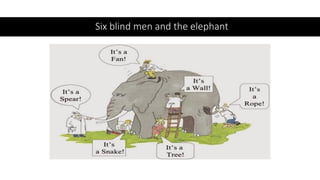
Six blind men and the elephant
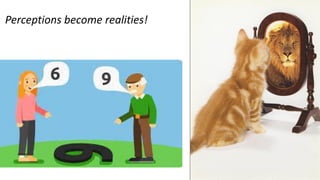
Perceptions become realities!
Perception
and Decision
Making
Presented by
Dr Nidhi Mishra
What is
Perception?
Perception is a process by which
individuals organize and interpret their
sensory impressions to give meaning
to their environment.
It is important to the study of OB
because people’s behaviors are based
on their perception of what reality is,
not on reality itself.
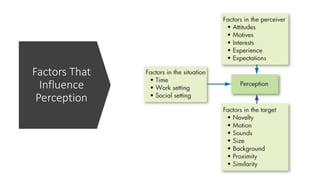
Factors That
Influence
Perception
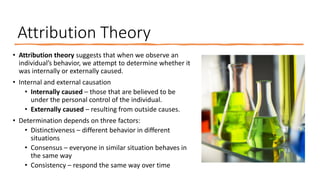
Attribution Theory
• Attribution theory suggests that when we observe an
individual’s behavior, we attempt to determine whether it
was internally or externally caused.
• Internal and external causation
• Internally caused – those that are believed to be
under the personal control of the individual.
• Externally caused – resulting from outside causes.
• Determination depends on three factors:
• Distinctiveness – different behavior in different
situations
• Consensus – everyone in similar situation behaves in
the same way
• Consistency – respond the same way over time
Attribution
Theory
Fundamental
attribution error
We have a tendency to underestimate the
influence of external factors and overestimate
the influence of internal or personal factors.
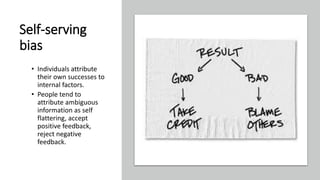
Self-serving
bias
• Individuals attribute
their own successes to
internal factors.
• People tend to
attribute ambiguous
information as self
flattering, accept
positive feedback,
reject negative
feedback.
Difference
between
heuristics
and biases
Heuristics are the ‘shortcuts’ that
humans use to reduce task complexity in
judgment and choice.
Biases are the resulting gaps between
normative behavior and the heuristically
determined behavior.
Cognitive biases stem from the reliance
on judgmental heuristics.
Common Shortcuts in Judging
Others
https://www.youtube.com/watch?v=IGQmdoK_ZfY
Selective
perception
• Any characteristic that
makes a person, object, or
event stand out will
increase the probability
that it will be perceived.
• Since we can’t observe
everything going on
around us, we engage in
selective perception.
Halo effect
The halo effect occurs when we draw a general impression
based on a single characteristic.
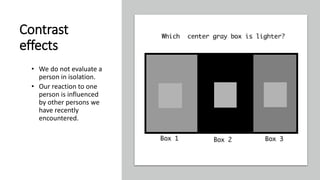
Contrast
effects
• We do not evaluate a
person in isolation.
• Our reaction to one
person is influenced
by other persons we
have recently
encountered.
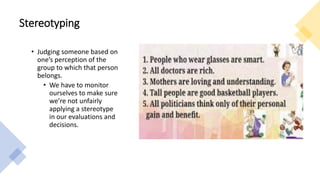
Stereotyping
• Judging someone based on
one’s perception of the
group to which that person
belongs.
• We have to monitor
ourselves to make sure
we’re not unfairly
applying a stereotype
in our evaluations and
decisions.
Applications
of Shortcuts in
Organizations
• Employment Interview
• Evidence indicates that interviewers make
perceptual judgments that are often
inaccurate.
• Interviewers generally draw early
impressions that become very quickly
entrenched.
• Studies indicate that most interviewers’
decisions change very little after the first
four or five minutes of the interview.
• Performance Evaluation
• An employee’s performance appraisal is very
much dependent upon the perceptual process.
• Many jobs are evaluated in subjective
terms.
• Subjective measures are problematic
because of selective perception, contrast
effects, halo effects, and so on.
Performance Expectations
• Evidence demonstrates that people will
attempt to validate their perceptions of
reality, even when those perceptions are
faulty.
• Self-fulfilling prophecy, or the
Pygmalion effect, characterizes the
fact that people’s expectations
determine their behavior.
• Expectations become reality.
• Example – Placebo effect
“When we expect certain behaviors of others, we are
likely to act in ways that make the expected behavior
more likely to occur.” (Rosenthal & Babad, 1985).
Decision Making in
Organizations
One person’s problem is
another’s satisfactory state
of affairs.
Rational
Model of
Decision
Making
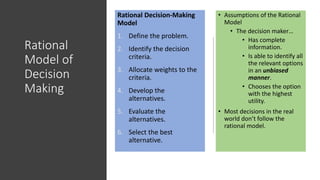
Rational Decision-Making
Model
1. Define the problem.
2. Identify the decision
criteria.
3. Allocate weights to the
criteria.
4. Develop the
alternatives.
5. Evaluate the
alternatives.
6. Select the best
alternative.
• Assumptions of the Rational
Model
• The decision maker…
• Has complete
information.
• Is able to identify all
the relevant options
in an unbiased
manner.
• Chooses the option
with the highest
utility.
• Most decisions in the real
world don’t follow the
rational model.
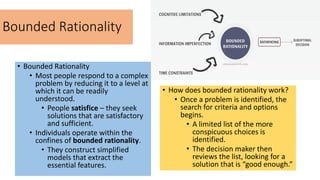
Bounded Rationality
• Bounded Rationality
• Most people respond to a complex
problem by reducing it to a level at
which it can be readily
understood.
• People satisfice – they seek
solutions that are satisfactory
and sufficient.
• Individuals operate within the
confines of bounded rationality.
• They construct simplified
models that extract the
essential features.
• How does bounded rationality work?
• Once a problem is identified, the
search for criteria and options
begins.
• A limited list of the more
conspicuous choices is
identified.
• The decision maker then
reviews the list, looking for a
solution that is “good enough.”
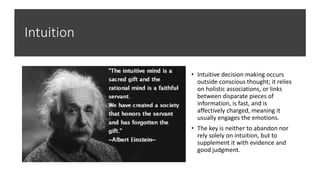
Intuition
• Intuitive decision making occurs
outside conscious thought; it relies
on holistic associations, or links
between disparate pieces of
information, is fast, and is
affectively charged, meaning it
usually engages the emotions.
• The key is neither to abandon nor
rely solely on intuition, but to
supplement it with evidence and
good judgment.
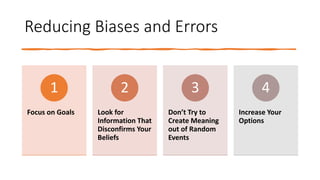
Reducing Biases and Errors
Focus on Goals
1
Look for
Information That
Disconfirms Your
Beliefs
2
Don’t Try to
Create Meaning
out of Random
Events
3
Increase Your
Options
4
Common Biases and Errors
in Decision Making
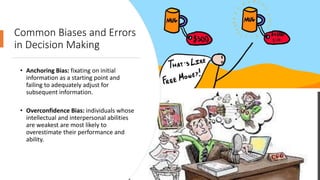
• Anchoring Bias: fixating on initial
information as a starting point and
failing to adequately adjust for
subsequent information.
• Overconfidence Bias: individuals whose
intellectual and interpersonal abilities
are weakest are most likely to
overestimate their performance and
ability.
Common Biases and
Errors in Decision Making
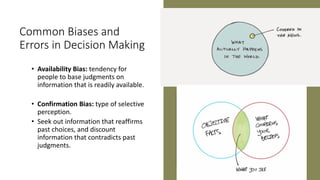
• Availability Bias: tendency for
people to base judgments on
information that is readily available.
• Confirmation Bias: type of selective
perception.
• Seek out information that reaffirms
past choices, and discount
information that contradicts past
judgments.
Common Biases and Errors in Decision Making
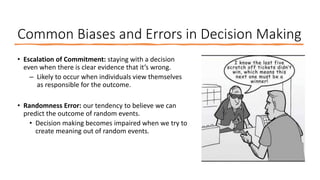
• Escalation of Commitment: staying with a decision
even when there is clear evidence that it’s wrong.
– Likely to occur when individuals view themselves
as responsible for the outcome.
• Randomness Error: our tendency to believe we can
predict the outcome of random events.
• Decision making becomes impaired when we try to
create meaning out of random events.
Common Biases and Errors
in Decision Making
• Hindsight Bias: the tendency to believe falsely
that one has accurately predicted the outcome
of an event, after that outcome is actually
known.
• Risk Aversion: the tendency to prefer a sure
thing instead of a risky outcome.
– Ambitious people with power that can be
taken away appear to be especially risk
averse.
– People will more likely engage in risk-
seeking behavior for negative outcomes,
and risk-averse behavior for positive
outcomes, when under stress.
Ethical Decision Criteria
• Utilitarianism: decisions are made solely on the basis of their outcomes or
consequences.
• Focus on rights: calls on individuals to make decisions consistent with
fundamental liberties and privileges as set forth in documents.
• Protects whistle-blowers.
• Impose and enforce rules fairly and impartially to ensure justice or an
equitable distribution of benefits and costs.
Ethical Decision Criteria
• Behavioral ethics: an area of study that analyzes how people behave when confronted
with ethical dilemmas.
• Individuals do not always follow ethical standards promulgated by their organizations,
and we sometimes violate our own standards.
• There are ways to increase ethical decision making in organizations.
• Consider cultural differences.
• Lying
– One of the top unethical activities we may indulge in daily.
– It undermines all efforts toward sound decision making.
• Managers—and organizations—simply cannot make good decisions when facts are
misrepresented and people give false motives for their behaviors.
• Lying is a big ethical problem as well.
Thank You!

sixblindmen (2).pdf

  • 1.
    Six blind menand the elephant
  • 2.
  • 3.
  • 4.
    What is Perception? Perception isa process by which individuals organize and interpret their sensory impressions to give meaning to their environment. It is important to the study of OB because people’s behaviors are based on their perception of what reality is, not on reality itself.
  • 5.
  • 6.
    Attribution Theory • Attributiontheory suggests that when we observe an individual’s behavior, we attempt to determine whether it was internally or externally caused. • Internal and external causation • Internally caused – those that are believed to be under the personal control of the individual. • Externally caused – resulting from outside causes. • Determination depends on three factors: • Distinctiveness – different behavior in different situations • Consensus – everyone in similar situation behaves in the same way • Consistency – respond the same way over time
  • 7.
  • 8.
    Fundamental attribution error We havea tendency to underestimate the influence of external factors and overestimate the influence of internal or personal factors.
  • 9.
    Self-serving bias • Individuals attribute theirown successes to internal factors. • People tend to attribute ambiguous information as self flattering, accept positive feedback, reject negative feedback.
  • 10.
    Difference between heuristics and biases Heuristics arethe ‘shortcuts’ that humans use to reduce task complexity in judgment and choice. Biases are the resulting gaps between normative behavior and the heuristically determined behavior. Cognitive biases stem from the reliance on judgmental heuristics.
  • 11.
    Common Shortcuts inJudging Others
  • 12.
  • 13.
    Selective perception • Any characteristicthat makes a person, object, or event stand out will increase the probability that it will be perceived. • Since we can’t observe everything going on around us, we engage in selective perception.
  • 14.
    Halo effect The haloeffect occurs when we draw a general impression based on a single characteristic.
  • 15.
    Contrast effects • We donot evaluate a person in isolation. • Our reaction to one person is influenced by other persons we have recently encountered.
  • 16.
    Stereotyping • Judging someonebased on one’s perception of the group to which that person belongs. • We have to monitor ourselves to make sure we’re not unfairly applying a stereotype in our evaluations and decisions.
  • 17.
    Applications of Shortcuts in Organizations •Employment Interview • Evidence indicates that interviewers make perceptual judgments that are often inaccurate. • Interviewers generally draw early impressions that become very quickly entrenched. • Studies indicate that most interviewers’ decisions change very little after the first four or five minutes of the interview. • Performance Evaluation • An employee’s performance appraisal is very much dependent upon the perceptual process. • Many jobs are evaluated in subjective terms. • Subjective measures are problematic because of selective perception, contrast effects, halo effects, and so on.
  • 18.
    Performance Expectations • Evidencedemonstrates that people will attempt to validate their perceptions of reality, even when those perceptions are faulty. • Self-fulfilling prophecy, or the Pygmalion effect, characterizes the fact that people’s expectations determine their behavior. • Expectations become reality. • Example – Placebo effect “When we expect certain behaviors of others, we are likely to act in ways that make the expected behavior more likely to occur.” (Rosenthal & Babad, 1985).
  • 19.
  • 20.
    One person’s problemis another’s satisfactory state of affairs.
  • 21.
    Rational Model of Decision Making Rational Decision-Making Model 1.Define the problem. 2. Identify the decision criteria. 3. Allocate weights to the criteria. 4. Develop the alternatives. 5. Evaluate the alternatives. 6. Select the best alternative. • Assumptions of the Rational Model • The decision maker… • Has complete information. • Is able to identify all the relevant options in an unbiased manner. • Chooses the option with the highest utility. • Most decisions in the real world don’t follow the rational model.
  • 22.
    Bounded Rationality • BoundedRationality • Most people respond to a complex problem by reducing it to a level at which it can be readily understood. • People satisfice – they seek solutions that are satisfactory and sufficient. • Individuals operate within the confines of bounded rationality. • They construct simplified models that extract the essential features. • How does bounded rationality work? • Once a problem is identified, the search for criteria and options begins. • A limited list of the more conspicuous choices is identified. • The decision maker then reviews the list, looking for a solution that is “good enough.”
  • 23.
    Intuition • Intuitive decisionmaking occurs outside conscious thought; it relies on holistic associations, or links between disparate pieces of information, is fast, and is affectively charged, meaning it usually engages the emotions. • The key is neither to abandon nor rely solely on intuition, but to supplement it with evidence and good judgment.
  • 24.
    Reducing Biases andErrors Focus on Goals 1 Look for Information That Disconfirms Your Beliefs 2 Don’t Try to Create Meaning out of Random Events 3 Increase Your Options 4
  • 25.
    Common Biases andErrors in Decision Making • Anchoring Bias: fixating on initial information as a starting point and failing to adequately adjust for subsequent information. • Overconfidence Bias: individuals whose intellectual and interpersonal abilities are weakest are most likely to overestimate their performance and ability.
  • 26.
    Common Biases and Errorsin Decision Making • Availability Bias: tendency for people to base judgments on information that is readily available. • Confirmation Bias: type of selective perception. • Seek out information that reaffirms past choices, and discount information that contradicts past judgments.
  • 27.
    Common Biases andErrors in Decision Making • Escalation of Commitment: staying with a decision even when there is clear evidence that it’s wrong. – Likely to occur when individuals view themselves as responsible for the outcome. • Randomness Error: our tendency to believe we can predict the outcome of random events. • Decision making becomes impaired when we try to create meaning out of random events.
  • 28.
    Common Biases andErrors in Decision Making • Hindsight Bias: the tendency to believe falsely that one has accurately predicted the outcome of an event, after that outcome is actually known. • Risk Aversion: the tendency to prefer a sure thing instead of a risky outcome. – Ambitious people with power that can be taken away appear to be especially risk averse. – People will more likely engage in risk- seeking behavior for negative outcomes, and risk-averse behavior for positive outcomes, when under stress.
  • 29.
    Ethical Decision Criteria •Utilitarianism: decisions are made solely on the basis of their outcomes or consequences. • Focus on rights: calls on individuals to make decisions consistent with fundamental liberties and privileges as set forth in documents. • Protects whistle-blowers. • Impose and enforce rules fairly and impartially to ensure justice or an equitable distribution of benefits and costs.
  • 30.
    Ethical Decision Criteria •Behavioral ethics: an area of study that analyzes how people behave when confronted with ethical dilemmas. • Individuals do not always follow ethical standards promulgated by their organizations, and we sometimes violate our own standards. • There are ways to increase ethical decision making in organizations. • Consider cultural differences. • Lying – One of the top unethical activities we may indulge in daily. – It undermines all efforts toward sound decision making. • Managers—and organizations—simply cannot make good decisions when facts are misrepresented and people give false motives for their behaviors. • Lying is a big ethical problem as well.
  • 31.