PSYCOLOGY FOR MANAGERS
Chapter-10
Understanding Work Teams
Dr.Amrinder Singh
Assistant Professor
Govt. College of Commerce & Business Administration,
Sector-50,Chandigarh
Why Have Teams Become So
Popular?
 Because we believe they are effective.
 Teams are more flexible and responsive to changing events.
 They can quickly assemble, deploy, refocus, and disband.
 They are an effective means to democratize organizations and
increase employee involvement.
 And finally, research indicates that our involvement in teams
positively shapes the way we think as individuals, introducing a
collaborative mindset about even our personal decision making.
21-3
Differences Between Groups and Teams
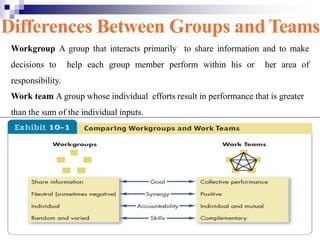
Workgroup A group that interacts primarily to share information and to make
decisions to help each group member perform within his or her area of
responsibility.
Work team A group whose individual efforts result in performance that is greater
than the sum of the individual inputs.
Types of Teams
 Problem-solvingTeams
 self-managedWorkTeams
 Cross-FunctionalTeams
 VirtualTeams
 Multiteamsystems
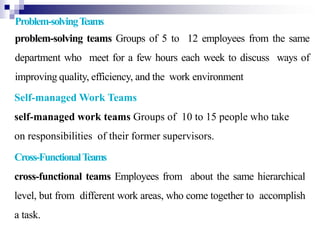
Problem-solvingTeams
problem-solving teams Groups of 5 to 12 employees from the same
department who meet for a few hours each week to discuss ways of
improving quality, efficiency, and the work environment
.Self-managed Work Teams
self-managed work teams Groups of 10 to 15 people who take
on responsibilities of their former supervisors.
Cross-FunctionalTeams
cross-functional teams Employees from about the same hierarchical
level, but from different work areas, who come together to accomplish
a task.
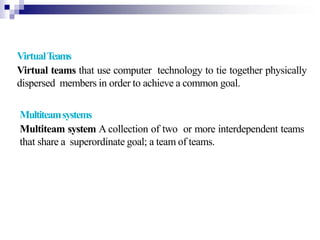
VirtualTeams
Virtual teams that use computer technology to tie together physically
dispersed members in order to achieve a common goal.
Multiteamsystems
Multiteam system A collection of two or more interdependent teams
that share a superordinate goal; a team of teams.
Creating Effective Teams
Keep in mind two points.
First, teams differ in form and structure.
Second, the model assumes teamwork is preferable to
individual work.
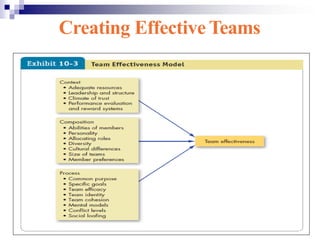
Third, let’s consider what team effectiveness means in this
model. Typically, team effectiveness includes objective measures
Exhibit 10-3
21-8
Creating Effective Teams
Team Context: What Factors Determine
Whether Teams are successful?
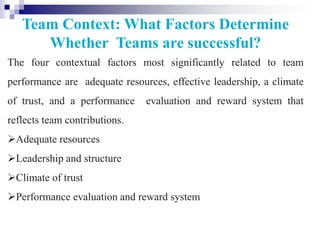
The four contextual factors most significantly related to team
performance are adequate resources, effective leadership, a climate
of trust, and a performance evaluation and reward system that
reflects team contributions.
Adequate resources
Leadership and structure
Climate of trust
Performance evaluation and reward system
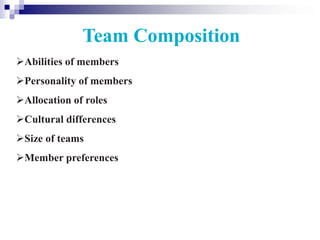
Team Composition
Abilities of members
Personality of members
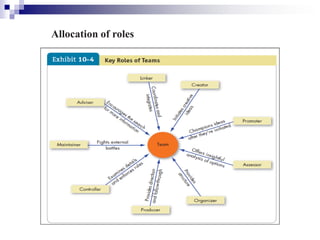
Allocation of roles
Cultural differences
Size of teams
Member preferences
mythorscience?
Allocation of roles
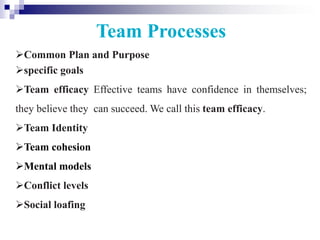
Team Processes
Common Plan and Purpose
specific goals
Team efficacy Effective teams have confidence in themselves;
they believe they can succeed. We call this team efficacy.
Team Identity
Team cohesion
Mental models
Conflict levels
Social loafing
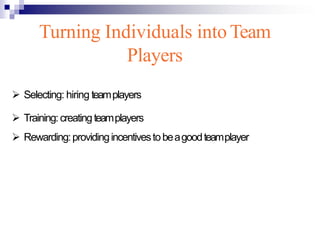
Turning Individuals into Team
Players
 Selecting: hiring teamplayers
 Training:creatingteamplayers
 Rewarding:providingincentivestobeagoodteamplayer

Understanding Work Teams, Chapter-10 Organizational Behavior

  • 1.
    PSYCOLOGY FOR MANAGERS Chapter-10 UnderstandingWork Teams Dr.Amrinder Singh Assistant Professor Govt. College of Commerce & Business Administration, Sector-50,Chandigarh
  • 2.
    Why Have TeamsBecome So Popular?  Because we believe they are effective.  Teams are more flexible and responsive to changing events.  They can quickly assemble, deploy, refocus, and disband.  They are an effective means to democratize organizations and increase employee involvement.  And finally, research indicates that our involvement in teams positively shapes the way we think as individuals, introducing a collaborative mindset about even our personal decision making.
  • 3.
    21-3 Differences Between Groupsand Teams Workgroup A group that interacts primarily to share information and to make decisions to help each group member perform within his or her area of responsibility. Work team A group whose individual efforts result in performance that is greater than the sum of the individual inputs.
  • 4.
    Types of Teams Problem-solvingTeams  self-managedWorkTeams  Cross-FunctionalTeams  VirtualTeams  Multiteamsystems
  • 5.
    Problem-solvingTeams problem-solving teams Groupsof 5 to 12 employees from the same department who meet for a few hours each week to discuss ways of improving quality, efficiency, and the work environment .Self-managed Work Teams self-managed work teams Groups of 10 to 15 people who take on responsibilities of their former supervisors. Cross-FunctionalTeams cross-functional teams Employees from about the same hierarchical level, but from different work areas, who come together to accomplish a task.
  • 6.
    VirtualTeams Virtual teams thatuse computer technology to tie together physically dispersed members in order to achieve a common goal. Multiteamsystems Multiteam system A collection of two or more interdependent teams that share a superordinate goal; a team of teams.
  • 7.
    Creating Effective Teams Keepin mind two points. First, teams differ in form and structure. Second, the model assumes teamwork is preferable to individual work. Third, let’s consider what team effectiveness means in this model. Typically, team effectiveness includes objective measures Exhibit 10-3
  • 8.
  • 9.
    Team Context: WhatFactors Determine Whether Teams are successful? The four contextual factors most significantly related to team performance are adequate resources, effective leadership, a climate of trust, and a performance evaluation and reward system that reflects team contributions. Adequate resources Leadership and structure Climate of trust Performance evaluation and reward system
  • 10.
    Team Composition Abilities ofmembers Personality of members Allocation of roles Cultural differences Size of teams Member preferences
  • 11.
  • 12.
    Team Processes Common Planand Purpose specific goals Team efficacy Effective teams have confidence in themselves; they believe they can succeed. We call this team efficacy. Team Identity Team cohesion Mental models Conflict levels Social loafing
  • 13.
    Turning Individuals intoTeam Players  Selecting: hiring teamplayers  Training:creatingteamplayers  Rewarding:providingincentivestobeagoodteamplayer