





PRESENTED BY : Mir Zeeshan Ali


PERCEPTION AND INDIVIDUAL
     DECISION MAKING
Learning Objectives
1.  Perception and the factors that influence it.
2.  Attribution Theory
3.  Making judgements about others
4.  Link between Perception and Decision Making
5.  Rational Model of Decision Making
6.  Common Decision biases or errors
7.  Individual differences and organizational constraints
    affects decision making
8. Three Ethical decision criteria
9. Creativity
10. Global Implications

                                                            2
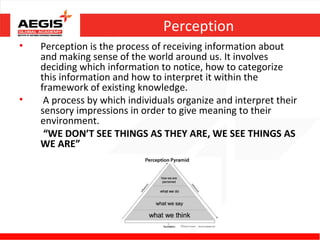
Perception
•   Perception is the process of receiving information about
    and making sense of the world around us. It involves
    deciding which information to notice, how to categorize
    this information and how to interpret it within the
    framework of existing knowledge.
•    A process by which individuals organize and interpret their
    sensory impressions in order to give meaning to their
    environment.
     “WE DON’T SEE THINGS AS THEY ARE, WE SEE THINGS AS
    WE ARE”
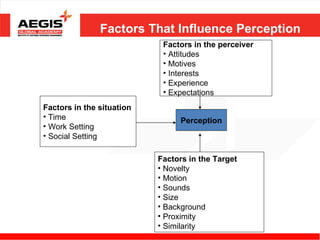
Factors That Influence Perception
                            Factors in the perceiver
                            • Attitudes
                            • Motives
                            • Interests
                            • Experience
                            • Expectations
Factors in the situation
• Time                           Perception
• Work Setting
• Social Setting

                           Factors in the Target
                           • Novelty
                           • Motion
                           • Sounds
                           • Size
                           • Background
                           • Proximity
                           • Similarity
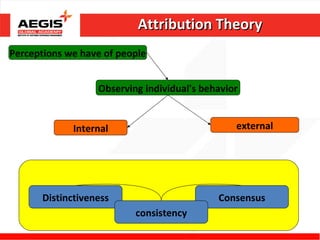
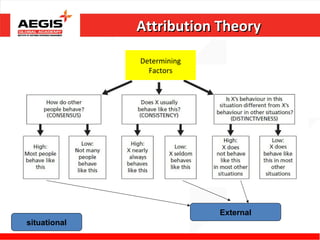
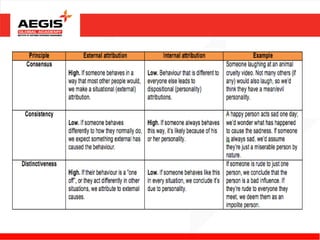
Attribution Theory
Perceptions we have of people


                  Observing individual's behavior


             Internal                           external


      Distinctiveness                       Consensus
                          consistency
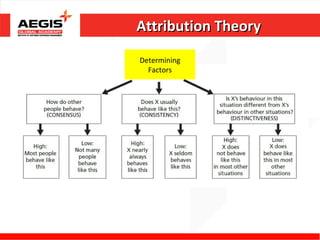
Attribution Theory
Determining
  Factors
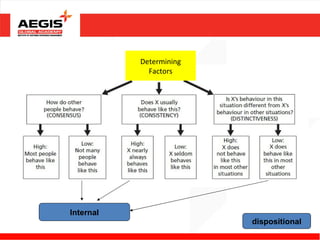
Determining
             Factors


Internal
                         dispositional
Attribution Theory

              Determining
                Factors


                            External
situational
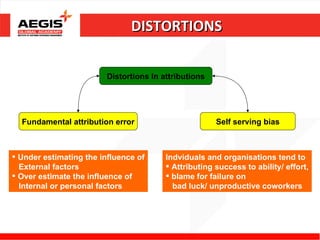
DISTORTIONS


                         Distortions In attributions


  Fundamental attribution error                        Self serving bias


 Under estimating the influence of      Indviduals and organisations tend to
  External factors                        Attributing success to ability/ effort,
 Over estimate the influence of          blame for failure on
  Internal or personal factors             bad luck/ unproductive coworkers
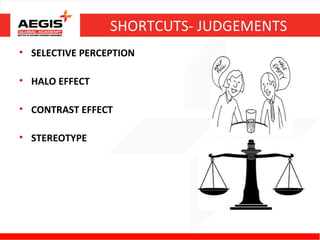
SHORTCUTS- JUDGEMENTS
• SELECTIVE PERCEPTION

• HALO EFFECT

• CONTRAST EFFECT

• STEREOTYPE
APPLICATION OF SHORTCUTS
•   Employment interview


•   Performance
    Expectation


•   Performance
    Evaluation
LINK BETWEEN PERCEPTION &INDIVIDUAL
                         DECISION MAKING

• What is perception and its importance?

• Factors influencing perception.

• How decision should be made?

• How to improve quality of decision?
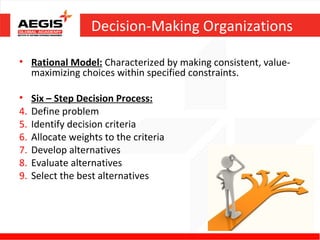
Decision-Making Organizations

• Rational Model: Characterized by making consistent, value-
  maximizing choices within specified constraints.

•    Six – Step Decision Process:
4.   Define problem
5.   Identify decision criteria
6.   Allocate weights to the criteria
7.   Develop alternatives
8.   Evaluate alternatives
9.   Select the best alternatives
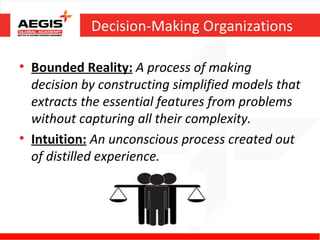
Decision-Making Organizations

• Bounded Reality: A process of making
  decision by constructing simplified models that
  extracts the essential features from problems
  without capturing all their complexity.
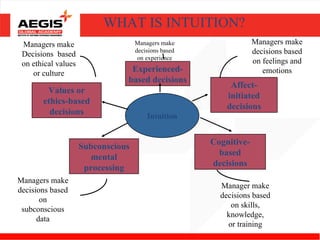
• Intuition: An unconscious process created out
  of distilled experience.
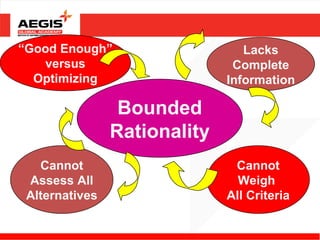
“Good Enough”                    Lacks
   versus                      Complete
  Optimizing                  Information

                 Bounded
                Rationality
   Cannot                      Cannot
 Assess All                     Weigh
 Alternatives                 All Criteria
WHAT IS INTUITION?
    Managers make                       Managers make                  Managers make
    Decisions based                     decisions based                decisions based
                                         on experience
    on ethical values                                                  on feelings and
       or culture                       Experienced-                      emotions
                                       based decisions
                                                               Affect-
            Values or
                                                              initiated
           ethics-based
                                                              decisions
             decisions                      Intuition


                                                          Cognitive-
                        Subconscious
                                                            based
                          mental
                                                          decisions
                         processing
   Managers make
                                                            Manager make
   decisions based
                                                            decisions based
          on
                                                               on skills,
    subconscious
                                                              knowledge,
         data
© 2003 Pearson Education Canada Inc.                          or training
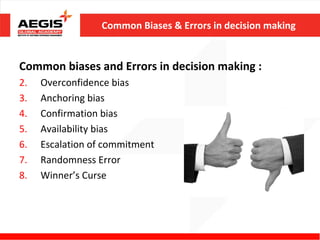
Common Biases & Errors in decision making


Common biases and Errors in decision making :
2.   Overconfidence bias
3.   Anchoring bias
4.   Confirmation bias
5.   Availability bias
6.   Escalation of commitment
7.   Randomness Error
8.   Winner’s Curse
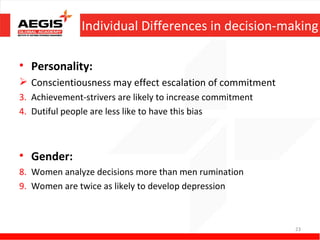
Individual Differences in decision-making

• Personality:
 Conscientiousness may effect escalation of commitment
3. Achievement-strivers are likely to increase commitment
4. Dutiful people are less like to have this bias


• Gender:
8. Women analyze decisions more than men rumination
9. Women are twice as likely to develop depression


                                                            23
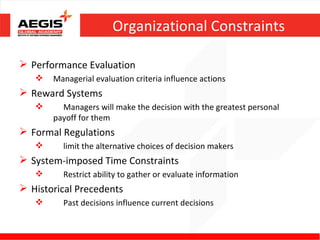
Organizational Constraints

 Performance Evaluation
      Managerial evaluation criteria influence actions
 Reward Systems
        Managers will make the decision with the greatest personal
       payoff for them
 Formal Regulations
        limit the alternative choices of decision makers
 System-imposed Time Constraints
        Restrict ability to gather or evaluate information
 Historical Precedents
        Past decisions influence current decisions
Ethics in Decision Making
         Ethics, also known as moral philosophy, is a branch
    of philosophy that addresses questions about morality — that is,
                concepts such as good and evil, right and
              wrong, virtue and vice, justice and crime, etc.

    Here are some criteria that can help ensure appropriate ethical
       considerations are part of the decisions being made in the
                              organization .

•   Compliance.
•   Promote good and reduce harm.
•   Responsibility.
•   Respects and preserves rights.
•   Promotes trust.
•   Builds reputation
Three Ethical Decision Criteria
An individual can use three different criteria in making ethical choices

•   Utilitarian criterion;
-   Decisions are made solely on the basis of their outcomes or consequences.
-   The goal is to provide the greatest god for the greatest number.
-   It promotes efficiency and productivity, but it can result in ignoring the rights of some
    individuals, particularly those with minority representation.

•   Focus on Rights
-   To make decisions consistent with fundamental liberties and privileges as set forth in
    documents such as Constitution of India.
-   It means respecting and protecting the basic rights of individuals.
-   It creates an overly legalistic work environment that hinders productivity and efficiency.

•   Focus on Justice
-   This requires individuals to impose and enforce rules fairly and impartially so that there is an
    equitable distribution of benefits and costs.
-   It justifies paying people the same wage for a given job, regardless of performance
    differences and using seniority as the primary determination in making layoff decisions.
-   It encourages a sense of entitlement that reduces risk taking, innovation and productivity.
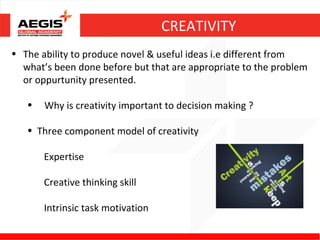
CREATIVITY
• The ability to produce novel & useful ideas i.e different from
  what’s been done before but that are appropriate to the problem
  or oppurtunity presented.

   •   Why is creativity important to decision making ?

   • Three component model of creativity

       Expertise

       Creative thinking skill

       Intrinsic task motivation
GLOBAL IMPLICATIONS

•   Attributions
•   Decisions Making
•   Ethics
THANK YOU

PERCEPTION AND INDIVIDUAL DECISION MAKING

  • 1.
    PRESENTED BY :Mir Zeeshan Ali PERCEPTION AND INDIVIDUAL DECISION MAKING
  • 2.
    Learning Objectives 1. Perception and the factors that influence it. 2. Attribution Theory 3. Making judgements about others 4. Link between Perception and Decision Making 5. Rational Model of Decision Making 6. Common Decision biases or errors 7. Individual differences and organizational constraints affects decision making 8. Three Ethical decision criteria 9. Creativity 10. Global Implications 2
  • 3.
    Perception • Perception is the process of receiving information about and making sense of the world around us. It involves deciding which information to notice, how to categorize this information and how to interpret it within the framework of existing knowledge. • A process by which individuals organize and interpret their sensory impressions in order to give meaning to their environment. “WE DON’T SEE THINGS AS THEY ARE, WE SEE THINGS AS WE ARE”
  • 4.
    Factors That InfluencePerception Factors in the perceiver • Attitudes • Motives • Interests • Experience • Expectations Factors in the situation • Time Perception • Work Setting • Social Setting Factors in the Target • Novelty • Motion • Sounds • Size • Background • Proximity • Similarity
  • 9.
    Attribution Theory Perceptions wehave of people Observing individual's behavior Internal external Distinctiveness Consensus consistency
  • 10.
  • 11.
    Determining Factors Internal dispositional
  • 12.
    Attribution Theory Determining Factors External situational
  • 13.
    DISTORTIONS Distortions In attributions Fundamental attribution error Self serving bias  Under estimating the influence of Indviduals and organisations tend to External factors  Attributing success to ability/ effort,  Over estimate the influence of  blame for failure on Internal or personal factors bad luck/ unproductive coworkers
  • 15.
    SHORTCUTS- JUDGEMENTS • SELECTIVEPERCEPTION • HALO EFFECT • CONTRAST EFFECT • STEREOTYPE
  • 16.
    APPLICATION OF SHORTCUTS • Employment interview • Performance Expectation • Performance Evaluation
  • 17.
    LINK BETWEEN PERCEPTION&INDIVIDUAL DECISION MAKING • What is perception and its importance? • Factors influencing perception. • How decision should be made? • How to improve quality of decision?
  • 18.
    Decision-Making Organizations • RationalModel: Characterized by making consistent, value- maximizing choices within specified constraints. • Six – Step Decision Process: 4. Define problem 5. Identify decision criteria 6. Allocate weights to the criteria 7. Develop alternatives 8. Evaluate alternatives 9. Select the best alternatives
  • 19.
    Decision-Making Organizations • BoundedReality: A process of making decision by constructing simplified models that extracts the essential features from problems without capturing all their complexity. • Intuition: An unconscious process created out of distilled experience.
  • 20.
    “Good Enough” Lacks versus Complete Optimizing Information Bounded Rationality Cannot Cannot Assess All Weigh Alternatives All Criteria
  • 21.
    WHAT IS INTUITION? Managers make Managers make Managers make Decisions based decisions based decisions based on experience on ethical values on feelings and or culture Experienced- emotions based decisions Affect- Values or initiated ethics-based decisions decisions Intuition Cognitive- Subconscious based mental decisions processing Managers make Manager make decisions based decisions based on on skills, subconscious knowledge, data © 2003 Pearson Education Canada Inc. or training
  • 22.
    Common Biases &Errors in decision making Common biases and Errors in decision making : 2. Overconfidence bias 3. Anchoring bias 4. Confirmation bias 5. Availability bias 6. Escalation of commitment 7. Randomness Error 8. Winner’s Curse
  • 23.
    Individual Differences indecision-making • Personality:  Conscientiousness may effect escalation of commitment 3. Achievement-strivers are likely to increase commitment 4. Dutiful people are less like to have this bias • Gender: 8. Women analyze decisions more than men rumination 9. Women are twice as likely to develop depression 23
  • 24.
    Organizational Constraints  PerformanceEvaluation  Managerial evaluation criteria influence actions  Reward Systems  Managers will make the decision with the greatest personal payoff for them  Formal Regulations  limit the alternative choices of decision makers  System-imposed Time Constraints  Restrict ability to gather or evaluate information  Historical Precedents  Past decisions influence current decisions
  • 25.
    Ethics in DecisionMaking Ethics, also known as moral philosophy, is a branch of philosophy that addresses questions about morality — that is, concepts such as good and evil, right and wrong, virtue and vice, justice and crime, etc. Here are some criteria that can help ensure appropriate ethical considerations are part of the decisions being made in the organization . • Compliance. • Promote good and reduce harm. • Responsibility. • Respects and preserves rights. • Promotes trust. • Builds reputation
  • 26.
    Three Ethical DecisionCriteria An individual can use three different criteria in making ethical choices • Utilitarian criterion; - Decisions are made solely on the basis of their outcomes or consequences. - The goal is to provide the greatest god for the greatest number. - It promotes efficiency and productivity, but it can result in ignoring the rights of some individuals, particularly those with minority representation. • Focus on Rights - To make decisions consistent with fundamental liberties and privileges as set forth in documents such as Constitution of India. - It means respecting and protecting the basic rights of individuals. - It creates an overly legalistic work environment that hinders productivity and efficiency. • Focus on Justice - This requires individuals to impose and enforce rules fairly and impartially so that there is an equitable distribution of benefits and costs. - It justifies paying people the same wage for a given job, regardless of performance differences and using seniority as the primary determination in making layoff decisions. - It encourages a sense of entitlement that reduces risk taking, innovation and productivity.
  • 27.
    CREATIVITY • The abilityto produce novel & useful ideas i.e different from what’s been done before but that are appropriate to the problem or oppurtunity presented. • Why is creativity important to decision making ? • Three component model of creativity Expertise Creative thinking skill Intrinsic task motivation
  • 28.
    GLOBAL IMPLICATIONS • Attributions • Decisions Making • Ethics
  • 29.

Editor's Notes