TEAM EFFECTIVENESS
Dr. Kiran Kakade
Assistant Professor (HR) ,TIMSR Mumbai
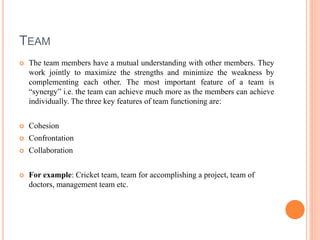
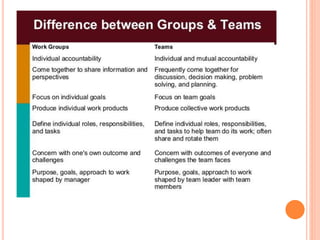
TEAM
 The team members have a mutual understanding with other members. They
work jointly to maximize the strengths and minimize the weakness by
complementing each other. The most important feature of a team is
“synergy” i.e. the team can achieve much more as the members can achieve
individually. The three key features of team functioning are:
 Cohesion
 Confrontation
 Collaboration
 For example: Cricket team, team for accomplishing a project, team of
doctors, management team etc.
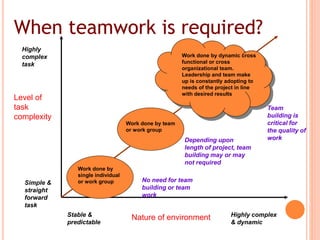
Nature of environmentStable &
predictable
Highly complex
& dynamic
Level of
task
complexity
Highly
complex
task
Simple &
straight
forward
task
Work done by
single individual
or work group
Work done by team
or work group
Work done by dynamic cross
functional or cross
organizational team.
Leadership and team make
up is constantly adopting to
needs of the project in line
with desired results
No need for team
building or team
work
Depending upon
length of project, team
building may or may
not required
Team
building is
critical for
the quality of
work
When teamwork is required?
Performance
Impact
Team Effectiveness
Working
Group
Real
Team
High-Performance
Team
Pseudo-Team
Potential
Team
The team performance curve
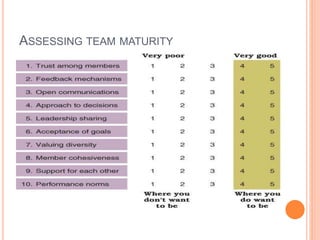
ASSESSING TEAM MATURITY
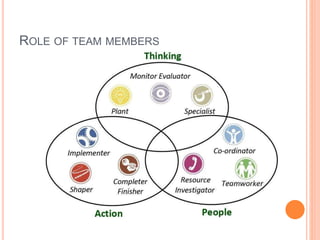
ROLE OF TEAM MEMBERS
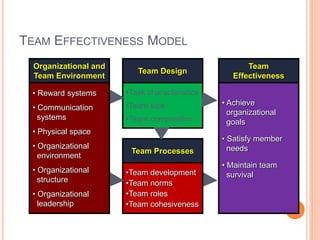
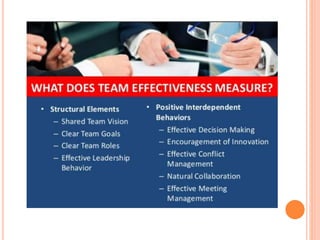
TEAM EFFECTIVENESS MODEL
•Task characteristics
•Team size
•Team composition
Team Design
• Achieve
organizational
goals
• Satisfy member
needs
• Maintain team
survival
Team
Effectiveness
•Team development
•Team norms
•Team roles
•Team cohesiveness
Team Processes
Organizational and
Team Environment
• Reward systems
• Communication
systems
• Physical space
• Organizational
environment
• Organizational
structure
• Organizational
leadership
HIGH PERFORMING TEAM HAS…
 Clear, elevating goals
 Results-driven structure
 Competent team members
 Unified commitments
 Collaborative climate
 Standards of excellence
 External support and recognition
 Principled leadership
FOR EFFECTIVE TEAMWORK…
 Be realistic and prepared
 Appropriate individual workload
 Clear expectations
 Communication of short/long-term goals
 Enthusiasm builds commitment
 Confidence in the team
 Open-minded and mutual respect
 Spirit of Cooperation is must
 Learn key skills to be a good team player
THANK YOU

Organizational Behaviour : Team Effectiveness

  • 1.
    TEAM EFFECTIVENESS Dr. KiranKakade Assistant Professor (HR) ,TIMSR Mumbai
  • 8.
    TEAM  The teammembers have a mutual understanding with other members. They work jointly to maximize the strengths and minimize the weakness by complementing each other. The most important feature of a team is “synergy” i.e. the team can achieve much more as the members can achieve individually. The three key features of team functioning are:  Cohesion  Confrontation  Collaboration  For example: Cricket team, team for accomplishing a project, team of doctors, management team etc.
  • 11.
    Nature of environmentStable& predictable Highly complex & dynamic Level of task complexity Highly complex task Simple & straight forward task Work done by single individual or work group Work done by team or work group Work done by dynamic cross functional or cross organizational team. Leadership and team make up is constantly adopting to needs of the project in line with desired results No need for team building or team work Depending upon length of project, team building may or may not required Team building is critical for the quality of work When teamwork is required?
  • 12.
  • 13.
  • 14.
    ROLE OF TEAMMEMBERS
  • 19.
    TEAM EFFECTIVENESS MODEL •Taskcharacteristics •Team size •Team composition Team Design • Achieve organizational goals • Satisfy member needs • Maintain team survival Team Effectiveness •Team development •Team norms •Team roles •Team cohesiveness Team Processes Organizational and Team Environment • Reward systems • Communication systems • Physical space • Organizational environment • Organizational structure • Organizational leadership
  • 22.
    HIGH PERFORMING TEAMHAS…  Clear, elevating goals  Results-driven structure  Competent team members  Unified commitments  Collaborative climate  Standards of excellence  External support and recognition  Principled leadership
  • 23.
    FOR EFFECTIVE TEAMWORK… Be realistic and prepared  Appropriate individual workload  Clear expectations  Communication of short/long-term goals  Enthusiasm builds commitment  Confidence in the team  Open-minded and mutual respect  Spirit of Cooperation is must  Learn key skills to be a good team player
  • 38.