 A person or organization using the services of
a lawyer or other professional person or
company .
 A person who provides expert advice
professionally in a specific field and has wide
knowledge of the subject matter.
 Internal consultant
 External consultant
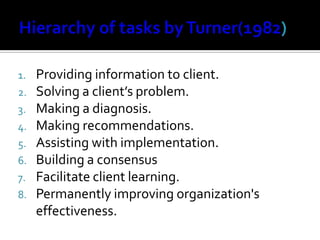
1. Providing information to client.
2. Solving a client’s problem.
3. Making a diagnosis.
4. Making recommendations.
5. Assisting with implementation.
6. Building a consensus
7. Facilitate client learning.
8. Permanently improving organization's
effectiveness.
AREAS OF ISSUES IN CONSULTANT –
CLIENT RELATIONSHIP
Entry and contracting
Defining the client system
Trust
The nature of consultant’s expertise
Diagnosis and appropriate interventions
The depth of interventions
On being absorbed by the culture
The consultant as a model
The consultant team as a microcosm
Action research and the od process
Client dependency and terminating the
relationship
Ethical standards in OD
Implications of OD for the client
 OD Consulting contract can occur in various
ways.
 The consultants & clients begin to sought out
what group should do to in order to start a
logicalOD intervention.
 When both the parties agree , this becomes
the overall psychological contract.
 Usually the consultant is referred as singular
but there can also be consultant teams.
 People will be encouraged to criticize their
superiors.
 Subordinates may be concerned that they
will be manipulated toward their superior’s
goals with little attention given to their own.
 It is possible and desirable for the OD
consultant to be an expert .
 But the OD consultant also needs to resist the
temptation of playing the content expert.
 OD consultant should be prepared to
describe in broad outline what the
organization might look like.
 Temptation to a apply a particular
intervention technique.
 Appropriate interventions with intensive look
at the data.
ACCESSIBILITY : PUBLICVS HIDDEN DATA
INDIVIDUALITY :SELFVS ORGANISATION
 Consultant let himself indulge into joining the
culture of the client organization.
 The consultant should practice what he she
preaches.
 The consultant should give out clear
messages.
 The team must set an example of an effective
unit to enhance its credibility
 The team should have n effective
interpersonal relationship.
 Practitioner should also focus on continuous
growth & process renewal.
 Simple questionnaires or interviews could be
helpful.
 Relationship between consultant and client
depends on :
 consultant competence :the longer the
consultant are able to provide innovative and
productive intervention the more longer the
relationship will lasts.
Client resourcefulness & capabilities in OD.
 LouisWhite & KevinWooten see five
categories of ethical dilemmas in OD practice
stemming from either the client or consultant
actions or both. These are :
1. misrepresentation & collusion
2. Misuse of data
3. Manipulation and coercion
4. Value & goal conflicts
5. Technical ineptness
1. Honesty
2. Openness
3. Voluntarism
4. Integrity
5. Confidentiality
6. The development of people
7. The development of consultant expertise
8. High standards & self-awareness
1. To enlarge the database for making
management decisions
2. To expand the influence process
3. To capitalize the strengths of formal system
4. To become more responsive
5. To legitimize conflicts
6. To examine its own leadership style
7. To encourage collaborative management
 BETRANSPARENT
 UNDER COMMIT-OVER DELIVER
 DON’T BE AFTRAIDTOTELLTHE CLIENT
THATYOU HAVE A DIFFERENCE OF
OPINION
 SOCIALIZE
 OFFER KNOWLEDGETRANSFER INTHE
FORM OF COACHING & MENTORING.
Issues in c c relationships

Issues in c c relationships

  • 2.
     A personor organization using the services of a lawyer or other professional person or company .
  • 3.
     A personwho provides expert advice professionally in a specific field and has wide knowledge of the subject matter.  Internal consultant  External consultant
  • 4.
    1. Providing informationto client. 2. Solving a client’s problem. 3. Making a diagnosis. 4. Making recommendations. 5. Assisting with implementation. 6. Building a consensus 7. Facilitate client learning. 8. Permanently improving organization's effectiveness.
  • 5.
    AREAS OF ISSUESIN CONSULTANT – CLIENT RELATIONSHIP Entry and contracting Defining the client system Trust The nature of consultant’s expertise Diagnosis and appropriate interventions The depth of interventions
  • 6.
    On being absorbedby the culture The consultant as a model The consultant team as a microcosm Action research and the od process Client dependency and terminating the relationship Ethical standards in OD Implications of OD for the client
  • 7.
     OD Consultingcontract can occur in various ways.  The consultants & clients begin to sought out what group should do to in order to start a logicalOD intervention.  When both the parties agree , this becomes the overall psychological contract.
  • 8.
     Usually theconsultant is referred as singular but there can also be consultant teams.
  • 9.
     People willbe encouraged to criticize their superiors.  Subordinates may be concerned that they will be manipulated toward their superior’s goals with little attention given to their own.
  • 10.
     It ispossible and desirable for the OD consultant to be an expert .  But the OD consultant also needs to resist the temptation of playing the content expert.  OD consultant should be prepared to describe in broad outline what the organization might look like.
  • 11.
     Temptation toa apply a particular intervention technique.  Appropriate interventions with intensive look at the data.
  • 12.
    ACCESSIBILITY : PUBLICVSHIDDEN DATA INDIVIDUALITY :SELFVS ORGANISATION
  • 13.
     Consultant lethimself indulge into joining the culture of the client organization.
  • 14.
     The consultantshould practice what he she preaches.  The consultant should give out clear messages.
  • 15.
     The teammust set an example of an effective unit to enhance its credibility  The team should have n effective interpersonal relationship.  Practitioner should also focus on continuous growth & process renewal.
  • 16.
     Simple questionnairesor interviews could be helpful.
  • 17.
     Relationship betweenconsultant and client depends on :  consultant competence :the longer the consultant are able to provide innovative and productive intervention the more longer the relationship will lasts. Client resourcefulness & capabilities in OD.
  • 18.
     LouisWhite &KevinWooten see five categories of ethical dilemmas in OD practice stemming from either the client or consultant actions or both. These are : 1. misrepresentation & collusion 2. Misuse of data 3. Manipulation and coercion 4. Value & goal conflicts 5. Technical ineptness
  • 19.
    1. Honesty 2. Openness 3.Voluntarism 4. Integrity 5. Confidentiality 6. The development of people 7. The development of consultant expertise 8. High standards & self-awareness
  • 20.
    1. To enlargethe database for making management decisions 2. To expand the influence process 3. To capitalize the strengths of formal system 4. To become more responsive 5. To legitimize conflicts 6. To examine its own leadership style 7. To encourage collaborative management
  • 21.
     BETRANSPARENT  UNDERCOMMIT-OVER DELIVER  DON’T BE AFTRAIDTOTELLTHE CLIENT THATYOU HAVE A DIFFERENCE OF OPINION  SOCIALIZE  OFFER KNOWLEDGETRANSFER INTHE FORM OF COACHING & MENTORING.