Naik
Devang
2/01/2016
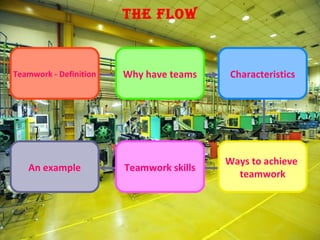
The Flow
Teamwork - Definition Why have teams Characteristics
Ways to achieve
teamwork
Teamwork skillsAn example
DeFiniTion oF Teamwork:
• Teamwork is the concept of people workingTeamwork is the concept of people working
together as a team for one specific purposetogether as a team for one specific purpose
under the same value.under the same value.
• Teamwork is defined in Webster's New World
Dictionary as "a joint action by a group of
people, in which each person subordinates his or
her individual interests and opinions to the unity
and efficiency of the group."
• This does not mean that the individual is no
longer important; however, it does mean that
effective and efficient teamwork goes beyond
individual accomplishments.
• The most effective teamwork is produced when
all the individuals involved harmonize their
contributions and work towards a common goal.
Common identity Willing participation
Contributions valued Shared responsibilityGood Teamwork
Clarity of roles and
relationships Members enjoy being in
the team
Common objectives
Open discussion of
disagreements and
conflicts
Team BuilDing
Stages of team development
Forming: “Nice to Meet you,
not sure why we’re here, it looks
like a lot of work!” Leader
encourages equitable
participation, begin focus on
project
Storming: “Do I HAVE to work with
this team???”. Leader helps team to
focus on strengths, not weaknesses, in
working toward the task at hand
Norming: “Maybe we will be able to pull
this all together, if we stop fighting and
listen to each other...” Collective decision
to behave professionally, and agree to
norms. Leader and others may have to
facilitate towards group accountability
Performing: “We’ve got a great
plan, and everyone is pulling
together….” True teamwork and
cooperation, members individually
committed, multiple leaders
Adjourning: Goal accomplished,
Project Over
Teamwork .... whaT is iT?
how Do Teams work BesT?
• Greater interpersonal skills are necessary if
you are to work together.
• Teams succeed when members
have:
Commitment to common
• objectives;
Defined roles and responsibilities;
Effective decision systems, communication
and work procedures; and,
Good personal relationships.
• Condition:
• Cooperation:
• Coordination :
• Cognition:
• Communication:
• Coaching:
• Conflict:
• Clarity:
The eighT C’s
 CondiTions: Practices – including policies and incentives – need to support teams. Teams must
have the resources that they need to be successful, leaders must show that teamwork matters, and
good team performance must be recognized and reinforced. You can have the best team in the world
but if the conditions are not optimal for teamwork, organizations won’t get the behavior, cognition, or
attitudes needed.
 CooperaTion: Team members must like being on their team. This means that members need to
trust each other and each member needs to contribute to the team’s work. When members fail to
contribute (the “social loafing” syndrome), teams may experience greater conflict and reduced
satisfaction and performance.
 CoordinaTion: Effective teams foster mutual support, adaptability, and flexibility. Effective teams
coordinate their processes to match the requirements of their tasks. For example, teams dealing with
emergencies should increase their communication by verbalizing their plans and sharing their
information.
 CommuniCaTion: Communication occurs in a precise, timely and clear manner. Effective teams
have protocols in place for exchanging information, their members communicate face-to-face as often
as possible, their members contribute equally, and contributions are succinct and to-the-point.
 CogniTion: Team cognition is unique from individual cognition and involves a shared
understanding of tasks and member roles. Effective teams have a shared understanding of their tasks,
member roles and capabilities, and their equipment.
 CoaChing: Leaders promote teamwork and care about team members. Effective team
leaders facilitate their teams by building trust, establishing norms, engaging in teambuilding, and
focusing on the conditions that promote success.
 ConfliCT: Effective teams provide a climate where it is safe to deal with conflict. This climate is
called psychological safety, and is promoted by active listening, looking for common ground, and
expressing concern for the relationships between members by focusing on problems not people.
 laCk of ClariTy: And the biggest team killer is another C, lack of Clarity. This is defined as the
lack of clarity in roles and responsibilities – who does what, when, why and with whom. Team
members must know their precise roles and responsibilities.
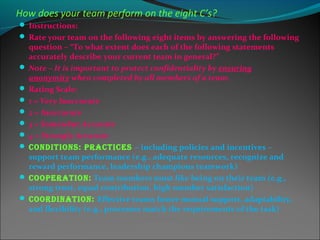
How does your team perform on the eight C’s?
 Instructions:
 Rate your team on the following eight items by answering the following
question – “To what extent does each of the following statements
accurately describe your current team in general?”
 Note – It is important to protect confidentiality by ensuring 
anonymity when completed by all members of a team.
 Rating Scale:
 1 = Very Inaccurate
 2 = Inaccurate
 3 = Somewhat Accurate
 4 = Strongly Accurate
 CondiTions: praCTiCes – including policies and incentives –
support team performance (e.g., adequate resources, recognize and
reward performance, leadership champions teamwork)
 CooperaTion: Team members must like being on their team (e.g.,
strong trust, equal contribution, high member satisfaction)
 CoordinaTion: Effective teams foster mutual support, adaptability,
and flexibility (e.g., processes match the requirements of the task)
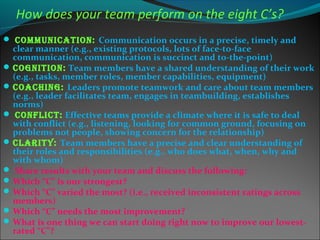
How does your team perform on the eight C’s?
 CommuniCaTion: Communication occurs in a precise, timely and
clear manner (e.g., existing protocols, lots of face-to-face
communication, communication is succinct and to-the-point)
CogniTion: Team members have a shared understanding of their work
(e.g., tasks, member roles, member capabilities, equipment)
CoaChing: Leaders promote teamwork and care about team members
(e.g., leader facilitates team, engages in teambuilding, establishes
norms)
 ConfliCT: Effective teams provide a climate where it is safe to deal
with conflict (e.g., listening, looking for common ground, focusing on
problems not people, showing concern for the relationship)
ClariTy: Team members have a precise and clear understanding of
their roles and responsibilities (e.g., who does what, when, why and
with whom)
 Share results with your team and discuss the following:
Which “C” is our strongest?
Which “C” varied the most? (i.e., received inconsistent ratings across
members)
Which “C” needs the most improvement?
What is one thing we can start doing right now to improve our lowest-
rated “C”?
Teamwork skills
 lisTening - it is important to listen to other people's ideas.
 DisCussing - It is important to discuss your ideas with your teammates until
you agree.
 QuesTioning - it is important to ask questions, interact, and discuss the
objectives of the team.
 persuading - individuals are encouraged to exchange, defend, and then to
ultimately rethink their ideas.
 respeCTing - it is important to treat others with respect and to support their
ideas.
 helping - it is crucial to help one's coworkers, which is the general theme of
teamwork.
 sharing - it is important to share with the team to create an environment of
teamwork.
 parTiCipaTing - all members of the team are encouraged to participate in
the team.
 CommuniCaTion - For a team to work effectively it is essential team
members acquire communication skills and use effective communication channels
make Teamwork 'work' for
you
Participate
Be clear about your
roleSupport your
leader
Be Open Minded
Keep the common
goal in mind
Don't forget to
have fun
Don't be the
dominating one
Team work advanTage
• Tasks are accomplished at a faster
pace when it is done by a team
rather than an individual.
• No organization runs for charity.
– Work never suffers or takes a
backseat in a team.
• There is always a healthy
competition among the team
members
shared responsibiliTy
& goals
• Allows team members to feel equally
responsible for the performance of the team and
its outcome.
• Permits individuals to have primary roles for
completing team tasks and remain flexible to do
what is necessary to accomplish the team’s
goals and tasks.
• Teamwork depends not only on your skills, but
on your attitudes as well.
 Increased flexibility in skills and abilities.
 More productive than work groups with
individual mindset.
 More beneficial in times of organizational
change.
 Encourage both individual and team
development and improvement.
 Focuses on group goals to accomplish more
beneficial tasks.
open
CommuniCaTions . . .
Creates and maintains a climate of trust and
open, honest communication.
Allows team members to talk openly with one
another.
Promotes the exchange of feedback.
Provide team members to work through
misunderstandings and conflicts.
Keep the following in mind:
• Teamwork improves the working environment.Teamwork improves the working environment.
• Teamwork keeps communication consistent.Teamwork keeps communication consistent.
• Teamwork relieves stress.Teamwork relieves stress.
• Teamwork reduces errors.Teamwork reduces errors.
• Teamwork keeps communication lines open.Teamwork keeps communication lines open.
CharaCteristiCs of
effeCtive team
members
• Team members are supportive to
achieve the results.
• Team members avoid "winning" or
looking good at the expense of
others.
• Team members are open to the ideas
of others.
• Team members share information
and ideas.
• Team members support the
contribution of others.
guidelines forguidelines for
effeCtive teameffeCtive team
membershipmembership
• Listen and share informationListen and share information
• Really listening to what other team membersReally listening to what other team members
have to say is one of the most vital skills youhave to say is one of the most vital skills you
can contribute to a productive teamcan contribute to a productive team
atmosphere.atmosphere.
• You should always be willing to give anYou should always be willing to give an
attentive ear to the views of other teamattentive ear to the views of other team
members and expect them to do the same formembers and expect them to do the same for
you.you.
• Ask questions and get clarification.
• If an idea isn't clear to you, it is your
responsibility to the team to ask questions until
the matter is clarified
ConfliCt
• Most difficult to deal with personally and
professionally.
• Conflict is inevitable;
• Conflict develops because we are dealing with
people's lives, jobs, children, pride, self-concept, ego
and sense of mission or purpose;
• Early indicators of conflict can be recognized;
• There are strategies for resolution that are available
and DO work;
• Although inevitable, conflict can be minimized,
diverted and/or resolved.
ConfliCt indiCators
Body language
Disagreements, regardless of issue
Withholding bad news
Surprises
Conflicts in value system
Desire for power
Increasing lack of respect
Open disagreement
Lack of clear goals
the Controversies usually
involve:
Changes in the way "we've always
done things"
Notions of fundamental values
Determined, articulate advocates for
every side
Inability to compromise
Rampant rumors
Threats of retaliation
dealing with
ConfliCt
• Conflict occurs when individuals or
groups are not obtaining what they
need or want and are seeking their
own self-interest.
• Sometimes the individual is not
aware of the need and unconsciously
starts to act out.
• Other times, the individual is very
aware of what he or she wants and
actively works at achieving the goal.
ConfliCt is destruCtive
when it:
• Takes attention away from other
important activities.
• Undermines morale or self-concept
• Polarizes people and groups, reducing
cooperation.
• Increases or sharpens difference
• Leads to irresponsible and harmful
behavior, such as fighting, name-calling.
teChniques forteChniques for
avoiding and/oravoiding and/or
resolvingresolving ConfliCt:ConfliCt:
• Meet conflict head on
• Plan for and communicate frequently
• Be honest about concerns
• Agree to disagree - understand healthy
disagreement would build better decisions
• Let your team create - people will support
what they help create
• Discuss differences in values openly
• Continually stress the importance of
following policy
• Communicate honestly - avoid playing
"gotcha" type games
Follow these guidelines
For reaching a consensus:
• Avoid arguing over individual ranking or
position. Present a position as logically as
possible.
• Avoid "win-lose" statements. Discard the
notion that someone must win.
• Avoid changing of minds only in order to avoid
conflict and to achieve harmony.
• Treat differences of opinion as indicative of
incomplete sharing of relevant information,
keep asking questions.
• Keep the attitude that holding different views
is both natural and healthy to team building.
team Quotes
Coming together is a beginning
Keeping together is a progress
Working together is a success
If everyone is moving forward together
than success takes care of itself.
Team work is less ME and more WE.
Lets do it is more powerful than I do it or
you do it.
Many Hands makes work light.
team Quotes
• Compromising when it is best for the
welfare of others shows the capacity for
team work.
• Individually we are one drop, together we
are an ocean.
• A champion team is a team of champions.
• Talent wins games, but teamwork and
intelligence win championship.
nine tips
• 1 Be understood by each person.
• 2 Often good procedures and doing new
things are important to the team as a
whole. It is the team has to understand
what is wanted and what is expected. We
should check all individual have
understood what is wanted. The common
goal should be understood by each person.
nine tips
3 Learn From Mistakes.
Mistakes happen Human makes mistakes
Team succeeds as the success is only
possible if they are not afraid of mistakes.
Instead learn from them and find a best
way.
nine tips
• 4 Represent individual difference.
• 5 Teams expects differences between
each members. Members should not have
to be same. Some of them smarter.
• 6 Seek Ideas from group.
• 7 Disrespecting others is unprofessional.
• 8 The power of team Belief.
• 9 Praise your own team often.
thanK You
 Naik Devang

Ratan team building

  • 1.
  • 3.
    The Flow Teamwork -Definition Why have teams Characteristics Ways to achieve teamwork Teamwork skillsAn example
  • 4.
    DeFiniTion oF Teamwork: •Teamwork is the concept of people workingTeamwork is the concept of people working together as a team for one specific purposetogether as a team for one specific purpose under the same value.under the same value. • Teamwork is defined in Webster's New World Dictionary as "a joint action by a group of people, in which each person subordinates his or her individual interests and opinions to the unity and efficiency of the group." • This does not mean that the individual is no longer important; however, it does mean that effective and efficient teamwork goes beyond individual accomplishments. • The most effective teamwork is produced when all the individuals involved harmonize their contributions and work towards a common goal.
  • 5.
    Common identity Willingparticipation Contributions valued Shared responsibilityGood Teamwork Clarity of roles and relationships Members enjoy being in the team Common objectives Open discussion of disagreements and conflicts
  • 6.
  • 7.
    Stages of teamdevelopment Forming: “Nice to Meet you, not sure why we’re here, it looks like a lot of work!” Leader encourages equitable participation, begin focus on project Storming: “Do I HAVE to work with this team???”. Leader helps team to focus on strengths, not weaknesses, in working toward the task at hand Norming: “Maybe we will be able to pull this all together, if we stop fighting and listen to each other...” Collective decision to behave professionally, and agree to norms. Leader and others may have to facilitate towards group accountability Performing: “We’ve got a great plan, and everyone is pulling together….” True teamwork and cooperation, members individually committed, multiple leaders Adjourning: Goal accomplished, Project Over
  • 8.
    Teamwork .... whaTis iT? how Do Teams work BesT? • Greater interpersonal skills are necessary if you are to work together. • Teams succeed when members have: Commitment to common • objectives; Defined roles and responsibilities; Effective decision systems, communication and work procedures; and, Good personal relationships.
  • 9.
    • Condition: • Cooperation: •Coordination : • Cognition: • Communication: • Coaching: • Conflict: • Clarity:
  • 10.
    The eighT C’s CondiTions: Practices – including policies and incentives – need to support teams. Teams must have the resources that they need to be successful, leaders must show that teamwork matters, and good team performance must be recognized and reinforced. You can have the best team in the world but if the conditions are not optimal for teamwork, organizations won’t get the behavior, cognition, or attitudes needed.  CooperaTion: Team members must like being on their team. This means that members need to trust each other and each member needs to contribute to the team’s work. When members fail to contribute (the “social loafing” syndrome), teams may experience greater conflict and reduced satisfaction and performance.  CoordinaTion: Effective teams foster mutual support, adaptability, and flexibility. Effective teams coordinate their processes to match the requirements of their tasks. For example, teams dealing with emergencies should increase their communication by verbalizing their plans and sharing their information.  CommuniCaTion: Communication occurs in a precise, timely and clear manner. Effective teams have protocols in place for exchanging information, their members communicate face-to-face as often as possible, their members contribute equally, and contributions are succinct and to-the-point.  CogniTion: Team cognition is unique from individual cognition and involves a shared understanding of tasks and member roles. Effective teams have a shared understanding of their tasks, member roles and capabilities, and their equipment.  CoaChing: Leaders promote teamwork and care about team members. Effective team leaders facilitate their teams by building trust, establishing norms, engaging in teambuilding, and focusing on the conditions that promote success.  ConfliCT: Effective teams provide a climate where it is safe to deal with conflict. This climate is called psychological safety, and is promoted by active listening, looking for common ground, and expressing concern for the relationships between members by focusing on problems not people.  laCk of ClariTy: And the biggest team killer is another C, lack of Clarity. This is defined as the lack of clarity in roles and responsibilities – who does what, when, why and with whom. Team members must know their precise roles and responsibilities.
  • 11.
    How does yourteam perform on the eight C’s?  Instructions:  Rate your team on the following eight items by answering the following question – “To what extent does each of the following statements accurately describe your current team in general?”  Note – It is important to protect confidentiality by ensuring  anonymity when completed by all members of a team.  Rating Scale:  1 = Very Inaccurate  2 = Inaccurate  3 = Somewhat Accurate  4 = Strongly Accurate  CondiTions: praCTiCes – including policies and incentives – support team performance (e.g., adequate resources, recognize and reward performance, leadership champions teamwork)  CooperaTion: Team members must like being on their team (e.g., strong trust, equal contribution, high member satisfaction)  CoordinaTion: Effective teams foster mutual support, adaptability, and flexibility (e.g., processes match the requirements of the task)
  • 12.
    How does yourteam perform on the eight C’s?  CommuniCaTion: Communication occurs in a precise, timely and clear manner (e.g., existing protocols, lots of face-to-face communication, communication is succinct and to-the-point) CogniTion: Team members have a shared understanding of their work (e.g., tasks, member roles, member capabilities, equipment) CoaChing: Leaders promote teamwork and care about team members (e.g., leader facilitates team, engages in teambuilding, establishes norms)  ConfliCT: Effective teams provide a climate where it is safe to deal with conflict (e.g., listening, looking for common ground, focusing on problems not people, showing concern for the relationship) ClariTy: Team members have a precise and clear understanding of their roles and responsibilities (e.g., who does what, when, why and with whom)  Share results with your team and discuss the following: Which “C” is our strongest? Which “C” varied the most? (i.e., received inconsistent ratings across members) Which “C” needs the most improvement? What is one thing we can start doing right now to improve our lowest- rated “C”?
  • 13.
    Teamwork skills  lisTening- it is important to listen to other people's ideas.  DisCussing - It is important to discuss your ideas with your teammates until you agree.  QuesTioning - it is important to ask questions, interact, and discuss the objectives of the team.  persuading - individuals are encouraged to exchange, defend, and then to ultimately rethink their ideas.  respeCTing - it is important to treat others with respect and to support their ideas.  helping - it is crucial to help one's coworkers, which is the general theme of teamwork.  sharing - it is important to share with the team to create an environment of teamwork.  parTiCipaTing - all members of the team are encouraged to participate in the team.  CommuniCaTion - For a team to work effectively it is essential team members acquire communication skills and use effective communication channels
  • 14.
    make Teamwork 'work'for you Participate Be clear about your roleSupport your leader Be Open Minded Keep the common goal in mind Don't forget to have fun Don't be the dominating one
  • 15.
    Team work advanTage •Tasks are accomplished at a faster pace when it is done by a team rather than an individual. • No organization runs for charity. – Work never suffers or takes a backseat in a team. • There is always a healthy competition among the team members
  • 16.
    shared responsibiliTy & goals •Allows team members to feel equally responsible for the performance of the team and its outcome. • Permits individuals to have primary roles for completing team tasks and remain flexible to do what is necessary to accomplish the team’s goals and tasks. • Teamwork depends not only on your skills, but on your attitudes as well.  Increased flexibility in skills and abilities.  More productive than work groups with individual mindset.  More beneficial in times of organizational change.  Encourage both individual and team development and improvement.  Focuses on group goals to accomplish more beneficial tasks.
  • 17.
    open CommuniCaTions . .. Creates and maintains a climate of trust and open, honest communication. Allows team members to talk openly with one another. Promotes the exchange of feedback. Provide team members to work through misunderstandings and conflicts.
  • 18.
    Keep the followingin mind: • Teamwork improves the working environment.Teamwork improves the working environment. • Teamwork keeps communication consistent.Teamwork keeps communication consistent. • Teamwork relieves stress.Teamwork relieves stress. • Teamwork reduces errors.Teamwork reduces errors. • Teamwork keeps communication lines open.Teamwork keeps communication lines open.
  • 19.
    CharaCteristiCs of effeCtive team members •Team members are supportive to achieve the results. • Team members avoid "winning" or looking good at the expense of others. • Team members are open to the ideas of others. • Team members share information and ideas. • Team members support the contribution of others.
  • 20.
    guidelines forguidelines for effeCtiveteameffeCtive team membershipmembership • Listen and share informationListen and share information • Really listening to what other team membersReally listening to what other team members have to say is one of the most vital skills youhave to say is one of the most vital skills you can contribute to a productive teamcan contribute to a productive team atmosphere.atmosphere. • You should always be willing to give anYou should always be willing to give an attentive ear to the views of other teamattentive ear to the views of other team members and expect them to do the same formembers and expect them to do the same for you.you. • Ask questions and get clarification. • If an idea isn't clear to you, it is your responsibility to the team to ask questions until the matter is clarified
  • 21.
    ConfliCt • Most difficultto deal with personally and professionally. • Conflict is inevitable; • Conflict develops because we are dealing with people's lives, jobs, children, pride, self-concept, ego and sense of mission or purpose; • Early indicators of conflict can be recognized; • There are strategies for resolution that are available and DO work; • Although inevitable, conflict can be minimized, diverted and/or resolved.
  • 22.
    ConfliCt indiCators Body language Disagreements,regardless of issue Withholding bad news Surprises Conflicts in value system Desire for power Increasing lack of respect Open disagreement Lack of clear goals
  • 23.
    the Controversies usually involve: Changesin the way "we've always done things" Notions of fundamental values Determined, articulate advocates for every side Inability to compromise Rampant rumors Threats of retaliation
  • 24.
    dealing with ConfliCt • Conflictoccurs when individuals or groups are not obtaining what they need or want and are seeking their own self-interest. • Sometimes the individual is not aware of the need and unconsciously starts to act out. • Other times, the individual is very aware of what he or she wants and actively works at achieving the goal.
  • 25.
    ConfliCt is destruCtive whenit: • Takes attention away from other important activities. • Undermines morale or self-concept • Polarizes people and groups, reducing cooperation. • Increases or sharpens difference • Leads to irresponsible and harmful behavior, such as fighting, name-calling.
  • 26.
    teChniques forteChniques for avoidingand/oravoiding and/or resolvingresolving ConfliCt:ConfliCt: • Meet conflict head on • Plan for and communicate frequently • Be honest about concerns • Agree to disagree - understand healthy disagreement would build better decisions • Let your team create - people will support what they help create • Discuss differences in values openly • Continually stress the importance of following policy • Communicate honestly - avoid playing "gotcha" type games
  • 27.
    Follow these guidelines Forreaching a consensus: • Avoid arguing over individual ranking or position. Present a position as logically as possible. • Avoid "win-lose" statements. Discard the notion that someone must win. • Avoid changing of minds only in order to avoid conflict and to achieve harmony. • Treat differences of opinion as indicative of incomplete sharing of relevant information, keep asking questions. • Keep the attitude that holding different views is both natural and healthy to team building.
  • 28.
    team Quotes Coming togetheris a beginning Keeping together is a progress Working together is a success If everyone is moving forward together than success takes care of itself. Team work is less ME and more WE. Lets do it is more powerful than I do it or you do it. Many Hands makes work light.
  • 29.
    team Quotes • Compromisingwhen it is best for the welfare of others shows the capacity for team work. • Individually we are one drop, together we are an ocean. • A champion team is a team of champions. • Talent wins games, but teamwork and intelligence win championship.
  • 30.
    nine tips • 1Be understood by each person. • 2 Often good procedures and doing new things are important to the team as a whole. It is the team has to understand what is wanted and what is expected. We should check all individual have understood what is wanted. The common goal should be understood by each person.
  • 31.
    nine tips 3 LearnFrom Mistakes. Mistakes happen Human makes mistakes Team succeeds as the success is only possible if they are not afraid of mistakes. Instead learn from them and find a best way.
  • 32.
    nine tips • 4Represent individual difference. • 5 Teams expects differences between each members. Members should not have to be same. Some of them smarter. • 6 Seek Ideas from group. • 7 Disrespecting others is unprofessional. • 8 The power of team Belief. • 9 Praise your own team often.
  • 33.