Organizational
Development
Interventions
Debbie Nell G. Geronimo
OD
INTERVENTIONS
INTERVENE
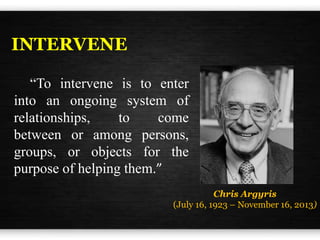
“To intervene is to enter
into an ongoing system of
relationships, to come
between or among persons,
groups, or objects for the
purpose of helping them.”
Chris Argyris
(July 16, 1923 – November 16, 2013)
INTERVENTION
Interventions are sets of structured activities
in which selected organizational units engage in a
series of tasks which will lead to organizational
improvement.
The intervention is the procedure the OD
consultant uses, after diagnosing an organizational
situation and providing feedback to management,
to address an organization problem or positive
future.
CRITERIA FOR
EFFECTIVE INTERVENTIONS
1. The Extent to Which it (the Intervention)
fits the needs of the organization.
2. The degree to which it is based on causal
knowledge of intended outcomes.
3. The extent to which the OD intervention
transfers change-management competence to
organization members.
2 Factors that Impact the Success of
OD Interventions
1. Factors relating to Change Situation
These relate to the environment of the
organization and include the physical and human
environment.
A. Readiness for Change
B. Capability to Change
C. Cultural Context
D. Capabilities of the
Change Agent
2. Factors Related to the Target of Change
2 Factors that Impact the Success of
OD Interventions
These relate to the specific targets at which OD
interventions are targeted. The targets of change can
be different issues of the organization and at
different levels.
A. Organizational Issues
B. Organizational Levels
A. Organizational Issues
1. Strategic Issues
2. Technology and Structure Issues
3. Human Resource Issues
4. Human Process Issues
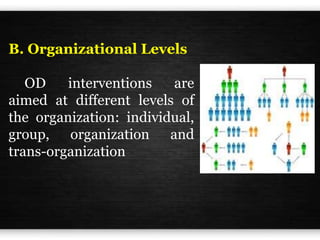
B. Organizational Levels
OD interventions are
aimed at different levels of
the organization: individual,
group, organization and
trans-organization
TEAM
INTERVENTIONS
Alex B. Hermogeno
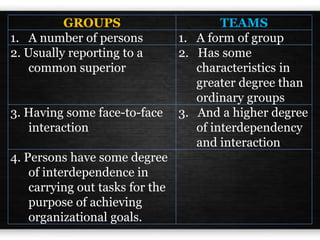
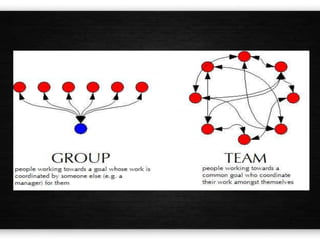
GROUPS TEAMS
1. A number of persons 1. A form of group
2. Usually reporting to a
common superior
2. Has some
characteristics in
greater degree than
ordinary groups
3. Having some face-to-face
interaction
3. And a higher degree
of interdependency
and interaction
4. Persons have some degree
of interdependence in
carrying out tasks for the
purpose of achieving
organizational goals.
TEAM INTERVENTION
The purpose of this team is to help
employees/members of the team that are
struggling in some way.
This usually refers to
performance but can include
emotional / behavioral / social
concerns.
DIFFERENT TYPES OF TEAMS
1. Cross-Functional Teams
Comprised of individuals with functional home
base but they meet regularly to solve ongoing
challenges requiring input from a number of
functional areas
2. Effective Teams
Effective teams are relaxed, comfortable and
informal.
3. High Performance Teams
Have strong personal commitment to each other
commitment to other’s growth and success.
DIFFERENT TYPES OF
TEAM INTERVENTION
These activities focus on task issues such
as the way things are done, the skills and
resources needed to accomplish tasks, the
quality of relationship among the team
members or between members and the leader,
and how well the team gets its job done.
TEAM BUILDING
Interventions focus on:
1. Formal Groups
2. Special Groups
4 MAIN AREAS OF
TEAM INTERVENTION
1. Diagnosis
2. Task Accomplishments
3. Team Relationships
4. Team and Organization Processes
Its purpose is to conduct a general critique of the
performance of the group and to uncover and identify
problems on which they will work on.
THE FORMAL GROUP DIAGNOSTIC MEETING
“Where we are going” and “how we are going.”
After sharing the data throughout the group, next
steps are: discussing the issues, grouping the issues in
terms of themes, and getting a preliminary look at the
next action steps.
Primary emphasis is on processes such as
communications, leader and member roles in
groups, problem solving and decision making,
group norms and group growth, leadership and
authority, and intergroup cooperation and
competition.
PROCESS CONSULTATION
INTERVENTIONS
It places greater emphasis on diagnosing and
understanding process events
STEPS IN TEAM INTERVENTION
Step 1 - Identify At-Risk Population
It must be determined which members are “at-risk”.
The lowest 10% in each level will be the target group.
Step 2 - Initial Intervention Team Meeting
Review data with all personnel in attendance.
Brainstorm interventions. Other interventions may
have been agreed upon during the initial Intervention Team
meeting.
Step 3 - Interventions Begin
Step 4 - Second Intervention Team Meeting
Step 5 - Request for Further Testing
1. Clarify Direction
2. Inspiring Performance
3. Building Relationships and Trust
4. Conflict Management
5. Relating to the External World
TEAM INTERVENTIONS
INTER-GROUP
AND THIRD PARTY
INTERVENTIONS
Cherry Andrea G. Lucero
• The focus of this is on improving
intergroup relations.
• OD methods provide ways of
increasing intergroup co-operation and
communication.
• Blake, Shepherd and Mouton have
developed activities applicable to
stressed situations in the forms of steps.
THIRD PARTY PEACE
MAKING
Intermediaries (or third
parties) are people,
organizations, or nations
who enter a conflict to try to
help the parties de-escalate
or resolve it.
WALTON’S APPROACH TO
THIRD PARTY PEACEMAKING
Walton has presented a statement of
theory and practice for third-party
peacemaking interventions that is
important in its own right and important
in its own right and important for its role
in organization development.
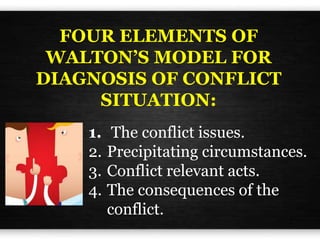
FOUR ELEMENTS OF
WALTON’S MODEL FOR
DIAGNOSIS OF CONFLICT
SITUATION:
1. The conflict issues.
2. Precipitating circumstances.
3. Conflict relevant acts.
4. The consequences of the
conflict.
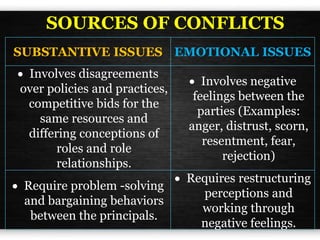
SOURCES OF CONFLICTS
SUBSTANTIVE ISSUES EMOTIONAL ISSUES
 Involves disagreements
over policies and practices,
competitive bids for the
same resources and
differing conceptions of
roles and role
relationships.
 Involves negative
feelings between the
parties (Examples:
anger, distrust, scorn,
resentment, fear,
rejection)
 Require problem -solving
and bargaining behaviors
between the principals.
 Requires restructuring
perceptions and
working through
negative feelings.
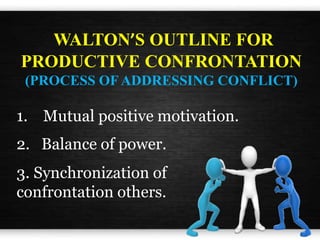
WALTON’S OUTLINE FOR
PRODUCTIVE CONFRONTATION
(PROCESS OF ADDRESSING CONFLICT)
1. Mutual positive motivation.
2. Balance of power.
3. Synchronization of
confrontation others.
4. Differentiation and integration of
different phases of the intervention must
be well paced.
5. Conditions that promote openness
should be created.
6. Reliable communicative signals.
7. Optimum tension in the situation.
ORGANIZATION MIRROR
INTERVENTION
• It is a technique designed
to work unites feedback in
how other elements of
organization view them.
• Set of activities in which host group
receives feedback about how it is
perceived and regarded from reps across
organization.
PARTNERING
• Used in situations where two or more
entities are likely to incur unnecessary
and/or cost overruns.
• A variation of team
building and strategic
planning
COMPREHENSIVE
OD INTERVENTIONS
Junior Hilario
These are the interventions
that are comprehensive in
the terms of the extent to
which total organization is
involved and/or the depth
of cultural change
addressed.
COMPREHENSIVE
OD INTERVENTIONS
GETTING THE WHOLE SYSTEM
IN THE ROOM
Getting all the key actors of a
complex organization or
system together in a team
building for future planning
kind of session.
BECKHARDS
CONFRONTATION MEETING
The confrontation meeting is developed
by Richard Beckhard, is one day meeting of
the entire management
of an organization, in
which they take a
reading of their own
organizational health.
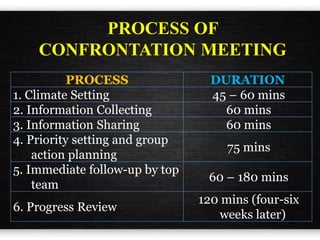
PROCESS OF
CONFRONTATION MEETING
PROCESS DURATION
1. Climate Setting 45 – 60 mins
2. Information Collecting 60 mins
3. Information Sharing 60 mins
4. Priority setting and group
action planning
75 mins
5. Immediate follow-up by top
team
60 – 180 mins
6. Progress Review
120 mins (four-six
weeks later)
STRATEGIC MANAGEMENT
ACTIVITIES
The concept is described by Schendel and
Hofers It is defined as the development and
implementation of the organization’s grand
design or overall strategy for relating to its
current and future environmental demands.
6 MAJOR TASKS OF
STRATEGIC MGT ACTIVITIES
1. Goal Formulation- Defining Mission &
purpose
2. Environmental analysis- SWOT Analysis
3. Strategy formulation
4. Strategy evaluation
5. Strategy implementation
6. Strategic control
STREAM ANALYSIS
• Developed by Jerry Porras is a valuable
model for thinking about change and for
managing change.
• Displaying the problems of an
organization, examining the interconnections
between the problems, identifying core
problems and graphically tracking the
corrective actions taken to solve the
problems.
STEPS OF STREAM ANALYSIS
1. Categorizing the important features of
organizational work setting in to four
streams.
a. Organizational arrangements
b. Social factors
c. Technology
d. Physical Setting
2. Diagnosing the problems and barriers to
effectiveness
3. Classifying the problems into four streams.
4. Identifying the core
problems by noting the
interconnections
between the problems.
STEPS OF STREAM ANALYSIS
SURVEY FEEDBACK
It’s a process of systematically collecting data
about the system and feeding back the data for
individuals and groups at all levels of the
organization to analyze, interpret meanings and
design corrective action
steps.
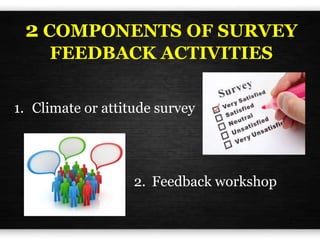
2 COMPONENTS OF SURVEY
FEEDBACK ACTIVITIES
1. Climate or attitude survey
2. Feedback workshop
GRID ORGANIZATONAL
DEVELOPMENT
• It’s a six phase program lasting about
three to five years, an organization can move
systematically from the stage of examining
managerial behavior and style to the
development and implementation of an ideal
strategic corporate model.
• It enables individuals and groups to assess
their own strengths and weaknesses.
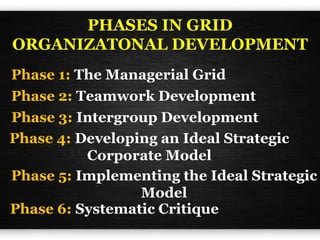
PHASES IN GRID
ORGANIZATONAL DEVELOPMENT
Phase 1: The Managerial Grid
Phase 2: Teamwork Development
Phase 3: Intergroup Development
Phase 5: Implementing the Ideal Strategic
Model
Phase 4: Developing an Ideal Strategic
Corporate Model
Phase 6: Systematic Critique
STRUCTURAL
INTERVENTION
Nacer Ferreras
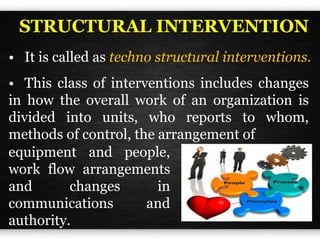
• This class of interventions includes changes
in how the overall work of an organization is
divided into units, who reports to whom,
methods of control, the arrangement of
• It is called as techno structural interventions.
equipment and people,
work flow arrangements
and changes in
communications and
authority.
STRUCTURAL INTERVENTION
6 TYPES OF
STRUCTURAL INTERVENTION
1. Structural Design
is largely associated with
experiments attempted to
create better fit among the
technology, structure and
social interactions of a
particular production unit.
PREMISES OF
SOCIOTECHNICAL SYSTEM
1. Effective work system must jointly optimize
the relationship between their social and
technical parts.
2. Such system must effectively manage the
boundary separating and relating them to the
environment.
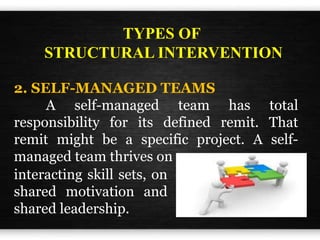
2. SELF-MANAGED TEAMS
A self-managed team has total
responsibility for its defined remit. That
remit might be a specific project. A self-
managed team thrives on
TYPES OF
STRUCTURAL INTERVENTION
interacting skill sets, on
shared motivation and
shared leadership.
3. WORK REDESIGN
Hackman and Oldham – theoretical model
of what job characteristics lead to the
psychological states that produce what they call
“HIGH INTERNAL WORK MOTIVATION”
FIVE CORE JOB CHARACTERISTICS
1. Skill Variety
2. Task Identity
3. Task Significance
4. Autonomy
5. Feedback from Job
4. QUALITY OF WORK LIFE (QWL)
An attempt to restructure multiple
dimensions of the organization and to
institute a mechanism, which introduces and
sustains changes over time.
QWL FEATURES
1. Voluntary involvement on the part of employees
2. Union agreement with process and participation.
3. Assurance of no loss of job
4. Training for team problem solving
5. Use of quality circles
6. Participation in forecasting, work planning
7. Regular plant and team meetings.
8. Encouragement for skill development.
9. Job rotations.
5. REENGINEERING
The fundamental rethinking
and radical redesign of
business processes to achieve
dramatic improvements in
critical, contemporary
measures of performance,
such as cost, quality, service,
and speed.
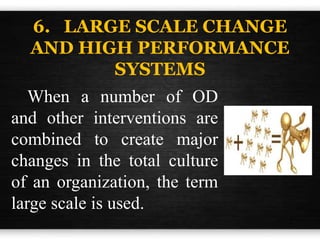
6. LARGE SCALE CHANGE
AND HIGH PERFORMANCE
SYSTEMS
When a number of OD
and other interventions are
combined to create major
changes in the total culture
of an organization, the term
large scale is used.
Thank you
for listening!
TEAM INTERVENTION
Cherry Andrea G. Lucero
Organizational Development
Interventions
COMPREHENSIVE OD INTERVENTIONS
Junior Hilario
STRUCTURAL INTERVENTION
Nacer Ferreras
INTER-GROUP AND THIRD PARTY INTERVENTIONS
Alex B. Hermogeno
MPA 1A - Camarin
Debbie Nell G. Geronimo
OD INTERVENTION & ITS CONCEPTS

Organizational development interventions

  • 1.
  • 2.
    Debbie Nell G.Geronimo OD INTERVENTIONS
  • 3.
    INTERVENE “To intervene isto enter into an ongoing system of relationships, to come between or among persons, groups, or objects for the purpose of helping them.” Chris Argyris (July 16, 1923 – November 16, 2013)
  • 4.
    INTERVENTION Interventions are setsof structured activities in which selected organizational units engage in a series of tasks which will lead to organizational improvement. The intervention is the procedure the OD consultant uses, after diagnosing an organizational situation and providing feedback to management, to address an organization problem or positive future.
  • 5.
    CRITERIA FOR EFFECTIVE INTERVENTIONS 1.The Extent to Which it (the Intervention) fits the needs of the organization. 2. The degree to which it is based on causal knowledge of intended outcomes. 3. The extent to which the OD intervention transfers change-management competence to organization members.
  • 6.
    2 Factors thatImpact the Success of OD Interventions 1. Factors relating to Change Situation These relate to the environment of the organization and include the physical and human environment. A. Readiness for Change B. Capability to Change C. Cultural Context D. Capabilities of the Change Agent
  • 7.
    2. Factors Relatedto the Target of Change 2 Factors that Impact the Success of OD Interventions These relate to the specific targets at which OD interventions are targeted. The targets of change can be different issues of the organization and at different levels. A. Organizational Issues B. Organizational Levels
  • 8.
    A. Organizational Issues 1.Strategic Issues 2. Technology and Structure Issues 3. Human Resource Issues 4. Human Process Issues
  • 9.
    B. Organizational Levels ODinterventions are aimed at different levels of the organization: individual, group, organization and trans-organization
  • 10.
  • 11.
    GROUPS TEAMS 1. Anumber of persons 1. A form of group 2. Usually reporting to a common superior 2. Has some characteristics in greater degree than ordinary groups 3. Having some face-to-face interaction 3. And a higher degree of interdependency and interaction 4. Persons have some degree of interdependence in carrying out tasks for the purpose of achieving organizational goals.
  • 13.
    TEAM INTERVENTION The purposeof this team is to help employees/members of the team that are struggling in some way. This usually refers to performance but can include emotional / behavioral / social concerns.
  • 14.
    DIFFERENT TYPES OFTEAMS 1. Cross-Functional Teams Comprised of individuals with functional home base but they meet regularly to solve ongoing challenges requiring input from a number of functional areas 2. Effective Teams Effective teams are relaxed, comfortable and informal. 3. High Performance Teams Have strong personal commitment to each other commitment to other’s growth and success.
  • 15.
  • 16.
    These activities focuson task issues such as the way things are done, the skills and resources needed to accomplish tasks, the quality of relationship among the team members or between members and the leader, and how well the team gets its job done. TEAM BUILDING Interventions focus on: 1. Formal Groups 2. Special Groups
  • 17.
    4 MAIN AREASOF TEAM INTERVENTION 1. Diagnosis 2. Task Accomplishments 3. Team Relationships 4. Team and Organization Processes
  • 18.
    Its purpose isto conduct a general critique of the performance of the group and to uncover and identify problems on which they will work on. THE FORMAL GROUP DIAGNOSTIC MEETING “Where we are going” and “how we are going.” After sharing the data throughout the group, next steps are: discussing the issues, grouping the issues in terms of themes, and getting a preliminary look at the next action steps.
  • 19.
    Primary emphasis ison processes such as communications, leader and member roles in groups, problem solving and decision making, group norms and group growth, leadership and authority, and intergroup cooperation and competition. PROCESS CONSULTATION INTERVENTIONS It places greater emphasis on diagnosing and understanding process events
  • 20.
    STEPS IN TEAMINTERVENTION Step 1 - Identify At-Risk Population It must be determined which members are “at-risk”. The lowest 10% in each level will be the target group. Step 2 - Initial Intervention Team Meeting Review data with all personnel in attendance. Brainstorm interventions. Other interventions may have been agreed upon during the initial Intervention Team meeting. Step 3 - Interventions Begin Step 4 - Second Intervention Team Meeting Step 5 - Request for Further Testing
  • 21.
    1. Clarify Direction 2.Inspiring Performance 3. Building Relationships and Trust 4. Conflict Management 5. Relating to the External World TEAM INTERVENTIONS
  • 22.
  • 23.
    • The focusof this is on improving intergroup relations. • OD methods provide ways of increasing intergroup co-operation and communication. • Blake, Shepherd and Mouton have developed activities applicable to stressed situations in the forms of steps.
  • 24.
    THIRD PARTY PEACE MAKING Intermediaries(or third parties) are people, organizations, or nations who enter a conflict to try to help the parties de-escalate or resolve it.
  • 25.
    WALTON’S APPROACH TO THIRDPARTY PEACEMAKING Walton has presented a statement of theory and practice for third-party peacemaking interventions that is important in its own right and important in its own right and important for its role in organization development.
  • 26.
    FOUR ELEMENTS OF WALTON’SMODEL FOR DIAGNOSIS OF CONFLICT SITUATION: 1. The conflict issues. 2. Precipitating circumstances. 3. Conflict relevant acts. 4. The consequences of the conflict.
  • 27.
    SOURCES OF CONFLICTS SUBSTANTIVEISSUES EMOTIONAL ISSUES  Involves disagreements over policies and practices, competitive bids for the same resources and differing conceptions of roles and role relationships.  Involves negative feelings between the parties (Examples: anger, distrust, scorn, resentment, fear, rejection)  Require problem -solving and bargaining behaviors between the principals.  Requires restructuring perceptions and working through negative feelings.
  • 28.
    WALTON’S OUTLINE FOR PRODUCTIVECONFRONTATION (PROCESS OF ADDRESSING CONFLICT) 1. Mutual positive motivation. 2. Balance of power. 3. Synchronization of confrontation others.
  • 29.
    4. Differentiation andintegration of different phases of the intervention must be well paced. 5. Conditions that promote openness should be created. 6. Reliable communicative signals. 7. Optimum tension in the situation.
  • 30.
    ORGANIZATION MIRROR INTERVENTION • Itis a technique designed to work unites feedback in how other elements of organization view them. • Set of activities in which host group receives feedback about how it is perceived and regarded from reps across organization.
  • 31.
    PARTNERING • Used insituations where two or more entities are likely to incur unnecessary and/or cost overruns. • A variation of team building and strategic planning
  • 32.
  • 33.
    These are theinterventions that are comprehensive in the terms of the extent to which total organization is involved and/or the depth of cultural change addressed. COMPREHENSIVE OD INTERVENTIONS
  • 34.
    GETTING THE WHOLESYSTEM IN THE ROOM Getting all the key actors of a complex organization or system together in a team building for future planning kind of session.
  • 35.
    BECKHARDS CONFRONTATION MEETING The confrontationmeeting is developed by Richard Beckhard, is one day meeting of the entire management of an organization, in which they take a reading of their own organizational health.
  • 36.
    PROCESS OF CONFRONTATION MEETING PROCESSDURATION 1. Climate Setting 45 – 60 mins 2. Information Collecting 60 mins 3. Information Sharing 60 mins 4. Priority setting and group action planning 75 mins 5. Immediate follow-up by top team 60 – 180 mins 6. Progress Review 120 mins (four-six weeks later)
  • 37.
    STRATEGIC MANAGEMENT ACTIVITIES The conceptis described by Schendel and Hofers It is defined as the development and implementation of the organization’s grand design or overall strategy for relating to its current and future environmental demands.
  • 38.
    6 MAJOR TASKSOF STRATEGIC MGT ACTIVITIES 1. Goal Formulation- Defining Mission & purpose 2. Environmental analysis- SWOT Analysis 3. Strategy formulation 4. Strategy evaluation 5. Strategy implementation 6. Strategic control
  • 39.
    STREAM ANALYSIS • Developedby Jerry Porras is a valuable model for thinking about change and for managing change. • Displaying the problems of an organization, examining the interconnections between the problems, identifying core problems and graphically tracking the corrective actions taken to solve the problems.
  • 40.
    STEPS OF STREAMANALYSIS 1. Categorizing the important features of organizational work setting in to four streams. a. Organizational arrangements b. Social factors c. Technology d. Physical Setting
  • 41.
    2. Diagnosing theproblems and barriers to effectiveness 3. Classifying the problems into four streams. 4. Identifying the core problems by noting the interconnections between the problems. STEPS OF STREAM ANALYSIS
  • 42.
    SURVEY FEEDBACK It’s aprocess of systematically collecting data about the system and feeding back the data for individuals and groups at all levels of the organization to analyze, interpret meanings and design corrective action steps.
  • 43.
    2 COMPONENTS OFSURVEY FEEDBACK ACTIVITIES 1. Climate or attitude survey 2. Feedback workshop
  • 44.
    GRID ORGANIZATONAL DEVELOPMENT • It’sa six phase program lasting about three to five years, an organization can move systematically from the stage of examining managerial behavior and style to the development and implementation of an ideal strategic corporate model. • It enables individuals and groups to assess their own strengths and weaknesses.
  • 45.
    PHASES IN GRID ORGANIZATONALDEVELOPMENT Phase 1: The Managerial Grid Phase 2: Teamwork Development Phase 3: Intergroup Development Phase 5: Implementing the Ideal Strategic Model Phase 4: Developing an Ideal Strategic Corporate Model Phase 6: Systematic Critique
  • 46.
  • 47.
    • This classof interventions includes changes in how the overall work of an organization is divided into units, who reports to whom, methods of control, the arrangement of • It is called as techno structural interventions. equipment and people, work flow arrangements and changes in communications and authority. STRUCTURAL INTERVENTION
  • 48.
    6 TYPES OF STRUCTURALINTERVENTION 1. Structural Design is largely associated with experiments attempted to create better fit among the technology, structure and social interactions of a particular production unit.
  • 49.
    PREMISES OF SOCIOTECHNICAL SYSTEM 1.Effective work system must jointly optimize the relationship between their social and technical parts. 2. Such system must effectively manage the boundary separating and relating them to the environment.
  • 50.
    2. SELF-MANAGED TEAMS Aself-managed team has total responsibility for its defined remit. That remit might be a specific project. A self- managed team thrives on TYPES OF STRUCTURAL INTERVENTION interacting skill sets, on shared motivation and shared leadership.
  • 51.
    3. WORK REDESIGN Hackmanand Oldham – theoretical model of what job characteristics lead to the psychological states that produce what they call “HIGH INTERNAL WORK MOTIVATION” FIVE CORE JOB CHARACTERISTICS 1. Skill Variety 2. Task Identity 3. Task Significance 4. Autonomy 5. Feedback from Job
  • 52.
    4. QUALITY OFWORK LIFE (QWL) An attempt to restructure multiple dimensions of the organization and to institute a mechanism, which introduces and sustains changes over time.
  • 53.
    QWL FEATURES 1. Voluntaryinvolvement on the part of employees 2. Union agreement with process and participation. 3. Assurance of no loss of job 4. Training for team problem solving 5. Use of quality circles 6. Participation in forecasting, work planning 7. Regular plant and team meetings. 8. Encouragement for skill development. 9. Job rotations.
  • 54.
    5. REENGINEERING The fundamentalrethinking and radical redesign of business processes to achieve dramatic improvements in critical, contemporary measures of performance, such as cost, quality, service, and speed.
  • 55.
    6. LARGE SCALECHANGE AND HIGH PERFORMANCE SYSTEMS When a number of OD and other interventions are combined to create major changes in the total culture of an organization, the term large scale is used.
  • 56.
  • 57.
    TEAM INTERVENTION Cherry AndreaG. Lucero Organizational Development Interventions COMPREHENSIVE OD INTERVENTIONS Junior Hilario STRUCTURAL INTERVENTION Nacer Ferreras INTER-GROUP AND THIRD PARTY INTERVENTIONS Alex B. Hermogeno MPA 1A - Camarin Debbie Nell G. Geronimo OD INTERVENTION & ITS CONCEPTS