PRESENTED BY:
Palak Pandoh
What is a Team?
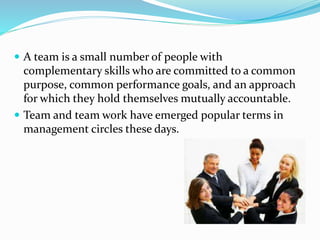
 A team is a small number of people with
complementary skills who are committed to a common
purpose, common performance goals, and an approach
for which they hold themselves mutually accountable.
 Team and team work have emerged popular terms in
management circles these days.
 A team includes few people, same as a small group,
because the interaction and influence processes, vital
for a team to function, can only occur when the
number of members is small.
 When more peoples are involved there will be a
difficulty in interacting and influencing each other.
 Basically team includes people with mix of skills
appropriate to the task to be done. Team members
need :
Technical
Problem solving
Decision making
Inter-personal skills
However, as the team grows, develops and matures,
team members will come to have more of the necessary
skills.
Following are the distinct features
of team
 They are empowered to share various management
and leadership functions.
 They plan, control and improve their own work
process.
 They set their own goals and inspect their own work.
 They often create their own schedules and review their
performance as a group.
 They, and not others outside the team, take
responsibility for the quality of their products or
services.
In Team:
 The performance however depends on both individual
contributions and collective efforts of team members
working in concert.
 Members work together to produce an outcome that
represents their joint contributions and each team member
shares responsibility for that outcome.
 Team members share a common commitment to purpose.
 Teams are free to set their own goals, timing and the
approach they wish to adopt without interference from
management.
 The teams are self-managing and are autonomous.
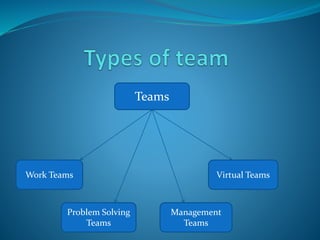
Teams
Work Teams
Problem Solving
Teams
Management
Teams
Virtual Teams
1. Work Teams = These are primarily concerned with the
work done by the organisation, such as developing and
manufacturing new products, providing services for
customers, etc. Their principle focus is on using the
organization resources effectively.
2. Problem solving teams – These are temporary teams
established to attack specific problems in the work place.
After solving the problems the team is usually disbanded,
allowing members to return to their normal work. These
teams are often cross-functional.
3. Management teams – These consist of managers from
various areas and co-ordinate work teams. They are
relatively permanent. Management teams must
concentrate on the teams that have the most impact on
overall corporate performance. The primary job of
management teams is to coach and counsel other teams to
be self managing by making decision within the teams.
4. Virtual teams – These are the teams that may never
actually meet together in the same room –their activities
takes place on the computer via teleconferencing & other
electronic information system. Engineers in the US, for eg:
can contact audibly and visually with counterparts all
around the globe , sharing files via internet, electronic
mail, and other communication networks; all participants
can look at the same drawing print, or specifications.
REFERENCES
 Organizational Behavior by K. Aswathappa 10th
edition.
 www.wikipedia.com

Team & their Types

  • 1.
  • 2.
    What is aTeam?
  • 3.
     A teamis a small number of people with complementary skills who are committed to a common purpose, common performance goals, and an approach for which they hold themselves mutually accountable.  Team and team work have emerged popular terms in management circles these days.
  • 4.
     A teamincludes few people, same as a small group, because the interaction and influence processes, vital for a team to function, can only occur when the number of members is small.  When more peoples are involved there will be a difficulty in interacting and influencing each other.
  • 5.
     Basically teamincludes people with mix of skills appropriate to the task to be done. Team members need : Technical Problem solving Decision making Inter-personal skills However, as the team grows, develops and matures, team members will come to have more of the necessary skills.
  • 6.
    Following are thedistinct features of team  They are empowered to share various management and leadership functions.  They plan, control and improve their own work process.  They set their own goals and inspect their own work.  They often create their own schedules and review their performance as a group.  They, and not others outside the team, take responsibility for the quality of their products or services.
  • 7.
    In Team:  Theperformance however depends on both individual contributions and collective efforts of team members working in concert.  Members work together to produce an outcome that represents their joint contributions and each team member shares responsibility for that outcome.  Team members share a common commitment to purpose.  Teams are free to set their own goals, timing and the approach they wish to adopt without interference from management.  The teams are self-managing and are autonomous.
  • 8.
  • 9.
    1. Work Teams= These are primarily concerned with the work done by the organisation, such as developing and manufacturing new products, providing services for customers, etc. Their principle focus is on using the organization resources effectively. 2. Problem solving teams – These are temporary teams established to attack specific problems in the work place. After solving the problems the team is usually disbanded, allowing members to return to their normal work. These teams are often cross-functional.
  • 10.
    3. Management teams– These consist of managers from various areas and co-ordinate work teams. They are relatively permanent. Management teams must concentrate on the teams that have the most impact on overall corporate performance. The primary job of management teams is to coach and counsel other teams to be self managing by making decision within the teams. 4. Virtual teams – These are the teams that may never actually meet together in the same room –their activities takes place on the computer via teleconferencing & other electronic information system. Engineers in the US, for eg: can contact audibly and visually with counterparts all around the globe , sharing files via internet, electronic mail, and other communication networks; all participants can look at the same drawing print, or specifications.
  • 11.
    REFERENCES  Organizational Behaviorby K. Aswathappa 10th edition.  www.wikipedia.com