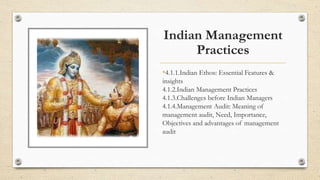
Indian Management
Practices
•4.1.1.Indian Ethos: Essential Features &
insights
4.1.2.Indian Management Practices
4.1.3.Challenges before Indian Managers
4.1.4.Management Audit: Meaning of
management audit, Need, Importance,
Objectives and advantages of management
audit
Meaning
• Ethos is a set of beliefs, ideas, etc., about social
behaviour and relationship of a person or
group.
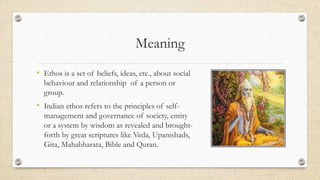
• Indian ethos refers to the principles of self-
management and governance of society, entity
or a system by wisdom as revealed and brought-
forth by great scriptures like Veda, Upanishads,
Gita, Mahabharata, Bible and Quran.
Ethos
According to Oxford
Advanced Learner’s
Dictionary, “Ethos are
the moral ideas and
attitudes that belong to a
particular group or society
Ethos is a discipline that
examines one’s morality or
the moral standard of the
society.
FEATURES
1. Divinity of Human Being: Indian ethos focuses on the existence of human being as truth.
There is nothing more perfect than the supreme soul.
2. Balance or Equilibrium: Balance or equilibrium is a stable state of Indian thought, i.e.,
balance between desire and desirelessness, spiritual and secular values, subjective and materialistic
world.
3. Balance of Personal and Work Life: Indian ethos focuses on the concept that if you are good
then the world is also good for you. So, every individual should have an effective management and
balance of personal and work life in the organisation.
FEATURES
4. Cosmic or Pure Consciousness: The divine element, which is an inner part of an individual,
is a part of cosmic or pure consciousness. It gives a base for mutual trust, cooperative, teamwork
and common good.
5. Importance to Character: The Indian ethos gives much importance to character not to the
knowledge. It is the character, which is the real power and wealth.
6. Whole-Man Approach: Indian ethos is based on Indian scripture like-Shruties of Gita and
Upanishad and Smruties of Puranas. Indian thought provides the whole-man approach through
knowledge of creation, cosmos and internal relation between spiritual and materialistic life.
FEATURES
7. Work in Worship: Indian ethos works with the fact that all work is worthy and honourable. ‘Work
is worship’ is the guiding principle for all effort as advocated in the Indian ethos.
8. Duty and Responsibility: Indian ethos rarely talks of rights and prevails ages. It always emphasises
only on the duties and responsibilities of human beings.
9. Knowledge: Indian ethos deals with two types of knowledge:
1. Knowledge of creation 2. Knowledge of creator
10. Excellence at Work: According to Indian ethos, total quality management can be assured through
excellence at work, through self-motivation and self-development.
Indian Ethos in Management (IEM)
• The body knowledge which derives its solution from the rich and huge Indian
system of ethos is known as Indian Ethos in Management (IEM). It helps a
manager look at the perceived problem situation in a creative manner.
• The silent ideas and thoughts of Indian Ethos in Management revealed by
Indian’s ancient scriptures are:
1. आत्मनो मोक्षार्थं जगद्हिताय च
Atmano Mokshartham Jagat Hitaya Cha : All work is an opportunity for
doing well to the world and thus gaining materially and spiritually in our lives.
2. आर्चेत दाना मानभयं
Archet Dana Manabhyam : Worship people not only with material things but
also by showing respect to their enterprising divinity within.
3. आत्मना विन्द्यते िीयााम
Atmana Vindyate Viryam: Strength and inspiration for excelling in work
comes from the Divine, God within, through prayer, spiritual reading and
unselfish work.
4. योगः कममशु कौशलम , समत्वाम योग उच्यते
Yogah Karmashu Kaushalam, Samatvam Yoga Uchyate : He who works
with calm and even mind achieves the most.
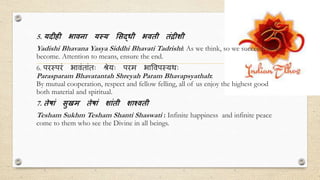
5. यदीही भािना यस्य सि्धी भिती तंद्रीशी
Yadishi Bhavana Yasya Siddhi Bhavati Tadrishi: As we think, so we succeed, so we
become. Attention to means, ensure the end.
6. परस्परं भावंतांतः श्रेयः परम भाववपस्यर्थः
Parasparam Bhavatantah Shreyah Param Bhavapsyathah:
By mutual cooperation, respect and fellow felling, all of us enjoy the highest good
both material and spiritual.
7. तेषां िुखम तेषां शांती शाश्िती
Tesham Sukhm Tesham Shanti Shaswati : Infinite happiness and infinite peace
come to them who see the Divine in all beings.
8. परस्पर देिो भि
Paraspar Devo Bhava: Regard the other person as a divine being. All of us
have the same consciousness though our packages and containers are different.
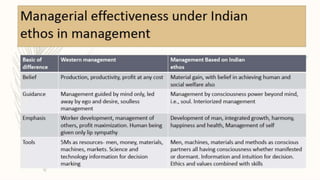
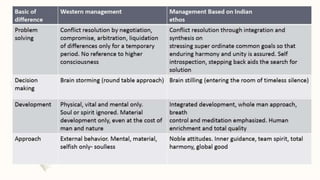
Indian Ethos For Management
• It means application of principles of management revealed in our ancient
wisdom described in Upanishades and Gita. The following basic principles
of management are as per ancient Indian Wisdom and Insight :
• Each Soul is a Potential God
• Holistic Approach
• Equal Importance to Subjectivity/Objectivity
• Karma Yoga (selfless work)
• Yogah Karmasu Kaushalam
• Co – operation
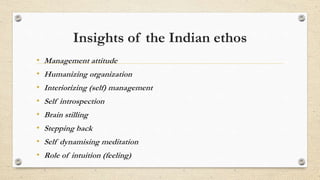
Insights of the Indian ethos
• Management attitude
• Humanizing organization
• Interiorizing (self) management
• Self introspection
• Brain stilling
• Stepping back
• Self dynamising meditation
• Role of intuition (feeling)
ROLE OF
INDIAN
ETHOS IN
MANAGERIAL
PRACTICES
1. Creates strong relation: Organizations
following Indian ethos consider humanity as
supreme. This provides a strong bond with internal
as well as external customers, resulting in an
improved performance.
2. Inward considerations: Indian ethos focuses
on ‘if a person is good then the whole world is
good’. Any organization which follows the above
ethical thought automatically get converted into an
ethical organization with less conflicts and
hindrances.
3. Avoids unethical aspects: As Indian ethos is a
principle derived from Upanishads, Bhagwat Gita
and Puranas, where the performance is always
ethical
ROLE OF
INDIAN
ETHOS IN
MANAGERIAL
PRACTICES
4. Balanced values: Indian ethos promotes a person
to live a life of materialism and spirituality by
maintaining a balance between spiritual values and
secular values.
5. Improves performance: Indian ethos impacts the
performance of business by emphasising on the
concept like sacrificing individual desires in favour of
social benefits, preferring long-term benefits.
6. Improves quality: Self-motivation and self-
development helps a lot in development of business
and its quality
7. Helps in problem solving
8. Develops self-reliability
Business
ethos
principles
practiced
by Indian
Companies
• 1. Principle of `sacrifice’
An individual is trained by the principle of `sacrifice’
through the process of `give and take’ policy. A person,
who is willing to sacrifice part of his bread or effort,
commands a superior place in the organization.
2. Principle of `harmony’
An individual is trained in such a way that to avoid
conflicts and friction one should be guided by certain set
of moral conducts and principles.
3. Principle of `non-violence’
This principle protects an organization from strikes and
lockouts and unnecessary avoidable conflicts
• 4. Principle of `reward’
The one who performs well are encouraged to do so. This
implies that the activities of individuals need to be
monitored and encouragement in the form of `rewards’
may cultivate the spirit of higher productivity among
groups.
5. Principle of `justice’
The one who works hard is `rewarded’ and the one who
fails to do so is `punished’. This is essence the principle of
Justice.
6. Principle of `taxation’
The one who is taxed more is encouraged to stay fit for a
longer period by proper appreciation and encouragement.
This principle applies to individuals who are hardworking
and productive.
7. Principle of `Integrity’
An integrated mind is more productive. Groups are
encouraged to stay united in order to reap the benefits of
division of labour.
Business
ethos
principles
practiced
by Indian
Companies
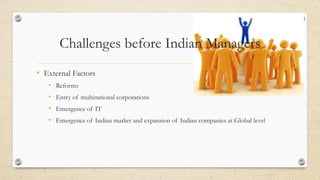
Challenges before Indian Managers
• External Factors
• Reforms
• Entry of multinational corporations
• Emergence of IT
• Emergence of Indian market and expansion of Indian companies at Global level
Challenges before Indian Managers
• Internal Factors
• Continuous learning
• Teaming and collaboration
• Global outlook
Innovation
Emphasis on productivity and efficiency
Managing diverse set of stake holders
Challenges before Indian Managers
• Enhanced requirement of global outlook & mobility
• Integration with global economy
• Acquisition overseas by Indian companies
• FDI in India
• Need of work and life balance
• Enhanced focus on developing and harnessing network
• Engagement with leadership
• Connecting with other talent in the company
Management Audit
• Management audit tries to search the answer of how well the management
has been operating the work of the organization?
• Is managerial style well suited for organizational operation?
• Management Audit focuses on Results, evaluating the effectiveness and
suitability of controls by challenging underlying rules, procedures and
methods
Management Audit
• It is a systematic examination of decisions and actions of the management to
analyze the performance. It involves the review of managerial aspects like –
organizational objective, policies, procedures, structure and control system in
order to check the efficiency or performance of the management over the
activities of the organization
Management Audit
• Management Audit is generally conducted by the employee of the
organization or by the independent consultant and focused on the critical
evaluation of management as a team rather than appraisal of individual.
• Unlike financial audit management audit mainly examine the non
financial data
Objectives of Management Audit
1. To identify the level of achievement of the main objectives of the organisation.
2. To identify the defects or irregularities of management executives.
3. To ensure that the management is going to achieve the objectives.
4. To help the management to do efficient administration of the operations.
5. To help the management executives in the effective discharge of their responsibilities.
6. To suggest to the management the ways and means available to achieve the objectives.
7. To improve the profitability of the organisation.
8. To obtain or utilise the full efficiency of the management.
9. To help the management executives in the effective discharge of their duties.
Need for management audit
• Management audit periodically assess the performance of various managers
and link incentives with such assessment.
• Government and foreign collaborators is interested in getting management
audit conducted to examine the efficiency of management
Importance of management audit
• 1. Management Audit sets the policies and objectives right in view of changing
environment, competitors’ strategies, changes in technology, consumers’ preferences etc.
• 2. It helps the management in improving its systems in view of developments or creations in
management principles, techniques and approaches.
• 3. It helps the management in improving its performance in execution of policies and in
utilising resources.
• 4. It sets the direction of objectives policies and business definition.
• 5. It provides scope to the business to interact openly with the environment and maxmises
the benefit of the environmental opportunities and controlling the effects of environmental
threats.
Advantages of management audit
1. It helps to identify the present and potential strength and weaknesses in
management. With this information, major improvements or rectification of
defects can be made.
2. It assists in establishing and reviewing the system of planning in an
organisation. Then, it allocates responsibility for planning.
3. It helps to improve the communication and control system. Effective
management information systems can be followed. Proper control system
ensures no deviations from standards.
Advantages of management audit
4. It reviews the decision-making-process and the quality of decision. It helps
the management to bring about more objectivity in decision-making.
5. It protects the interests of the organisation by continuous review of all
aspects of organisation and improving the performance.
6. It helps the management to ensure free flow of communication between the
responsibility centres.
• 7. It assists the management in identifying the opportunities through
innovations in the light of changes in the business world.
• 8. It helps the management to improve co-ordination and to evaluate the
control techniques.
• 9. It assists the management in pinpointing the inhibiting factors which affect
the profitability and the ways to remove them so that the profitability may
improve.
Advantages of management audit
• 10. It suggests to the management to bring about better efficiency and
overall improvement.
• 11. Human resource is crucial in every organisation. Management audit helps
the management to improve performance appraisal system and to develop
human resources.
• 12. It relieves the management of pressure. Thus, the management can
devote more attention to important and special matters.
Advantages of management audit
Indian ethos

Indian ethos

  • 1.
    Indian Management Practices •4.1.1.Indian Ethos:Essential Features & insights 4.1.2.Indian Management Practices 4.1.3.Challenges before Indian Managers 4.1.4.Management Audit: Meaning of management audit, Need, Importance, Objectives and advantages of management audit
  • 2.
    Meaning • Ethos isa set of beliefs, ideas, etc., about social behaviour and relationship of a person or group. • Indian ethos refers to the principles of self- management and governance of society, entity or a system by wisdom as revealed and brought- forth by great scriptures like Veda, Upanishads, Gita, Mahabharata, Bible and Quran.
  • 3.
    Ethos According to Oxford AdvancedLearner’s Dictionary, “Ethos are the moral ideas and attitudes that belong to a particular group or society Ethos is a discipline that examines one’s morality or the moral standard of the society.
  • 4.
    FEATURES 1. Divinity ofHuman Being: Indian ethos focuses on the existence of human being as truth. There is nothing more perfect than the supreme soul. 2. Balance or Equilibrium: Balance or equilibrium is a stable state of Indian thought, i.e., balance between desire and desirelessness, spiritual and secular values, subjective and materialistic world. 3. Balance of Personal and Work Life: Indian ethos focuses on the concept that if you are good then the world is also good for you. So, every individual should have an effective management and balance of personal and work life in the organisation.
  • 5.
    FEATURES 4. Cosmic orPure Consciousness: The divine element, which is an inner part of an individual, is a part of cosmic or pure consciousness. It gives a base for mutual trust, cooperative, teamwork and common good. 5. Importance to Character: The Indian ethos gives much importance to character not to the knowledge. It is the character, which is the real power and wealth. 6. Whole-Man Approach: Indian ethos is based on Indian scripture like-Shruties of Gita and Upanishad and Smruties of Puranas. Indian thought provides the whole-man approach through knowledge of creation, cosmos and internal relation between spiritual and materialistic life.
  • 6.
    FEATURES 7. Work inWorship: Indian ethos works with the fact that all work is worthy and honourable. ‘Work is worship’ is the guiding principle for all effort as advocated in the Indian ethos. 8. Duty and Responsibility: Indian ethos rarely talks of rights and prevails ages. It always emphasises only on the duties and responsibilities of human beings. 9. Knowledge: Indian ethos deals with two types of knowledge: 1. Knowledge of creation 2. Knowledge of creator 10. Excellence at Work: According to Indian ethos, total quality management can be assured through excellence at work, through self-motivation and self-development.
  • 7.
    Indian Ethos inManagement (IEM) • The body knowledge which derives its solution from the rich and huge Indian system of ethos is known as Indian Ethos in Management (IEM). It helps a manager look at the perceived problem situation in a creative manner. • The silent ideas and thoughts of Indian Ethos in Management revealed by Indian’s ancient scriptures are: 1. आत्मनो मोक्षार्थं जगद्हिताय च Atmano Mokshartham Jagat Hitaya Cha : All work is an opportunity for doing well to the world and thus gaining materially and spiritually in our lives.
  • 8.
    2. आर्चेत दानामानभयं Archet Dana Manabhyam : Worship people not only with material things but also by showing respect to their enterprising divinity within. 3. आत्मना विन्द्यते िीयााम Atmana Vindyate Viryam: Strength and inspiration for excelling in work comes from the Divine, God within, through prayer, spiritual reading and unselfish work. 4. योगः कममशु कौशलम , समत्वाम योग उच्यते Yogah Karmashu Kaushalam, Samatvam Yoga Uchyate : He who works with calm and even mind achieves the most.
  • 9.
    5. यदीही भािनायस्य सि्धी भिती तंद्रीशी Yadishi Bhavana Yasya Siddhi Bhavati Tadrishi: As we think, so we succeed, so we become. Attention to means, ensure the end. 6. परस्परं भावंतांतः श्रेयः परम भाववपस्यर्थः Parasparam Bhavatantah Shreyah Param Bhavapsyathah: By mutual cooperation, respect and fellow felling, all of us enjoy the highest good both material and spiritual. 7. तेषां िुखम तेषां शांती शाश्िती Tesham Sukhm Tesham Shanti Shaswati : Infinite happiness and infinite peace come to them who see the Divine in all beings.
  • 10.
    8. परस्पर देिोभि Paraspar Devo Bhava: Regard the other person as a divine being. All of us have the same consciousness though our packages and containers are different.
  • 11.
    Indian Ethos ForManagement • It means application of principles of management revealed in our ancient wisdom described in Upanishades and Gita. The following basic principles of management are as per ancient Indian Wisdom and Insight : • Each Soul is a Potential God • Holistic Approach • Equal Importance to Subjectivity/Objectivity • Karma Yoga (selfless work) • Yogah Karmasu Kaushalam • Co – operation
  • 12.
    Insights of theIndian ethos • Management attitude • Humanizing organization • Interiorizing (self) management • Self introspection • Brain stilling • Stepping back • Self dynamising meditation • Role of intuition (feeling)
  • 15.
    ROLE OF INDIAN ETHOS IN MANAGERIAL PRACTICES 1.Creates strong relation: Organizations following Indian ethos consider humanity as supreme. This provides a strong bond with internal as well as external customers, resulting in an improved performance. 2. Inward considerations: Indian ethos focuses on ‘if a person is good then the whole world is good’. Any organization which follows the above ethical thought automatically get converted into an ethical organization with less conflicts and hindrances. 3. Avoids unethical aspects: As Indian ethos is a principle derived from Upanishads, Bhagwat Gita and Puranas, where the performance is always ethical
  • 16.
    ROLE OF INDIAN ETHOS IN MANAGERIAL PRACTICES 4.Balanced values: Indian ethos promotes a person to live a life of materialism and spirituality by maintaining a balance between spiritual values and secular values. 5. Improves performance: Indian ethos impacts the performance of business by emphasising on the concept like sacrificing individual desires in favour of social benefits, preferring long-term benefits. 6. Improves quality: Self-motivation and self- development helps a lot in development of business and its quality 7. Helps in problem solving 8. Develops self-reliability
  • 17.
    Business ethos principles practiced by Indian Companies • 1.Principle of `sacrifice’ An individual is trained by the principle of `sacrifice’ through the process of `give and take’ policy. A person, who is willing to sacrifice part of his bread or effort, commands a superior place in the organization. 2. Principle of `harmony’ An individual is trained in such a way that to avoid conflicts and friction one should be guided by certain set of moral conducts and principles. 3. Principle of `non-violence’ This principle protects an organization from strikes and lockouts and unnecessary avoidable conflicts
  • 18.
    • 4. Principleof `reward’ The one who performs well are encouraged to do so. This implies that the activities of individuals need to be monitored and encouragement in the form of `rewards’ may cultivate the spirit of higher productivity among groups. 5. Principle of `justice’ The one who works hard is `rewarded’ and the one who fails to do so is `punished’. This is essence the principle of Justice. 6. Principle of `taxation’ The one who is taxed more is encouraged to stay fit for a longer period by proper appreciation and encouragement. This principle applies to individuals who are hardworking and productive. 7. Principle of `Integrity’ An integrated mind is more productive. Groups are encouraged to stay united in order to reap the benefits of division of labour. Business ethos principles practiced by Indian Companies
  • 19.
    Challenges before IndianManagers • External Factors • Reforms • Entry of multinational corporations • Emergence of IT • Emergence of Indian market and expansion of Indian companies at Global level
  • 20.
    Challenges before IndianManagers • Internal Factors • Continuous learning • Teaming and collaboration • Global outlook Innovation Emphasis on productivity and efficiency Managing diverse set of stake holders
  • 21.
    Challenges before IndianManagers • Enhanced requirement of global outlook & mobility • Integration with global economy • Acquisition overseas by Indian companies • FDI in India • Need of work and life balance • Enhanced focus on developing and harnessing network • Engagement with leadership • Connecting with other talent in the company
  • 22.
    Management Audit • Managementaudit tries to search the answer of how well the management has been operating the work of the organization? • Is managerial style well suited for organizational operation? • Management Audit focuses on Results, evaluating the effectiveness and suitability of controls by challenging underlying rules, procedures and methods
  • 23.
    Management Audit • Itis a systematic examination of decisions and actions of the management to analyze the performance. It involves the review of managerial aspects like – organizational objective, policies, procedures, structure and control system in order to check the efficiency or performance of the management over the activities of the organization
  • 24.
    Management Audit • ManagementAudit is generally conducted by the employee of the organization or by the independent consultant and focused on the critical evaluation of management as a team rather than appraisal of individual. • Unlike financial audit management audit mainly examine the non financial data
  • 25.
    Objectives of ManagementAudit 1. To identify the level of achievement of the main objectives of the organisation. 2. To identify the defects or irregularities of management executives. 3. To ensure that the management is going to achieve the objectives. 4. To help the management to do efficient administration of the operations. 5. To help the management executives in the effective discharge of their responsibilities. 6. To suggest to the management the ways and means available to achieve the objectives. 7. To improve the profitability of the organisation. 8. To obtain or utilise the full efficiency of the management. 9. To help the management executives in the effective discharge of their duties.
  • 26.
    Need for managementaudit • Management audit periodically assess the performance of various managers and link incentives with such assessment. • Government and foreign collaborators is interested in getting management audit conducted to examine the efficiency of management
  • 27.
    Importance of managementaudit • 1. Management Audit sets the policies and objectives right in view of changing environment, competitors’ strategies, changes in technology, consumers’ preferences etc. • 2. It helps the management in improving its systems in view of developments or creations in management principles, techniques and approaches. • 3. It helps the management in improving its performance in execution of policies and in utilising resources. • 4. It sets the direction of objectives policies and business definition. • 5. It provides scope to the business to interact openly with the environment and maxmises the benefit of the environmental opportunities and controlling the effects of environmental threats.
  • 28.
    Advantages of managementaudit 1. It helps to identify the present and potential strength and weaknesses in management. With this information, major improvements or rectification of defects can be made. 2. It assists in establishing and reviewing the system of planning in an organisation. Then, it allocates responsibility for planning. 3. It helps to improve the communication and control system. Effective management information systems can be followed. Proper control system ensures no deviations from standards.
  • 29.
    Advantages of managementaudit 4. It reviews the decision-making-process and the quality of decision. It helps the management to bring about more objectivity in decision-making. 5. It protects the interests of the organisation by continuous review of all aspects of organisation and improving the performance. 6. It helps the management to ensure free flow of communication between the responsibility centres.
  • 30.
    • 7. Itassists the management in identifying the opportunities through innovations in the light of changes in the business world. • 8. It helps the management to improve co-ordination and to evaluate the control techniques. • 9. It assists the management in pinpointing the inhibiting factors which affect the profitability and the ways to remove them so that the profitability may improve. Advantages of management audit
  • 31.
    • 10. Itsuggests to the management to bring about better efficiency and overall improvement. • 11. Human resource is crucial in every organisation. Management audit helps the management to improve performance appraisal system and to develop human resources. • 12. It relieves the management of pressure. Thus, the management can devote more attention to important and special matters. Advantages of management audit