GROUP
A group is defined as "a number of persons near, placed,
or classified together."
INTERGROUP RELATIONS
Intergroup relations between two or more groups and their
respective members are often necessary to complete the work
required to operate a business.
CONFLICTS
• Some conflict, called functional conflict, is considered
positive, because it enhances performance and identifies
weaknesses.
• Dysfunctional conflict, however, is confrontation or
interaction between groups that harms the organization or
hinders attainment of goals or objectives.
INTERGROUP CONFLICT
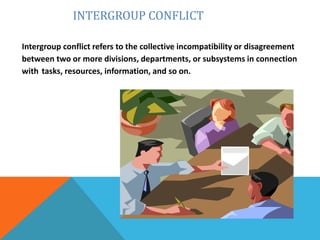
Intergroup conflict refers to the collective incompatibility or disagreement
between two or more divisions, departments, or subsystems in connection
with tasks, resources, information, and so on.
MANAGING INTERGROUP CONFLICT
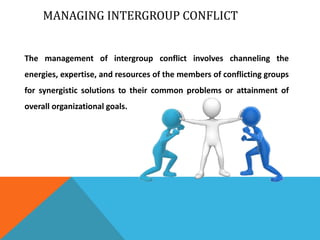
The management of intergroup conflict involves channeling the
energies, expertise, and resources of the members of conflicting groups
for synergistic solutions to their common problems or attainment of
overall organizational goals.
DIAGNOSIS
The diagnosis of intergroup conflict can be performed by means of interviews,
observation, company records, and the perceptions of the organizational
members.
MEASUREMENT
A comprehensive diagnosis of intergroup conflict should include the
measurement of the following:
1. The amount of conflict that exists between two specific groups.
2. The styles of handling conflict of the ingroup members with the
outgroup members.
3. The sources of intergroup conflict and the style of handling such
conflict.
4. Organizational learning and effectiveness
ORGANISATION STUDIED
State Bank of Pakistan
‫بینک‬‫دولت‬‫پاکستان‬ v
State Bank of Pakistan
Headquarters Karachi, Pakistan
Established 1948
Governor Ashraf Mahmood Wathra
Central bank of Pakistan
Currency Pakistani rupee
PKR (ISO 4217)
COMPANY OVERVIEW
The State Bank of Pakistan (SBP; Urdu: ‫پاکستان‬ ‫دولت‬ ‫)بینک‬ is
the central bank of Pakistan. While its constitution, as
originally laid down in the State Bank of Pakistan Order
1948, remained basically unchanged until January 1, 1974,
when the bank was nationalized, the scope of its functions
was considerably enlarged. The State Bank of Pakistan Act
1956, with subsequent amendments, forms the basis of its
operations today. The headquarters are located in the
financial capital of Pakistan, Karachi with its second in the
capital, Islamabad.
DIFFERENT DEPARTMENTS OF SBP
1. AGRICULTURAL CREDIT AND MICRO FINANCE DEPARTEMENT
2. BANKING INSPECTION ON SITE DEPARTEMENT
3. BANKING POLICY AND REGULATIONS DEPARTEMENT
4. CONSUMER PROTECTION DEPARTEMENT
5. EXCHANGE POLICY DEPARTMENT
6. FINANCE DEPARTEMENT
7. LEGAL SERVICES DEPARTEMENT
8. HUMAN RESOURCE DEPARTEMENT
9. INFORMATION SYSTEM AND TECHNOLOGY DEPARTEMENT
10. ISLAMIC BANKING DEPARTEMENT
HUMAN RESOURCE DEPARTEMENT
Mission Statement
To transform the State Bank of Pakistan into an “Employer of Choice”
which nurtures talent through its enabling culture.
VISION STATEMENT
We are committed to excellence at acquiring, developing and retaining the right
talent by:
 Aligning our HR policies with market
 Serving as a strategic partner to the line Departments
 Administering superior and prompt HR services
1. Recruitment & Career Development
2. Employees Benefits
3. General Services & Admin
4. Reward Management & PMIS
5. Employee Relations & Trainings
MANAGING INTERGROUP CONFLICTS
• Management makes cogent decisions because they know that conflict is very
important and it has significant impact on employee’s performance.
• It’s an era of competition in banking sectors, all banks are in pursuit to
improve their services and products by according due importance to the
customers.
• Large number of stakeholders transfers their loyalty from one bank to another.
• It had put the banks on toes to operate with improved performance.
• Conversely, there is no supposition of a “best way” to control conflict.
• Bank management is offering Golden Handshake for reduction of their
employees.
Strengths
Brand name
Market Leader
Wide Distribution
Network
Government Owned
Diversified Portfolio
Weaknesses
Minor hindrances
Hierarchical management
Lags modernization
Opportunities
Merger of associate banks
with SBP
Opportunities for public
sector banks
New Branches and ATM's
Expansion on Foreign soil
Threats
CRM customer relationship
management
Private banks venturing into
the rural
Employee Strike
SWOT ANALYSIS
• Measurement of relationship aspect in the
Banking sector is essential due to the
sensitivity of employees’ job.
• Management strives to reduce the conflict
by keeping employees focus towards their
objectives and team work.
CONCLUSION
Special strategies may be adopted
to lessen relationship conflict
amongst the employees of an
organization enabling organization to
improve their performance.
RECOMMENDATIONS
Intergroup conflict

Intergroup conflict

  • 2.
    GROUP A group isdefined as "a number of persons near, placed, or classified together."
  • 3.
    INTERGROUP RELATIONS Intergroup relationsbetween two or more groups and their respective members are often necessary to complete the work required to operate a business.
  • 4.
    CONFLICTS • Some conflict,called functional conflict, is considered positive, because it enhances performance and identifies weaknesses. • Dysfunctional conflict, however, is confrontation or interaction between groups that harms the organization or hinders attainment of goals or objectives.
  • 5.
    INTERGROUP CONFLICT Intergroup conflictrefers to the collective incompatibility or disagreement between two or more divisions, departments, or subsystems in connection with tasks, resources, information, and so on.
  • 6.
    MANAGING INTERGROUP CONFLICT Themanagement of intergroup conflict involves channeling the energies, expertise, and resources of the members of conflicting groups for synergistic solutions to their common problems or attainment of overall organizational goals.
  • 7.
    DIAGNOSIS The diagnosis ofintergroup conflict can be performed by means of interviews, observation, company records, and the perceptions of the organizational members.
  • 8.
    MEASUREMENT A comprehensive diagnosisof intergroup conflict should include the measurement of the following: 1. The amount of conflict that exists between two specific groups. 2. The styles of handling conflict of the ingroup members with the outgroup members. 3. The sources of intergroup conflict and the style of handling such conflict. 4. Organizational learning and effectiveness
  • 9.
    ORGANISATION STUDIED State Bankof Pakistan ‫بینک‬‫دولت‬‫پاکستان‬ v State Bank of Pakistan Headquarters Karachi, Pakistan Established 1948 Governor Ashraf Mahmood Wathra Central bank of Pakistan Currency Pakistani rupee PKR (ISO 4217)
  • 10.
    COMPANY OVERVIEW The StateBank of Pakistan (SBP; Urdu: ‫پاکستان‬ ‫دولت‬ ‫)بینک‬ is the central bank of Pakistan. While its constitution, as originally laid down in the State Bank of Pakistan Order 1948, remained basically unchanged until January 1, 1974, when the bank was nationalized, the scope of its functions was considerably enlarged. The State Bank of Pakistan Act 1956, with subsequent amendments, forms the basis of its operations today. The headquarters are located in the financial capital of Pakistan, Karachi with its second in the capital, Islamabad.
  • 11.
    DIFFERENT DEPARTMENTS OFSBP 1. AGRICULTURAL CREDIT AND MICRO FINANCE DEPARTEMENT 2. BANKING INSPECTION ON SITE DEPARTEMENT 3. BANKING POLICY AND REGULATIONS DEPARTEMENT 4. CONSUMER PROTECTION DEPARTEMENT 5. EXCHANGE POLICY DEPARTMENT 6. FINANCE DEPARTEMENT 7. LEGAL SERVICES DEPARTEMENT 8. HUMAN RESOURCE DEPARTEMENT 9. INFORMATION SYSTEM AND TECHNOLOGY DEPARTEMENT 10. ISLAMIC BANKING DEPARTEMENT
  • 12.
    HUMAN RESOURCE DEPARTEMENT MissionStatement To transform the State Bank of Pakistan into an “Employer of Choice” which nurtures talent through its enabling culture.
  • 13.
    VISION STATEMENT We arecommitted to excellence at acquiring, developing and retaining the right talent by:  Aligning our HR policies with market  Serving as a strategic partner to the line Departments  Administering superior and prompt HR services
  • 14.
    1. Recruitment &Career Development 2. Employees Benefits 3. General Services & Admin 4. Reward Management & PMIS 5. Employee Relations & Trainings
  • 15.
    MANAGING INTERGROUP CONFLICTS •Management makes cogent decisions because they know that conflict is very important and it has significant impact on employee’s performance. • It’s an era of competition in banking sectors, all banks are in pursuit to improve their services and products by according due importance to the customers. • Large number of stakeholders transfers their loyalty from one bank to another. • It had put the banks on toes to operate with improved performance. • Conversely, there is no supposition of a “best way” to control conflict. • Bank management is offering Golden Handshake for reduction of their employees.
  • 17.
    Strengths Brand name Market Leader WideDistribution Network Government Owned Diversified Portfolio Weaknesses Minor hindrances Hierarchical management Lags modernization Opportunities Merger of associate banks with SBP Opportunities for public sector banks New Branches and ATM's Expansion on Foreign soil Threats CRM customer relationship management Private banks venturing into the rural Employee Strike SWOT ANALYSIS
  • 18.
    • Measurement ofrelationship aspect in the Banking sector is essential due to the sensitivity of employees’ job. • Management strives to reduce the conflict by keeping employees focus towards their objectives and team work. CONCLUSION
  • 19.
    Special strategies maybe adopted to lessen relationship conflict amongst the employees of an organization enabling organization to improve their performance. RECOMMENDATIONS