PERSONALITY
Dr. Kiran Kakade
Assistant Professor (HR) ,TIMSR Mumbai
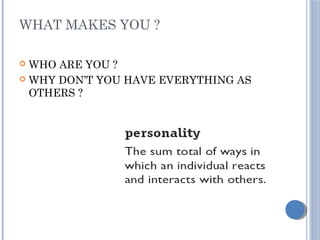
WHAT MAKES YOU ?
 WHO ARE YOU ?
 WHY DON’T YOU HAVE EVERYTHING AS
OTHERS ?
DEFINITION
 According to Gordon Allport says
“personality is the dynamic organization within
the individual of those psychophysical systems
that determine his unique adjustments to his
environment”
Personality
A person’s internally based
characteristic ways of
acting and thinking
DETERMINANTS OF PERSONALITY
 HEREDITY FACTORS
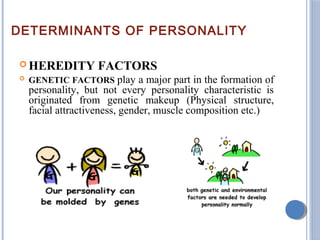
 GENETIC FACTORS play a major part in the formation of
personality, but not every personality characteristic is
originated from genetic makeup (Physical structure,
facial attractiveness, gender, muscle composition etc.)
DETERMINANTS OF
PERSONALITY
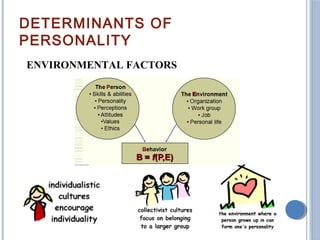
ENVIRONMENTAL FACTORS
PERSONALITY
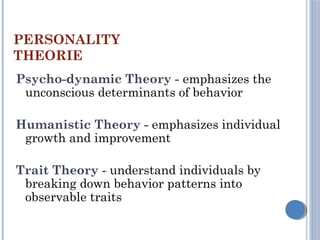
THEORIE
Psycho-dynamic Theory - emphasizes the
unconscious determinants of behavior
Humanistic Theory - emphasizes individual
growth and improvement
Trait Theory - understand individuals by
breaking down behavior patterns into
observable traits
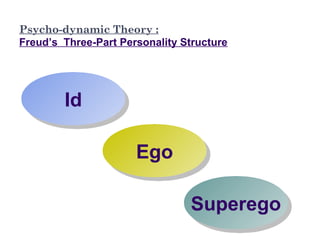
Psycho-dynamic Theory :
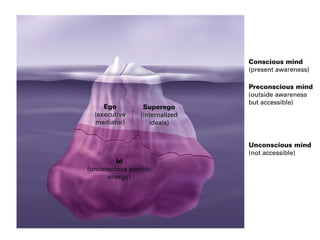
Freud’s Three-Part Personality Structure
IdId
EgoEgo
SuperegoSuperego

The id, ego, and superego are names for the three parts of the
human personality which are part of Sigmund Freud’s
psychoanalytic personality theory.

According to Freud, these three parts combine to create the
complex behavior of human beings.

Id: Meeting Basic Needs

The id is the most basic part of the personality, and wants instant
gratification for our wants and needs. If these needs or wants are
not met, a person becomes tense or anxious.

Example:- Sally was thirsty. Rather than waiting for the server to
refill her glass of water, she reached across the table and drank
from Mr. Smith’s water glass, much to his surprise.

Ego: Dealing with Reality
The ego deals with reality, trying to meet the desires of the
id in a way that is socially acceptable in the world. This
may mean delaying gratification, and helping to get rid of
the tension the id feels if a desire is not met right away.
The ego recognizes that other people have needs and
wants too, and that being selfish is not always good for us
in the long run
Example: Sally was thirsty. However, she knew that her
server would be back soon to refill her water glass, so
she waited until then to get a drink, even though she
really just wanted to drink from Mr. Smith’s glass.
Superego: Adding Morals
The superego develops last, and is based on morals and
judgments about right and wrong. Even though the superego and
the ego may reach the same decision about something, the
superego’s reason for that decision is more based on moral
values, while the ego’s decision is based more on what others will
think or what the consequences of an action could be.
Example- Sarah knew that she could steal the supplies from work
and no one would know about it. However, she knew that stealing
was wrong, so she decided not to take anything even though she
would probably never get caught.

The Humanistic
Approach to Personality

Abraham Maslow is considered the father of
the humanistic movement
− He studied the lives of very healthy and creative
people to develop his theory of personality

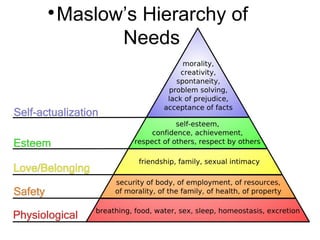
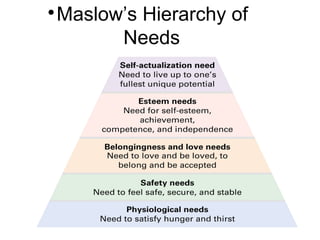
Maslow’s hierarchy of needs is an
arrangement of the innate needs that
motivate our behavior, from the strongest
needs at the bottom of the pyramid to the
weakness needs at the top of the pyramid

Maslow’s Hierarchy of
Needs

Maslow’s Hierarchy of
Needs

The Social-Cognitive
Approach to Personality

Is research-based by combining
elements of three major research perspectives
− Cognitive
− Behavioral
− Sociocultural

Maintains that learning through environmental
conditioning contributes to personality
development
− However, social learning/modeling and cognitive
processes, such as perception and thinking, are also
involved and are actually more important to the
development of our personality

Bandura’s Self-System

The self-system is the set of cognitive processes by
which a person observes, evaluates, and regulates
his/her social behavior
− There is a conscious decision to choose what behavior to
engage in, acting in accordance with the assessment of
whether the behavior will be reinforced or not

Self-efficacy is a judgment of one’s effectiveness in
dealing with particular situations and plays a major role in
determining our behavior
− Low self-efficacy is associated with depression, anxiety, and
helplessness
− High self-efficacy is associated with self-confidence, positive
outlook, and minimal self-doubt
Activity

BAT

LEMON

CINERAMA
MEASURING PERSONALITY
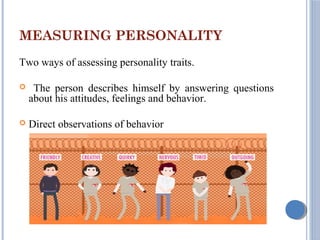
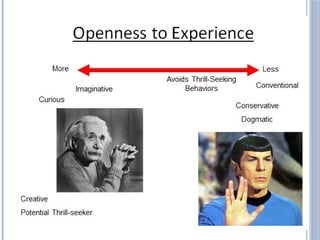
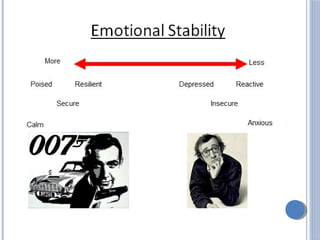
Two ways of assessing personality traits.
 The person describes himself by answering questions
about his attitudes, feelings and behavior.
 Direct observations of behavior
PERSONALITY TRAITS
 Traits are typically defined as the different
characteristics that make up an individual's
personality.
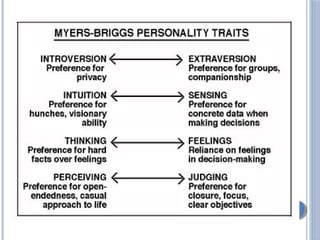
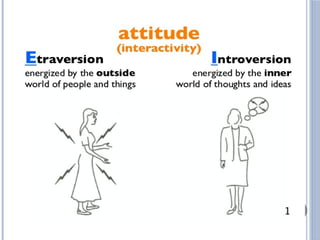
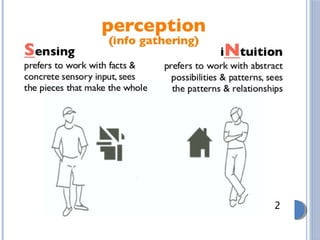
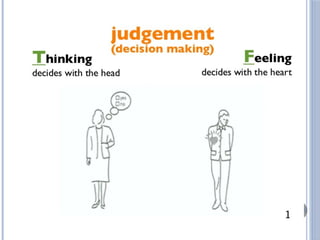
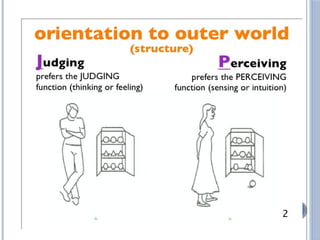
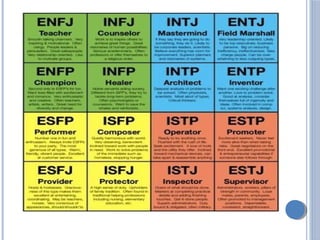
MYERS BRIGS TYPE INDICATOR
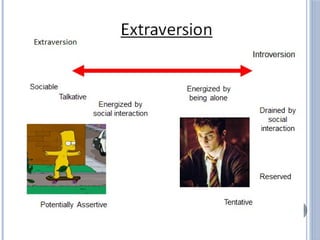
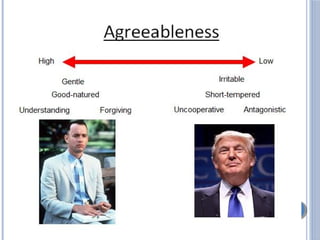
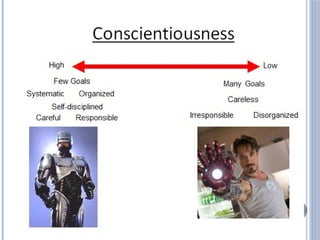
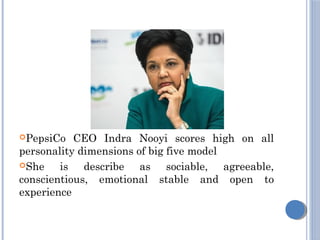
PepsiCo CEO Indra Nooyi scores high on all
personality dimensions of big five model
She is describe as sociable, agreeable,
conscientious, emotional stable and open to
experience
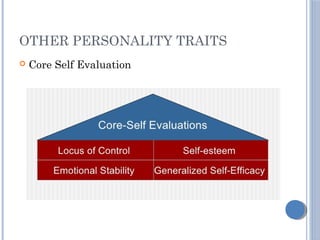
OTHER PERSONALITY TRAITS
 Core Self Evaluation
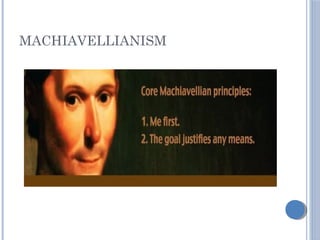
MACHIAVELLIANISM
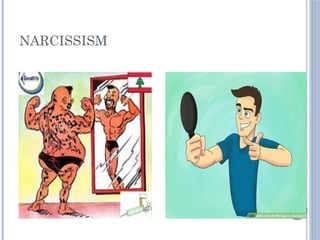
NARCISSISM
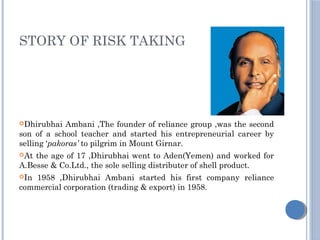
STORY OF RISK TAKING
Dhirubhai Ambani ,The founder of reliance group ,was the second
son of a school teacher and started his entrepreneurial career by
selling ‘pakoras’ to pilgrim in Mount Girnar.
At the age of 17 ,Dhirubhai went to Aden(Yemen) and worked for
A.Besse & Co.Ltd., the sole selling distributer of shell product.
In 1958 ,Dhirubhai Ambani started his first company reliance
commercial corporation (trading & export) in 1958.
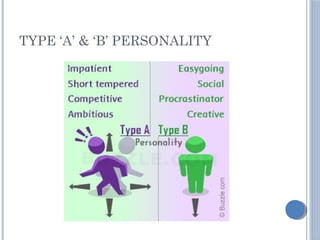
TYPE ‘A’ & ‘B’ PERSONALITY
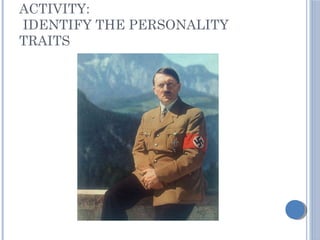
ACTIVITY:
IDENTIFY THE PERSONALITY
TRAITS
URL FOR CHECK YOUR PERSONALITY
https://www.123test.com/personality-test/

Organizational Behavior : Personality

  • 1.
    PERSONALITY Dr. Kiran Kakade AssistantProfessor (HR) ,TIMSR Mumbai
  • 4.
    WHAT MAKES YOU?  WHO ARE YOU ?  WHY DON’T YOU HAVE EVERYTHING AS OTHERS ?
  • 5.
    DEFINITION  According toGordon Allport says “personality is the dynamic organization within the individual of those psychophysical systems that determine his unique adjustments to his environment”
  • 6.
    Personality A person’s internallybased characteristic ways of acting and thinking
  • 7.
    DETERMINANTS OF PERSONALITY HEREDITY FACTORS  GENETIC FACTORS play a major part in the formation of personality, but not every personality characteristic is originated from genetic makeup (Physical structure, facial attractiveness, gender, muscle composition etc.)
  • 8.
  • 9.
    PERSONALITY THEORIE Psycho-dynamic Theory -emphasizes the unconscious determinants of behavior Humanistic Theory - emphasizes individual growth and improvement Trait Theory - understand individuals by breaking down behavior patterns into observable traits
  • 10.
    Psycho-dynamic Theory : Freud’sThree-Part Personality Structure IdId EgoEgo SuperegoSuperego
  • 11.
     The id, ego,and superego are names for the three parts of the human personality which are part of Sigmund Freud’s psychoanalytic personality theory.  According to Freud, these three parts combine to create the complex behavior of human beings.  Id: Meeting Basic Needs  The id is the most basic part of the personality, and wants instant gratification for our wants and needs. If these needs or wants are not met, a person becomes tense or anxious.  Example:- Sally was thirsty. Rather than waiting for the server to refill her glass of water, she reached across the table and drank from Mr. Smith’s water glass, much to his surprise.
  • 12.
     Ego: Dealing withReality The ego deals with reality, trying to meet the desires of the id in a way that is socially acceptable in the world. This may mean delaying gratification, and helping to get rid of the tension the id feels if a desire is not met right away. The ego recognizes that other people have needs and wants too, and that being selfish is not always good for us in the long run Example: Sally was thirsty. However, she knew that her server would be back soon to refill her water glass, so she waited until then to get a drink, even though she really just wanted to drink from Mr. Smith’s glass.
  • 13.
    Superego: Adding Morals Thesuperego develops last, and is based on morals and judgments about right and wrong. Even though the superego and the ego may reach the same decision about something, the superego’s reason for that decision is more based on moral values, while the ego’s decision is based more on what others will think or what the consequences of an action could be. Example- Sarah knew that she could steal the supplies from work and no one would know about it. However, she knew that stealing was wrong, so she decided not to take anything even though she would probably never get caught.
  • 15.
     The Humanistic Approach toPersonality  Abraham Maslow is considered the father of the humanistic movement − He studied the lives of very healthy and creative people to develop his theory of personality  Maslow’s hierarchy of needs is an arrangement of the innate needs that motivate our behavior, from the strongest needs at the bottom of the pyramid to the weakness needs at the top of the pyramid
  • 16.
  • 17.
  • 18.
     The Social-Cognitive Approach toPersonality  Is research-based by combining elements of three major research perspectives − Cognitive − Behavioral − Sociocultural  Maintains that learning through environmental conditioning contributes to personality development − However, social learning/modeling and cognitive processes, such as perception and thinking, are also involved and are actually more important to the development of our personality
  • 19.
     Bandura’s Self-System  The self-systemis the set of cognitive processes by which a person observes, evaluates, and regulates his/her social behavior − There is a conscious decision to choose what behavior to engage in, acting in accordance with the assessment of whether the behavior will be reinforced or not  Self-efficacy is a judgment of one’s effectiveness in dealing with particular situations and plays a major role in determining our behavior − Low self-efficacy is associated with depression, anxiety, and helplessness − High self-efficacy is associated with self-confidence, positive outlook, and minimal self-doubt
  • 20.
  • 21.
    MEASURING PERSONALITY Two waysof assessing personality traits.  The person describes himself by answering questions about his attitudes, feelings and behavior.  Direct observations of behavior
  • 22.
    PERSONALITY TRAITS  Traitsare typically defined as the different characteristics that make up an individual's personality.
  • 24.
  • 35.
    PepsiCo CEO IndraNooyi scores high on all personality dimensions of big five model She is describe as sociable, agreeable, conscientious, emotional stable and open to experience
  • 36.
    OTHER PERSONALITY TRAITS Core Self Evaluation
  • 37.
  • 38.
  • 40.
    STORY OF RISKTAKING Dhirubhai Ambani ,The founder of reliance group ,was the second son of a school teacher and started his entrepreneurial career by selling ‘pakoras’ to pilgrim in Mount Girnar. At the age of 17 ,Dhirubhai went to Aden(Yemen) and worked for A.Besse & Co.Ltd., the sole selling distributer of shell product. In 1958 ,Dhirubhai Ambani started his first company reliance commercial corporation (trading & export) in 1958.
  • 41.
    TYPE ‘A’ &‘B’ PERSONALITY
  • 43.
  • 46.
    URL FOR CHECKYOUR PERSONALITY https://www.123test.com/personality-test/