Ginnett’s Team Effectiveness
Leadership Model
By:- Ramendra Mani Tripathi
MBA
1Ramendra Mani Tripathi MBA
Ginnett’s Team Effectiveness
Leadership Model
• Leadership is a group or team function. The
leader's job is to create the conditions for the
team to be effective."
Dr. Robert Ginnett
2Ramendra Mani Tripathi MBA
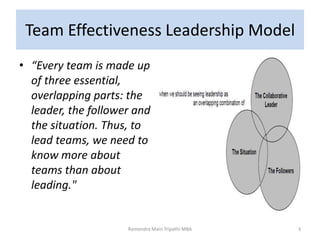
• “Every team is made up
of three essential,
overlapping parts: the
leader, the follower and
the situation. Thus, to
lead teams, we need to
know more about
teams than about
leading."
Ramendra Mani Tripathi MBA 3
Team Effectiveness Leadership Model
• Usually leaders know when their teams are
doing well or doing poorly, often by paying
attention to team dynamics. But what makes
the good ones good? And how can you help
the teams that are not doing well? Using
TELM, you can put your finger on the leverage
points and you can initiate the preferred
change.
4Ramendra Mani Tripathi MBA
Team Effectiveness Leadership Model
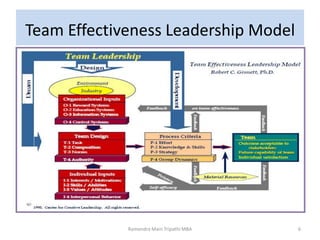
• In TELM, the major leadership functions –
Dream, Design and Development – are applied
through Inputs and Context. Achieving team
effectiveness requires paying attention to all
three of the critical Team Leadership
Functions.
5Ramendra Mani Tripathi MBA
Team Effectiveness Leadership Model
6Ramendra Mani Tripathi MBA
Team Effectiveness Leadership Model
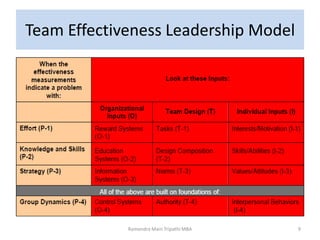
• If your team is having problems with Effort (P-
1), then examine Reward Systems (O-1),Tasks
(T-1) and Interests/Motivation (I-1).
• Knowledge and Skills issues (P-2) require a
look at Education Systems (O-2), Team Design
Composition (T-2) and Team Skills/Abilities (I-
2)
7Ramendra Mani Tripathi MBA
Team Effectiveness Leadership Model
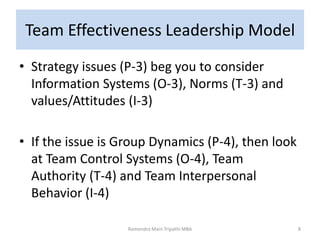
• Strategy issues (P-3) beg you to consider
Information Systems (O-3), Norms (T-3) and
values/Attitudes (I-3)
• If the issue is Group Dynamics (P-4), then look
at Team Control Systems (O-4), Team
Authority (T-4) and Team Interpersonal
Behavior (I-4)
8Ramendra Mani Tripathi MBA
Team Effectiveness Leadership Model
9Ramendra Mani Tripathi MBA
Team Effectiveness Leadership Model
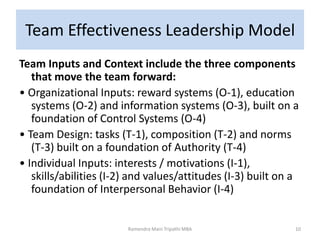
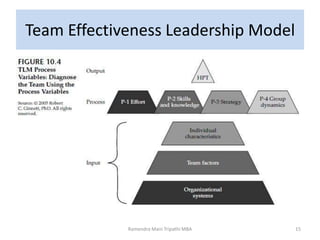
Team Inputs and Context include the three components
that move the team forward:
• Organizational Inputs: reward systems (O-1), education
systems (O-2) and information systems (O-3), built on a
foundation of Control Systems (O-4)
• Team Design: tasks (T-1), composition (T-2) and norms
(T-3) built on a foundation of Authority (T-4)
• Individual Inputs: interests / motivations (I-1),
skills/abilities (I-2) and values/attitudes (I-3) built on a
foundation of Interpersonal Behavior (I-4)
Ramendra Mani Tripathi MBA 10
Team Effectiveness Leadership Model
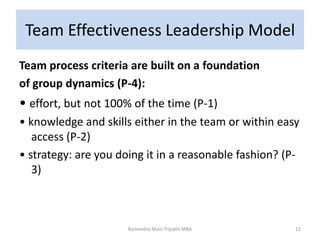
Team process criteria are built on a foundation
of group dynamics (P-4):
• effort, but not 100% of the time (P-1)
• knowledge and skills either in the team or within easy
access (P-2)
• strategy: are you doing it in a reasonable fashion? (P-
3)
Ramendra Mani Tripathi MBA 11
Team Effectiveness Leadership Model
Team effectiveness is built on:
• outcomes acceptable to stakeholders (i.e., meeting
their satisfaction)
• future capability of the team which must improve over
time without burning people out
• individual satisfaction. This does not mean coming to
work pegging out on the fun meter. Teams can be
frustrating. Satisfaction is not a vacuum of 'bad', but it
has to achieve at least a break-even between positive
and negative. Note that the leader doesn't make this
happen: the team makes it happen.
Ramendra Mani Tripathi MBA 12
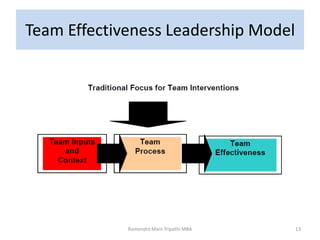
Team Effectiveness Leadership Model
Ramendra Mani Tripathi MBA 13
Team Effectiveness Leadership Model
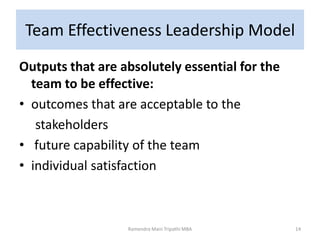
Outputs that are absolutely essential for the
team to be effective:
• outcomes that are acceptable to the
stakeholders
• future capability of the team
• individual satisfaction
Ramendra Mani Tripathi MBA 14
Team Effectiveness Leadership Model
Ramendra Mani Tripathi MBA 15
Ramendra Mani Tripathi MBA 16

Ginnett’s team effectiveness leadership model

  • 1.
    Ginnett’s Team Effectiveness LeadershipModel By:- Ramendra Mani Tripathi MBA 1Ramendra Mani Tripathi MBA
  • 2.
    Ginnett’s Team Effectiveness LeadershipModel • Leadership is a group or team function. The leader's job is to create the conditions for the team to be effective." Dr. Robert Ginnett 2Ramendra Mani Tripathi MBA
  • 3.
    • “Every teamis made up of three essential, overlapping parts: the leader, the follower and the situation. Thus, to lead teams, we need to know more about teams than about leading." Ramendra Mani Tripathi MBA 3 Team Effectiveness Leadership Model
  • 4.
    Team Effectiveness LeadershipModel • Usually leaders know when their teams are doing well or doing poorly, often by paying attention to team dynamics. But what makes the good ones good? And how can you help the teams that are not doing well? Using TELM, you can put your finger on the leverage points and you can initiate the preferred change. 4Ramendra Mani Tripathi MBA
  • 5.
    Team Effectiveness LeadershipModel • In TELM, the major leadership functions – Dream, Design and Development – are applied through Inputs and Context. Achieving team effectiveness requires paying attention to all three of the critical Team Leadership Functions. 5Ramendra Mani Tripathi MBA
  • 6.
    Team Effectiveness LeadershipModel 6Ramendra Mani Tripathi MBA
  • 7.
    Team Effectiveness LeadershipModel • If your team is having problems with Effort (P- 1), then examine Reward Systems (O-1),Tasks (T-1) and Interests/Motivation (I-1). • Knowledge and Skills issues (P-2) require a look at Education Systems (O-2), Team Design Composition (T-2) and Team Skills/Abilities (I- 2) 7Ramendra Mani Tripathi MBA
  • 8.
    Team Effectiveness LeadershipModel • Strategy issues (P-3) beg you to consider Information Systems (O-3), Norms (T-3) and values/Attitudes (I-3) • If the issue is Group Dynamics (P-4), then look at Team Control Systems (O-4), Team Authority (T-4) and Team Interpersonal Behavior (I-4) 8Ramendra Mani Tripathi MBA
  • 9.
    Team Effectiveness LeadershipModel 9Ramendra Mani Tripathi MBA
  • 10.
    Team Effectiveness LeadershipModel Team Inputs and Context include the three components that move the team forward: • Organizational Inputs: reward systems (O-1), education systems (O-2) and information systems (O-3), built on a foundation of Control Systems (O-4) • Team Design: tasks (T-1), composition (T-2) and norms (T-3) built on a foundation of Authority (T-4) • Individual Inputs: interests / motivations (I-1), skills/abilities (I-2) and values/attitudes (I-3) built on a foundation of Interpersonal Behavior (I-4) Ramendra Mani Tripathi MBA 10
  • 11.
    Team Effectiveness LeadershipModel Team process criteria are built on a foundation of group dynamics (P-4): • effort, but not 100% of the time (P-1) • knowledge and skills either in the team or within easy access (P-2) • strategy: are you doing it in a reasonable fashion? (P- 3) Ramendra Mani Tripathi MBA 11
  • 12.
    Team Effectiveness LeadershipModel Team effectiveness is built on: • outcomes acceptable to stakeholders (i.e., meeting their satisfaction) • future capability of the team which must improve over time without burning people out • individual satisfaction. This does not mean coming to work pegging out on the fun meter. Teams can be frustrating. Satisfaction is not a vacuum of 'bad', but it has to achieve at least a break-even between positive and negative. Note that the leader doesn't make this happen: the team makes it happen. Ramendra Mani Tripathi MBA 12
  • 13.
    Team Effectiveness LeadershipModel Ramendra Mani Tripathi MBA 13
  • 14.
    Team Effectiveness LeadershipModel Outputs that are absolutely essential for the team to be effective: • outcomes that are acceptable to the stakeholders • future capability of the team • individual satisfaction Ramendra Mani Tripathi MBA 14
  • 15.
    Team Effectiveness LeadershipModel Ramendra Mani Tripathi MBA 15
  • 16.

Editor's Notes

  • #3 Dr. Robert Ginnett, the developer of the TELM, is a Senior Fellow at the Center for CreativeLeadership (CCL) and lead instructor for the Leadership at the Peak program for corporateCEOs, Presidents and their direct reports. Prior to joining CCL, Ginnett was a tenured professorat the United States Air Force Academy where he served as Director of Leadership andCounseling. His background includes leadership of an 875-man combat force in Vietnam. Anorganizational psychologist by training, Ginnett's graduate education includes an MBA, twoadditional Masters degrees, and a Ph.D. in organizational behavior from Yale University. He isco-author of the best-selling undergraduate textbook, LEADERSHIP: Enhancing the Lessons ofExperience, now in it's 4th edition. His next book, Leading Great Teams, is due out in 2006.