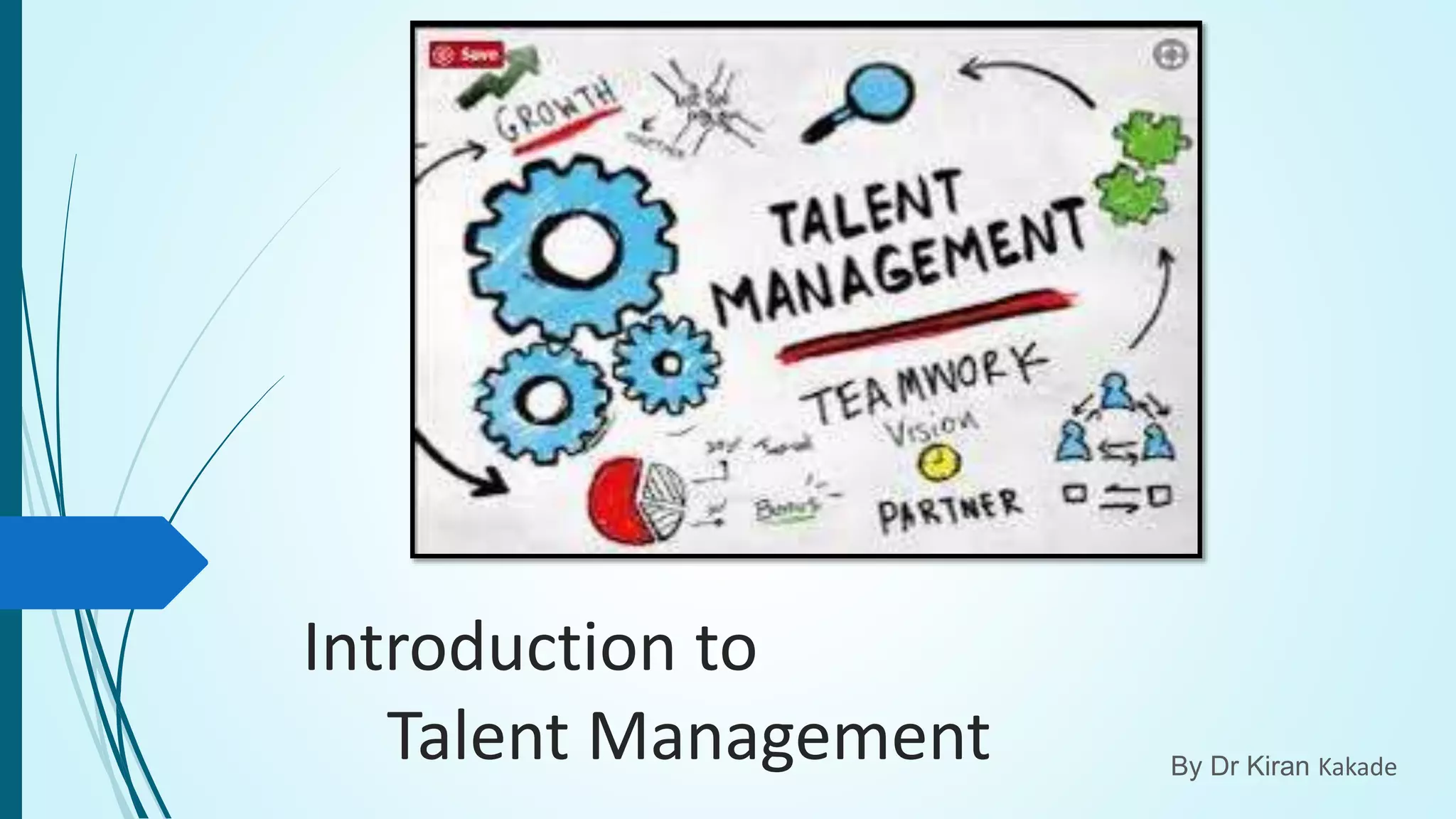
Introduction to
Talent Management By Dr Kiran Kakade
WHAT IS TALENT MANAGEMENT ?
 TALENT:
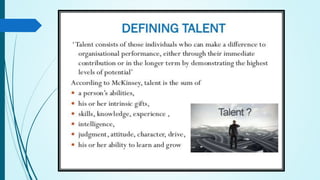
Talent consists of those individuals who can make a difference
to organizational performance either through their immediate
contribution or, in the longer-term, by demonstrating the
highest levels of potential.
 TALENT MANAGEMENT
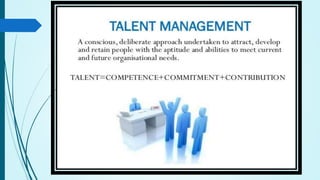
Talent management is the systematic attraction, identification,
development, engagement, retention and deployment of those
individuals who are of particular value to an organization, either
in view of their ‘high potential’ for the future or because they
are fulfilling business/operation-critical roles
INTRODUCTION
 The term was coined by McKinsey & Company following a 1997 study.
The profession that supports talent management became increasingly
formalized in the early 2000s.
 Talent management seeks to attract, identify, develop, engage, retain
and deploy individuals who are considered particularly valuable to an
organization.
 It should align with business goals and strategic objectives.
 By managing talent strategically, organizations can build a high
performance workplace, encourage a ‘learning’ organization, add value to
their employer brand, and improve diversity management.
 Talent management is defined as the methodically organized, strategic
process of getting the right talent onboard and helping them grow to
their optimal capabilities keeping organizational objectives in mind.
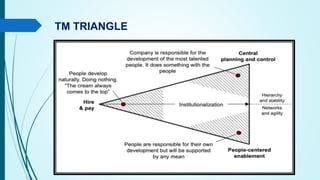
TM TRIANGLE
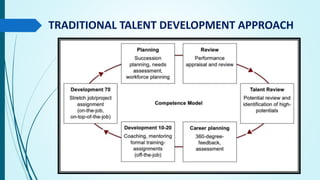
TRADITIONAL TALENT DEVELOPMENT APPROACH
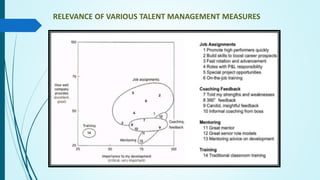
RELEVANCE OF VARIOUS TALENT MANAGEMENT MEASURES
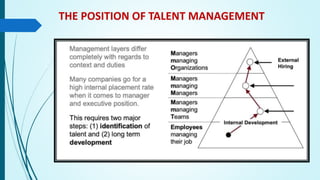
THE POSITION OF TALENT MANAGEMENT
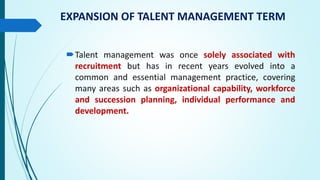
EXPANSION OF TALENT MANAGEMENT TERM
Talent management was once solely associated with
recruitment but has in recent years evolved into a
common and essential management practice, covering
many areas such as organizational capability, workforce
and succession planning, individual performance and
development.
FEATURES OF TALENT MANAGEMENT
STRATEGY
 A clearly defined and communicated corporate strategy will pave the way
for a talent management strategy closely aligned to business objectives.
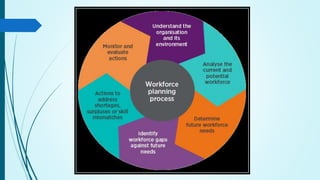
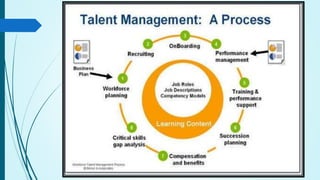
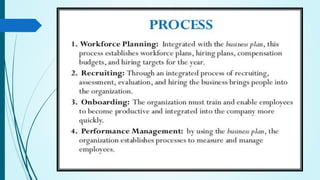
Creating a talent management strategy starts with workforce planning, a
process of analyzing the current workforce and capability to determine
future workforce needs.
 Workforce planning is a process of analyzing the current workforce,
determining future workforce needs, identifying the gap between the
present and the future, and implementing solutions so that an
organization can accomplish its mission, goals, and strategic plan.
 It’s about getting the right number of people with the right skills
employed in the right place at the right time, at the right cost and on the
right contract to deliver an organization's short and long-term objectives.
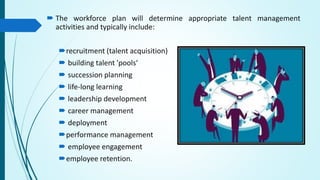
 The workforce plan will determine appropriate talent management
activities and typically include:
recruitment (talent acquisition)
 building talent 'pools‘
 succession planning
 life-long learning
 leadership development
 career management
 deployment
performance management
 employee engagement
employee retention.
INCLUSIVE VERSUS EXCLUSIVE APPROACHES
Some organizations develop an exclusive focus, segmenting
talent according to need, that is, the talent management
process relates specifically to key or high-potential
individuals.
A recent trend has seen organizations adopt a more inclusive
approach creating a ‘whole workforce’ focus on engagement
and talent development.
Often a blended approach is used in practice, with attention
paid to the engagement and development of all employees,
but with special focus given to a particular core group or
groups of employees.
INVOLVING THE RIGHT PEOPLE
 It’s important to include the right stakeholders in developing the
talent management strategy and associated activities.
 Senior leaders and managers need to be actively involved in the
whole talent management process and make recruitment,
succession planning, ongoing development, and retention of key
employees their top priority
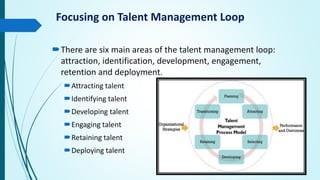
Focusing on Talent Management Loop
There are six main areas of the talent management loop:
attraction, identification, development, engagement,
retention and deployment.
Attracting talent
Identifying talent
Developing talent
Engaging talent
Retaining talent
Deploying talent
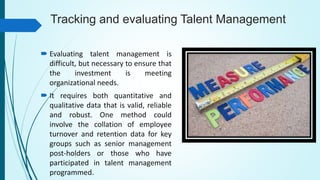
Tracking and evaluating Talent Management
 Evaluating talent management is
difficult, but necessary to ensure that
the investment is meeting
organizational needs.
 It requires both quantitative and
qualitative data that is valid, reliable
and robust. One method could
involve the collation of employee
turnover and retention data for key
groups such as senior management
post-holders or those who have
participated in talent management
programmed.
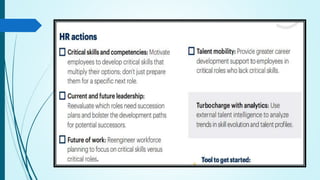
????????????.............Covid-19
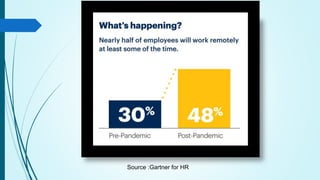
Source :Gartner for HR
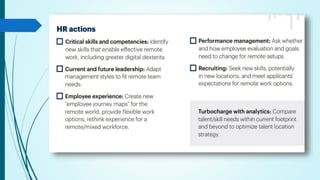
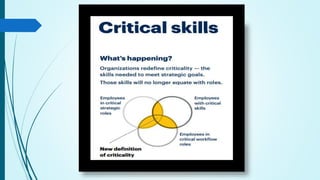
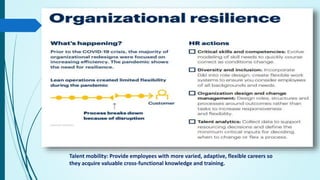
Talent mobility: Provide employees with more varied, adaptive, flexible careers so
they acquire valuable cross-functional knowledge and training.
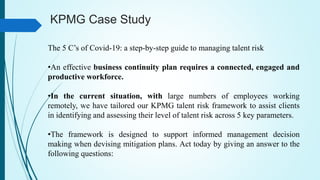
KPMG Case Study
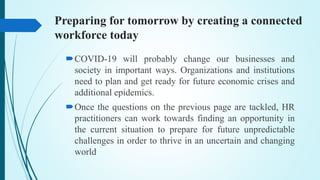
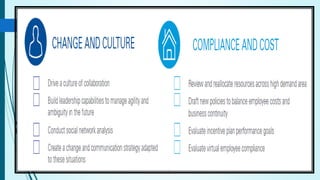
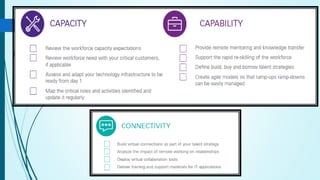
The 5 C’s of Covid-19: a step-by-step guide to managing talent risk
•An effective business continuity plan requires a connected, engaged and
productive workforce.
•In the current situation, with large numbers of employees working
remotely, we have tailored our KPMG talent risk framework to assist clients
in identifying and assessing their level of talent risk across 5 key parameters.
•The framework is designed to support informed management decision
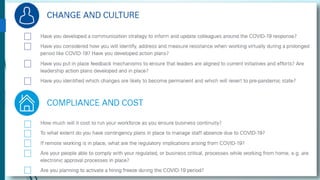
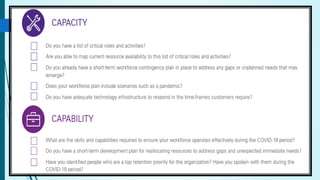
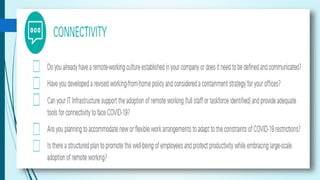
making when devising mitigation plans. Act today by giving an answer to the
following questions:
Preparing for tomorrow by creating a connected
workforce today
COVID-19 will probably change our businesses and
society in important ways. Organizations and institutions
need to plan and get ready for future economic crises and
additional epidemics.
Once the questions on the previous page are tackled, HR
practitioners can work towards finding an opportunity in
the current situation to prepare for future unpredictable
challenges in order to thrive in an uncertain and changing
world
THANK
YOU..

Introduction to Talent Management

  • 1.
  • 5.
    WHAT IS TALENTMANAGEMENT ?  TALENT: Talent consists of those individuals who can make a difference to organizational performance either through their immediate contribution or, in the longer-term, by demonstrating the highest levels of potential.  TALENT MANAGEMENT Talent management is the systematic attraction, identification, development, engagement, retention and deployment of those individuals who are of particular value to an organization, either in view of their ‘high potential’ for the future or because they are fulfilling business/operation-critical roles
  • 6.
    INTRODUCTION  The termwas coined by McKinsey & Company following a 1997 study. The profession that supports talent management became increasingly formalized in the early 2000s.  Talent management seeks to attract, identify, develop, engage, retain and deploy individuals who are considered particularly valuable to an organization.  It should align with business goals and strategic objectives.  By managing talent strategically, organizations can build a high performance workplace, encourage a ‘learning’ organization, add value to their employer brand, and improve diversity management.  Talent management is defined as the methodically organized, strategic process of getting the right talent onboard and helping them grow to their optimal capabilities keeping organizational objectives in mind.
  • 8.
  • 9.
  • 10.
    RELEVANCE OF VARIOUSTALENT MANAGEMENT MEASURES
  • 11.
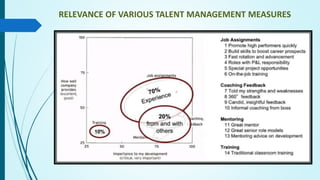
    RELEVANCE OF VARIOUSTALENT MANAGEMENT MEASURES
  • 12.
    THE POSITION OFTALENT MANAGEMENT
  • 14.
    EXPANSION OF TALENTMANAGEMENT TERM Talent management was once solely associated with recruitment but has in recent years evolved into a common and essential management practice, covering many areas such as organizational capability, workforce and succession planning, individual performance and development.
  • 16.
    FEATURES OF TALENTMANAGEMENT STRATEGY  A clearly defined and communicated corporate strategy will pave the way for a talent management strategy closely aligned to business objectives. Creating a talent management strategy starts with workforce planning, a process of analyzing the current workforce and capability to determine future workforce needs.  Workforce planning is a process of analyzing the current workforce, determining future workforce needs, identifying the gap between the present and the future, and implementing solutions so that an organization can accomplish its mission, goals, and strategic plan.  It’s about getting the right number of people with the right skills employed in the right place at the right time, at the right cost and on the right contract to deliver an organization's short and long-term objectives.
  • 17.
     The workforceplan will determine appropriate talent management activities and typically include: recruitment (talent acquisition)  building talent 'pools‘  succession planning  life-long learning  leadership development  career management  deployment performance management  employee engagement employee retention.
  • 19.
    INCLUSIVE VERSUS EXCLUSIVEAPPROACHES Some organizations develop an exclusive focus, segmenting talent according to need, that is, the talent management process relates specifically to key or high-potential individuals. A recent trend has seen organizations adopt a more inclusive approach creating a ‘whole workforce’ focus on engagement and talent development. Often a blended approach is used in practice, with attention paid to the engagement and development of all employees, but with special focus given to a particular core group or groups of employees.
  • 20.
    INVOLVING THE RIGHTPEOPLE  It’s important to include the right stakeholders in developing the talent management strategy and associated activities.  Senior leaders and managers need to be actively involved in the whole talent management process and make recruitment, succession planning, ongoing development, and retention of key employees their top priority
  • 21.
    Focusing on TalentManagement Loop There are six main areas of the talent management loop: attraction, identification, development, engagement, retention and deployment. Attracting talent Identifying talent Developing talent Engaging talent Retaining talent Deploying talent
  • 28.
    Tracking and evaluatingTalent Management  Evaluating talent management is difficult, but necessary to ensure that the investment is meeting organizational needs.  It requires both quantitative and qualitative data that is valid, reliable and robust. One method could involve the collation of employee turnover and retention data for key groups such as senior management post-holders or those who have participated in talent management programmed.
  • 33.
  • 34.
  • 38.
    Talent mobility: Provideemployees with more varied, adaptive, flexible careers so they acquire valuable cross-functional knowledge and training.
  • 39.
    KPMG Case Study The5 C’s of Covid-19: a step-by-step guide to managing talent risk •An effective business continuity plan requires a connected, engaged and productive workforce. •In the current situation, with large numbers of employees working remotely, we have tailored our KPMG talent risk framework to assist clients in identifying and assessing their level of talent risk across 5 key parameters. •The framework is designed to support informed management decision making when devising mitigation plans. Act today by giving an answer to the following questions:
  • 43.
    Preparing for tomorrowby creating a connected workforce today COVID-19 will probably change our businesses and society in important ways. Organizations and institutions need to plan and get ready for future economic crises and additional epidemics. Once the questions on the previous page are tackled, HR practitioners can work towards finding an opportunity in the current situation to prepare for future unpredictable challenges in order to thrive in an uncertain and changing world
  • 46.