Development and
Implementation of HRIS
Introduction:
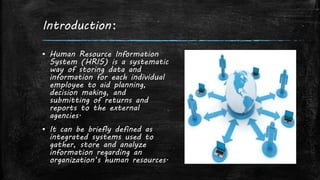
▪ Human Resource Information
System (HRIS) is a systematic
way of storing data and
information for each individual
employee to aid planning,
decision making, and
submitting of returns and
reports to the external
agencies.
▪ It can be briefly defined as
integrated systems used to
gather, store and analyze
information regarding an
organization’s human resources.
Steps in Developing and
Implementing HRIS:
Steps to be followed:
▪ The following steps are
involved in developing and
implementing an HRIS.
▪ Step 1:Inception of idea
The first step of HRIS
implementation is the
inception of the idea. The
need of the organization to
have HRIS software must
be realized and agreed by
the top management. It is
an investment and
management needs to keep
it in mind
▪ Step 2. Feasibility study
▪ As this is an investment the
feasibility of HRIS must be assessed.
▪ It covers the following areas
 Scope of the software
 Future benefits after implementation
 Potential software developers
assessment
 Cost estimate
 Value addition to business
 ROI calculation
▪ A proper feasibility study will help
the management to make the
decision based on facts and figures.
▪ Step 3. Selecting a project
team
 Implementation of HRIS is a
project as it requires ensuring
budgeted cost, specific timeline with
quality delivery.
 Successful implementation largely
depends on capability and effort of
project team.
 Project team members should be
taken from both HR and IT.
 Involvement of senior managers is
required to get the top management
buy in on different issues.
▪ Step 4. Defining the requirements
 At this stage the scope needs to be defined.
 It will not be a detailed requirement specification
but at least the processes that will be
incorporated in the software.
 Some organization may want to develop the
payroll module while others may want more
modules to be developed.
 It all depends on the affordability and plan of
the concerned organization. But it is an essential
step before communicating with the vendor or
software developers.
 Otherwise it will create complexity during
discussion and negotiation with the software
developers.
 At this stage the company HR policies and
processes must be analyzed and defined
rigorously.
 If there is any ambiguity in process, difficulty
may arise to incorporate it in the software
▪ Step 5. Vendor analysis
 Selecting the right software developer is
another challenge.
 The capability, track record and good will
of the developers must be taken into
consideration.
 The requirement of the organization must
be shared with the developers clearly
without ambiguity.
 The existing processes can be clarified with
them, if required. After getting clear
understanding about the requirement they
will come up with their offer that includes
cost and specific timeline for project
completion.
 The software requirement specification
needs to be documented to avoid ambiguity
in future.
▪ Step 6. Package contract
negotiation
 After getting the final offer
from the vendors, the decision
of work order will be finalized
based on cost and quality
actors.
 Then the contract will be signed
with the software developers.
 The development work will
start then.
 But the company needs to
monitor the development work
time to time to ensure on
time quality delivery of the
project.
▪ Step 7. Training
 Training usually begins as soon
as possible after the contract
has been signed.
 First, the members of the
project team are trained to use
the Human Resource
Information System.
 Toward the end of the
implementation, the human
resource representation will
train managers from other
departments in how to submit
information to the HRIS and
how to request information
from it.
▪ Step 8. Tailoring the
system
 After finalizing the
system requirement
specification, the design
of the software will be
initiated. The design
should be shared with
the company to identify
improvement areas
▪ Step 9. Collecting data
 At this stage required data
to enter in the software will
be collected.
 A team of HR needs to be
deployed to collect data for
the software. Data validation
is also required.
 This is a very critical part of
the project.
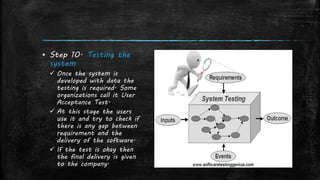
▪ Step 10. Testing the
system
 Once the system is
developed with data the
testing is required. Some
organizations call it User
Acceptance Test.
 At this stage the users
use it and try to check if
there is any gap between
requirement and the
delivery of the software.
 If the test is okay then
the final delivery is given
to the company.
▪ Step 11. Starting
up
 After the User
Acceptance the
software will be
installed in user’s
PC or web as per
system
configuration and
requirement
specification.
▪ Step 12. Running in
parallel
 It is a safe stand to run
the existing process
whether it is manual or
software and the new
software run in parallel.
 In case of any malfunction
of the new software the
process will not get
hampered.
 At least one full cycle of
the process needs to be
run in parallel to avoid any
technical hitch.
▪ Step 13. Maintenance
 Once the software has
been installed regular
maintenance and
performance monitoring
is essential.
 For effectiveness annual
maintenance contract
can be signed with the
software development
company.
▪ Step 14. Evaluation
 After running the
software for a certain
period of time the
performance evaluation
will be done. What value
the software has added
since its inception needs
to be evaluated
Development and implementation of hris

Development and implementation of hris

  • 1.
  • 2.
    Introduction: ▪ Human ResourceInformation System (HRIS) is a systematic way of storing data and information for each individual employee to aid planning, decision making, and submitting of returns and reports to the external agencies. ▪ It can be briefly defined as integrated systems used to gather, store and analyze information regarding an organization’s human resources.
  • 3.
    Steps in Developingand Implementing HRIS:
  • 4.
    Steps to befollowed: ▪ The following steps are involved in developing and implementing an HRIS. ▪ Step 1:Inception of idea The first step of HRIS implementation is the inception of the idea. The need of the organization to have HRIS software must be realized and agreed by the top management. It is an investment and management needs to keep it in mind
  • 5.
    ▪ Step 2.Feasibility study ▪ As this is an investment the feasibility of HRIS must be assessed. ▪ It covers the following areas  Scope of the software  Future benefits after implementation  Potential software developers assessment  Cost estimate  Value addition to business  ROI calculation ▪ A proper feasibility study will help the management to make the decision based on facts and figures.
  • 6.
    ▪ Step 3.Selecting a project team  Implementation of HRIS is a project as it requires ensuring budgeted cost, specific timeline with quality delivery.  Successful implementation largely depends on capability and effort of project team.  Project team members should be taken from both HR and IT.  Involvement of senior managers is required to get the top management buy in on different issues.
  • 7.
    ▪ Step 4.Defining the requirements  At this stage the scope needs to be defined.  It will not be a detailed requirement specification but at least the processes that will be incorporated in the software.  Some organization may want to develop the payroll module while others may want more modules to be developed.  It all depends on the affordability and plan of the concerned organization. But it is an essential step before communicating with the vendor or software developers.  Otherwise it will create complexity during discussion and negotiation with the software developers.  At this stage the company HR policies and processes must be analyzed and defined rigorously.  If there is any ambiguity in process, difficulty may arise to incorporate it in the software
  • 8.
    ▪ Step 5.Vendor analysis  Selecting the right software developer is another challenge.  The capability, track record and good will of the developers must be taken into consideration.  The requirement of the organization must be shared with the developers clearly without ambiguity.  The existing processes can be clarified with them, if required. After getting clear understanding about the requirement they will come up with their offer that includes cost and specific timeline for project completion.  The software requirement specification needs to be documented to avoid ambiguity in future.
  • 9.
    ▪ Step 6.Package contract negotiation  After getting the final offer from the vendors, the decision of work order will be finalized based on cost and quality actors.  Then the contract will be signed with the software developers.  The development work will start then.  But the company needs to monitor the development work time to time to ensure on time quality delivery of the project.
  • 10.
    ▪ Step 7.Training  Training usually begins as soon as possible after the contract has been signed.  First, the members of the project team are trained to use the Human Resource Information System.  Toward the end of the implementation, the human resource representation will train managers from other departments in how to submit information to the HRIS and how to request information from it.
  • 11.
    ▪ Step 8.Tailoring the system  After finalizing the system requirement specification, the design of the software will be initiated. The design should be shared with the company to identify improvement areas
  • 12.
    ▪ Step 9.Collecting data  At this stage required data to enter in the software will be collected.  A team of HR needs to be deployed to collect data for the software. Data validation is also required.  This is a very critical part of the project.
  • 13.
    ▪ Step 10.Testing the system  Once the system is developed with data the testing is required. Some organizations call it User Acceptance Test.  At this stage the users use it and try to check if there is any gap between requirement and the delivery of the software.  If the test is okay then the final delivery is given to the company.
  • 14.
    ▪ Step 11.Starting up  After the User Acceptance the software will be installed in user’s PC or web as per system configuration and requirement specification.
  • 15.
    ▪ Step 12.Running in parallel  It is a safe stand to run the existing process whether it is manual or software and the new software run in parallel.  In case of any malfunction of the new software the process will not get hampered.  At least one full cycle of the process needs to be run in parallel to avoid any technical hitch.
  • 16.
    ▪ Step 13.Maintenance  Once the software has been installed regular maintenance and performance monitoring is essential.  For effectiveness annual maintenance contract can be signed with the software development company.
  • 17.
    ▪ Step 14.Evaluation  After running the software for a certain period of time the performance evaluation will be done. What value the software has added since its inception needs to be evaluated