TEAMPROCESSESby:  jurrian c. juliano
Team Processes – It is the third set of team effectiveness elements including:      a) Team Development     b) Norms     c) Cohesiveness     d) Trust      e) Conflict Management
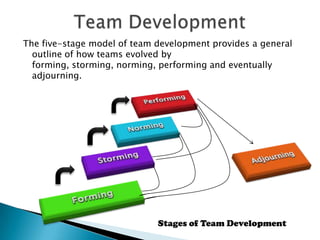
Team DevelopmentThe five-stage model of team development provides a general outline of how teams evolved by forming, storming, norming, performing and eventually adjourning.Stages of Team Development
1) Forming – the first stage is a period of testing and orientation in w/c members learn about each other & evaluate the benefits and costs  of continued membership.2) Storming – the storming stage is marked by interpersonal conflict as members become more proactive and compete for various team roles.3) Norming– the team develops its first real sense of cohesion as roles are established and a consensus forms around group objectives.4) Performing – the team becomes more task-oriented in the performing stage.5) Adjourning – Most work teams and informed groups eventually end.Speeding Up The Team Development through Team BuildingSheila Baumgardner– a school principal, she took her new teaching and support staff to Arlington Echo Outdoor Education Center, for 3 days of team building.                            She sped up the team development process through team building.Team Building – Any formal activity intended to improve the development and functioning of a work team.
Team NormsNorms – the informal rules and shared expectations that groups establish to regulate the behavior of their members.How Team Norms Develop      Norms develop as soon as teams form because people need to anticipate or predict how others will act.Preventing and Changing Dysfunctional  Team Norms       Team norms often become deeply anchored, so the best way to avoid norms that undermine organizational success or employee well-being is to establish desirable norms when teams are first formed.
Team CohesivenessTeam Cohesiveness – the degree of attraction people feel toward a team and their motivation to remain members – is considered an important factor in a team’s success.Member Similarity    Earlier in this chapter we learned that highly diverse teams potentially tend to experience more conflict, leading to factious subgroups and higher turnover among team member.Team Size     Smaller teams tend to be more cohesive than larger teams because it is easier for a few people to agree on goals and coordinate work activities.Member Interaction      Teams tend to be more cohesive when team members interact with each other fairly regularly.Somewhat Difficult Entry     Teams tend to be more cohesive when entry to the team is restricted.
Team Success   Cohesiveness increases with the team’s level of success because people feel more connected to teams that fulfill their goals.External Competition and Challenges    Team cohesiveness tends to increase when members face external competition or a challenging objective that is valued.Consequences of Team Cohesiveness    Every team must have some minimal level of cohesiveness to maintain its existence.
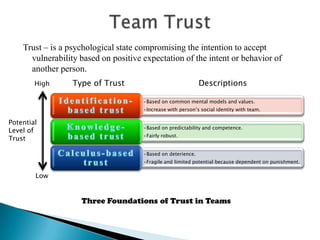
Team TrustTrust – is a psychological state compromising the intention to accept vulnerability based on positive expectation of the intent or behavior of another person.High         Type of Trust                             DescriptionsPotentialLevel ofTrust         LowThree Foundations of Trust in Teams
Calculus-based Trust – it represents a logical calculation that other team members will act appropriately because they face sanctions if their actions violate reasonable expectation.Knowledge-based Trust – the more we understand others and can predict what they will do in the future, the more we trust them, up to a moderate level.Identification-based Trust – it is based on mutual understanding and emotional bonds among team members.
A Hierarchy of Team Trust    These three foundations of trust can be arranged in a hierarchy, Calculus-based trust offers the lowest potential level of trust & easily broken by violation of expectations. Knowledge-based trust might be dented, but not broken, in this incident. Identification-based trust is potentially the strongest and most robust of all three.Dynamics of Team Trust    A common misconception is that team members build trust from a low level when they first join a team.

Team processes

  • 1.
  • 2.
    Team Processes –It is the third set of team effectiveness elements including: a) Team Development b) Norms c) Cohesiveness d) Trust e) Conflict Management
  • 3.
    Team DevelopmentThe five-stagemodel of team development provides a general outline of how teams evolved by forming, storming, norming, performing and eventually adjourning.Stages of Team Development
  • 4.
    1) Forming –the first stage is a period of testing and orientation in w/c members learn about each other & evaluate the benefits and costs of continued membership.2) Storming – the storming stage is marked by interpersonal conflict as members become more proactive and compete for various team roles.3) Norming– the team develops its first real sense of cohesion as roles are established and a consensus forms around group objectives.4) Performing – the team becomes more task-oriented in the performing stage.5) Adjourning – Most work teams and informed groups eventually end.Speeding Up The Team Development through Team BuildingSheila Baumgardner– a school principal, she took her new teaching and support staff to Arlington Echo Outdoor Education Center, for 3 days of team building. She sped up the team development process through team building.Team Building – Any formal activity intended to improve the development and functioning of a work team.
  • 5.
    Team NormsNorms –the informal rules and shared expectations that groups establish to regulate the behavior of their members.How Team Norms Develop Norms develop as soon as teams form because people need to anticipate or predict how others will act.Preventing and Changing Dysfunctional Team Norms Team norms often become deeply anchored, so the best way to avoid norms that undermine organizational success or employee well-being is to establish desirable norms when teams are first formed.
  • 6.
    Team CohesivenessTeam Cohesiveness– the degree of attraction people feel toward a team and their motivation to remain members – is considered an important factor in a team’s success.Member Similarity Earlier in this chapter we learned that highly diverse teams potentially tend to experience more conflict, leading to factious subgroups and higher turnover among team member.Team Size Smaller teams tend to be more cohesive than larger teams because it is easier for a few people to agree on goals and coordinate work activities.Member Interaction Teams tend to be more cohesive when team members interact with each other fairly regularly.Somewhat Difficult Entry Teams tend to be more cohesive when entry to the team is restricted.
  • 7.
    Team Success Cohesiveness increases with the team’s level of success because people feel more connected to teams that fulfill their goals.External Competition and Challenges Team cohesiveness tends to increase when members face external competition or a challenging objective that is valued.Consequences of Team Cohesiveness Every team must have some minimal level of cohesiveness to maintain its existence.
  • 8.
    Team TrustTrust –is a psychological state compromising the intention to accept vulnerability based on positive expectation of the intent or behavior of another person.High Type of Trust DescriptionsPotentialLevel ofTrust LowThree Foundations of Trust in Teams
  • 9.
    Calculus-based Trust –it represents a logical calculation that other team members will act appropriately because they face sanctions if their actions violate reasonable expectation.Knowledge-based Trust – the more we understand others and can predict what they will do in the future, the more we trust them, up to a moderate level.Identification-based Trust – it is based on mutual understanding and emotional bonds among team members.
  • 10.
    A Hierarchy ofTeam Trust These three foundations of trust can be arranged in a hierarchy, Calculus-based trust offers the lowest potential level of trust & easily broken by violation of expectations. Knowledge-based trust might be dented, but not broken, in this incident. Identification-based trust is potentially the strongest and most robust of all three.Dynamics of Team Trust A common misconception is that team members build trust from a low level when they first join a team.