ACTIVE LEARNING AND
CLASSROOM STRATEGIES
- By Dr. Kiran Kakade
Source:IITBX
This work is licensed under a Creative Commons Attribution-NoDerivatives 4.0 International License.
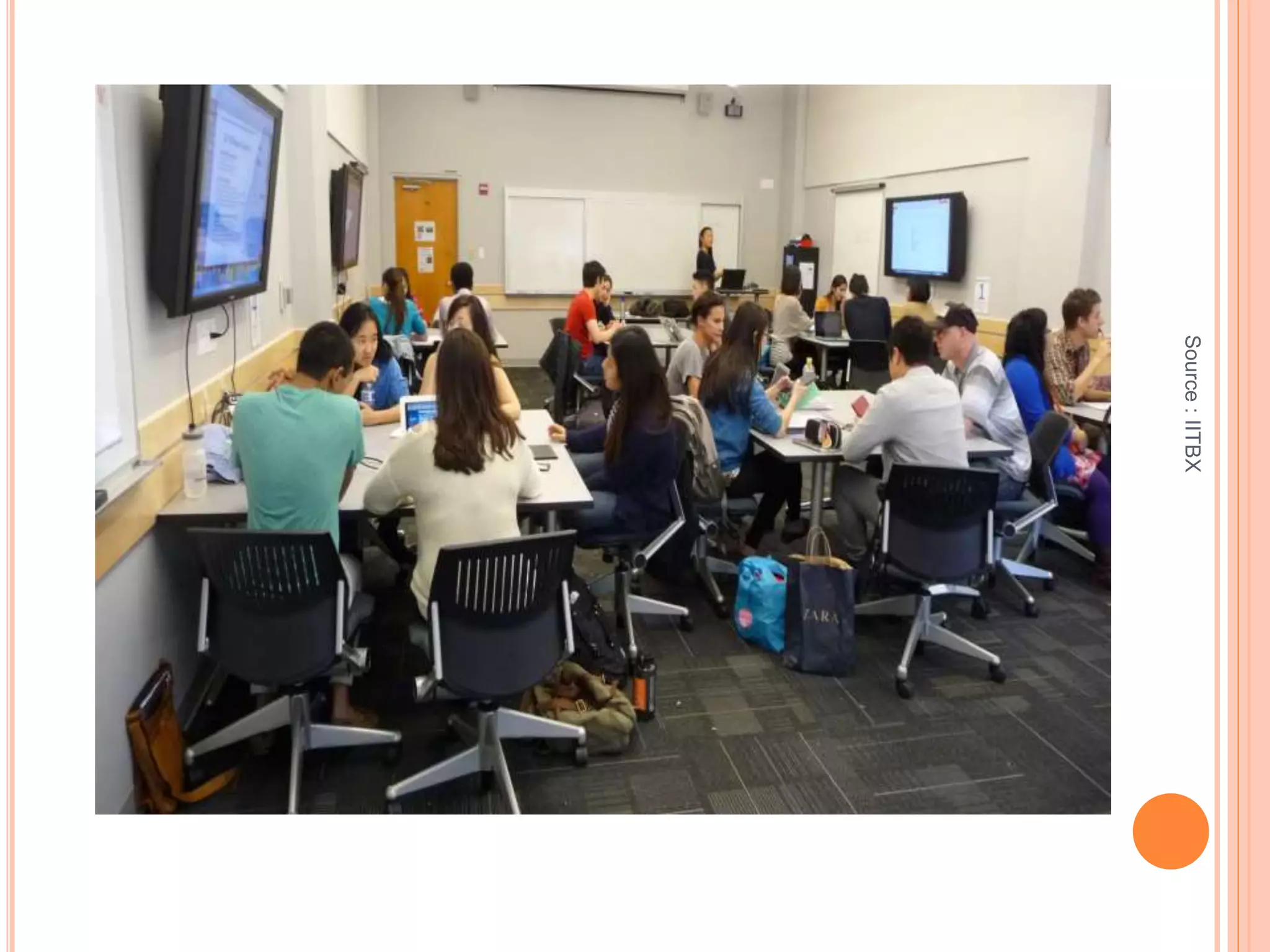
Source : https://goo.gl/images/RSBfjd
WHAT IS ACTIVE LEARNING?
Approach to teaching and learning whose
goal is to engage students with the content
via specific activities that get students to talk,
write, reflect and express their thinking.
 There are several instructional strategies that can come
under active learning.
 Many informal strategies may have the same goal, but to
be termed as active learning, they need to meet the
following requirements.
Source:IITBX
Source:IITBX
REQUIREMENTS OF ACTIVE LEARNING STRATEGIES:
Instructor creates carefully designed activities that
require students to talk, write, reflect and express
their thinking.
Students go beyond listening, copying of notes,
execution of prescribed procedures.
Explicitly based on theories of learning.
Evaluated repeatedly through empirical research.
Source:IITBX
INTRODUCTION
 WHY, WHAT and HOW of active learning
 Active learning strategies lead to student-centered
teaching where students go beyond just listening
and taking notes
 Students get actively engaged with the content
being taught in the class
Source:IITBX
ACTIVE LEARNING : WHY?
Source:IITBX
Source:IITBX
Source:IITBX
Source:IITBX
SOME EVIDENCE FOR NEED FOR ACTIVE
LEARNING
9
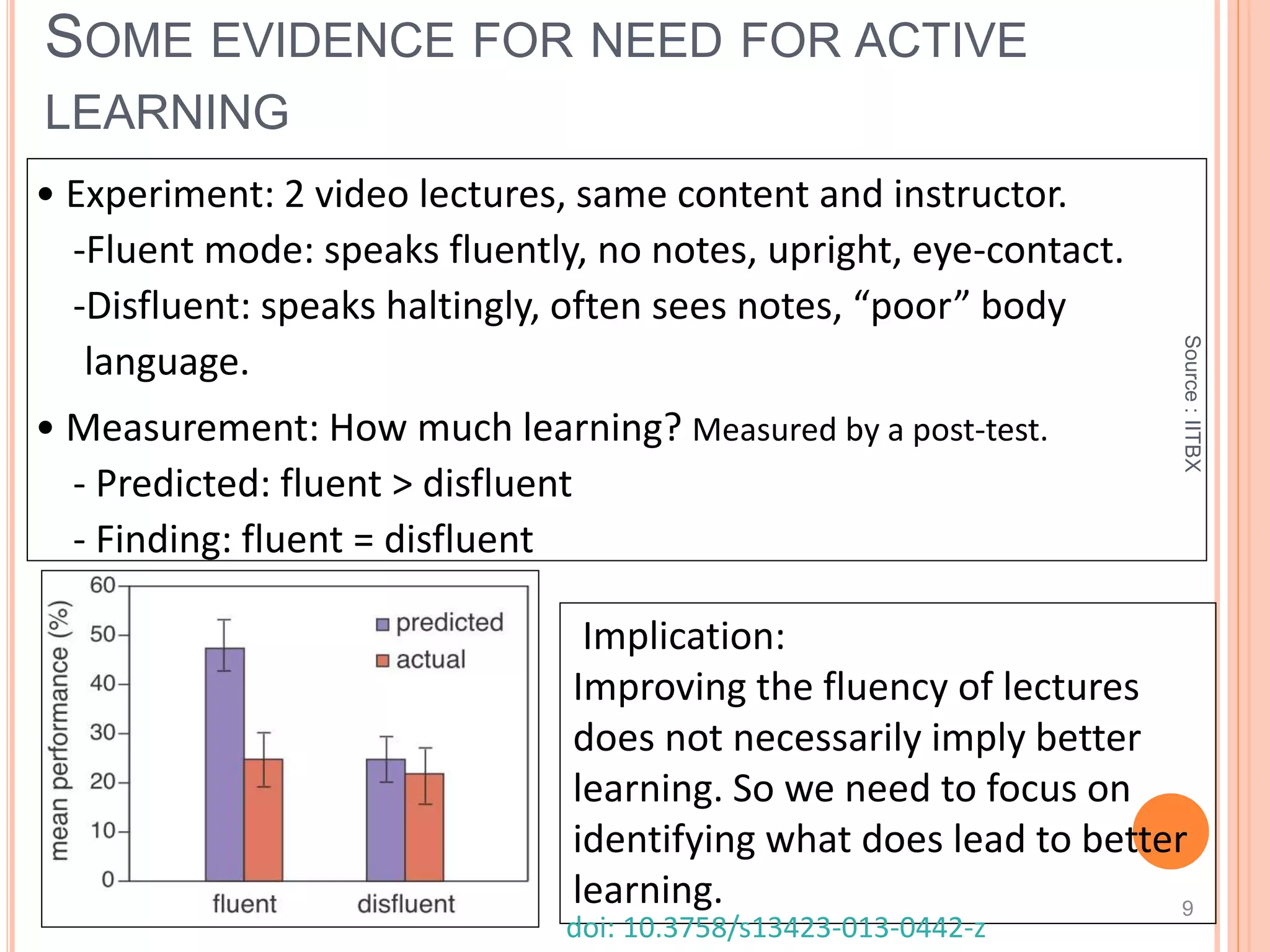
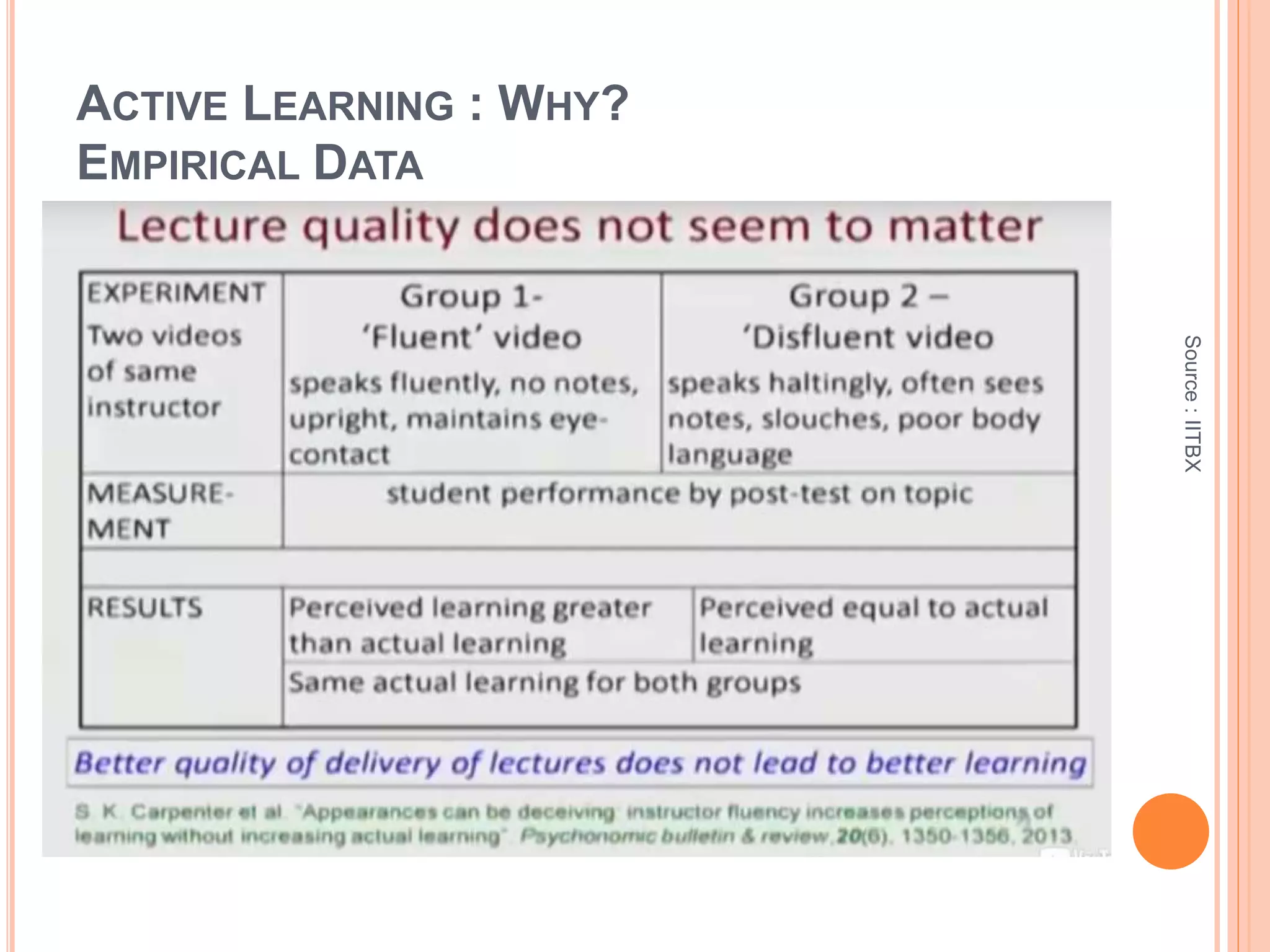
• Experiment: 2 video lectures, same content and instructor.
-Fluent mode: speaks fluently, no notes, upright, eye-contact.
-Disfluent: speaks haltingly, often sees notes, “poor” body
language.
• Measurement: How much learning? Measured by a post-test.
- Predicted: fluent > disfluent
- Finding: fluent = disfluent
Implication:
Improving the fluency of lectures
does not necessarily imply better
learning. So we need to focus on
identifying what does lead to better
learning.
doi: 10.3758/s13423-013-0442-z
ACTIVE LEARNING : WHY?
EMPIRICAL DATA
Source:IITBX
Source:IITBX
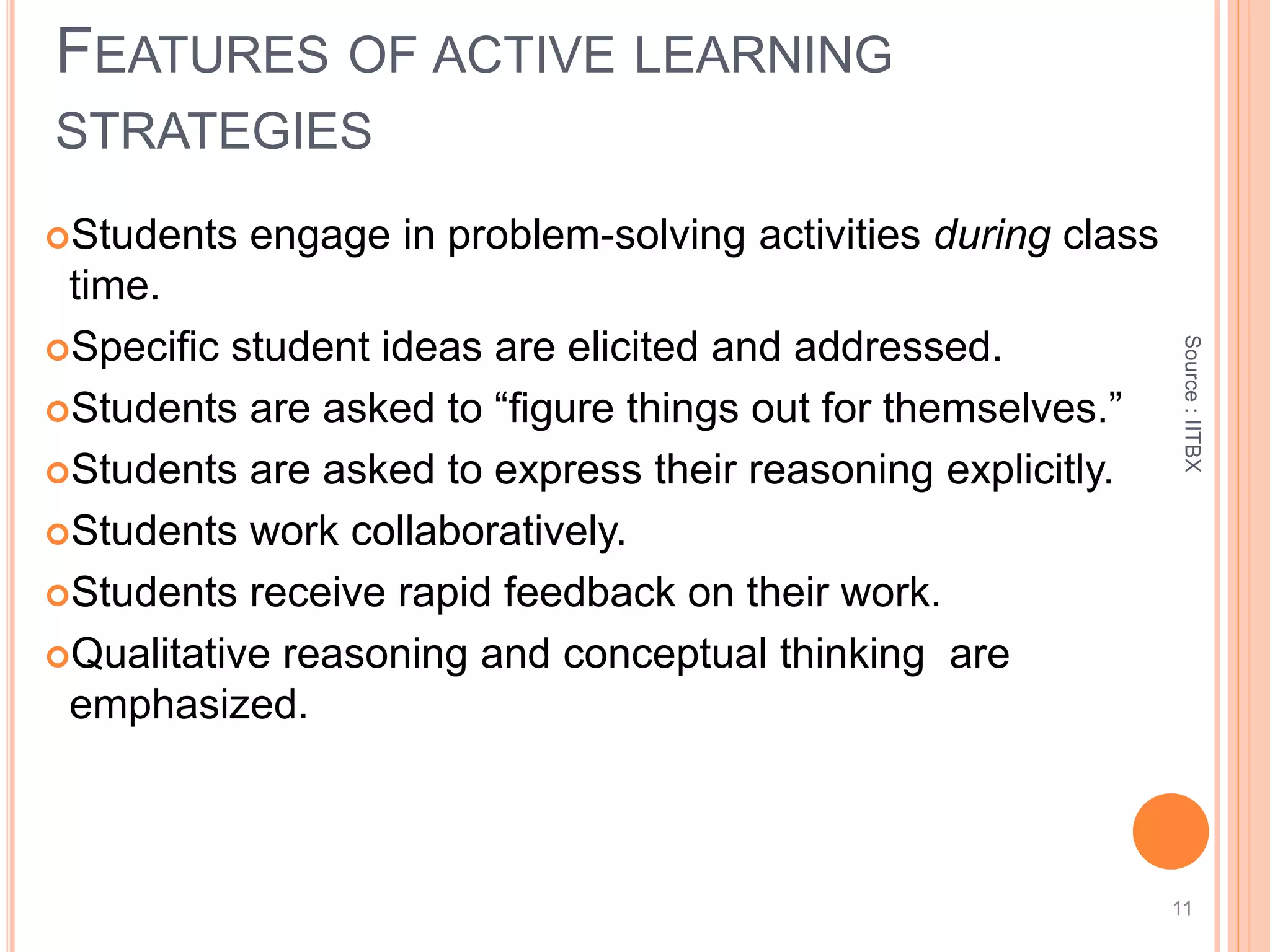
Students engage in problem-solving activities during class
time.
Specific student ideas are elicited and addressed.
Students are asked to “figure things out for themselves.”
Students are asked to express their reasoning explicitly.
Students work collaboratively.
Students receive rapid feedback on their work.
Qualitative reasoning and conceptual thinking are
emphasized.
FEATURES OF ACTIVE LEARNING
STRATEGIES
11
WHAT ARE SOME ACTIVE LEARNING STRATEGIES?
 Think-Pair-Share
[Frank Lyman, University of Maryland, early 1980s]
 Peer-Instruction
[Eric Mazur, Harvard University, early 1990s]
 Many others:
 Debates, Role-play, Jigsaw, problem-based learning, productive
failure.
Source:IITBX
THANK YOU
Source:IITBX

Active Learning

  • 1.
    ACTIVE LEARNING AND CLASSROOMSTRATEGIES - By Dr. Kiran Kakade Source:IITBX This work is licensed under a Creative Commons Attribution-NoDerivatives 4.0 International License. Source : https://goo.gl/images/RSBfjd
  • 2.
    WHAT IS ACTIVELEARNING? Approach to teaching and learning whose goal is to engage students with the content via specific activities that get students to talk, write, reflect and express their thinking.  There are several instructional strategies that can come under active learning.  Many informal strategies may have the same goal, but to be termed as active learning, they need to meet the following requirements. Source:IITBX
  • 3.
  • 4.
    REQUIREMENTS OF ACTIVELEARNING STRATEGIES: Instructor creates carefully designed activities that require students to talk, write, reflect and express their thinking. Students go beyond listening, copying of notes, execution of prescribed procedures. Explicitly based on theories of learning. Evaluated repeatedly through empirical research. Source:IITBX
  • 5.
    INTRODUCTION  WHY, WHATand HOW of active learning  Active learning strategies lead to student-centered teaching where students go beyond just listening and taking notes  Students get actively engaged with the content being taught in the class Source:IITBX
  • 6.
    ACTIVE LEARNING :WHY? Source:IITBX
  • 7.
  • 8.
  • 9.
    Source:IITBX SOME EVIDENCE FORNEED FOR ACTIVE LEARNING 9 • Experiment: 2 video lectures, same content and instructor. -Fluent mode: speaks fluently, no notes, upright, eye-contact. -Disfluent: speaks haltingly, often sees notes, “poor” body language. • Measurement: How much learning? Measured by a post-test. - Predicted: fluent > disfluent - Finding: fluent = disfluent Implication: Improving the fluency of lectures does not necessarily imply better learning. So we need to focus on identifying what does lead to better learning. doi: 10.3758/s13423-013-0442-z
  • 10.
    ACTIVE LEARNING :WHY? EMPIRICAL DATA Source:IITBX
  • 11.
    Source:IITBX Students engage inproblem-solving activities during class time. Specific student ideas are elicited and addressed. Students are asked to “figure things out for themselves.” Students are asked to express their reasoning explicitly. Students work collaboratively. Students receive rapid feedback on their work. Qualitative reasoning and conceptual thinking are emphasized. FEATURES OF ACTIVE LEARNING STRATEGIES 11
  • 12.
    WHAT ARE SOMEACTIVE LEARNING STRATEGIES?  Think-Pair-Share [Frank Lyman, University of Maryland, early 1980s]  Peer-Instruction [Eric Mazur, Harvard University, early 1990s]  Many others:  Debates, Role-play, Jigsaw, problem-based learning, productive failure. Source:IITBX
  • 13.