Carboxylic Acid
Introduction , Nomenclature & Preparation
Introduction
 In Carboxylic Acid, Functional group is –COOH.
 Any class of organic compounds with a Carbon double
bonded
to an oxygen and a terminal hydroxyl group.
 So, Carbonyl Group + Hydroxyl Group = Carboxyl
Group.
 R-COOH is a Aliphatic Acid & Ar-COOH is a Aromatic
Acid.
R = Alkyle Group & Ar = Aryle Group. If R = CH3 ,
CH3COOH
(Acetic Acid ) & If Ar = C6H5 , C6H5-COOH (Benzoic
Acid)
Nomenclature
Common System:
A. HCOOH formic acid L. Formica = ant
B. CH3COOH acetic acid L. acetum = vinegar
C. CH3CH2CH2COOH butyric acid L. butyrum = butter
Nomenclature(cont.)
IUPAC System :
A. Identify the longest continuous chain of carbons with the
carboxyl carbon as part of the chain.
B. Number the carbon chain so that the carboxyl carbon is always
number 1.
C. Locate and identify alphabetically the branched
groups by prefixing the carbon number it is attached to.
D. If more than one of the same type of branched group
is involved use prefixes di for 2, tri for three, etc.
E. alkane, drop –e, add –oic acid.
methane – e + oic acid = methanoic acid (H-COOH)
ethane – e + oic acid = ethanoic acid (CH3-COOH)
Nomenclature (cont.)
F. Functional groups priority : -COOH > -COOR
> -COX > -CONH2 > -CN > -CHO > -CO- > -OH
> - NH2 > -OR > -C=C- > -X > -NO2
CH3- CH(CH3)-CH(OH)-COOH
[ 2-hydroxy-3-methyl-butanoic acid ]
CH3-CH=CH-CH2-COOH
[ Pent-3-en-1-oic Acid ]
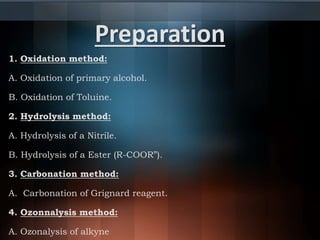
Preparation
1. Oxidation method:
A. Oxidation of primary alcohol.
B. Oxidation of Toluine.
2. Hydrolysis method:
A. Hydrolysis of a Nitrile.
B. Hydrolysis of a Ester (R-COOR”).
3. Carbonation method:
A. Carbonation of Grignard reagent.
4. Ozonnalysis method:
A. Ozonalysis of alkyne
Thank you

Carboxylic Acid.

  • 1.
    Carboxylic Acid Introduction ,Nomenclature & Preparation
  • 2.
    Introduction  In CarboxylicAcid, Functional group is –COOH.  Any class of organic compounds with a Carbon double bonded to an oxygen and a terminal hydroxyl group.  So, Carbonyl Group + Hydroxyl Group = Carboxyl Group.  R-COOH is a Aliphatic Acid & Ar-COOH is a Aromatic Acid. R = Alkyle Group & Ar = Aryle Group. If R = CH3 , CH3COOH (Acetic Acid ) & If Ar = C6H5 , C6H5-COOH (Benzoic Acid)
  • 3.
    Nomenclature Common System: A. HCOOHformic acid L. Formica = ant B. CH3COOH acetic acid L. acetum = vinegar C. CH3CH2CH2COOH butyric acid L. butyrum = butter
  • 4.
    Nomenclature(cont.) IUPAC System : A.Identify the longest continuous chain of carbons with the carboxyl carbon as part of the chain. B. Number the carbon chain so that the carboxyl carbon is always number 1. C. Locate and identify alphabetically the branched groups by prefixing the carbon number it is attached to. D. If more than one of the same type of branched group is involved use prefixes di for 2, tri for three, etc. E. alkane, drop –e, add –oic acid. methane – e + oic acid = methanoic acid (H-COOH) ethane – e + oic acid = ethanoic acid (CH3-COOH)
  • 5.
    Nomenclature (cont.) F. Functionalgroups priority : -COOH > -COOR > -COX > -CONH2 > -CN > -CHO > -CO- > -OH > - NH2 > -OR > -C=C- > -X > -NO2 CH3- CH(CH3)-CH(OH)-COOH [ 2-hydroxy-3-methyl-butanoic acid ] CH3-CH=CH-CH2-COOH [ Pent-3-en-1-oic Acid ]
  • 6.
    Preparation 1. Oxidation method: A.Oxidation of primary alcohol. B. Oxidation of Toluine. 2. Hydrolysis method: A. Hydrolysis of a Nitrile. B. Hydrolysis of a Ester (R-COOR”). 3. Carbonation method: A. Carbonation of Grignard reagent. 4. Ozonnalysis method: A. Ozonalysis of alkyne
  • 7.