PAULI EXCLUSION
PRINCIPLE
1-Pauli Exclusion Principle
2-Uses of the principle in periodic table
May
2019
Presented to:-
Prof. Dr. M. Irfan
Presented by:-
 Muhammad Imran
 Muhammad Sohail
 Muhammad Salahuddin
 Muhammad Shakeel
 Tanveer Azmat
2
Concept of Shells
& Subshells
These are actually the residing
places of electrons in an atom.
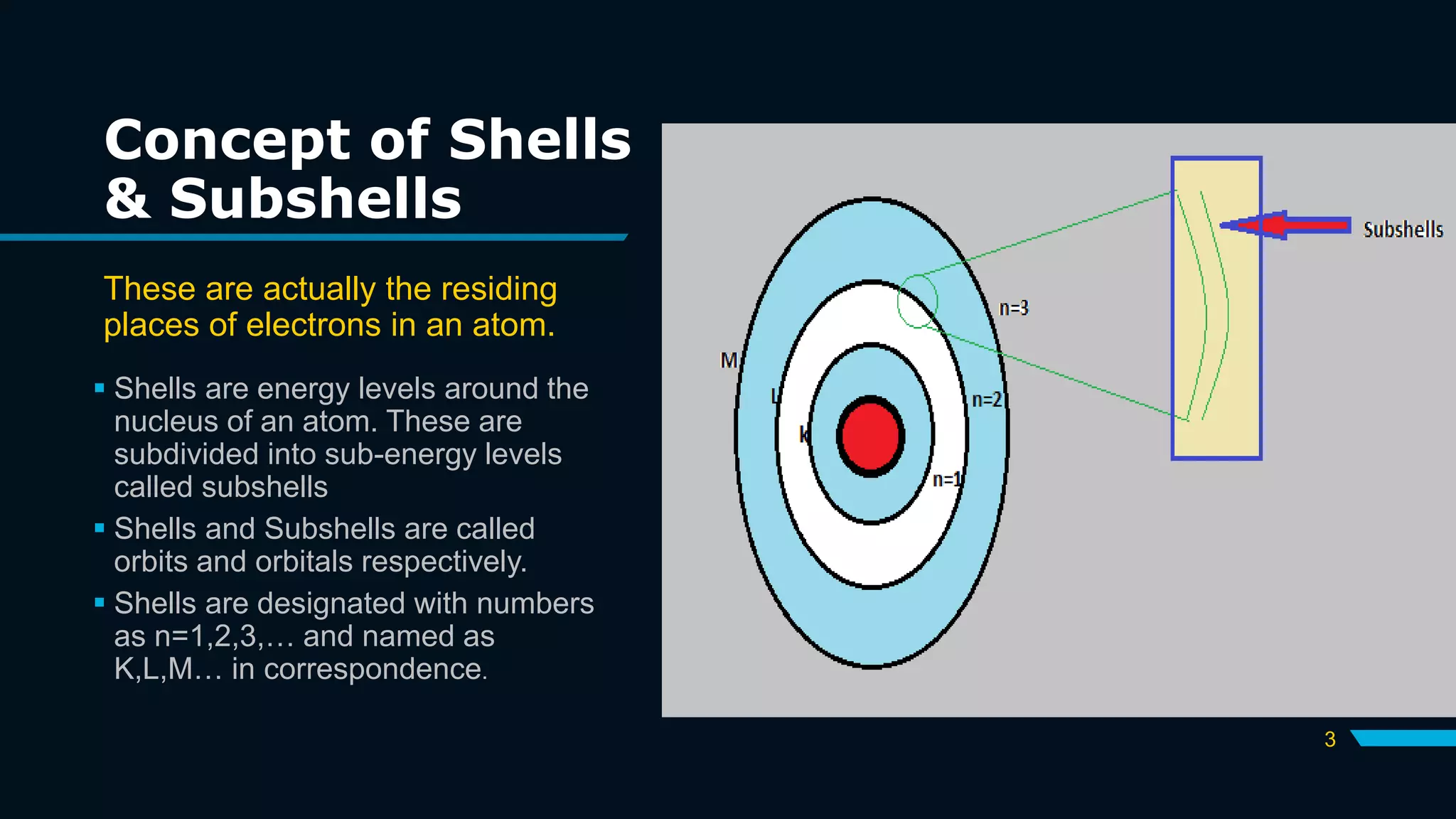
 Shells are energy levels around the
nucleus of an atom. These are
subdivided into sub-energy levels
called subshells
 Shells and Subshells are called
orbits and orbitals respectively.
 Shells are designated with numbers
as n=1,2,3,… and named as
K,L,M… in correspondence.
3
Intro to Orbitals
Also Known as Subshells or sub
energy levels.
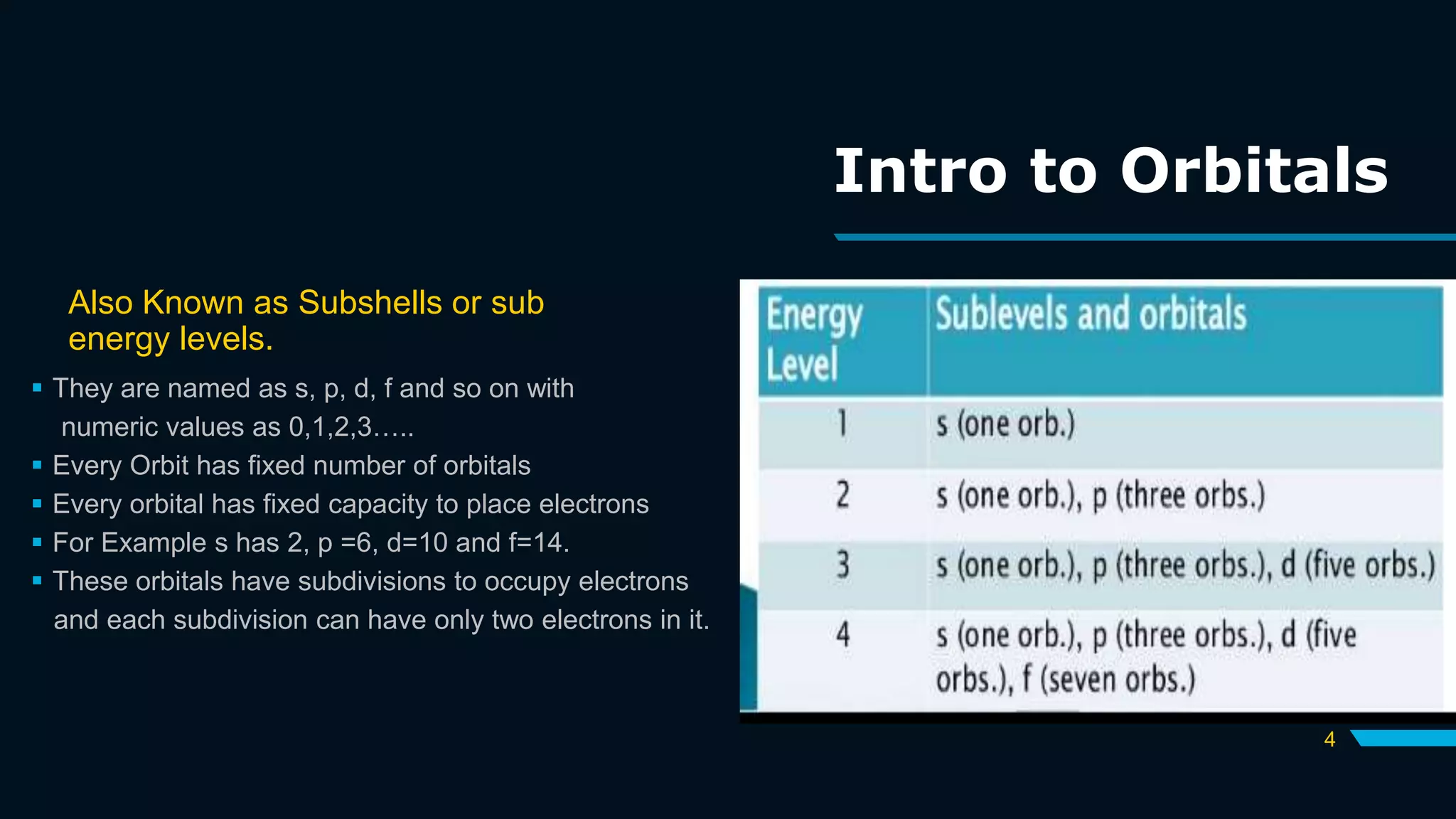
 They are named as s, p, d, f and so on with
numeric values as 0,1,2,3…..
 Every Orbit has fixed number of orbitals
 Every orbital has fixed capacity to place electrons
 For Example s has 2, p =6, d=10 and f=14.
 These orbitals have subdivisions to occupy electrons
and each subdivision can have only two electrons in it.
4
PAULI EXCLUSION PRINCIPLE
Based upon the previous electronic management in an atom we’ll try to explain
the above mentioned principle
Principle states that:-
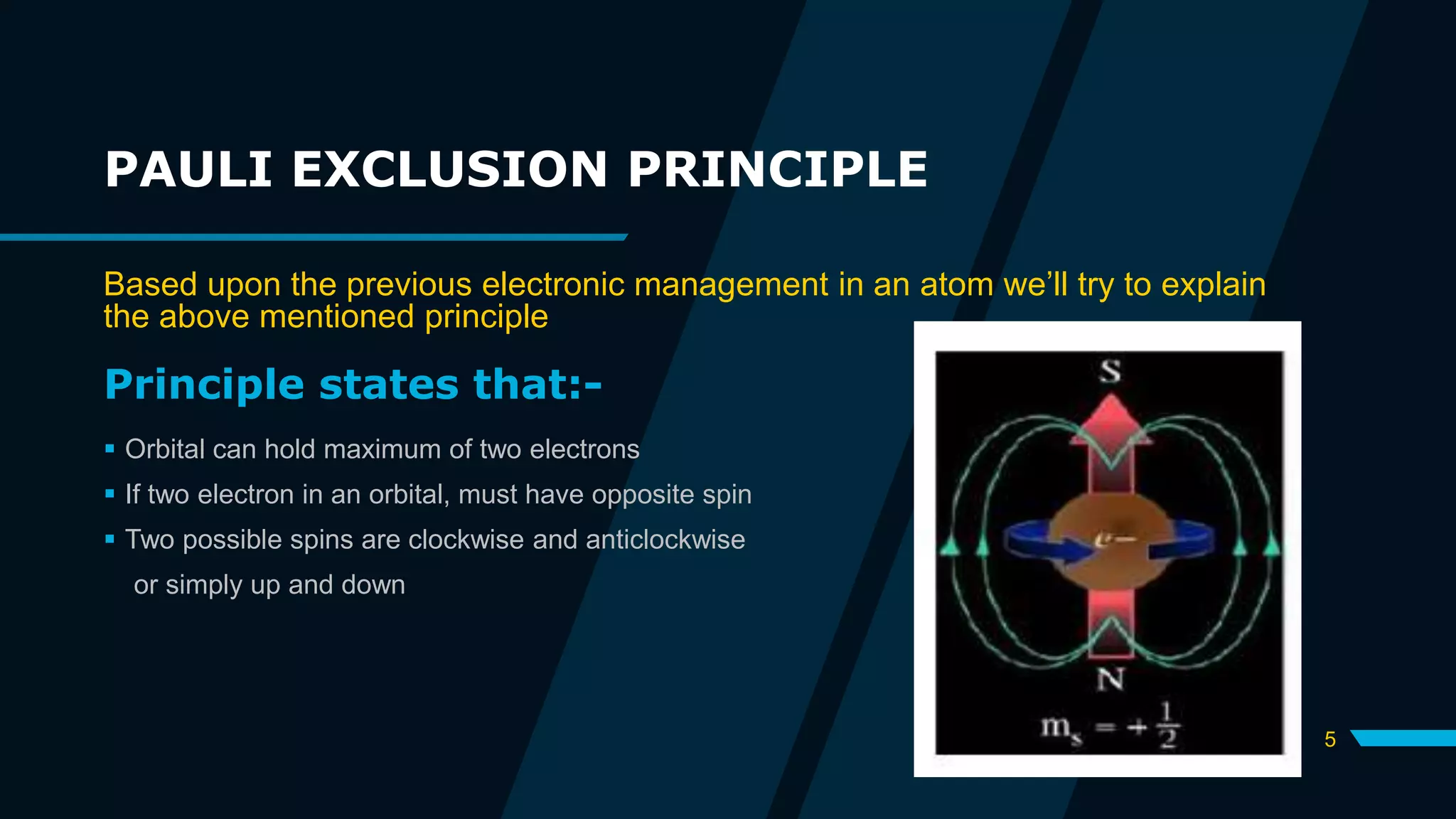
 Orbital can hold maximum of two electrons
 If two electron in an orbital, must have opposite spin
 Two possible spins are clockwise and anticlockwise
or simply up and down
5
Quantum Numbers
There are four quantum numbers which help in the explanation of atomic structure
and construction of periodic table. Those are:-
 Principle Quantum Number (n) where n= 1, 2, 3,…..
 Azimuthal Quantum Number(l) where l= 0, 1, 2,…….
 Spin Quantum Number(s) where s= +(1/2) & -(1/2)
 Magnetic Quantum Number(m) where m= 0,±1,±2,……….
6
Construction Of Periodic Table
& Pauli Exclusion Principle
The construction of the existing periodic table would not have been possible
without “the Pauli Exclusion Principle”. But we also need to utilize and follow
following rules:-
 Hund’s Rule
 Aufbao Principle
The above mentioned two rules along with the exclusion principle help in
construction of periodic table.
7
8
Main points for construction of Periodic Table
 Filling of Electrons in Shells/Subshells/sublevels( “/” shows path)
 Energy wise Sequence of Electronic Configuration
 Placement of elements in respective Blocks
9
Filling of Electrons in Shells/Subshells/sublevels
Considering Shell 2 or L with n=2, l=0,1 m=0,±1
10
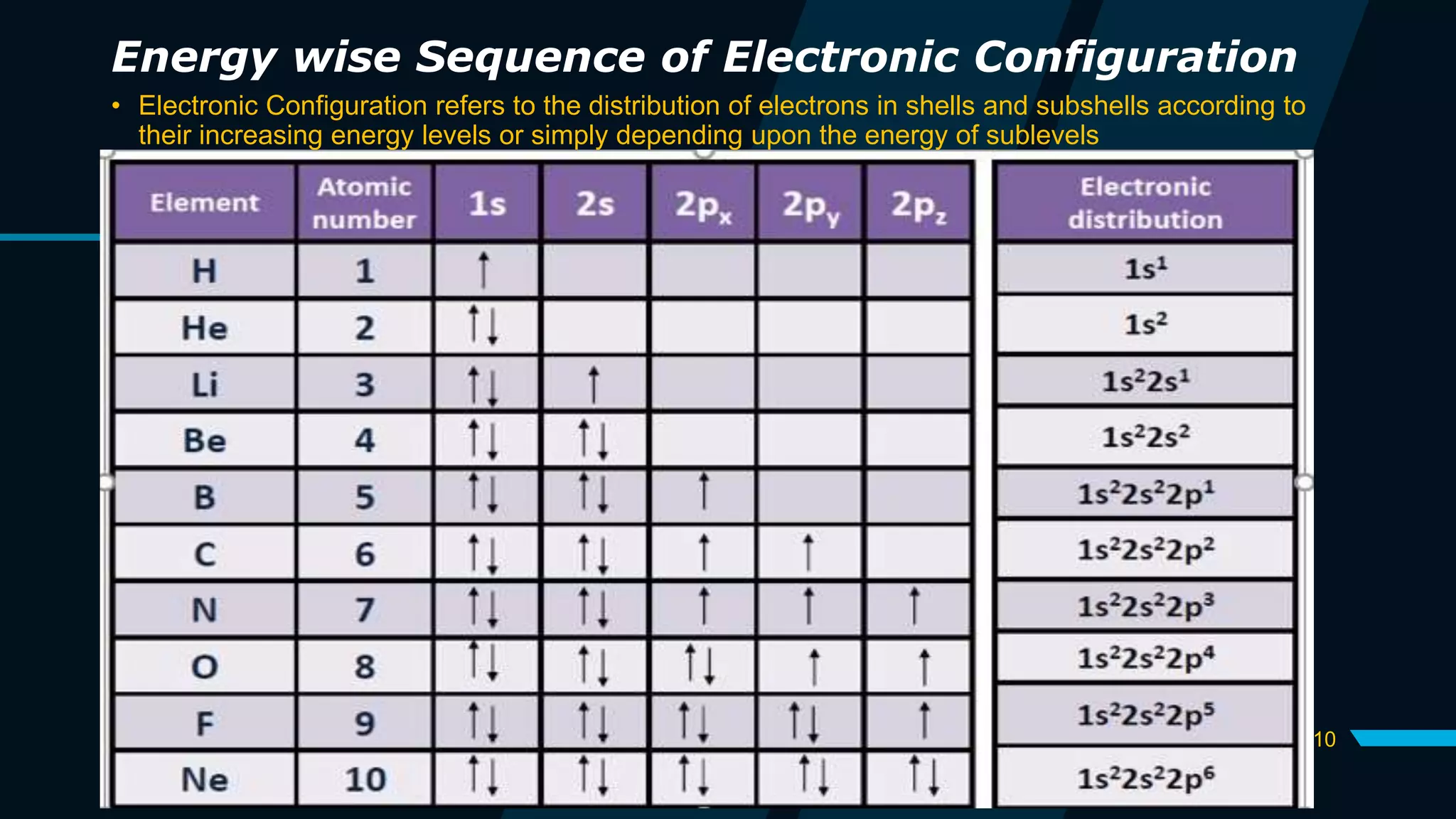
Energy wise Sequence of Electronic Configuration
• Electronic Configuration refers to the distribution of electrons in shells and subshells according to
their increasing energy levels or simply depending upon the energy of sublevels
11
Here is the trick for energy wise sequence
12
Placement of elements in respective Blocks
The periodic table is styled with a block distribution of the
elements depending upon their chemical properties which is
directly governed by electronic configuration of the shells,
ultimately Pauli Exclusion Principle stood responsible for the
chemical properties of elements and development Periodic table.
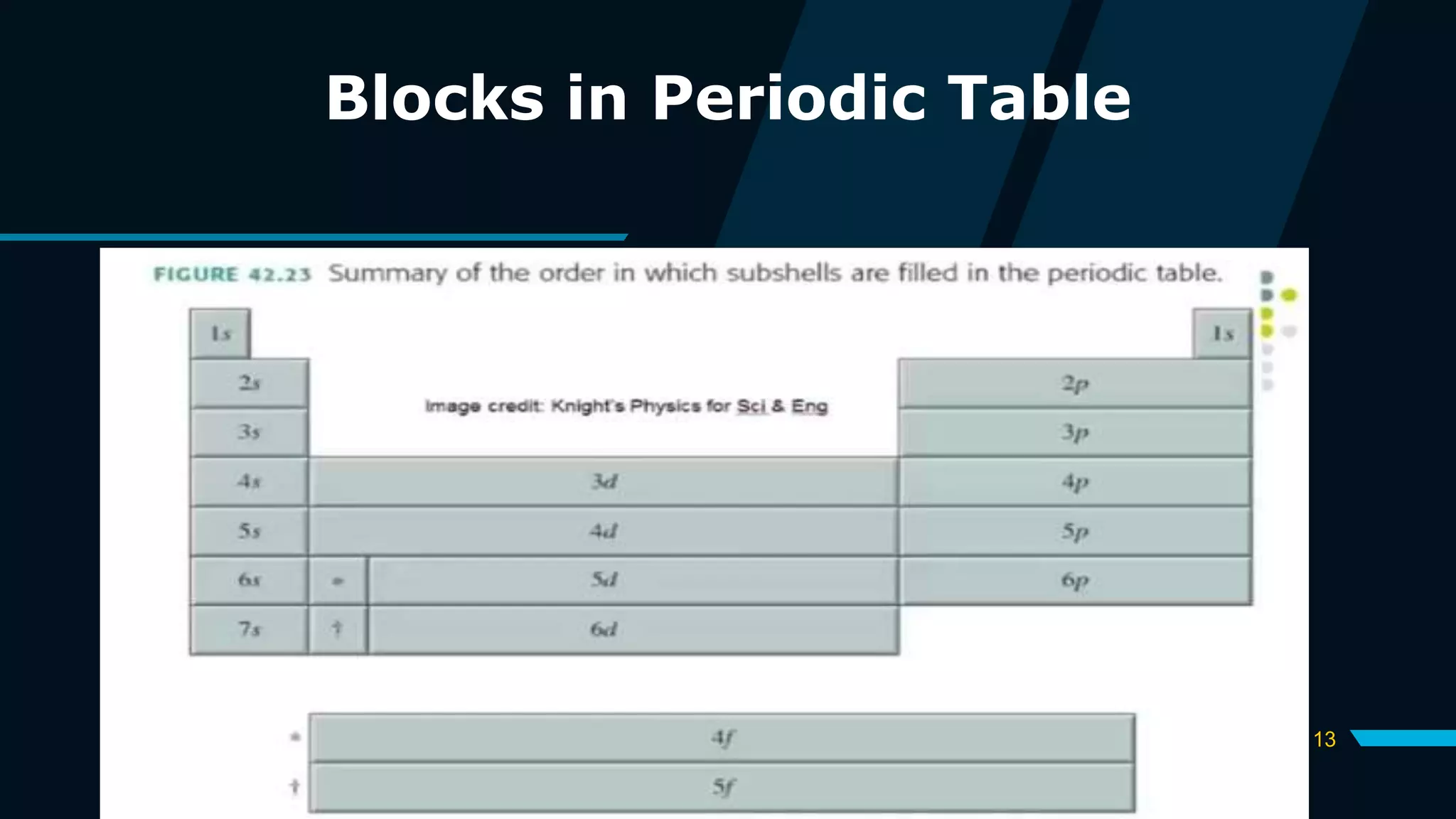
Following Picture shows the blocks along with configuration:-
13
Blocks in Periodic Table
14
Importance Of Pauli Exclusion Principle
If this principle were not valid, an atom could radiate energy until
every electron in the atom is in the lowest possible energy state
and therefore the chemical behavior of the elements would be
grossly modified. Nature as we know it would not exist. That’s the
importance of Pauli Exclusion Principle in the construction of
periodic table.
THANK
YOU!
Group-C
Email
imran8163733@gmail.com

Pauli exclusion principle

  • 1.
    PAULI EXCLUSION PRINCIPLE 1-Pauli ExclusionPrinciple 2-Uses of the principle in periodic table May 2019
  • 2.
    Presented to:- Prof. Dr.M. Irfan Presented by:-  Muhammad Imran  Muhammad Sohail  Muhammad Salahuddin  Muhammad Shakeel  Tanveer Azmat 2
  • 3.
    Concept of Shells &Subshells These are actually the residing places of electrons in an atom.  Shells are energy levels around the nucleus of an atom. These are subdivided into sub-energy levels called subshells  Shells and Subshells are called orbits and orbitals respectively.  Shells are designated with numbers as n=1,2,3,… and named as K,L,M… in correspondence. 3
  • 4.
    Intro to Orbitals AlsoKnown as Subshells or sub energy levels.  They are named as s, p, d, f and so on with numeric values as 0,1,2,3…..  Every Orbit has fixed number of orbitals  Every orbital has fixed capacity to place electrons  For Example s has 2, p =6, d=10 and f=14.  These orbitals have subdivisions to occupy electrons and each subdivision can have only two electrons in it. 4
  • 5.
    PAULI EXCLUSION PRINCIPLE Basedupon the previous electronic management in an atom we’ll try to explain the above mentioned principle Principle states that:-  Orbital can hold maximum of two electrons  If two electron in an orbital, must have opposite spin  Two possible spins are clockwise and anticlockwise or simply up and down 5
  • 6.
    Quantum Numbers There arefour quantum numbers which help in the explanation of atomic structure and construction of periodic table. Those are:-  Principle Quantum Number (n) where n= 1, 2, 3,…..  Azimuthal Quantum Number(l) where l= 0, 1, 2,…….  Spin Quantum Number(s) where s= +(1/2) & -(1/2)  Magnetic Quantum Number(m) where m= 0,±1,±2,………. 6
  • 7.
    Construction Of PeriodicTable & Pauli Exclusion Principle The construction of the existing periodic table would not have been possible without “the Pauli Exclusion Principle”. But we also need to utilize and follow following rules:-  Hund’s Rule  Aufbao Principle The above mentioned two rules along with the exclusion principle help in construction of periodic table. 7
  • 8.
    8 Main points forconstruction of Periodic Table  Filling of Electrons in Shells/Subshells/sublevels( “/” shows path)  Energy wise Sequence of Electronic Configuration  Placement of elements in respective Blocks
  • 9.
    9 Filling of Electronsin Shells/Subshells/sublevels Considering Shell 2 or L with n=2, l=0,1 m=0,±1
  • 10.
    10 Energy wise Sequenceof Electronic Configuration • Electronic Configuration refers to the distribution of electrons in shells and subshells according to their increasing energy levels or simply depending upon the energy of sublevels
  • 11.
    11 Here is thetrick for energy wise sequence
  • 12.
    12 Placement of elementsin respective Blocks The periodic table is styled with a block distribution of the elements depending upon their chemical properties which is directly governed by electronic configuration of the shells, ultimately Pauli Exclusion Principle stood responsible for the chemical properties of elements and development Periodic table. Following Picture shows the blocks along with configuration:-
  • 13.
  • 14.
    14 Importance Of PauliExclusion Principle If this principle were not valid, an atom could radiate energy until every electron in the atom is in the lowest possible energy state and therefore the chemical behavior of the elements would be grossly modified. Nature as we know it would not exist. That’s the importance of Pauli Exclusion Principle in the construction of periodic table.
  • 15.