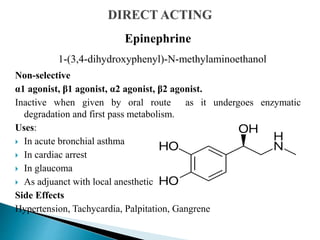
Epinephrine
1-(3,4-dihydroxyphenyl)-N-methylaminoethanol
Non-selective
α1 agonist, β1 agonist, α2 agonist, β2 agonist.
Inactive when given by oral route as it undergoes enzymatic
degradation and first pass metabolism.
Uses:
 In acute bronchial asthma
 In cardiac arrest
 In glaucoma
 As adjuanct with local anesthetic
Side Effects
Hypertension, Tachycardia, Palpitation, Gangrene
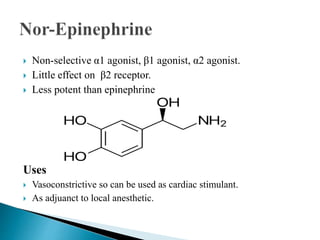
 Non-selective α1 agonist, β1 agonist, α2 agonist.
 Little effect on β2 receptor.
 Less potent than epinephrine
Uses
 Vasoconstrictive so can be used as cardiac stimulant.
 As adjuanct to local anesthetic.
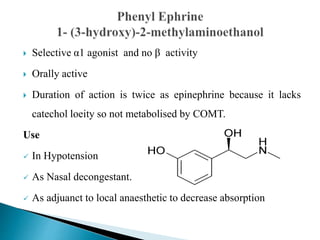
 Selective α1 agonist and no β activity
 Orally active
 Duration of action is twice as epinephrine because it lacks
catechol loeity so not metabolised by COMT.
Use
 In Hypotension
 As Nasal decongestant.
 As adjuanct to local anaesthetic to decrease absorption
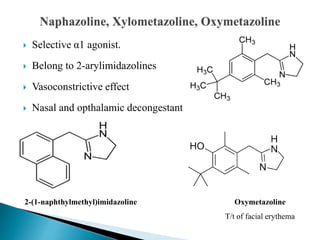
 Selective α1 agonist.
 Belong to 2-arylimidazolines
 Vasoconstrictive effect
 Nasal and opthalamic decongestant
2-(1-naphthylmethyl)imidazoline Oxymetazoline
T/t of facial erythema
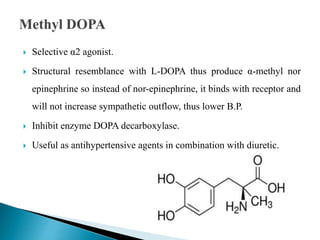
 Selective α2 agonist.
 Structural resemblance with L-DOPA thus produce α-methyl nor
epinephrine so instead of nor-epinephrine, it binds with receptor and
will not increase sympathetic outflow, thus lower B.P.
 Inhibit enzyme DOPA decarboxylase.
 Useful as antihypertensive agents in combination with diuretic.
 2-[(2,6-dichlorophenyl)amino]-2-imidazoline
 Selective α2 agonist.
 Orally as well as I/v active
 Interact specifically with α2 receptor and decrease sympathetic outflow.
 Used as anti-hypertensive agent and in migraine also.
 T/t of tourette syndrome (neuropsychiatric disorder with onset in childhood)
 For clonidine, basicity of guanidine group is decreased to 8 because of
inductive and resonance effect of dichlorophenyl ring. Thus, it will exist in non-
ionized form required to enter CNS and thus produce sedative effect
(Premedication before surgery)
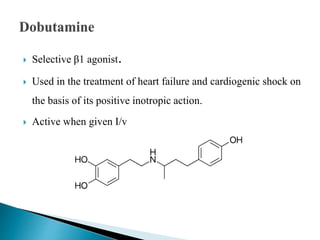
 Selective β1 agonist.
 Used in the treatment of heart failure and cardiogenic shock on
the basis of its positive inotropic action.
 Active when given I/v
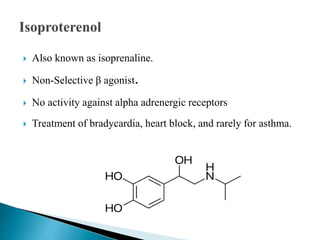
 Also known as isoprenaline.
 Non-Selective β agonist.
 No activity against alpha adrenergic receptors
 Treatment of bradycardia, heart block, and rarely for asthma.
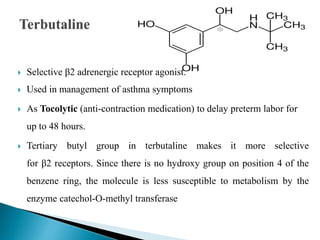
 Selective β2 adrenergic receptor agonist.
 Used in management of asthma symptoms
 As Tocolytic (anti-contraction medication) to delay preterm labor for
up to 48 hours.
 Tertiary butyl group in terbutaline makes it more selective
for β2 receptors. Since there is no hydroxy group on position 4 of the
benzene ring, the molecule is less susceptible to metabolism by the
enzyme catechol-O-methyl transferase
 2- t-butylamino-1-[(3-hdroxymethyl-4-hydroxy)phenyl]ethanol
 Selective β2 adrenergic receptor agonist.
 Used in management of asthma symptoms and COPD
 Salbutamol has been used to treat acute hyperkalemia, as it stimulates
potassium flow into cells, thus lowering the potassium in the blood
 As Tocolytic (anti-contraction medication)
 Tertiary butyl group makes it more selective for β2 receptors. Since there is no
hydroxy group on position 4 of the benzene ring, the molecule is less
susceptible to metabolism by the enzyme catechol-O-methyl transferase
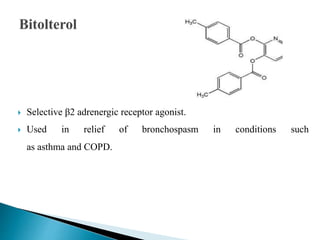
 Selective β2 adrenergic receptor agonist.
 Used in relief of bronchospasm in conditions such
as asthma and COPD.
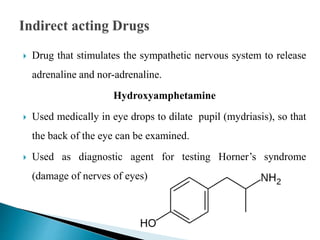
 Drug that stimulates the sympathetic nervous system to release
adrenaline and nor-adrenaline.
Hydroxyamphetamine
 Used medically in eye drops to dilate pupil (mydriasis), so that
the back of the eye can be examined.
 Used as diagnostic agent for testing Horner’s syndrome
(damage of nerves of eyes)
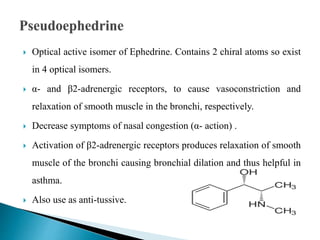
 Optical active isomer of Ephedrine. Contains 2 chiral atoms so exist
in 4 optical isomers.
 α- and β2-adrenergic receptors, to cause vasoconstriction and
relaxation of smooth muscle in the bronchi, respectively.
 Decrease symptoms of nasal congestion (α- action) .
 Activation of β2-adrenergic receptors produces relaxation of smooth
muscle of the bronchi causing bronchial dilation and thus helpful in
asthma.
 Also use as anti-tussive.
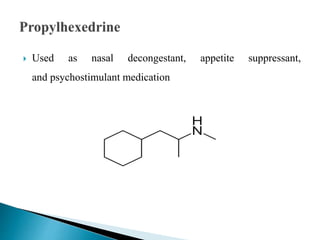
 Used as nasal decongestant, appetite suppressant,
and psychostimulant medication
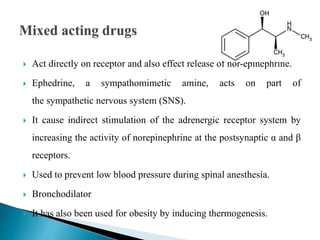
 Act directly on receptor and also effect release of nor-epinephrine.
 Ephedrine, a sympathomimetic amine, acts on part of
the sympathetic nervous system (SNS).
 It cause indirect stimulation of the adrenergic receptor system by
increasing the activity of norepinephrine at the postsynaptic α and β
receptors.
 Used to prevent low blood pressure during spinal anesthesia.
 Bronchodilator
 It has also been used for obesity by inducing thermogenesis.
 Metaraminol, also known as metaradrine, a stereoisomer of meta-
hydroxynorephedrine is a potent sympathomimetic amine used in
the prevention and treatment of hypotension.
 It is an α1-adrenergic receptor agonist with some β effect.
 Metaraminol is also used in the treatment of priapism (condition in
which a penis remains erect for hours in the absence of stimulation
or after stimulation has ended)

Sympathomimetic Drugs.ppt

  • 2.
    Epinephrine 1-(3,4-dihydroxyphenyl)-N-methylaminoethanol Non-selective α1 agonist, β1agonist, α2 agonist, β2 agonist. Inactive when given by oral route as it undergoes enzymatic degradation and first pass metabolism. Uses:  In acute bronchial asthma  In cardiac arrest  In glaucoma  As adjuanct with local anesthetic Side Effects Hypertension, Tachycardia, Palpitation, Gangrene
  • 3.
     Non-selective α1agonist, β1 agonist, α2 agonist.  Little effect on β2 receptor.  Less potent than epinephrine Uses  Vasoconstrictive so can be used as cardiac stimulant.  As adjuanct to local anesthetic.
  • 4.
     Selective α1agonist and no β activity  Orally active  Duration of action is twice as epinephrine because it lacks catechol loeity so not metabolised by COMT. Use  In Hypotension  As Nasal decongestant.  As adjuanct to local anaesthetic to decrease absorption
  • 5.
     Selective α1agonist.  Belong to 2-arylimidazolines  Vasoconstrictive effect  Nasal and opthalamic decongestant 2-(1-naphthylmethyl)imidazoline Oxymetazoline T/t of facial erythema
  • 6.
     Selective α2agonist.  Structural resemblance with L-DOPA thus produce α-methyl nor epinephrine so instead of nor-epinephrine, it binds with receptor and will not increase sympathetic outflow, thus lower B.P.  Inhibit enzyme DOPA decarboxylase.  Useful as antihypertensive agents in combination with diuretic.
  • 7.
     2-[(2,6-dichlorophenyl)amino]-2-imidazoline  Selectiveα2 agonist.  Orally as well as I/v active  Interact specifically with α2 receptor and decrease sympathetic outflow.  Used as anti-hypertensive agent and in migraine also.  T/t of tourette syndrome (neuropsychiatric disorder with onset in childhood)  For clonidine, basicity of guanidine group is decreased to 8 because of inductive and resonance effect of dichlorophenyl ring. Thus, it will exist in non- ionized form required to enter CNS and thus produce sedative effect (Premedication before surgery)
  • 8.
     Selective β1agonist.  Used in the treatment of heart failure and cardiogenic shock on the basis of its positive inotropic action.  Active when given I/v
  • 9.
     Also knownas isoprenaline.  Non-Selective β agonist.  No activity against alpha adrenergic receptors  Treatment of bradycardia, heart block, and rarely for asthma.
  • 10.
     Selective β2adrenergic receptor agonist.  Used in management of asthma symptoms  As Tocolytic (anti-contraction medication) to delay preterm labor for up to 48 hours.  Tertiary butyl group in terbutaline makes it more selective for β2 receptors. Since there is no hydroxy group on position 4 of the benzene ring, the molecule is less susceptible to metabolism by the enzyme catechol-O-methyl transferase
  • 11.
     2- t-butylamino-1-[(3-hdroxymethyl-4-hydroxy)phenyl]ethanol Selective β2 adrenergic receptor agonist.  Used in management of asthma symptoms and COPD  Salbutamol has been used to treat acute hyperkalemia, as it stimulates potassium flow into cells, thus lowering the potassium in the blood  As Tocolytic (anti-contraction medication)  Tertiary butyl group makes it more selective for β2 receptors. Since there is no hydroxy group on position 4 of the benzene ring, the molecule is less susceptible to metabolism by the enzyme catechol-O-methyl transferase
  • 12.
     Selective β2adrenergic receptor agonist.  Used in relief of bronchospasm in conditions such as asthma and COPD.
  • 13.
     Drug thatstimulates the sympathetic nervous system to release adrenaline and nor-adrenaline. Hydroxyamphetamine  Used medically in eye drops to dilate pupil (mydriasis), so that the back of the eye can be examined.  Used as diagnostic agent for testing Horner’s syndrome (damage of nerves of eyes)
  • 14.
     Optical activeisomer of Ephedrine. Contains 2 chiral atoms so exist in 4 optical isomers.  α- and β2-adrenergic receptors, to cause vasoconstriction and relaxation of smooth muscle in the bronchi, respectively.  Decrease symptoms of nasal congestion (α- action) .  Activation of β2-adrenergic receptors produces relaxation of smooth muscle of the bronchi causing bronchial dilation and thus helpful in asthma.  Also use as anti-tussive.
  • 15.
     Used asnasal decongestant, appetite suppressant, and psychostimulant medication
  • 16.
     Act directlyon receptor and also effect release of nor-epinephrine.  Ephedrine, a sympathomimetic amine, acts on part of the sympathetic nervous system (SNS).  It cause indirect stimulation of the adrenergic receptor system by increasing the activity of norepinephrine at the postsynaptic α and β receptors.  Used to prevent low blood pressure during spinal anesthesia.  Bronchodilator  It has also been used for obesity by inducing thermogenesis.
  • 17.
     Metaraminol, alsoknown as metaradrine, a stereoisomer of meta- hydroxynorephedrine is a potent sympathomimetic amine used in the prevention and treatment of hypotension.  It is an α1-adrenergic receptor agonist with some β effect.  Metaraminol is also used in the treatment of priapism (condition in which a penis remains erect for hours in the absence of stimulation or after stimulation has ended)