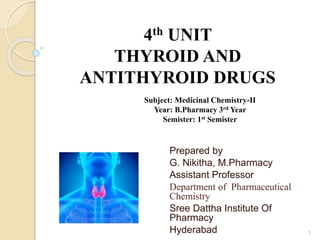
4th UNIT
THYROID AND
ANTITHYROID DRUGS
Prepared by
G. Nikitha, M.Pharmacy
Assistant Professor
Department of Pharmaceutical
Chemistry
Sree Dattha Institute Of
Pharmacy
Hyderabad 1
Subject: Medicinal Chemistry-II
Year: B.Pharmacy 3rd Year
Semister: 1st Semister
Contents
 Introduction.
 Biosynthesis
 Types of Thyroid diseases
 Thyroid Drugs
 Antithyroid Drugs
 Mechanism of action
 Structure
 Adverse Drug Reactions and Uses.
 Reference
2
Introduction
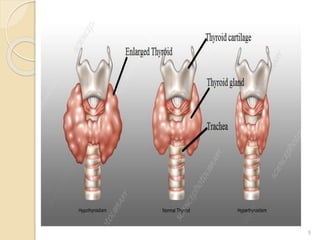
 Thyroid gland is one of the largest and highly vascularized
endocrine gland present in the body.
 It is made up of functional units called follicles or acinus.
 Follicles contain a cavity known as follicle lumen that is filled with
gelatinous colloid is surrounded by a single layer of epithelial cells.
 A glycoprotein known as thyroglobulin is a protein of high
molecular weight that binds the iodine present in organic form.
 Upon hydrolysis thyroglobulin releases thyroid hormones which
are considered to be iodinated tyrosine derivatives a they are
considered from l-tyrosine.
3
 Thyroid gland is controlled and maintained by pituitary gland and
hypothalamus.
 This gland secretes three main hormones known as thyroxine (T4),
triiodothyronine (T3) and calcitonin.
 The thyroid hormone (T3 and T4) are nonsteroidal in nature and are
chemically regarded as the amino acids containing iodinated
diphenyl ethers.
 Thyroxine (T4) is the major form of thyroid hormone found in
circulation.
 The ratio of Thyroxine (T4) to triiodothyronine (T3) releases into the
blood circulation is 20:1.
 Thyroid glands also secrete calcitanin that is responsible for
maintaining calcium homeostasis.
 Calcitonin is produced by the parafollicular cells of the thyroid
glands.
4
5
Biosynthesis
6
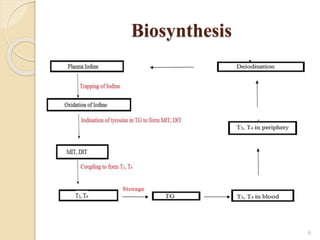
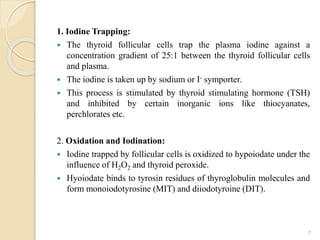
1. Iodine Trapping:
 The thyroid follicular cells trap the plasma iodine against a
concentration gradient of 25:1 between the thyroid follicular cells
and plasma.
 The iodine is taken up by sodium or I- symporter.
 This process is stimulated by thyroid stimulating hormone (TSH)
and inhibited by certain inorganic ions like thiocyanates,
perchlorates etc.
2. Oxidation and Iodination:
 Iodine trapped by follicular cells is oxidized to hypoiodate under the
influence of H2O2 and thyroid peroxide.
 Hyoiodate binds to tyrosin residues of thyroglobulin molecules and
form monoiodotyrosine (MIT) and diiodotyroine (DIT).
7
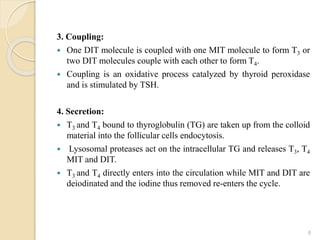
3. Coupling:
 One DIT molecule is coupled with one MIT molecule to form T3 or
two DIT molecules couple with each other to form T4.
 Coupling is an oxidative process catalyzed by thyroid peroxidase
and is stimulated by TSH.
4. Secretion:
 T3 and T4 bound to thyroglobulin (TG) are taken up from the colloid
material into the follicular cells endocytosis.
 Lysosomal proteases act on the intracellular TG and releases T3, T4
MIT and DIT.
 T3 and T4 directly enters into the circulation while MIT and DIT are
deiodinated and the iodine thus removed re-enters the cycle.
8
5. Peripheral conversion of T4 to T3:
 T3 is principle hormone and physiologically more active, but is
formed in lesser amounts than T4 converted to T3 (active form) in
the peripheral tissues especially liver and kidney.
 This process is inhibited by drugs such as propranolol,
glucocorticoids and propyithiouracil.
9
Mechanism of action:
 Thyroid hormones diffuse across the cell membrane and bind into
intracellular thyroid receptors.
 After penetrating into the cell T4 gets converted to T3 which as more
affinity for the thyroid receptors.
 When T3 binds to receptors they undergo a change in their
conformation which stimulates transcription resulting in the
synthesis of proteins which produce T3 and T4 action.
10
Pharmacokinetics:
 T3 and T4 are well absorbed orally. T3 gets distributed to a variety of
organs while T4 is concentrated mainly in liver and kidneys.
 Most of circulating T3 and T4 are bound to three proteins namely
thyroxin binding globulin (TBG), thyroxin binding prealbumin
(TBPA) and albumin.
 About 75% of T3 and T4 are bound to TBG hence only minute
amounts of free hormone is I available for action, metabolism and
elimination.
 T3 and T4 mainly gets metabolized in the liver by de-iodination and
glucoronide or sulfate conjugation and excreted in the bile and
urine.
11
Adverse Drug Reactions:
 Diarrhea
 Head ache,
 Weight loss
 Palpitation
 Tremors,
 Irritability
 Hyperkinesia,
 Heart Intolerance
 They occasionally cause anginal pain in the patients with ischemic
heart disease.
 They precipitate hypoadrenal crisis in patients suffering from
hypocortisolism and hyperthyroidism as well. Hence to avoid this
patients are retreated with glucocorticoids.
12
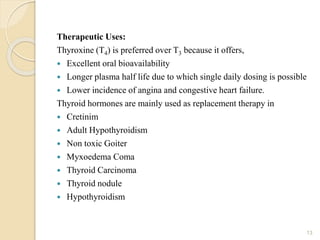
Therapeutic Uses:
Thyroxine (T4) is preferred over T3 because it offers,
 Excellent oral bioavailability
 Longer plasma half life due to which single daily dosing is possible
 Lower incidence of angina and congestive heart failure.
Thyroid hormones are mainly used as replacement therapy in
 Cretinim
 Adult Hypothyroidism
 Non toxic Goiter
 Myxoedema Coma
 Thyroid Carcinoma
 Thyroid nodule
 Hypothyroidism
13
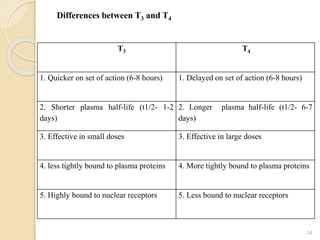
Differences between T3 and T4
14
T3 T4
1. Quicker on set of action (6-8 hours) 1. Delayed on set of action (6-8 hours)
2. Shorter plasma half-life (t1/2- 1-2
days)
2. Longer plasma half-life (t1/2- 6-7
days)
3. Effective in small doses 3. Effective in large doses
4. less tightly bound to plasma proteins 4. More tightly bound to plasma proteins
5. Highly bound to nuclear receptors 5. Less bound to nuclear receptors
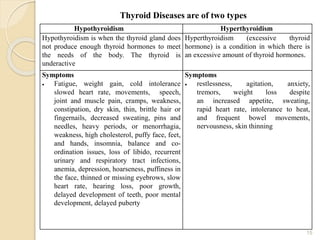
Thyroid Diseases are of two types
15
Hypothyroidism Hyperthyroidism
Hypothyroidism is when the thyroid gland does
not produce enough thyroid hormones to meet
the needs of the body. The thyroid is
underactive
Hyperthyroidism (excessive thyroid
hormone) is a condition in which there is
an excessive amount of thyroid hormones.
Symptoms
 Fatigue, weight gain, cold intolerance
slowed heart rate, movements, speech,
joint and muscle pain, cramps, weakness,
constipation, dry skin, thin, brittle hair or
fingernails, decreased sweating, pins and
needles, heavy periods, or menorrhagia,
weakness, high cholesterol, puffy face, feet,
and hands, insomnia, balance and co-
ordination issues, loss of libido, recurrent
urinary and respiratory tract infections,
anemia, depression, hoarseness, puffiness in
the face, thinned or missing eyebrows, slow
heart rate, hearing loss, poor growth,
delayed development of teeth, poor mental
development, delayed puberty
Symptoms
 restlessness, agitation, anxiety,
tremors, weight loss despite
an increased appetite, sweating,
rapid heart rate, intolerance to heat,
and frequent bowel movements,
nervousness, skin thinning
Thyroid Drugs
16
 Thyroid Drugs are used to correct hypothyroidism. Various Thyroid
Drugs employed include levothyroxine (L-Thyroxine),
Levothyronine (L-Thyronine), Liotrix and dessicated thyroid gland
and thyroglobulin.
Mechanism of action:
 Thyroid hormones diffuse across the cell membrane and bind into
intracellular thyroid receptors.
 After penetrating into the cell T4 gets converted to T3 which as more
affinity for the thyroid receptors.
 When T3 binds to receptors they undergo a change in their
conformation which stimulates transcription resulting in the
synthesis of proteins which produce T3 and T4 action.
17
Adverse Drug Reactions:
 Diarrhea
 Head ache
 Weight loss
 Palpitation
 Tremors
 Irritability
 Hyperkinesia
 Heart Intolerance
 They occasionally cause anginal pain in the patients with ischemic
heart disease.
 They precipitate hypoadrenal crisis in patients suffering from
hypocortisolism and hyperthyroidism as well. Hence to avoid this
patients are retreated with glucocorticoids.
18
Therapeutic Uses:
Thyroxine (T4) is preferred over T3 because it offers,
 Excellent oral bioavailability
 Longer plasma half life due to which single daily dosing is possible
 Lower incidence of angina and congestive heart failure.
Thyroid hormones are mainly used as replacement therapy in
 Cretinim
 Adult Hypothyroidism
 Non toxic Goiter
 Myxoedema Coma
 Thyroid Carcinoma
 Thyroid nodule
 Hypothyroidism
19
 L-Thyroxine
Structure:
IUPAC: 2-Amino-3-[4-(4-hydroxy-3,5-diiodophenoxy)-3,5-
diiodophenyl]propanoic acid
Properties:
Solid Crystals, Slightly soluble in water, Insoluble in ethanol, benzene
20
Molecular FormulaC15H11I4
Pharmacokinetics:
 Oral route and intravenous route of administration, food interferes
with absorption and hence it is given on an empty stomach
metabolized mainly in liver, kidneys, brain and muscles, eliminated
through urine and feces.
Adverse Drug Reactions:
 increased appetite, weight loss
 heat sensitivity, excessive sweating
 Headache, hyperactivity, nervousness, anxiety, tremors
 Irritability, mood swings
 trouble sleeping
 Tiredness, muscle weakness
 changes in menstrual periods
 hair loss (usually temporary)
 Diarrhea, vomiting, stomach cramps
21
Therapeutic Uses:
 L-thyroxine oral tablet is used to treat hypothyroidism. This is a
condition when your thyroid gland produces too little thyroid
hormone.
 L-thyroxine also can be used to treat goiter, which is an enlarged
thyroid gland. It also treats certain types of thyroid cancer
Dose:
0.05 -0.2 μg OD on an empty stomach
22
 L-Thyronine
Structure:
IUPAC: 2-amino-3-[4-(4-hydroxyphenoxy)phenyl]propanoic acid
Properties:
Solid Crystals, Slightly soluble in water, Insoluble in ethanol, benzene
23
Molecular Formula: C15H15NO4
Pharmacokinetics:
 Oral route and intravenous route of administration, in the liver, L-
tyrosine is involved in a number of biochemical reactions, including
protein synthesis and oxidative catabolic reactions. L-tyrosine that
is not metabolized in the liver is distributed via the systemic
circulation to the various tissues of the body, eliminated through
urine and feces.
Adverse Drug Reactions:
 Stomach pain
 Nausea, Headache
 Weight loss
 Diarrhea
 Anxiety
 Sweating
24
Therapeutic Uses:
 It is used to treat hypothyroidism.
 It is also used in special situations like myxeoedema, Myxoedema
coma, and thyroid cancer.
Dose:
It is given in a dose of 20μg 1-3 times/day
25
Antithyroid Drugs
26
 Antithyroid Drugs are used to suppress hyperactive thyroid gland.
Thyrotoxicosis occurs due to excessive production of T3 and T4 by
the thyroid gland.
 Grave’s disease is an autoimmune disorder characterized by
production of thyroid stimulating immunoglobulins. These
antibodies produces TSH-like effects but are not regulated by
negative feedback mechanism. As a results TSH is produced in
excessive amounts to produce T3 and T4. Enlarged thyroid gland
and exopthalmous are its characteristics sign.
27
Classification
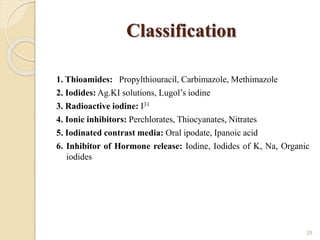
1. Thioamides: Propylthiouracil, Carbimazole, Methimazole
2. Iodides: Ag.KI solutions, Lugol’s iodine
3. Radioactive iodine: I31
4. Ionic inhibitors: Perchlorates, Thiocyanates, Nitrates
5. Iodinated contrast media: Oral ipodate, Ipanoic acid
6. Inhibitor of Hormone release: Iodine, Iodides of K, Na, Organic
iodides
28
Thioamides
29
Mechanism of action:
 These drugs act by binding to thyroid peroxidase and prevent the
oxidation of iodine or iodotyrosyl residues which in turn causes the
inhibition of iodination of tyrosine residues in thyroglobulin,
coupling of iodotyrosine to produce thyroid hormones.
 In addition to this proylthiouracil also inhibits peripheral conversion
of T4 to T3.
Pharmacokinetics:
Thioamides are absorbed orally. They get distributed throughout the
body. They get metabolized in liver and excreted in urine.
30
Adverse Drug Reactions:
 Over treatment with thioamides causes reversible hypothyroidism
and goiter.
 They commonly cause GI intolerance, joint pains, and skin rashes.
 Hair loss, dysgeusia, fever, hepatic damage and agranulocytosis
may occur but rarely.
Therapeutic Uses:
 Thioamides are used to control Thyrotoxicosis seen in Grave’s
diseases as well as in toxic nodular goiter.
 Carbimazole is given in young patients with florid hyperthyroidism
and substantial goiters to render them euthroid.
 Elderly patients who are treated with are initially treated with
Antithyroid drugs which are then gradually withdrawn when
response to develops.
31
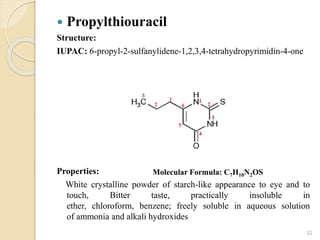
 Propylthiouracil
Structure:
IUPAC: 6-propyl-2-sulfanylidene-1,2,3,4-tetrahydropyrimidin-4-one
Properties:
White crystalline powder of starch-like appearance to eye and to
touch, Bitter taste, practically insoluble in
ether, chloroform, benzene; freely soluble in aqueous solution
of ammonia and alkali hydroxides
32
Molecular Formula: C7H10N2OS
Pharmacokinetics:
 Oral route of administration, metabolized mainly in liver,
Propylthiouracil is readily absorbed and is extensively metabolized.
Approximately 35% of the drug is excreted in the urine, in intact
and conjugated forms, within 24 hours.
Adverse Drug Reactions:
 Stomach upset,
 headache, nausea, vomiting,
 mild rash or itching,
 dizziness, spinning sensation,
 joint or muscle pain,
 decreased sense of taste, or
 Hair loss.
 Changes in the amount of urine.
33
Therapeutic Uses:
 It is used to treat overactive thyroid (hyperthyroidism). It works by
stopping the thyroid gland from making too much thyroid hormone.
 This medication is not recommended for use in children.
Dose:
 Propylthiouracil (Propylthiouracil tablet) is administered orally.
The total daily dosage is usually given in 3 equal doses at
approximately 8-hour intervals.
 Adults:
The initial dose is 300 mg daily. In patients with severe hyper-
thyroidism, very large goiters, or both, the beginning dosage usually
should be 400 mg daily, an occasional patient will require 600 to
900 mg/day initially. The usual maintenance dosage is 100 to 150
mg daily.
 Pediatric Patients:
For children 6 to 10 years of age, the initial dosage is 50 to 150 mg
daily. For pediatric patients 10 years and over, the initial dosage is
150 to 300 mg daily. The maintenance dosage is determined by the
response of the patient.
34
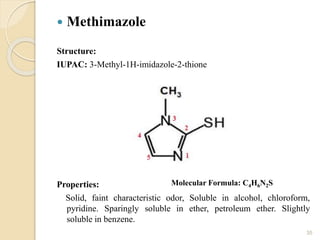
 Methimazole
Structure:
IUPAC: 3-Methyl-1H-imidazole-2-thione
Properties:
Solid, faint characteristic odor, Soluble in alcohol, chloroform,
pyridine. Sparingly soluble in ether, petroleum ether. Slightly
soluble in benzene.
35
Molecular Formula: C4H6N2S
Pharmacokinetics:
 Oral route of administration, methimazole is rapidly and extensively
metabolized by the liver, mainly via the CYP450 and FMO enzyme
systems.
 Several metabolites have been identified, though the specific
enzyme isoforms responsible for their formation are not entirely
clear.
 One of the first methimazole metabolites identified, 3-methyl-2-
thiohydantoin, may contribute to antithyroid activity - its antithyroid
activity has been demonstrated in rats and may explain the
prolonged duration of iodination inhibition following administration
despite methimazole's relatively short half-life, urinary excretion of
unchanged methimazole has been reported to be between 7% and
12%. Elimination via feces appears to be limited, with a cumulative
fecal excretion of 3% after administration of methimazole.
 Enterohepatic circulation also appears to play a role in the
elimination of methimazole and its metabolites, as significant
amounts of these substances are found in the bile post-
administration.
36
Adverse Drug Reactions:
 stomach upset,
 nausea,
 vomiting,
 mild skin rash/itching,
 headache, drowsiness,
 dizziness,
 muscle/joint/nerve pain,
 swelling, or
 Hair loss.
Therapeutic Uses:
 It is used to treat overactive thyroid (hyperthyroidism). It works by
stopping the thyroid gland from making too much thyroid hormone.
37
Dose:
It is administered orally. The total daily dosage is usually given in 3
divided doses at approximately 8-hour intervals.
 Adult:
The initial daily dosage is 15 mg for mild hyperthyroidism, 30 to 40
mg for moderately severe hyperthyroidism, and 60 mg for severe
hyperthyroidism, divided into 3 doses at 8-hour intervals. The
maintenance dosage is 5 to 15 mg daily.
 Pediatric:
Initially, the daily dosage is 0.4 mg/kg of body weight divided into 3
doses and given at 8-hour intervals. The maintenance dosage is
approximately 1/2 of the initial dose.
38
Reference books
 Text book of Medicinal chemistry volume-1-3rd edition by
V.Alagarasamy.
 Text book of Medicinal chemistry volume-2-3rd edition by
V.Alagarasamy.
 Medicinal chemistry by Rama Rao Nadendla.
 Faye’s Principles of Medicinal Chemistry- 7th edition by Thoms
L.Lemke, Victoria F.Roche, S. Willam Zito.
 Medicinal and Pharmaceutical Chemistry by Harkishan Singh, V.K
Kapoor.
39
Thank YOU
40

4th unit thyroid and antithyroid drugs

  • 1.
    4th UNIT THYROID AND ANTITHYROIDDRUGS Prepared by G. Nikitha, M.Pharmacy Assistant Professor Department of Pharmaceutical Chemistry Sree Dattha Institute Of Pharmacy Hyderabad 1 Subject: Medicinal Chemistry-II Year: B.Pharmacy 3rd Year Semister: 1st Semister
  • 2.
    Contents  Introduction.  Biosynthesis Types of Thyroid diseases  Thyroid Drugs  Antithyroid Drugs  Mechanism of action  Structure  Adverse Drug Reactions and Uses.  Reference 2
  • 3.
    Introduction  Thyroid glandis one of the largest and highly vascularized endocrine gland present in the body.  It is made up of functional units called follicles or acinus.  Follicles contain a cavity known as follicle lumen that is filled with gelatinous colloid is surrounded by a single layer of epithelial cells.  A glycoprotein known as thyroglobulin is a protein of high molecular weight that binds the iodine present in organic form.  Upon hydrolysis thyroglobulin releases thyroid hormones which are considered to be iodinated tyrosine derivatives a they are considered from l-tyrosine. 3
  • 4.
     Thyroid glandis controlled and maintained by pituitary gland and hypothalamus.  This gland secretes three main hormones known as thyroxine (T4), triiodothyronine (T3) and calcitonin.  The thyroid hormone (T3 and T4) are nonsteroidal in nature and are chemically regarded as the amino acids containing iodinated diphenyl ethers.  Thyroxine (T4) is the major form of thyroid hormone found in circulation.  The ratio of Thyroxine (T4) to triiodothyronine (T3) releases into the blood circulation is 20:1.  Thyroid glands also secrete calcitanin that is responsible for maintaining calcium homeostasis.  Calcitonin is produced by the parafollicular cells of the thyroid glands. 4
  • 5.
  • 6.
  • 7.
    1. Iodine Trapping: The thyroid follicular cells trap the plasma iodine against a concentration gradient of 25:1 between the thyroid follicular cells and plasma.  The iodine is taken up by sodium or I- symporter.  This process is stimulated by thyroid stimulating hormone (TSH) and inhibited by certain inorganic ions like thiocyanates, perchlorates etc. 2. Oxidation and Iodination:  Iodine trapped by follicular cells is oxidized to hypoiodate under the influence of H2O2 and thyroid peroxide.  Hyoiodate binds to tyrosin residues of thyroglobulin molecules and form monoiodotyrosine (MIT) and diiodotyroine (DIT). 7
  • 8.
    3. Coupling:  OneDIT molecule is coupled with one MIT molecule to form T3 or two DIT molecules couple with each other to form T4.  Coupling is an oxidative process catalyzed by thyroid peroxidase and is stimulated by TSH. 4. Secretion:  T3 and T4 bound to thyroglobulin (TG) are taken up from the colloid material into the follicular cells endocytosis.  Lysosomal proteases act on the intracellular TG and releases T3, T4 MIT and DIT.  T3 and T4 directly enters into the circulation while MIT and DIT are deiodinated and the iodine thus removed re-enters the cycle. 8
  • 9.
    5. Peripheral conversionof T4 to T3:  T3 is principle hormone and physiologically more active, but is formed in lesser amounts than T4 converted to T3 (active form) in the peripheral tissues especially liver and kidney.  This process is inhibited by drugs such as propranolol, glucocorticoids and propyithiouracil. 9
  • 10.
    Mechanism of action: Thyroid hormones diffuse across the cell membrane and bind into intracellular thyroid receptors.  After penetrating into the cell T4 gets converted to T3 which as more affinity for the thyroid receptors.  When T3 binds to receptors they undergo a change in their conformation which stimulates transcription resulting in the synthesis of proteins which produce T3 and T4 action. 10
  • 11.
    Pharmacokinetics:  T3 andT4 are well absorbed orally. T3 gets distributed to a variety of organs while T4 is concentrated mainly in liver and kidneys.  Most of circulating T3 and T4 are bound to three proteins namely thyroxin binding globulin (TBG), thyroxin binding prealbumin (TBPA) and albumin.  About 75% of T3 and T4 are bound to TBG hence only minute amounts of free hormone is I available for action, metabolism and elimination.  T3 and T4 mainly gets metabolized in the liver by de-iodination and glucoronide or sulfate conjugation and excreted in the bile and urine. 11
  • 12.
    Adverse Drug Reactions: Diarrhea  Head ache,  Weight loss  Palpitation  Tremors,  Irritability  Hyperkinesia,  Heart Intolerance  They occasionally cause anginal pain in the patients with ischemic heart disease.  They precipitate hypoadrenal crisis in patients suffering from hypocortisolism and hyperthyroidism as well. Hence to avoid this patients are retreated with glucocorticoids. 12
  • 13.
    Therapeutic Uses: Thyroxine (T4)is preferred over T3 because it offers,  Excellent oral bioavailability  Longer plasma half life due to which single daily dosing is possible  Lower incidence of angina and congestive heart failure. Thyroid hormones are mainly used as replacement therapy in  Cretinim  Adult Hypothyroidism  Non toxic Goiter  Myxoedema Coma  Thyroid Carcinoma  Thyroid nodule  Hypothyroidism 13
  • 14.
    Differences between T3and T4 14 T3 T4 1. Quicker on set of action (6-8 hours) 1. Delayed on set of action (6-8 hours) 2. Shorter plasma half-life (t1/2- 1-2 days) 2. Longer plasma half-life (t1/2- 6-7 days) 3. Effective in small doses 3. Effective in large doses 4. less tightly bound to plasma proteins 4. More tightly bound to plasma proteins 5. Highly bound to nuclear receptors 5. Less bound to nuclear receptors
  • 15.
    Thyroid Diseases areof two types 15 Hypothyroidism Hyperthyroidism Hypothyroidism is when the thyroid gland does not produce enough thyroid hormones to meet the needs of the body. The thyroid is underactive Hyperthyroidism (excessive thyroid hormone) is a condition in which there is an excessive amount of thyroid hormones. Symptoms  Fatigue, weight gain, cold intolerance slowed heart rate, movements, speech, joint and muscle pain, cramps, weakness, constipation, dry skin, thin, brittle hair or fingernails, decreased sweating, pins and needles, heavy periods, or menorrhagia, weakness, high cholesterol, puffy face, feet, and hands, insomnia, balance and co- ordination issues, loss of libido, recurrent urinary and respiratory tract infections, anemia, depression, hoarseness, puffiness in the face, thinned or missing eyebrows, slow heart rate, hearing loss, poor growth, delayed development of teeth, poor mental development, delayed puberty Symptoms  restlessness, agitation, anxiety, tremors, weight loss despite an increased appetite, sweating, rapid heart rate, intolerance to heat, and frequent bowel movements, nervousness, skin thinning
  • 16.
  • 17.
     Thyroid Drugsare used to correct hypothyroidism. Various Thyroid Drugs employed include levothyroxine (L-Thyroxine), Levothyronine (L-Thyronine), Liotrix and dessicated thyroid gland and thyroglobulin. Mechanism of action:  Thyroid hormones diffuse across the cell membrane and bind into intracellular thyroid receptors.  After penetrating into the cell T4 gets converted to T3 which as more affinity for the thyroid receptors.  When T3 binds to receptors they undergo a change in their conformation which stimulates transcription resulting in the synthesis of proteins which produce T3 and T4 action. 17
  • 18.
    Adverse Drug Reactions: Diarrhea  Head ache  Weight loss  Palpitation  Tremors  Irritability  Hyperkinesia  Heart Intolerance  They occasionally cause anginal pain in the patients with ischemic heart disease.  They precipitate hypoadrenal crisis in patients suffering from hypocortisolism and hyperthyroidism as well. Hence to avoid this patients are retreated with glucocorticoids. 18
  • 19.
    Therapeutic Uses: Thyroxine (T4)is preferred over T3 because it offers,  Excellent oral bioavailability  Longer plasma half life due to which single daily dosing is possible  Lower incidence of angina and congestive heart failure. Thyroid hormones are mainly used as replacement therapy in  Cretinim  Adult Hypothyroidism  Non toxic Goiter  Myxoedema Coma  Thyroid Carcinoma  Thyroid nodule  Hypothyroidism 19
  • 20.
     L-Thyroxine Structure: IUPAC: 2-Amino-3-[4-(4-hydroxy-3,5-diiodophenoxy)-3,5- diiodophenyl]propanoicacid Properties: Solid Crystals, Slightly soluble in water, Insoluble in ethanol, benzene 20 Molecular FormulaC15H11I4
  • 21.
    Pharmacokinetics:  Oral routeand intravenous route of administration, food interferes with absorption and hence it is given on an empty stomach metabolized mainly in liver, kidneys, brain and muscles, eliminated through urine and feces. Adverse Drug Reactions:  increased appetite, weight loss  heat sensitivity, excessive sweating  Headache, hyperactivity, nervousness, anxiety, tremors  Irritability, mood swings  trouble sleeping  Tiredness, muscle weakness  changes in menstrual periods  hair loss (usually temporary)  Diarrhea, vomiting, stomach cramps 21
  • 22.
    Therapeutic Uses:  L-thyroxineoral tablet is used to treat hypothyroidism. This is a condition when your thyroid gland produces too little thyroid hormone.  L-thyroxine also can be used to treat goiter, which is an enlarged thyroid gland. It also treats certain types of thyroid cancer Dose: 0.05 -0.2 μg OD on an empty stomach 22
  • 23.
     L-Thyronine Structure: IUPAC: 2-amino-3-[4-(4-hydroxyphenoxy)phenyl]propanoicacid Properties: Solid Crystals, Slightly soluble in water, Insoluble in ethanol, benzene 23 Molecular Formula: C15H15NO4
  • 24.
    Pharmacokinetics:  Oral routeand intravenous route of administration, in the liver, L- tyrosine is involved in a number of biochemical reactions, including protein synthesis and oxidative catabolic reactions. L-tyrosine that is not metabolized in the liver is distributed via the systemic circulation to the various tissues of the body, eliminated through urine and feces. Adverse Drug Reactions:  Stomach pain  Nausea, Headache  Weight loss  Diarrhea  Anxiety  Sweating 24
  • 25.
    Therapeutic Uses:  Itis used to treat hypothyroidism.  It is also used in special situations like myxeoedema, Myxoedema coma, and thyroid cancer. Dose: It is given in a dose of 20μg 1-3 times/day 25
  • 26.
  • 27.
     Antithyroid Drugsare used to suppress hyperactive thyroid gland. Thyrotoxicosis occurs due to excessive production of T3 and T4 by the thyroid gland.  Grave’s disease is an autoimmune disorder characterized by production of thyroid stimulating immunoglobulins. These antibodies produces TSH-like effects but are not regulated by negative feedback mechanism. As a results TSH is produced in excessive amounts to produce T3 and T4. Enlarged thyroid gland and exopthalmous are its characteristics sign. 27
  • 28.
    Classification 1. Thioamides: Propylthiouracil,Carbimazole, Methimazole 2. Iodides: Ag.KI solutions, Lugol’s iodine 3. Radioactive iodine: I31 4. Ionic inhibitors: Perchlorates, Thiocyanates, Nitrates 5. Iodinated contrast media: Oral ipodate, Ipanoic acid 6. Inhibitor of Hormone release: Iodine, Iodides of K, Na, Organic iodides 28
  • 29.
  • 30.
    Mechanism of action: These drugs act by binding to thyroid peroxidase and prevent the oxidation of iodine or iodotyrosyl residues which in turn causes the inhibition of iodination of tyrosine residues in thyroglobulin, coupling of iodotyrosine to produce thyroid hormones.  In addition to this proylthiouracil also inhibits peripheral conversion of T4 to T3. Pharmacokinetics: Thioamides are absorbed orally. They get distributed throughout the body. They get metabolized in liver and excreted in urine. 30
  • 31.
    Adverse Drug Reactions: Over treatment with thioamides causes reversible hypothyroidism and goiter.  They commonly cause GI intolerance, joint pains, and skin rashes.  Hair loss, dysgeusia, fever, hepatic damage and agranulocytosis may occur but rarely. Therapeutic Uses:  Thioamides are used to control Thyrotoxicosis seen in Grave’s diseases as well as in toxic nodular goiter.  Carbimazole is given in young patients with florid hyperthyroidism and substantial goiters to render them euthroid.  Elderly patients who are treated with are initially treated with Antithyroid drugs which are then gradually withdrawn when response to develops. 31
  • 32.
     Propylthiouracil Structure: IUPAC: 6-propyl-2-sulfanylidene-1,2,3,4-tetrahydropyrimidin-4-one Properties: Whitecrystalline powder of starch-like appearance to eye and to touch, Bitter taste, practically insoluble in ether, chloroform, benzene; freely soluble in aqueous solution of ammonia and alkali hydroxides 32 Molecular Formula: C7H10N2OS
  • 33.
    Pharmacokinetics:  Oral routeof administration, metabolized mainly in liver, Propylthiouracil is readily absorbed and is extensively metabolized. Approximately 35% of the drug is excreted in the urine, in intact and conjugated forms, within 24 hours. Adverse Drug Reactions:  Stomach upset,  headache, nausea, vomiting,  mild rash or itching,  dizziness, spinning sensation,  joint or muscle pain,  decreased sense of taste, or  Hair loss.  Changes in the amount of urine. 33
  • 34.
    Therapeutic Uses:  Itis used to treat overactive thyroid (hyperthyroidism). It works by stopping the thyroid gland from making too much thyroid hormone.  This medication is not recommended for use in children. Dose:  Propylthiouracil (Propylthiouracil tablet) is administered orally. The total daily dosage is usually given in 3 equal doses at approximately 8-hour intervals.  Adults: The initial dose is 300 mg daily. In patients with severe hyper- thyroidism, very large goiters, or both, the beginning dosage usually should be 400 mg daily, an occasional patient will require 600 to 900 mg/day initially. The usual maintenance dosage is 100 to 150 mg daily.  Pediatric Patients: For children 6 to 10 years of age, the initial dosage is 50 to 150 mg daily. For pediatric patients 10 years and over, the initial dosage is 150 to 300 mg daily. The maintenance dosage is determined by the response of the patient. 34
  • 35.
     Methimazole Structure: IUPAC: 3-Methyl-1H-imidazole-2-thione Properties: Solid,faint characteristic odor, Soluble in alcohol, chloroform, pyridine. Sparingly soluble in ether, petroleum ether. Slightly soluble in benzene. 35 Molecular Formula: C4H6N2S
  • 36.
    Pharmacokinetics:  Oral routeof administration, methimazole is rapidly and extensively metabolized by the liver, mainly via the CYP450 and FMO enzyme systems.  Several metabolites have been identified, though the specific enzyme isoforms responsible for their formation are not entirely clear.  One of the first methimazole metabolites identified, 3-methyl-2- thiohydantoin, may contribute to antithyroid activity - its antithyroid activity has been demonstrated in rats and may explain the prolonged duration of iodination inhibition following administration despite methimazole's relatively short half-life, urinary excretion of unchanged methimazole has been reported to be between 7% and 12%. Elimination via feces appears to be limited, with a cumulative fecal excretion of 3% after administration of methimazole.  Enterohepatic circulation also appears to play a role in the elimination of methimazole and its metabolites, as significant amounts of these substances are found in the bile post- administration. 36
  • 37.
    Adverse Drug Reactions: stomach upset,  nausea,  vomiting,  mild skin rash/itching,  headache, drowsiness,  dizziness,  muscle/joint/nerve pain,  swelling, or  Hair loss. Therapeutic Uses:  It is used to treat overactive thyroid (hyperthyroidism). It works by stopping the thyroid gland from making too much thyroid hormone. 37
  • 38.
    Dose: It is administeredorally. The total daily dosage is usually given in 3 divided doses at approximately 8-hour intervals.  Adult: The initial daily dosage is 15 mg for mild hyperthyroidism, 30 to 40 mg for moderately severe hyperthyroidism, and 60 mg for severe hyperthyroidism, divided into 3 doses at 8-hour intervals. The maintenance dosage is 5 to 15 mg daily.  Pediatric: Initially, the daily dosage is 0.4 mg/kg of body weight divided into 3 doses and given at 8-hour intervals. The maintenance dosage is approximately 1/2 of the initial dose. 38
  • 39.
    Reference books  Textbook of Medicinal chemistry volume-1-3rd edition by V.Alagarasamy.  Text book of Medicinal chemistry volume-2-3rd edition by V.Alagarasamy.  Medicinal chemistry by Rama Rao Nadendla.  Faye’s Principles of Medicinal Chemistry- 7th edition by Thoms L.Lemke, Victoria F.Roche, S. Willam Zito.  Medicinal and Pharmaceutical Chemistry by Harkishan Singh, V.K Kapoor. 39
  • 40.