BY,
SARANG
SREE RAMACHANDRA COLLEGE OF PHARMACY 1
ORAL
HYPOGLYCAEMIC
DRUGS
Oral hypoglycemics
• Drugs that are given orally to reduce the blood
glucose levels in diabetic patients
• Five types of oral antidiabetic drugs are
currently in use:
• Sulfonylureas
• Biguanides
• Meglitinides
• Thiazolidinediones
• Alpha -glucosidase inhibitors
2
3
Sulfonylureas
I Generation
– Tolbutamide
– Chlorpropamide
II Generation
– Glipizide
– Gliclazide
– Glibenclamide (Glyburide)
– Glimepiride
4
First Generation
Tolbutamide
• O.O.A. is within one hour & lasts for 6-12 Hrs
• It is weaker, short acting, less likely to cause hypoglycemia
Chlorpropamide
• O.O.A. is within one hour & lasts for 24-60 Hrs
• It is more potent, long lasting, risk of prolonged hypoglycemia
• Potentiates ADH action
5
Second Generation
Glibenclamide (glyburide)
• O.O.A. is within 1-4 hours & lasts for 10-24 Hrs
• It is more potent than tolbutamide, risk of severe hypoglycaemia.
Glipizide
• O.O.A. is within 1-3 hours & lasts for 10-24 Hrs
• Less potent than glibenclamide but more potent than tolbutamide
• Risk of prolonged hypoglycemia
Gliclazide
• O.O.A. & D.O.A, same as glipizide
• More potent than tolbutamide
• Has an antioxident and antiplatelet action
• Less weight gain
Glimepiride:
• Same as glipizide
6
Sulfonylureas -
MOA
7
Sulphonylureas
 Pharmacokinetics
• Well absorbed
• PPB is high
• Metabolized in liver or kidney and excreted in urine
 Adverse effects
• Hypoglycemia
• Weight gain
• Cross placental barrier – fetal hypoglycemia (avoid in gestational DM)
 Contra indications
• Ketocanazole, chloramphenicol and anticoagulants- inhibit their metabolism
• Sulfonamides, salicylates etc- protein binding displacement
• Propranolol masks the symptoms of sulfonylureas
8
BIGUANIDES
Metformin :
• The primary drug of choice for diabetes by ADA guidelines.
Dose: 0.5 to 2.5 g/day in 2-3 divided doses
Phenformin : Its use has been discontinued because of lacticacidosis
MOA:
• Suppress hepatic & renal gluconeogenesis
• Increases uptake & utilization of glucose by skeletal muscles
which reduces insulin resistance
• Inhibit alimentary absorption of glucose
• Interfere with mitochondrial respiratory chain & promote
peripheral glucose utilization by enhancing anaerobic
glycolysis.
9
• PHARMACOKINETICS:
• Taken orally, well absorbed through GI tract
• Not metabolized at all
• Excreted unchanged in urine
• INDICATIONS:
• Obese Type 2 Diabetes.
• Secondary Sulfonylurea Failure state.
• To reduce Insulin requirements.
• Can be combined with Sulfonylureas, Glitazones,
Insulin.
10
ADVERSE EFFECT:
• Anorexia, nausea, vomiting, diarrhoea
• Metallic taste
• Loss of weight
• Skin rashes
• Lactic acidosis: rare
• Vitamin B12 deficiency: due to malabsorption
• Usually does not cause hypoglycemia even in large doses
Contraindications:
• Renal failure
• Advanced Liver Disease.
• Alcohol abusers.
• Cardiac Disease.
• Pregnancy.
11
Meglitinide analogs
• This class of agents includes repaglinide and
nateglinide. Although they are not sulfonylureas, they
have common actions.
MOA:
• Their action is dependent on functioning pancreatic β cells.
• They bind to a distinct site on the sulfonylurea receptor of ATP-
sensitive potassium channels, thereby initiating a series of
reactions culminating in the release of insulin.
• However, in contrast to the sulfonylureas, the meglitinides have a
rapid onset and a short duration of action.
• They are are categorized as postprandial glucose regulators.
• Meglitinides should not be used in combination with sulfonylureas
due to overlapping mechanisms of action.
12
Pharmacokinetics:
• These drugs are well absorbed orally after being taken 1
to 30 minutes before meals.
• Both meglitinides are metabolized to inactive products by
CYP3A4 in the liver.
• Excreted through the bile.
Adverse Effects:
• Incidence of hypoglycemia is lower than that of the
sulfonylureas.
• Repaglinide has been reported to cause severe
hypoglycemia in patients who are also taking the lipid-
lowering drug gemfibrozil.
• Weight gain is less of a problem with the meglitinides
than with the sulfonylureas.
• Must be used with caution in patients with hepatic
impairment.
13
Thiazolidinediones (Glitazones)
Rosiglitazone & pioglitazone Selective agonists of PPAR
Bind to nuclear PPARγ
Activate insulin responsive genes -
regulate carbohydrate & lipid metabolism
Sensitize the peripheral tissues to insulin
↓blood glucose by
↑ Glucose transport
into muscle & adipose
tissue
Inhibit hepatic
gluconeogenesis
Promote
lipogenesis14
• Pharmacokinetics:
• Both pioglitazone and rosiglitazone are absorbed very
well after oral administration and are extensively bound
to serum albumin.
• Both undergo extensive metabolism by different
cytochrome P450 isozymes.
• Pioglitazone:
• Renal elimination is negligible, with the majority of the
active drug and metabolites excreted in the bile and
eliminated in the feces.
• Rosiglitazone:
• The metabolites are primarily excreted in the urine.
15
• Adverse Effects:
• Very few cases of liver toxicity have been reported with
rosiglitazone or pioglitazone.
• Weight increase can occur, possibly through the ability of
TZDs to increase subcutaneous fat or due to fluid
retention.
• Glitazones have been associated with osteopenia and
increased fracture risk.
• Other adverse effects include headache and anemia.
• DOSE:
• Pioglitazone: 15 to 45 mg once daily orally
• Rosiglitazone: 4 to 8 mg once daily orally
16
α-glucosidase inhibitors
• Alpha-glucosidase inhibitors works by preventing the
digestion of carbohydrates (such as starch and table
sugar).
• Hence, alpha-glucosidase inhibitors reduce the impact of
carbohydrates on blood sugar.
• Acarbose and miglitol are orally active drugs used for
the treatment of patients with Type 2 diabetes.
Dose:
• Acarbose - 50mg to 100mg TDS
• Miglitol - 25mg to 100mg TDS
• Voglibose - 0.2 to 0.3 mg TDS
17
• MOA:
• These drugs are taken at the beginning of meals.
• They act by delaying the digestion of carbohydrates,
thereby resulting in lower postprandial glucose levels.
• Both drugs exert their effects by reversibly inhibiting
membrane-bound α-glucosidase in the intestinal brush
border.
• This enzyme is responsible for the hydrolysis of
oligosaccharides to glucose and other sugars.
• Consequently, the postprandial rise of blood glucose is
blunted.
• Unlike the other oral hypoglycemic agents, these drugs
do not stimulate insulin release, nor do they increase
insulin action in target tissues.
• Thus, as monotherapy, they do not cause hypoglycemia.
• However, when used in combination with the
sulfonylureas or with insulin, hypoglycemia may develop.
18
PHARMACOKINETICS:
• Acarbose is poorly absorbed. It is metabolized primarily
by intestinal bacteria, and some of the metabolites are
absorbed and excreted into the urine.
• On the other hand, miglitol is very well absorbed but has
no systemic effects. It is excreted unchanged by the
kidney.
ADVERSE EFFECTS:
• The major side effects are flatulence, diarrhea, and
abdominal cramping. Patients with inflammatory bowel
disease, colonic ulceration, or intestinal obstruction
should not use these drugs
19
What is the role of an ideal oral
hypoglycaemic agent?
• Conserve islet cell function - delay the subsequent
use of insulin.
• Improve patient compliance- single daily dosing.
• Reduce the incidence of hypoglycaemic events
20
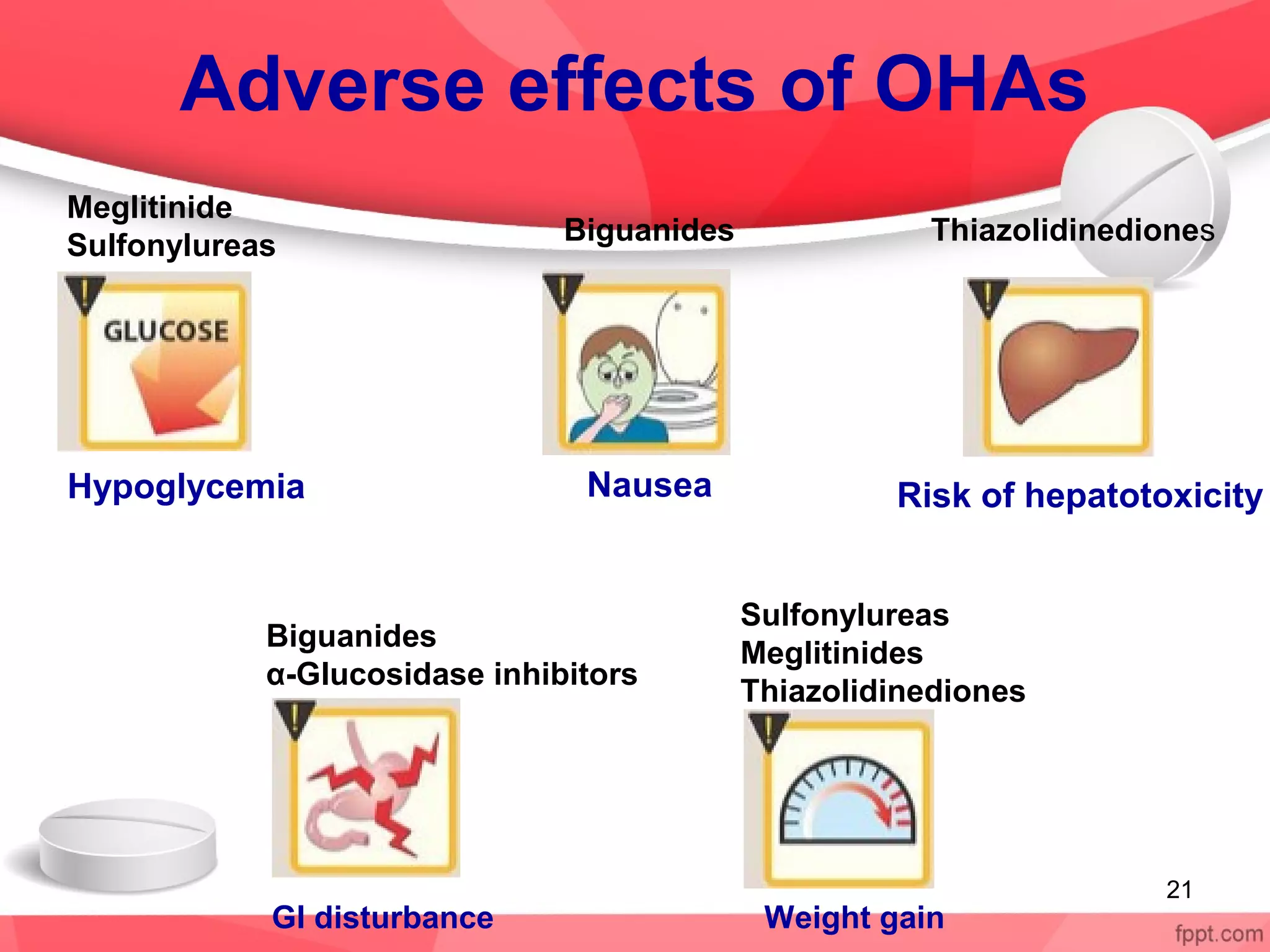
Adverse effects of OHAs
Meglitinide
Sulfonylureas
Hypoglycemia
Biguanides
α-Glucosidase inhibitors
GI disturbance
Biguanides
Nausea
Thiazolidinediones
Risk of hepatotoxicity
Sulfonylureas
Meglitinides
Thiazolidinediones
Weight gain
21
THANK
YOU
22

Oral hypoglycaemic drugs

  • 1.
    BY, SARANG SREE RAMACHANDRA COLLEGEOF PHARMACY 1 ORAL HYPOGLYCAEMIC DRUGS
  • 2.
    Oral hypoglycemics • Drugsthat are given orally to reduce the blood glucose levels in diabetic patients • Five types of oral antidiabetic drugs are currently in use: • Sulfonylureas • Biguanides • Meglitinides • Thiazolidinediones • Alpha -glucosidase inhibitors 2
  • 3.
  • 4.
    Sulfonylureas I Generation – Tolbutamide –Chlorpropamide II Generation – Glipizide – Gliclazide – Glibenclamide (Glyburide) – Glimepiride 4
  • 5.
    First Generation Tolbutamide • O.O.A.is within one hour & lasts for 6-12 Hrs • It is weaker, short acting, less likely to cause hypoglycemia Chlorpropamide • O.O.A. is within one hour & lasts for 24-60 Hrs • It is more potent, long lasting, risk of prolonged hypoglycemia • Potentiates ADH action 5
  • 6.
    Second Generation Glibenclamide (glyburide) •O.O.A. is within 1-4 hours & lasts for 10-24 Hrs • It is more potent than tolbutamide, risk of severe hypoglycaemia. Glipizide • O.O.A. is within 1-3 hours & lasts for 10-24 Hrs • Less potent than glibenclamide but more potent than tolbutamide • Risk of prolonged hypoglycemia Gliclazide • O.O.A. & D.O.A, same as glipizide • More potent than tolbutamide • Has an antioxident and antiplatelet action • Less weight gain Glimepiride: • Same as glipizide 6
  • 7.
  • 8.
    Sulphonylureas  Pharmacokinetics • Wellabsorbed • PPB is high • Metabolized in liver or kidney and excreted in urine  Adverse effects • Hypoglycemia • Weight gain • Cross placental barrier – fetal hypoglycemia (avoid in gestational DM)  Contra indications • Ketocanazole, chloramphenicol and anticoagulants- inhibit their metabolism • Sulfonamides, salicylates etc- protein binding displacement • Propranolol masks the symptoms of sulfonylureas 8
  • 9.
    BIGUANIDES Metformin : • Theprimary drug of choice for diabetes by ADA guidelines. Dose: 0.5 to 2.5 g/day in 2-3 divided doses Phenformin : Its use has been discontinued because of lacticacidosis MOA: • Suppress hepatic & renal gluconeogenesis • Increases uptake & utilization of glucose by skeletal muscles which reduces insulin resistance • Inhibit alimentary absorption of glucose • Interfere with mitochondrial respiratory chain & promote peripheral glucose utilization by enhancing anaerobic glycolysis. 9
  • 10.
    • PHARMACOKINETICS: • Takenorally, well absorbed through GI tract • Not metabolized at all • Excreted unchanged in urine • INDICATIONS: • Obese Type 2 Diabetes. • Secondary Sulfonylurea Failure state. • To reduce Insulin requirements. • Can be combined with Sulfonylureas, Glitazones, Insulin. 10
  • 11.
    ADVERSE EFFECT: • Anorexia,nausea, vomiting, diarrhoea • Metallic taste • Loss of weight • Skin rashes • Lactic acidosis: rare • Vitamin B12 deficiency: due to malabsorption • Usually does not cause hypoglycemia even in large doses Contraindications: • Renal failure • Advanced Liver Disease. • Alcohol abusers. • Cardiac Disease. • Pregnancy. 11
  • 12.
    Meglitinide analogs • Thisclass of agents includes repaglinide and nateglinide. Although they are not sulfonylureas, they have common actions. MOA: • Their action is dependent on functioning pancreatic β cells. • They bind to a distinct site on the sulfonylurea receptor of ATP- sensitive potassium channels, thereby initiating a series of reactions culminating in the release of insulin. • However, in contrast to the sulfonylureas, the meglitinides have a rapid onset and a short duration of action. • They are are categorized as postprandial glucose regulators. • Meglitinides should not be used in combination with sulfonylureas due to overlapping mechanisms of action. 12
  • 13.
    Pharmacokinetics: • These drugsare well absorbed orally after being taken 1 to 30 minutes before meals. • Both meglitinides are metabolized to inactive products by CYP3A4 in the liver. • Excreted through the bile. Adverse Effects: • Incidence of hypoglycemia is lower than that of the sulfonylureas. • Repaglinide has been reported to cause severe hypoglycemia in patients who are also taking the lipid- lowering drug gemfibrozil. • Weight gain is less of a problem with the meglitinides than with the sulfonylureas. • Must be used with caution in patients with hepatic impairment. 13
  • 14.
    Thiazolidinediones (Glitazones) Rosiglitazone &pioglitazone Selective agonists of PPAR Bind to nuclear PPARγ Activate insulin responsive genes - regulate carbohydrate & lipid metabolism Sensitize the peripheral tissues to insulin ↓blood glucose by ↑ Glucose transport into muscle & adipose tissue Inhibit hepatic gluconeogenesis Promote lipogenesis14
  • 15.
    • Pharmacokinetics: • Bothpioglitazone and rosiglitazone are absorbed very well after oral administration and are extensively bound to serum albumin. • Both undergo extensive metabolism by different cytochrome P450 isozymes. • Pioglitazone: • Renal elimination is negligible, with the majority of the active drug and metabolites excreted in the bile and eliminated in the feces. • Rosiglitazone: • The metabolites are primarily excreted in the urine. 15
  • 16.
    • Adverse Effects: •Very few cases of liver toxicity have been reported with rosiglitazone or pioglitazone. • Weight increase can occur, possibly through the ability of TZDs to increase subcutaneous fat or due to fluid retention. • Glitazones have been associated with osteopenia and increased fracture risk. • Other adverse effects include headache and anemia. • DOSE: • Pioglitazone: 15 to 45 mg once daily orally • Rosiglitazone: 4 to 8 mg once daily orally 16
  • 17.
    α-glucosidase inhibitors • Alpha-glucosidaseinhibitors works by preventing the digestion of carbohydrates (such as starch and table sugar). • Hence, alpha-glucosidase inhibitors reduce the impact of carbohydrates on blood sugar. • Acarbose and miglitol are orally active drugs used for the treatment of patients with Type 2 diabetes. Dose: • Acarbose - 50mg to 100mg TDS • Miglitol - 25mg to 100mg TDS • Voglibose - 0.2 to 0.3 mg TDS 17
  • 18.
    • MOA: • Thesedrugs are taken at the beginning of meals. • They act by delaying the digestion of carbohydrates, thereby resulting in lower postprandial glucose levels. • Both drugs exert their effects by reversibly inhibiting membrane-bound α-glucosidase in the intestinal brush border. • This enzyme is responsible for the hydrolysis of oligosaccharides to glucose and other sugars. • Consequently, the postprandial rise of blood glucose is blunted. • Unlike the other oral hypoglycemic agents, these drugs do not stimulate insulin release, nor do they increase insulin action in target tissues. • Thus, as monotherapy, they do not cause hypoglycemia. • However, when used in combination with the sulfonylureas or with insulin, hypoglycemia may develop. 18
  • 19.
    PHARMACOKINETICS: • Acarbose ispoorly absorbed. It is metabolized primarily by intestinal bacteria, and some of the metabolites are absorbed and excreted into the urine. • On the other hand, miglitol is very well absorbed but has no systemic effects. It is excreted unchanged by the kidney. ADVERSE EFFECTS: • The major side effects are flatulence, diarrhea, and abdominal cramping. Patients with inflammatory bowel disease, colonic ulceration, or intestinal obstruction should not use these drugs 19
  • 20.
    What is therole of an ideal oral hypoglycaemic agent? • Conserve islet cell function - delay the subsequent use of insulin. • Improve patient compliance- single daily dosing. • Reduce the incidence of hypoglycaemic events 20
  • 21.
    Adverse effects ofOHAs Meglitinide Sulfonylureas Hypoglycemia Biguanides α-Glucosidase inhibitors GI disturbance Biguanides Nausea Thiazolidinediones Risk of hepatotoxicity Sulfonylureas Meglitinides Thiazolidinediones Weight gain 21
  • 22.

Editor's Notes

  • #8 Mechanism of Action : Sulfonylureas Stimulates release of insulin from beta cells. Reduction of insulin resistance by increasing insulin receptor binding and postreceptor activity in liver, muscle and adipose tissue. Reduction of glucagon level.
  • #11 Do not cause insulin release but presence of some insulin is essential for their action Suppress hepatic gluconeogenesis & glucose output from liver : major action
  • #12 Reduces FPG by 16 % Reduces PPG by 25 % Reduces all cause mortality by 36 % Action in Fasting & Prandial state. Better action in milder disease. No Hypoglycemias.
  • #15 PEROXISOME PROLIFERATOR ACTIVATED RECEPTOR GAMMA RECEPTORS Reverse insulin resistance by stimulating GLUT 4 EXPRESSion and translocation and entry of glucose The first thiazolidinedione, ciglitazone, was synthesized in 1982(1). It was soon thereafter discovered that ciglitazone reduced insulin resistance in obese and diabetic animals. Because of their effects on insulin resistance, thiozolidinediones have been developed as pharmacological agents for the management of type 2 diabetes, although they were initially synthesized as potential lipid-reducing agents. Since their discovery, three thiozolidinediones have been introduced to the market in the U.S. : troglitazone (Rezulin), rosiglitazone (Avandia), and pioglitazone (Actos). In March 2000, troglitazone was withdrawn from the market because of liver toxicity. Reset glucose fatty acid cycle by reduction in circulating free fatty acids and by transcription of several genes that are imp for otimal insulin sensitivity as well as glucose and fat metabolism