ANTICONVULSANT DRUGS
Presented by,
Chinnu Suresh
1st semester Mpharm
Pharmaceutical Chemistry
 It is also known as Anti-epileptic OR Anti seizure drug
 These are those drugs which are used to treat epilepsy
and seizure.
 Epilepsy: it is a chronic disorder characterized by
paroxysmal brain dysfunction due to excessive neuronal
discharge and usually associated with some alteration of
consciousness.
 Convulsion: Involuntary spasmodic contractions of any
or all voluntary muscles throughout the body, including
skeletal and facial muscles.
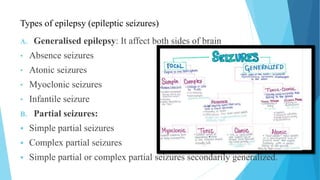
Types of epilepsy (epileptic seizures)
A. Generalised epilepsy: It affect both sides of brain
• Absence seizures
• Atonic seizures
• Myoclonic seizures
• Infantile seizure
B. Partial seizures:
 Simple partial seizures
 Complex partial seizures
 Simple partial or complex partial seizures secondarily generalized.
Mechanism of Action
 Some drugs block sodium channel: Epileptic seizure causes Na
ion accumulation within the central neuron, which initiates
enhanced synaptic nerve transmissions following presynaptic
stimulation. These drugs decreases Na intracellular ion by activating
biochemical process that normally extrudes Na ion from neurons.
Prolongation of this inactive state with prolongation of the
refractory period is the principle of mechanism.
 Some drugs block calcium channel: A low threshold calcium
current govern oscillatory response in thalamic neuron.
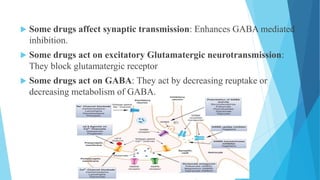
 Some drugs affect synaptic transmission: Enhances GABA mediated
inhibition.
 Some drugs act on excitatory Glutamatergic neurotransmission:
They block glutamatergic receptor
 Some drugs act on GABA: They act by decreasing reuptake or
decreasing metabolism of GABA.
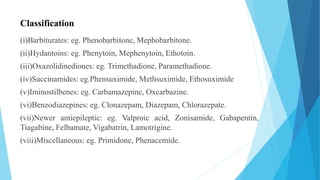
Classification
(i)Barbiturates: eg. Phenobarbitone, Mephobarbitone.
(ii)Hydantoins: eg. Phenytoin, Mephenytoin, Ethotoin.
(iii)Oxazolidinediones: eg. Trimethadione, Paramethadione.
(iv)Succinamides: eg.Phensuximide, Methsuximide, Ethosuximide
(v)Iminostilbenes: eg. Carbamazepine, Oxcarbazine.
(vi)Benzodiazepines: eg. Clonazepam, Diazepam, Chlorazepate.
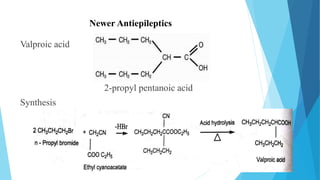
(vii)Newer antiepileptic: eg. Valproic acid, Zonisamide, Gabapentin,
Tiagabine, Felbamate, Vigabatrin, Lamotrigine.
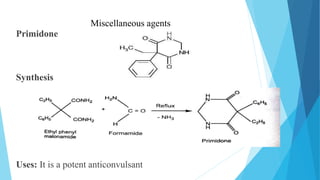
(viii)Miscellaneous: eg. Primidone, Phenacemide.
Barbiturates
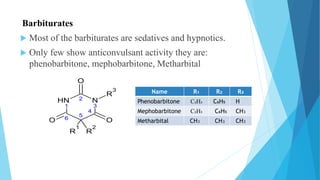
 Most of the barbiturates are sedatives and hypnotics.
 Only few show anticonvulsant activity they are:
phenobarbitone, mephobarbitone, Metharbital
Name R₁ R₂ R₃
Phenobarbitone C₂H₅ C₆H₅ H
Mephobarbitone C₂H₅ C₆H₅ CH₃
Metharbital CH₃ CH₃ CH₃
N
3
4
2
5
N
H
1
6
O
O
O
R
1
R
2
R
3
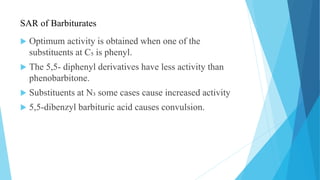
SAR of Barbiturates
 Optimum activity is obtained when one of the
substituents at C₅ is phenyl.
 The 5,5- diphenyl derivatives have less activity than
phenobarbitone.
 Substituents at N₃ some cases cause increased activity
 5,5-dibenzyl barbituric acid causes convulsion.
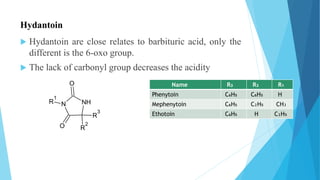
Hydantoin
 Hydantoin are close relates to barbituric acid, only the
different is the 6-oxo group.
 The lack of carbonyl group decreases the acidity
Name R₃ R₂ R₁
Phenytoin C₆H₅ C₆H₅ H
Mephenytoin C₆H₅ C₂H₅ CH₃
Ethotoin C₆H₅ H C₂H₅
N NH
R
1
O
O
R
3
R
2
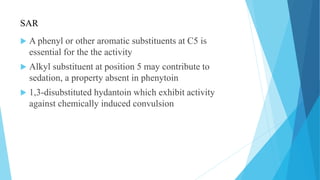
SAR
 A phenyl or other aromatic substituents at C5 is
essential for the the activity
 Alkyl substituent at position 5 may contribute to
sedation, a property absent in phenytoin
 1,3-disubstituted hydantoin which exhibit activity
against chemically induced convulsion
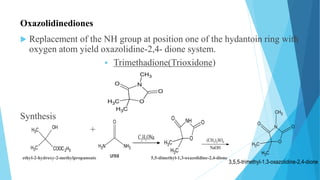
Oxazolidinediones
 Replacement of the NH group at position one of the hydantoin ring with
oxygen atom yield oxazolidine-2,4- dione system.
 Trimethadione(Trioxidone)
Synthesis
+
ethyl-2-hydroxy-2-methylpropanoate 5,5-dimethyl-1,3-oxazolidine-2,4-dione
N
O
CH3
O
O
C
H3
C
H3
N
H2 NH2
O
urea
C2H5ONa
NH
O
O
O
C
H3
C
H3
(CH3)2SO4
NaOH
N
O
CH3
O
O
C
H3
C
H3
3,5,5-trimethyl-1,3-oxazolidine-2,4-dione
OH
C
H3
C
H3 COOC2H5
Paramethadione(paradione)
Uses:It is used in the treatment of petitmal epilepsy
N
O
O
O
CH3
C
H3
H5C6
3,5-dimethyl-5-phenyl-1,3-oxazolidine-2,4-dione
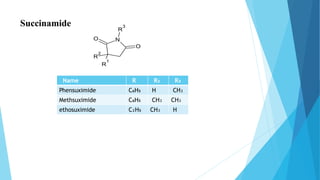
Succinamide
Name R R₂ R₃
Phensuximide C₆H₅ H CH₃
Methsuximide C₆H₅ CH₃ CH₃
ethosuximide C₂H₅ CH₃ H
N
O
O
R
3
R
2
R
1
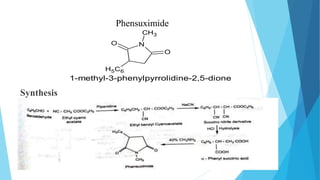
Phensuximide
Synthesis
N
CH3
O
O
H5C6
1-methyl-3-phenylpyrrolidine-2,5-dione
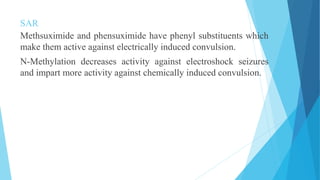
SAR
Methsuximide and phensuximide have phenyl substituents which
make them active against electrically induced convulsion.
N-Methylation decreases activity against electroshock seizures
and impart more activity against chemically induced convulsion.
Iminostilbenes
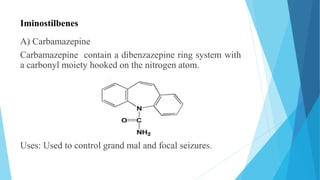
A) Carbamazepine
Carbamazepine contain a dibenzazepine ring system with
a carbonyl moiety hooked on the nitrogen atom.
Uses: Used to control grand mal and focal seizures.
Benzodiazepines
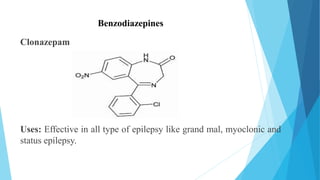
Clonazepam
Uses: Effective in all type of epilepsy like grand mal, myoclonic and
status epilepsy.
Newer Antiepileptics
Valproic acid
2-propyl pentanoic acid
Synthesis
Miscellaneous agents
Primidone
Synthesis
Uses: It is a potent anticonvulsant
REFERENCE
 Textbook of Medicinal chemistry by k.iiango and p
valentina. Page nbr 207
THANK YOU