
Antiarrhythmic Drugs
Suresh Kumar Ghritlahare
Assist. Professor
SRU, Raipur, (C.G.)
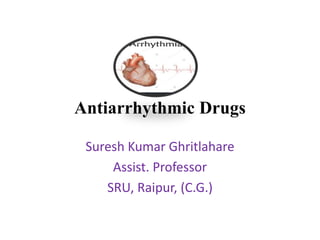
Antiarrhythmic Drugs
Arrhythmia:
• The cardiac arrhythmias are cause by disturbance conduction of
impulse through myocardial cell.
• Arrhythmia is irregularities in cardiac rhythm due to disorder of
impulse formation & impulse conduction.
• Disturbed impulse formation, irregular discharge of impulse from
pace maker, tachy arrhythmia.
Antiarrhythmic Drugs: These are drugs used to prevent or treat
irregularities of cardiac rhythm.
The important cardiac arrhythmias are:
 Atrial flutter (AFI)
 Atrial fibrillation (AF)
 Ventricular tachycardia (VT)
 Ventricular fibrillation (VF)
 Atrio-ventricular (A-V) block
Antiarrhythmic drugs
Class Actions Drugs
I Membrane stabilizing agents
(Na+ channel blockers)
Quinidine, Procainamide,
Disopyramide, Lidocaine,
Mexiletine, Propafenone,
Flecainide etc.
II Antiadrenergic agents
(β blockers)
Propranolol, Esmolol,
Sotalol (also class III)
III Agents widening AP
(prolong repolarization and ERP)
Amiodarone, Dronedarone,
Dofetilide, Ibutilide
IV Calcium channel blockers Verapamil, Diltiazem
Mechanism of action
1. Membrane stabilizing agents: Quinidine
Quinidine block myocardial Na + channel &
prevent Na+ enflux.
Reduce the maximal rate of 0 phase
depolarization & also decrease slope of phase-4
quinidine decrease the availability of Na+
channel as well as deals their reactivation
Inhibit action potentials
2. Beta Blocker: Propranolol
Propranolol is beta-adrenergic antagonist by
nature they are sympathetic antagonist
inhibit sympathetic tone & decrease heart rate
Prolong the AV conduction inhibit phase- 4
Delayed action potentials
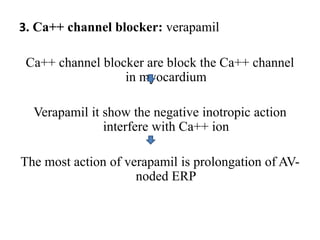
3. Ca++ channel blocker: verapamil
Ca++ channel blocker are block the Ca++ channel
in myocardium
Verapamil it show the negative inotropic action
interfere with Ca++ ion
The most action of verapamil is prolongation of AV-
noded ERP
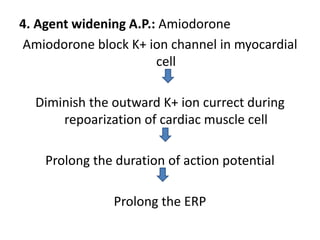
4. Agent widening A.P.: Amiodorone
Amiodorone block K+ ion channel in myocardial
cell
Diminish the outward K+ ion currect during
repoarization of cardiac muscle cell
Prolong the duration of action potential
Prolong the ERP
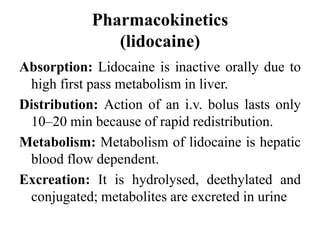
Pharmacokinetics
(lidocaine)
Absorption: Lidocaine is inactive orally due to
high first pass metabolism in liver.
Distribution: Action of an i.v. bolus lasts only
10–20 min because of rapid redistribution.
Metabolism: Metabolism of lidocaine is hepatic
blood flow dependent.
Excreation: It is hydrolysed, deethylated and
conjugated; metabolites are excreted in urine
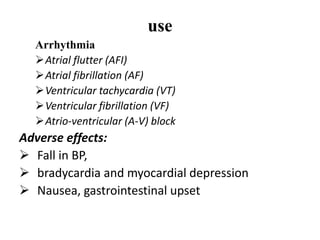
use
Arrhythmia
Atrial flutter (AFI)
Atrial fibrillation (AF)
Ventricular tachycardia (VT)
Ventricular fibrillation (VF)
Atrio-ventricular (A-V) block
Adverse effects:
 Fall in BP,
 bradycardia and myocardial depression
 Nausea, gastrointestinal upset
References
• Tripathi KD, “Essentials of Medical
Pharmacology” published by Jaypee Brothers
Medical Publishers (P) Ltd, Seventh Edition:
2013, New Delhi, p.p. no-526-538.
Antiarrhythmic drugs